How many artists can manage to create a five-star album when they weren’t actively trying to make an album in the first place?
I’m not going to reiterate the story behind Springsteen’s Nebraska. Aside from the fact that there’s already a film of the period in the works – honestly though; ‘man makes austere collection of songs on home four-track as guide for band, carries it around in pocket for so long it nearly gets absorbed by his denim before putting them out as is’ feels as thrillingly entertaining as watching Timothee Chalamet trying not to look like he knows what instragram is for long enough to finish singing ‘Like A Rolling Stone’ – it’s been told many a time.
My connection to Nebraska goes back to 1999, hearing ‘State Trooper’ played over the end credits of a Sopranos episode and – streaming services that mug off artists not being a thing yet – went out and picked up both my second and third (having picked up Greatest Hits in ’95) Springsteen albums in one hit as it came as double-cd combo with Darkness… Talk about an auspicious intro.
This, then, is the hardest one of these for me. There’s not a single song on Nebraska I don’t enjoy. These are ten songs that feel perfectly placed and without an ounce of fat on the whole joint. If I were to be picky, very, very, very picky – which is what I’d have to be to even think like this – I’d say that, possibly..
Least: Used Cars
But only because compared to everything else the lyrics sound a little slight. But then that’s not necessarily a bad thing because Springsteen was ‘high’ on Flannery O’Connor’s work and her ability to write pure narrative including from a child’s perspective and the songs simple yet pure dream of a greater life typified by the feeling that a lottery win would mean – of all things – the ability not to drive a used car is pitch perfect especially as it follows up ‘State Trooper.’ So this isn’t so much Least more like a Least (barely) but still fucking great….
Which leaves the trick of identifying the other end of the spectrum but for me that’s relatively straight forward…
Most:State Trooper
It has to be, for me: it’s the one that sent me spiralling deeper into Springsteen’s catalogue and still captivates me. That pulsating guitar line that emulates the monotonous, repetitive sound of the road.. the pleading ‘Please don’t stop me, PLEASE don’t stop me’… it’s perfect.
“I saw her standing on her front lawn just twirlin’ her baton.
Me and her went for a ride sir and ten innocent people died.”
It opens like countless Springsteen songs before (and since) with a guy and his girl going for a ride but with that opening verse’s change in direction to the dark, it’s clear that Nebraska is is a very different entry in the Springsteen catalogue.
It was the precursor to the lo-fi, bedroom recording fad would inform countless imitations in years to come as every singer/songwriter who fancied their salts as a ‘serious artiste’ grabbed an acoustic and holed themselves up with a four-track recorder in an effort to make their own Nebraska. But, in doing so, they’re overlooking the one key factor about this album which means that they fail in that element – Bruce never set out to record an album of such intimacy; the songs on Nebraska were meant as demos which he then went on to play to his band and try and capture full E Street versions.
After the mammoth sessions for previous albums like The River and Darkness On The Edge of Town, Springsteen realised that a huge amount of time was being spent in the studio working on song ideas. He’d go in with songs half-written or ready, record, take a break, write some more… So he asked his engineer to find him some way of recording at home, so he could get down his demos ahead of the studio and reduce (expensive) session time.
As was the way with Bruce at the time, he was in a writing storm and cut a lot of demos – more than would make it to Nebraska. His manager was the first to hear them all, he got a cassette containing ‘Bye Bye Johnny’, ‘Starkweather’ (which would become the title cut), ‘Atlantic City’, ‘Mansion on the Hill’, ‘Born in the USA’, ‘Johnny 99’, ‘Downbound Train’, ‘Losin’ Kind’, ‘State Trooper’, ‘Used Cars’, ‘Wanda (Open All Night)’, ‘Child Bride’ (which would go on to become ‘Working On The Highway’), ‘Pink Cadillac’, ‘Highway Patrolman’ and ‘Reason To Believe’. Songs that he said “were so dark they concerned me on a friendship level”.
While his manager wasn’t so sure, Springsteen was convinced he had the basics of his next album. But – as always – there was some time to spent before they’d be released. First he and Steven Van Zandt produced a second album for Gary U.S Bonds (for which Bruce wrote another seven songs) before trying to capture the songs with the E Street Band*. Legend has it that he walked around for weeks with the 4-track recordings on cassette in his back pocket as he tried, and failed, to capture versions of those songs that he was happy with. According to Steven Van Zandt it was he who intervened:
“I said to him, ‘Listen, I know this is a bit strange but I honestly think this is an album unto itself and I think you should release it.’ And he was like ‘What do you mean? It’s just demos for the band.’ And I’m like ‘I know you didn’t intended for this to be recorded but I just know greatness when I hear it, okay? It’s my thing, it’s why I’m a record producer and that’s why I’m your friend and I’m just telling you I think your fans will just love this and I think it’s actually an important piece of work. Because it captures this amazingly strange, weirdly cinematic kind of dreamlike mood. I don’t know what it is. All I know is I know greatness when I hear it and this is it, okay? And this deserves to be heard I think people will love it and I think it’s a unique opportunity to actually release something absurdly intimate.'”
Thinking about it, the folks at Columbia must have had some inkling as to what was to come after this one to have taken that bet – after the success of The River and ‘Hungry Heart’ to get them to agree to put out such a non-commercial album, even without any fanfare, as-is must have meant Jon Landau’s negotiating skills were at the forefront, promising the next one would be a hit maker.
From Nebraska, though, only two songs would be released as singles – ‘Atlantic City’ and ‘Open All Night’ and those would only be released in the UK and Europe.
My introduction to this album outside of ‘Atlantic City’ on Greatest Hits (I always loved the line “Everything dies, baby, that’s a fact, but maybe everything that dies someday comes back”) came via the closing credits on an episode of The Sopranos in 1999 as ‘State Trooper’ pulsated hypnotically over the credits. I found it hard to connect the sound I was hearing to the man behind ‘Born In The USA’. I went and bought Nebraska (bundled in a ‘Nice Price’ double with Darkness On The Edge of Town that still barely leaves my car) the next day and it served as my first Springsteen album (compilations excluded) and a real introduction to brilliance of his craft.
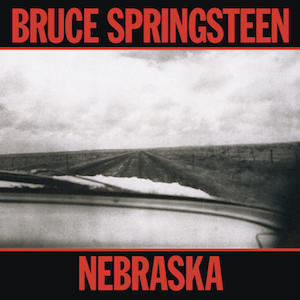
I think Nebraska‘s beauty certainly lies in its recording, the rawness and immediacy make for a great listen and their relative brevity (by Serious Springsteen standards) mean that listening to the album in one sitting makes for an absorbing 40 minutes that isn’t as austere of heavy as, perhaps, the cover might suggest with songs like ‘Johnny 99’ and ‘Open All Night’ adding some upbeat, urgency to proceedings.
Nebraska saw those characters that Springsteen had, with Born To Run, put into cars on a journey to the promised land confront the hard, bitter truth that not everybody arrives and some have to deal with the fact that “there’s just a meanness in this world” that his narrative had, thus far, only skirted. It was the full album realisation of the writing paths he began walking with some of The River‘s more serious songs and would continue to return to (less successfully) later in his career when he felt the need to explore beyond the confines of a full-band sound. This was Springsteen bringing new, literary influences into his songwriting and not blinking in the face of harsh realisations. It’s a slab of brilliance that, three and a half decades later, still sounds vital and compelling especially as, despite it all, at the end of every hard earned day people find some reason to believe.
*The Electric Nebraska sessions have become something of a Holy Grail amongst Springsteen devotees. At times it varied between just how many songs were tackled but, in 2010, Max Weinberg confirmed the band had tackled every one of them, he also said the album was “killing”. In his own book Springsteen, too, confirmed the existence of Electric Nebraska but has, previously, also said that the fan-given title for the sessions in misleading. In his book, Songs, he pointed out that they weren’t all “rock” arrangements – Max would play a light percussion on some or Roy Bittan a synth pad.
Many critics have argued, as Landau stated “the right version of Nebraska was released” – drawing their argument from the live versions of those songs like ‘Atlantic City’ or ‘Johnny 99’ that would feature full band versions. BUT… I’ll argue that to analyse it in that way is a mistake. The band are playing fleshed out versions of the arrangement that was released. A song wouldn’t necessarily have taken the same arrangement in a full-band casting. Take ‘Born In The USA’ and its evolution from demo to stadium thumper, or pretty much any Springsteen song’s evolution. Even ‘Blood Brothers’ has numerous arrangements. The shape and arrangement these tracks may have evolved into with further Electric Nebraska session (there’s arguments that poor recording experience on the side of the engineer for these sessions was also to blame for their curtailing) will likely never be revealed though.
 Mumbling About...