We got the means to make amends… Pearl Jam and the Rock & Roll Hall of Fame

Warning: rant incoming.

The Rock and Roll Hall of Fame is a strange thing. From where I sit it seems like a lot of back-slapping and congratulating from industry-types with very little real merit. Does it mean something to be a “Hall of Famer”? Does it add all that much credence anymore? Perhaps it means more in the States than it does here where a UK Music Hall of Fame sputtered, stalled and stopped before anyone paid it any attention.

Let’s spin back a bit to 1983; the Rock and Roll Hall of Fame was set up by Ahmet Ertegun (he of Atlantic Records) to “recognize and archive the history of the best-known and most influential artists, producers, engineers, and other notable figures, who have each had some major influence on the development of rock and roll” (Wikipedia) and began inducting such artists in 1986 with the first group of artists including Elvis Presley, Sam Cooke and Chuck Berry.

Since then each year a group of artists are nominated, voted for and inducted in a ceremony – again; from where I sit – that seems overly long on speeches and pretty short on the ‘rock and roll’. With each year there’s criticisms about who is and isn’t nominated (chief amongst which being that those controlling nominations, as a small group, are not musicians and nominate based on personal taste) and then there’s plenty of column inches and website debate and pages handed over to the ‘drama’ of which members from a certain band will be inducted, will attend, will tell the HoF to shove it…

From those Bozos in Makeup to Axl Rose’s tantrums, the question about which ex-members should be in alongside the nominees seems to draw more debate than discussing that band’s lasting impact. The cynical side of me (which seems to only get more so after a decade in marketing) certainly thinks that this is a deliberate act by the HoF in order to stir the pot, get more attention and create more buzz than the ceremony would otherwise get, nominating bands for whom the real question will be “will they induct that member who played tambourine on their first album or…?”

Nirvana had it in 2014 when those members inducted included Dave Grohl and not the four drummers that had sat on the stool pre-Nevermind. Would they induct Chad Channing or the first drummer, Aaron Burckhard? For, you see, there’s a criteria for getting in: “artists will first become eligible for the Rock Hall 25 years after the release of their first record (LP, EP or single)”. Bleach was released in 1989 (with Chad Channing on drums and Jason Everman on guitar*) but Nevermind, the first record Grohl drummed on, came out in 1991. It really adds weight to the idea that the HoF is after the popular vote more than anything – everyone loves a bit of Dave Grohl, nobody knows who Chad Channing is. There was, of course, a lot of online hubbub about the ‘snub’ of Chad.

Being the perennially nice guy of rock that he is, of course, Dave praised those drummers that had hit the skins before him in his speech and the band invited Channing to attend.

This year that question and the online buzz falls upon the collective shoulders of Pearl Jam. A band with a huge and dedicated following who forged a path for many to follow. Few can touch them live or match their unique set lists and they’re certainly the last men standing when it comes to the ‘Seattle Scene’. Their place in the Hall, even in the first year of eligibility, isn’t likely to be questioned. They’re also a band who, for the first half of their career, had a Spinal Tap scenario with their drummers**.

Released in August 1991, Ten featured Eddie Vedder, Stone Gossard, Mike McCready, Jeff Ament and, on drums, Dave Krusen. Krusen, though, had left the band in May due to alcoholism. His replacement, Matt Chamberlain only hung around for a handful of shows before heading off to join the SNL band. He suggested a guy to take his place; Dave Abbruzzese. Abbruzzese played drums through the rest of the tour supporting Ten, on Vs. and Vitalogy before he was fired in 1994.  During which time the band would tour extensively, Abbruzzese would write the music for ‘Go’, ‘Last Exit’ and ‘Angel’ and defined the band’s sound at the time with his ferocious drumming. The harder sound he bought helped them move away from being pigeon-holed as another clone.

If you ask a Pearl Jam fan what the band’s ‘peak’ period was I’m willing to lay money on a large percentage saying 1991-1994. Abbruzzesse was a key part of that sound. The problem is, he enjoyed it too much. I’m not talking piles of cocaine and claims of being a Golden God, no; he just loved it all and smiled too much. Rumours swirl as to why Abbruzzesse was actually let go but it boils down to the fact that he was obviously having fun. Vedder was, at this time, at his most serious and ‘punk’, it wasn’t ‘cool’ to be enjoying your success and, as the front man, he took most of the attention and it was a lot to handle. While the band withdrew from the spotlight, Dave would give interviews (albeit to drum magazines, not Spin or Rolling Stone). While the other members would go the Volvo or battered old truck route, Dave bought a Lexus. He didn’t really care about the famous Ticket Master Boycott either. Apparently the final straw for Dave’s tenure came when he accidentally broke the neck of one of Vedder’s guitars during Vitalogy sessions and didn’t hang around to tell Eddie or apologise. He wouldn’t be in the band when it came time to tour the album he’d helped create, he was let go – Vedder wouldn’t do it, the task fell to Stone Gossard.

Pearl Jam

Jack Irons, formerly of the Red Hot Chili Peppers*** was then in the saddle for four years and two albums before he ducked out (not happy with touring) in 1998 and then-former Soundgarden drummer Matt Cameron took the seat he still occupies. Now, Cameron is certainly the stick man with the longest tenure and its clear that he’s considered a full member of the band – Vedder continues to praise him and has credited his joining with keeping them together – but I don’t think I’m alone in seeing him as an outsider even some 19 years and five albums later.

Now of all their six drummers, only one, technically, qualifies: Dave Krusen. He played on Ten, twenty-five years ago. By all accounts he’s quite surprised at the nod. The Rock and Roll Hall of Fame, however, is also inducting Matt Cameron. And nobody from the period between the two.

Now, out-dated and bloated an institution as it may be, if the Rock and Roll Hall of Fame are recognising Matt Cameron then they sure as shit should recognise Dave Abbruzzese.  As much of a deliberate poking of a hornet’s nest as the snub is, it’s also pretty unfair to then place the onus of dealing with the question onto Pearl Jam (ever-shy of such publicity and awards) to be the ones to deal with it. Dave, obviously riled himself, has said plenty, chiefly:

“I have always thought that every award given to a band that celebrates the bands lifetime achievements should be awarded to every person that was ever a debt incurring, life sacrificing, blood spilling, member of that band. Maybe the Hall should reevaluate the need to put all the monkeys in the same cage in order to boost revenue, and instead let the history of the band be fully and completely represented as they were and as they are. …leave it up to the group to show their true colors as they celebrate their own history in a manner of their choosing…

I will admit to wanting to look out over my drum kit at the faces of Jeff, Stone, Mike and Eddie. Looking to my left at my drum tech, the mainest of mellow, Mr. Jimmy Shoaf and seeing him give me that look that dares me to destroy my cymbals and kick the songs ass, the bands ass and the crowds ass… The idea of counting it off and giving the band, the music & the people all that I have to give, as I always have without compromise or hesitation… The sound of the people singing along… Making eye contact with the person air drumming their ass off right before the big drum fill, so we can do it together…
I loved it.
I loved it every single time.”

Pearl Jam have always marked themselves out as a band of integrity and honest values. They’re continually raising money and awareness for important causes and fighting the good fight. Again, it’s unfair of the HoF to put this on them but it is gonna be down to them to decide how to deal with the Dave question. History gives no real clue – their 2004 compilation Rearviewmirror featured photos cropped not to include him yet in 2016 the band performed his composition ‘Angel’ for the first time since 1994 with Vedder stating it ” was written by the guy who was our drummer. Dave Abbruzzese, We wish him well.”

How it’s dealt with come the night, though, we’ll have to see. And that’s how the Rock and Roll Hall of Fame keeps getting people to pay attention. And, damn it, they’ve suckered me in to giving a damn too. The rat bastards.


* albeit in name only and his image was ‘tastefully’ removed from the album cover come the 20th Anniversary re-release. Everman would go through a musical life of ups and downs which would include a blink-and-you’ll-miss-it stint on bass for Soundgarden before cutting his hair and joining the army where he would serve with the Rangers and Special Forces – it makes for a fascinating read.

** You can’t dust for vomit.

***and was inducted into the HoF in 2012.

2016 On The Spin

So as I slip what is likely the last 2016 addition (the tortoiseshell edition of Chapter & Verse I received for Christmas) into place in my collection it’s time to chew over those other new albums that crossed my turntable over last year.

This isn’t a Top Ten such list nor does it include those I’ve streamed as I tend not to do whole-album listens in such a way, just a look at those I’ve purchased and spun.

I think this is the first year in which I’ve not bought any new album on CD. If I’ve parted with cash for it it’s been on vinyl. I’m clearly not alone in this habit as 2016 saw sales on this format reach a 25 year high at 3.2 million units in the UK. But then I also read that at least half of vinyl purchases never have a needle dropped on them…. people are just buying them for decoration and using the digital download code instead. I find this somewhat discouraging. For me, digital purchase alone has never been as satisfying as I like the feel of actually owning something and if I buy a record it gets played before I download and burn to CD for car use and played again (and again). Even the most attractive and (apparently) valuable item in my collection gets a regular play. Why own it otherwise?

Anyway, I’ve digressed. The new music buying started in earnest in January with some pre-orders and the discovery of Milk Teeth who’s début Vile Child got a lot of plays, was something my wife got into too and felt like a real blast from the past with a vital, punky, 90’s feel. A lot of fun to listen to and they’re only bloody kids (in comparison, that is).

Two of those pre-orders dropped through my post box on the same day – albums from two of post-rock’s finest. The Atomic soundtrack / album from Mogwai comprises material reworked from their contributions to a BBC4 documentary “Atomic: Living in Dread and Promise” about the Hiroshima nuclear bomb and its legacy. More textures and soundscapes than ‘rock’ it’s a wonderful album. Explosions In The Sky spent the four years since Take Care, Take Care, Take Care working on soundtracks (all well worth a listen) and this year’s The Wilderness was a triumphant return for EITS. Understated and beautiful, the album’s tracks are their most concise and direct to date, there are no ten or fifteen minute epics here – the longest track just tips over the seven minute mark – instead they’ve found a way to distil down to the purest, most urgent elements and create a great album. The artwork / packaging was stunning too.

Atomic recording and touring duties not enough, Mogwai‘s Stuart Braithwaite joined up with members of Slowdive and Editors to form the brilliant (don’t say supergroup) Minor Victories and their self-titled album is a fantastic one that crackles with a taut electricity and energy and I hope there’s more to come from the group.

“‘Alt-rock’ legends with new album” was probably slapped on reviews for at least a handful of bands this year, begging the question as to how many legends there are. Of the two I got my hands on that I’d apply such an honorific to I’d say Dinosaur Jr fared better than the PixiesHead Carrier – their first with Paz Lenchantin as a legit replacement for Kim Deal – is a strong effort, don’t get me wrong and certainly recalls more of the earlier quirkiness of their heyday. It’s always a mistake to try and judge a band by their work of twenty years earlier and if you leave your expectations and baggage at the door it’s a good effort. However, Give a Glimpse of What Yer Not, the band’s eleventh album, found Dinosaur Jr offering up a tight, focused slab of what makes them great.

In a similar vein Weezer‘s self-titled ‘White’ album is easily the best thing they’ve done in at least a decade. Without the self-conscious apologetic hues of 2014’s Everything Will Be Alright in the End,  this one represents a genuine return-to-form that had been long hoped for and given up on at least a few times, I’m still finding new things to enjoy some eight months after it first dropped.

Oh, on the subject of legends offering up new albums there was a new offering from that little outfit from Oxford… A Moon Shaped Pool was everything you could have hoped for from a new Radiohead album and more. Atmospheric, beautiful and compelling. At once their most direct and least-angular, this album certainly deserves the plaudits and places atop year-end polls its received.

Available digitally in 2015 but unheard by me until the physical EP arrived in February,  Foo Fighters‘ Saint Cecilia was a lot more enjoyable and blast-of-fun than their previous studio album and seemed like  – without Butch Vig at the helm – a more varied and energetic collection of songs than they’ve made with any producer thus far with the title track being one of the best things they’ve dropped for a while.

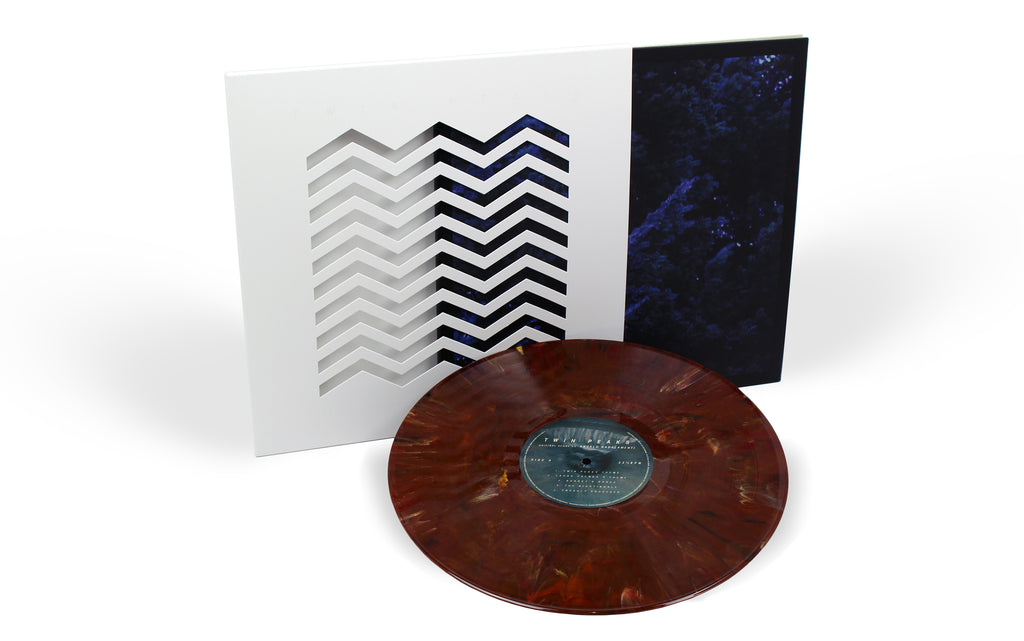
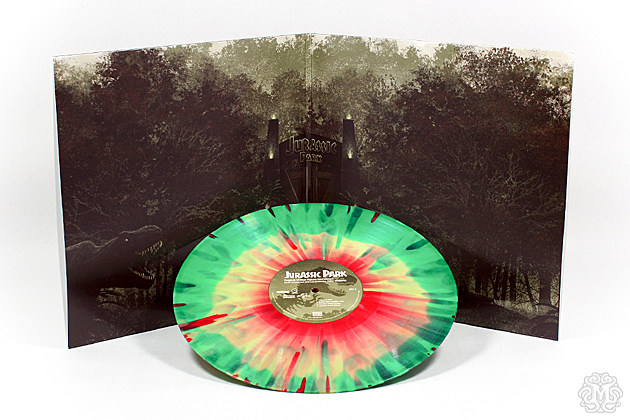
It’s always a pleasure to listen to the Twin Peaks OST and I was lucky enough to be given this year’s re-release of Angelo Badalamenti‘s score on vinyl which is just gorgeous to behold. Not always the case with coloured vinyl, it’s a great pressing and the sound is crisp – it’s done by Death Waltz / Mondo who are also responsible for the Jurassic Park OST in my collection that’s equally beautiful and high in quality. Shame they’re so sodding expensive really.

Perhaps the new album most played in 2016 was Heaven Adores You by Elliott Smith. I was still listening to it this morning. I’d held out for the vinyl of this one, the accompanying music to 2014’s film of the same name about Elliott’s life and music (I’ve still yet to watch) and resisted urges to stream until I could give it the proper attention. Not necessarily an entry point for those new to Mr Smith’s music, for those already converted it’s an essential – there’s tracks you love, twists on existing tracks and tracks previously unknown. I’m very much looking forward to 2017’s release of an expanded and remastered Either/Or.

2016 releases I missed and still plan on getting round to:

Regina Spektor – Remember Us To Life

Band of Horses – Why Are You OK?

Bon Iver – 22, A Million

Swans – The Glowing Man


Least to Most: Bruce – Born in the USA

“You end up like a dog that’s been beat too much
Till you spend half your life just covering up”

bruceborn1984Bruce at his largest in terms of both commercial appeal and sound, this was the spark that ignited ‘Boss Mania’ and saw Springsteen go from playing to packed arenas of the faithful to selling out stadiums and play-acting himself to newer audiences against a screen that projected his newly pumped-up image punching his fist into the air, ushering in the final verse of the misappropriated title-track to his then-new album Born in the USA to the cheap seats at the back of the crowd.

Thirty million (and still counting) sales, seven top ten hits. That cover. That Ben Stiller parody. Born in the USA is Bruce’s biggest selling album and, probably, his most well-known.  Yet commercial heights do not always equal creative heights. There’s always a sacrifice, a deal with the devil to achieve those numbers. For my money, the production and sound on this blockbuster meant that the details that make for a great Bruce song were sacrificed somewhat.

But let’s not get confused, though. At this point in the list we’re really getting into the quality end of the spectrum, the wheat has been separated from the chaff and we’re down to lining up in order of personal preference and anything from here on in will likely regularly feature on any stereo and may well top other ‘favourite / best’ lists.

The title track is inescapable, even on this side of the Atlantic, whenever Bruce is mentioned. That’s not necessarily a bad thing, it’s a belter of a song. Let’s skip over the way in which it was misinterpreted as that’s been discussed ad nauseam. I think what fascinates me is just how different this version is from the original demo cut around the Nebraska sessions is (perhaps this was the key to the sacrifice – in its original form it would not have been so misunderstood yet would never have reached such a wide audience) and that the version on the album is only the band’s second take at it – Max Weibnerg didn’t even know Bruce was going to count the band in for another punch at the four-and-a-half minute mark but The Boss has praised ‘Born in the USA’ as his drummer’s finest recording*.

That being said, I dont’ always listen to it when I play the album so over-exposed did it become and it was one of those songs that put me off Bruce initially. Listening to Chapter & Verse recently it sounds so out of place sat between ‘My Father’s House’ and ‘Brilliant Disguise’ as to almost sound like the work of a different artist. Almost.

Perhaps it was a cultural thing – Reagan harped on about a new morning in America while that country’s cinema heroes of the early 1980’s were muscle-bound and jingoistic, here we were had Thatcher and mining strikes (cinema audiences dropped to an all-time low in ’84) so a bicep-baring Bruce singing heartland rock against a backdrop of the Stars and Stripes was never going to be as huge here as it was in the US** and I don’t think this one has quite the lasting appeal in comparison to his other work.

I think that those songs at the start of the album are the ones I enjoy least and rarely listen to. I’d struggle to quote a lyric from ‘Darlington County’ say, or easily recognise ‘Working On The Highway’ if played live. The recording of Born In The USA dates back to 1982 and many of the tracks were written at the same time as those that appeared on Nebraska**. Bruce himself has said that “if you look at the material, particularly on the first side, it’s actually written very much like Nebraska – the characters and the stories, the style of writing – except it’s just in the rock-band setting.” Given that the fabled ‘Electric Nebraska’ has yet to see the light of day I can see why, the songs just don’t suit the sound – in my own humble.

Perhaps its another one of those results of a protracted recording period. Sessions for the album were spread over so many months (years even) that it can seem a little disjointed and with so many songs recorded it would be hard to find the perfect balance and he toiled with it for a long time. At one point in 1982, with the demo tape that would become Nebraska ready for release and a record of band material also ‘ready’ he toyed with releasing the two as a double album; one solo, one ‘band’ with a tracklisting ready as:

BORN IN THE U.S.A
MURDER INCORPORATED
DOWNBOUND TRAIN
DOWN, DOWN, DOWN (I’m Goin’ Down)
GLORY DAYS
MY LOVE WILL NOT LET YOU DOWN
WORKING ON THE HIGHWAY
DARLINGTON COUNTY
FRANKIE
I’M ON FIRE
THIS HARD LAND

Yet then he released Nebraska as a stand alone (no tour, no real fanfare) and took a break before picking up recording again in early 1983 with newer songs coming up and wouldn’t conclude until February of 1984. As such a wealth of material was recorded and never released – you could easily pick a dozen of any such songs and create an album that would still be considered a classic. So the protracted recording, agonising and umming and erring (toying with releasing different selections and demos as is) as Bruce searched for that elusive ‘binding factor’ means that perhaps this record isn’t as consistent as it deserves to be.

But… but BUT. This album contains a wealth of such strong material that even if I tend to skip a few tracks a the start there’s enough here to warrant its inclusion in the top half of this list. Even limiting myself to two tracks from each album when I compiled my own Top 20 Springsteen songs was a tough one with this album and those I chose weren’t released as singles.

‘Downbound Train’ remains one of my favourite Springsteen songs and one I feel is criminally overlooked.

‘I’m On Fire’ gets many a play as does ‘Bobby Jean’. And then there’s ‘Dancing In The Dark’. When Landau listened to Born in the USA his reaction was “we don’t have a single” and told his charge to go home and write one. Legend has it a guitar was thrown at this point. However, Bruce set about writing about his frustration about writing – “It went as far in the direction of pop music as I wanted to go – and probably a little farther.” His biggest single to date (with it the album actually had seven) and one which initially wasn’t popular with the band. Van Zandt has said “It was much, much, much more produced. I didn’t like that song when I first heard it.”*** While it may still have its detractors I still really enjoy it a lot more than some of the album’s other singles like ‘Glory Days’.

Overall Born in the USA is something of a grab-bag album. Certainly affected by over-production in its unabashed reach for the maistream (no qualms here, if any artist is going to shift thirty million copies of an album I’d rather it a Springsteen than a Beiber) it nonetheless contains more than its fare share of solid Springsteen tunes that carry the album into the higher quality end of his catalogue.

Highlights: ‘Downbound Train’, ‘Bobby Jean’. ‘I’m On Fire’, ‘Born In The USA, ‘No Surrender’, ‘Dancing In The Dark’.

*While Weinberg is fond of the song for the same reasons, his favourite of these sessions, ‘This Hard Land’ was shelved like so many of the 80(!) recorded.

**It was a hit, though, nonetheless, topping the charts and shifting just over a million. I don’t feel though that it had quite the same cultural impact as it did for Bruce at home.

***Van Zandt would leave the E Street band in 82 (though this wasn’t really announced until after the recording of Born in the USA) and Nils Lofgren would join in time for the tour. The official line being that he’d joined in order to help see Bruce rise to success and, job done, it was time to focus on his own music.

Quick List: Top Five ‘River Songs’

I was up in Cambridge the other day and aside from the usual insistence my mental jukebox has of lining up Pink Floyd songs, the chalked up directions to the Cam got me thinking about ‘river songs’ – songs either about or with rivers in their title.

Once I’d started thinking though it was quite the flood. However, here’s a quick Top Five:

Nick Drake – River Man

Pixies – River Euphrates

Bob Dylan – Red River Shore

I think that period from Oh Mercy to Time Out of Mind was one of Dylan’s finest so Tell Tale Signs: The Bootleg Seties Vol.8 is a real treasure trove and this is a real gem upon it.

REM – Find The River

Bruce Springsteen – The River

Was there ever any question this would be here?

Of course there could also be CCR’s ‘Green River’ (‘Proud Mary’ being overdone), Ocean Colour Scene’s ‘Riverboat Song’, ‘Dam That River’ by Alice In Chains, ‘Five Feet High and Rising’…..


Least To Most: Bruce – “halfway to heaven and just a mile outta hell”

Ok, so I’ve just looked at my (much revised, scrawled over and rewritten) list and realised we’re at the half way point in my rambling about Bruce’s albums in Least to Most Favourite order. We’re ten down with ten to go and that feels like a good point to take a breather* and talk about some Springsteen songs (a couple of favourites amongst them) that wouldn’t otherwise get a mention and take a look at those releases that don’t qualify for the list.

Compilations 

Bruce was twenty three years into his recording career before he decided it was time for a compilation. 1995’s Greatest Hits oddly didn’t get the best reviews – many felt that by omitting anything prior to Born To Run, Bruce was cutting out an important part of his history (“no Rosalita?!” was a common cry in reviews I’ve found in archives**) and others suggested that these songs simply didn’t belong together and performed better in their original album sequencing… though isn’t that the case with all such compilations? Seems like a trite comment to make.

Personally, this was my introduction to Bruce Springsteen so I’m a little biased. I was a little put-off by the sounds of ‘Born In The USA’ and it’s kin (this was 1995, after all, and such sounds weren’t ageing well) but there was no denying the draw of songs like ‘The River’ and ‘Atlantic City’ which were the big hook for me.

I’ll also make a fight for the new songs included here that many a critic argued were weak. I think ‘Blood Brothers’ remains an essential Bruce Springsteen song and both ‘Streets of Philidelphia’ and ‘Secret Garden’ are strong tracks and that’s without the dusted-off and revisited ‘Murder Incorporated’ (which saw Steven Van Zandt return to the fold for the video and would become a real blazer on the Reunion Tour) and ‘This Hard Land’ – both Born In The USA cuts that didn’t make selection, the latter of which was Max Weinberg’s favourite tune. For a one-stop sampler of Bruce Springsteen V1***, Greatest Hits is still a damn good start for any Bruce newbie.

Strangely enough, just two studio albums later and with the successful launch of Bruce Springsteen V2 cemented, it was time for another compilation.

This time more space was allotted to it and the selection was allowed to span out across two discs so that The Essential Bruce Springsteen kicked off with ‘Blinded By The Light’ and wrapped it up with cuts from Live In NYC and The Rising making sure to include ‘Rosalita (Come Out Tonight)’, all the hits, some fan favourites like ‘Jungleland’ and ‘Nebraska’. Of course, the fans would already have all of these so a limited run with a third disc of rarities was offered and some of those are none-too shabby either. I particularly enjoy Springsteen’s live take on ‘Trapped’:

Odder still, in 2015 the track listing was revised. Out went ‘Jungleland’ and ‘Tunnel of Love’ and in came ‘Tenth Avenue Freeze Out’ and ‘One Step Up’ and a handful of other tracks were shuffled / cut in order to make space for a couple of bolted-on post-The Rising tunes. Bonkers, if you ask me; cutting ‘The Darkness On The Edge of Town’  to make space for something from High Hopes?! Why bother?

On the ‘Why Bother’ list is the 2009 Greatest Hits which was billed to Bruce and The E Street Band (is that only their second billing? Though they didn’t get the US cover) which strips it all back to one disc and adds a couple of newer tracks – presumably released to catch the newer casuals after Superbowl and festival appearances.

Chapter & Verse was released this year to coincide / accompany Bruce’s Born To Run book. It’s somewhat linear and obvious in its song selection and only really stands out in as much as being more ‘personally’ selected than the above comp and featuring a handful of pre-Columbia Recording Artist Bruce. The best of which being ‘Ballad of Jesse James’. I’ve yet to add this to the shelves as they’re not what you’d call ‘required listening’ for anything other than an intro to the origins story.

Live

In terms of live albums, while there’s certainly a couple listed on Bruce’s discography, Live 1975-85 is inarguably the best way to get a take on what makes Springsteen live so legendary. Sure, Live In NYC is a good capture of the reunited E Street Band (and the best place to hear its new songs) but it’s strange sequencing and fading out have hampered it and interrupt the flow.

Live 1975-85 contains 40 songs recorded with the band in its prime, a wealth of classics, Springsteen pre-song story telling and, in ‘Seeds’ another great original:

It’s only downfall – and one that was much picked up on by fans I’m given to understand – was that it didn’t include ‘Prove It All Night’ in the live reshaping (or at all, in fact) that had acquired a massive fandom. So here it is:

Worth mentioning that Bruce is more than savvy to the current musical buying trends and has made many a current and classic concert available for download at http://live.brucespringsteen.net/

EPs

1988’s Chimes of Freedom was released to tie-in with the Human Rights Now! tour. The live rendition of ‘Tougher Than The Rest’ is suitably girded by the E Street Band’s backing, ‘Be True’ is a decent enough tune but the flip side with Bruce’s take on Dylan’s ‘Chimes of Freedom’ and the acoustic ‘Born To Run’ and still captivating stadium-size crowds is the strongest, in my opinion:

Blood Brothers originally came with the film of the same name (in a very limited pressing) that documented the mini-reunion of the E Street Band. While the tracks included are certainly interesting there’s nothing really here other than curiosities – like the ‘alt’ version of the title song.

Which brings us to the last release of new Bruce Springsteen material – American Beauty. Now, if High Hopes was made up of songs that didn’t make the cut for The Rising or Wrecking Ball then an ep of songs that didn’t make the cut of THAT might be stretching it a bit….  Indeed it is. Nothing on here is particularly essential in its listening and there’s chunks of all that were salvaged and better used elsewhere, it’s release remains something of a mystery to me, almost an example of a big artist and major label slapping something together to cash in on Record Store Day and it pains me to say that as a fan. That being said, ‘Hey Blue Eyes’ is a very good song and I do play it a fair old bit on stream. One of Springsteen’s angry Bush-era political songs that isn’t mired by over-production – almost demonstrating in on four-track EP how clearly Brendan O’Brien is the better set of hands for Springsteen’s songs over Ron Aniello.


*Whether I’ll manage to finish this series by the New Year remains to be seen.

**Bruce made reference to this in the linear notes for The Essential and, if you watch the accompanying ‘Blood Brothers’ DVD, there was plenty of discussion against the inclusion of earlier tracks

***Bruce Version 1 extends from his debut up to the conclusion of The Reunion Tour. The Rising marked the emergence of Bruce Springsteen Version 2.0

Least to Most: Bruce – Greetings From Asbury Park, N.J

“Madman drummers bummers and Indians in the summer with a teenage diplomat
In the dumps with the mumps as the adolescent pumps his way into his hat
With a boulder on my shoulder feelin’ kinda older I tripped the merry-go-round”

Pardon?

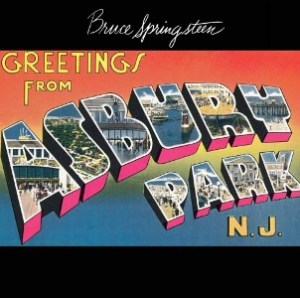
greetings_from_asbury_park_njGreetings From Asbury Park, NJ feels exactly like a debut album should: it’s full of energy, enthusiasm and awash with ideas – essentially what happens when an act has been working up these songs long before getting a deal and let into a recording studio. So here we find Bruce Springsteen at the tender age of 23, in thrall still to his idols, making his recording début not as a frontman for a rock band but, essentially, a solo artist with a few band members on a couple of tracks.

Indeed a bit of a dispute arouse very early in as Bruce wanted more tracks with his band (at that time featuring Vini ‘Mad Dog’ Lopez, Garry Tallent and David Sancious) whereas Mike Appel and John Hammond wanted more of the solo artist, acoustic feel. Not only that but Hammond’s boss, Columbia Records president Clive Davis,  didn’t feel there was a single on the album and sent his new signing back to work.

So Springsteen, proving his craft, wrote two – ‘Spirit In The Night’ and ‘Blinded By The Light’* (which would mark Clarence Clemons’ entry into Bruce’s catalogue). Neither would prove a hit for Bruce but Manfred Mann’s Earth Band would take ‘Blinded…’ to the top of the charts. The two songs pushed a trio of ‘solo acoustic’ songs off never to be heard from again. I’ve never been this song’s biggest fan, to be honest. I don’t like what I feel is wordplay for the sake of wordplay and I still can’t fathom the meaning of lines like “And go-cart Mozart was checkin’ out the weather chart to see if it was safe to go outside, And little Early-Pearly came in by her curly-wurly and asked me if I needed a ride, Oh, some hazard from Harvard was skunked on beer playin’ backyard bombardier”… it’s almost as though he’s just going for rhyme over reason… but that’s just me.


But then if – after seventeen studio albums – your début was still considered your best you’d have to wonder what you’re doing wrong, right? He’d later start finding his own voice and stripping away all the wordiness and start matching his poetry to more muscular, tighter rhythms that really worked together. At the time, though, I think he was desperate to get his foot in the door. I think he’s even explained that he’d sit on the bed with a rhyming dictionary to help with the lyrics. It’s a fun anecdote now but I think it does kinda harm the music – Jon Landau and his editing hand were still a way off.

I think the only reason I don’t spend as much time with this as I do with later albums is probably down to the production / guiding hands behind it. The whole ‘New Dylan’ tag that Columbia was marketing Bruce behind meant that  it landed somewhere between folk and rock and not firmly in either, in amongst some that don’t really leave much of an impression are some great songs on here that would later go on to become fleshed out monsters live restrained by their studio rendering –  as though Bruce wasn’t being allowed to really bust loose with his own material. When he’d play the final album to a friend, the question was “where’s the band?”

For my money the album’s stronger tracks are those which most prominently feature a band – ‘Lost In The Flood’ is an immense song for someone in their early twenties to have penned (and features Mr Van Zandt clobbering Springsteen’s Danelctro amp to get the opening sound) remains a favourite and I’m sure it’s not just one of mine, and marks the start of those ‘story’ songs that would continue on up to ‘Jungleland’.

As I’ve said, we’re already into real strong territory on this list so I won’t say anything on Greetings is bad, more that the kitchen-sink attempts don’t always work and songs like ‘Mary Queen of Arkansas’ and ‘The Angel’ don’t really hold long in my memory after listening. There’s just not much about them to kinda hang your hat on – they don’t have the melody / hook of ‘Growin’ Up’ or ‘It’s Hard to Be a Saint in the City’ which, although it’s almost drowned in the Dylanesque lyrical flood, points as to where he’d be going with his next effort in just a few months.

One of this album’s fans included David Bowie – who actually covered ‘It’s Hard to Be a Saint in the City’. Initially, though, it was meant to feature on his Young Americans album but, according to Tony Visconti, after they played the cover to Bruce, David and The Boss had a tense, private chat after which work on the song was abandoned (later released on Bowie’s 1989 box set).

I think what I really love about Greetings From Asbury Park, N.J – aside from the music – is the sheer journey it started. It’s amazing to listen to this and associate it the the same artist who, just a decade later, would be muscle-bound and singing about how he “had a brother at Khe Sahn”. Here he is in all his youthful, bearded glory, searching out the avenues his music would later stride down, a little in awe to the poetry of his idols over his own voice but still, unquestionably, massively talented.

Highlights – ‘Lost In The Flood’, ‘Growin’ Up’, ‘It’s Hard to Be a Saint in the City’.

*Jon Landau would pull the same method just a decade later, sending Bruce back to come up with a ‘hit’ as he felt that Born In The USA lacked one. Turns out that with the resulting ‘Dancing In The Dark’ it had seven singles in it.

Least to Most: Bruce – The Promise

“When the promise is broken you go on living
But it steals something from down in your soul
Like when the truth is spoken and it don’t make no difference
Something in your heart goes cold”

Three years separated the release of Springsteen’s star-making Born To Run and its follow-up Darkness on the Edge of Town. If you look at it on paper, even factoring in the long tour for BTR, that’s a big chunk of time for an artist that needs to prove he’s more than a Newsweek and Time double cover and hype. But, due to legal and contractual malarkey with his former manager Mike Appel, Bruce was forbidden from entering a recording studio and releasing new music.

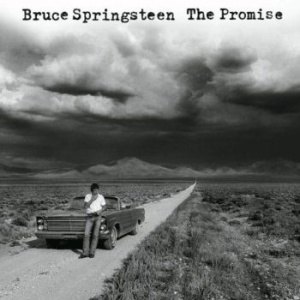
bruce_springsteen_-_the_promiseFrustratingly, this was also right at the point that Bruce was hitting his prolific stride in terms of song writing. So when, four days after his lawsuit with Appel was finished*, he finally hit the studio in May 1977 he was over-flowing with ideas and laid down eight songs in the first night alone. The take of ‘Something in the Night’ from this first session made the album. By the time recording for Darkness on the Edge of Town finished in January 1978 , Jimmy Iovine estimated that some thirty songs had been recorded and readied for release (and probably just as many in a less-refined state) – a huge increase in output when you consider that there were perhaps seven out-takes for BTR and albums prior, most of which only ever made it to raw mixing stages.

So what happened to those other songs? For a long time nothing. Some (‘Don’t Look Back’, ‘Hearts of Stone’, ‘Iceman’, ‘Give the Girl a Kiss’) were released twenty years later on Tracks. ‘The Promise’ was played live a couple of times and caused uproar when it wasn’t released on that box set (Bruce recorded a ‘new’ version in 1999 for 18 Tracks as partial recompense) along with a handful of others which became solid bootleg items but, for the most part, nobody outside of the group heard ’em.

Until 2010 when, while putting together a slightly-late retrospective package for Darkness on the Edge of Town, the songs were revisited. Most of the 22 (there’s an uncredited one at the end) are presented as-is, some had new vocals added and one was completely re-recorded by Bruce and the Darkness era E Street band, making the chiming, delightful ‘Save My Love’ the final recording session for Clarence Clemons.

‘The Promise’ was written as something of a sequel to ‘Thunder Road’ and appeared on likely track listings for Darkness almost until the last minute. One of his most-revered out-takes, Bruce felt it too soon after the release of ‘Thunder Road’ and that it threatened to over-shadow the rest of the album as well as not finding it in tune with the general theme of Darkness.

Originally released as part of  the box set The Promise: The Darkness on the Edge of Town Story, then later as a stand-along (though the box set is well worth investment) The Promise is more than a compilation of ‘lost songs’. More a ‘lost album’ in my opinion – it’s not only packed with previously unheard gems but really shows the evolution of Bruce’s songwriting. The choices he’d make in terms of cutting and refining down to get the sound he wanted for Darkness as well as showing the range of directions he could’ve gone down and just how comfortable he was with each.

There’s gorgeous pop songs in ‘Gotta Get That Feeling’, ‘Rendezvous’ and ‘The Little Things (My Baby Does)’ that must’ve been a massive delight for Steven Van Zandt when they finally saw the light of day. The slashing guitar player believes it’s “just full of some of my favorite things ever in Bruce’s history. That is now neck-and-neck with my favorite E Street album, which is the second disc of the Tracks box set”.

There’s the old-school R&B feel with songs like ‘Ain’t Good Enough for You’ (with a shout out to the up & coming Iovine) and even his recording of the the song he wrote for Elvis Presley – ‘Fire’ – which he and Steve jammed up in about 20 minutes (The Pointer Sisters would have a huge hit with it) and his own ‘Because The Night’.

This album also showcases just how much of a craftsman Bruce is – the early versions of songs that would make Darkness here demonstrate just how determined he was to work a song to get it to perfection. Take ‘Racing in the Street ’78’ as an example, how many other artists would release the version included here once they’d hit it? Not Bruce; he refined this further, working on the details until a line like “Other guys do it cause they don’t know what else they can do,  well and they just hang around in an empty home, waking up in a world that somebody else owns, and tonight tonight the strip’s just right…” became that beautiful punching line “Some guys they just give up living and start dying little by little, piece by piece. Some guys come home from work and wash up, and go racin’ in the street”.

It’s also a real insight into the creative process to hear ‘Candy’s Boy’ as something of an E Street waltz before Bruce took his axe to it and turned it into the turbo-charged (really been listening to a lot of The Boss’ car songs) ‘Candy’s Room’ for Darkness or the ‘Come On (Let’s Go Out Tonight)’ would be similarly parred down into ‘Factory’. Not only that but, in the same way as Tracks would reveal, Bruce would take a ‘discarded’ song and strip it for parts when he needed to make another song work. Any fan listening to ‘Spanish Eye’s for example is going to sit up in their car seat (or comfy chair) and say “hang on a bloody second”**…

But… but BUT. Here’s the thing. They all work in these versions too. The Promise is a fantastic album not just because it shows the different paths Bruce and these songs could’ve taken after Born To Run but because these songs are so fucking good as they are; they’re peak-period Springsteen songs recorded and mixed to a releasable state backed by one of the finest bands of its time. They could all just as easily made up an album and it would still be a solid contender. I’ve had this album spinning in my car again for the last week and I still keep stumbling across moments that make me go “shit, how did I miss that on first listen?”

While the songs here certainly point the way to what Darkness on the Edge of Town would become, they represent a ‘lost’ album, highlighting what was a very productive time for Bruce. It really isn’t just a collection of off-cuts, it’s a real insight into a creative genius hitting its stride and I’d gladly recommend that any ‘Springsteen newbie’ check out the songs on these two discs to discover what he’s all about than many a weaker studio album ‘proper’.

Highlights: ‘Racing in the Street – ’78’, ‘Gotta Get That Feeling’. ‘Wrong Side of the Street’, ‘Save My Love’, ‘It’s A Shame’, ‘Breakaway’, ‘The Promise’.

Not-so highlights: Again, pretty much into solid gold rankings now.


*Appel got $800,000 and retained 50% of rights to songs from up to and including BTR.

** or the less-British version. Interestingly the lyrics listed for this one on Springsteen’s site are nothing like the version on The Promise which begs the question as to how many versions of ‘Spanish Eyes’ there are.

2016 Between Covers

Here we are once again amongst the closing days of another year. This is certainly one year I’ll be glad to see the back off. I won’t go off-topic here or cross that line into putting too much of the personal up here but I will say 2016 was an utter bloody farce of a year.

However, as the days before the fat man with a beard drops down the chimney diminish, it’s also that time to share what I think were the best things I read during 2016.

Once again – save for a few weeks where I simply couldn’t read / take anything in – I read a lot this year – some amazing fiction new and old and plenty of fascinating non-fiction. There are some I’ve started but not finished (I do aim to finish Life and Fate in 2017) and some that still sit on the To Be Read pile.

This list, then, is my take on the best written word I consumed during 2016 and is in no particular order with the obvious exception…

Fiction

IMG_7211Jihadi: A Love Story by Yusuf Torpov

One of the first books I read this year and one that’s stayed with me throughout. Echoes of great writers can be found throughout but it’s truly marked by the unique voice of Yusuf Toropov who here has written an important novel of our time. In my review I said that  its a rare thing to find “a book that is so unarguably great that you find yourself telling everyone they should read it regardless of their usual choice of paperback writer. Jihadi; A Love Story by Yusuf Toropov is just such a book.” I stand by that.

Leaving Berlin by Joseph Kanon

A spy thriller set at the very start of the Cold War, as divisions and sides are drawn in a country still beset by the scars of war and trying to rebuild itself amongst the rubble. As much as I was fascinated by the historical element the plot equally gripped my attention and has sent me off down another path of reading with a couple of Cold War thrillers already en route to my letter box. Original review.

For Two Thousand Years by Mihail Sebastian

For completely personal reasons this book would already make the top ten. It was purchased while spending ten hours waiting for a plane at Gatwick airport ahead of a family holiday where it was hungrily consumed. I’d been searching for Sebastian’s work in English and this, published this year, did not dissapoint. Beautifully written and deeplu insightful and evokative. The knowledge of the tragedies that lay in store for Mihail Sebastian only make it all the more poignant. Original review.

imageIn Her Wake by Amada Jennings

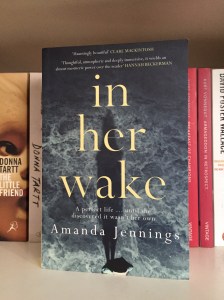
This book absolutely broke my heart. This book was so far from what I was expecting and so gripping that I honestly can’t see how it wouldn’t make this list. If everything you knew about yourself turned out to be a lie, that your whole life was built around a crime so devestating that lives have been ruined, what would you do? In Her Wake, is a real story of hope and courage. And, yes, the final revelation about Bella still guts me many months down the road.

Notes on a Cuff by Mikhail Bulgakov

Finding this book last year, and finally reading it in this, was such a joyous experience. I thought I’d read all that was available so to discover the stories in Notes on a Cuff was like stumbling upon gold dust. These stories, written in the early 1920s, show a real master finding his voice and revelling in the art and joy of writing. There are elements here that he’d perfect later in his career but it’s amazing to see just how brilliantly formed his work already was.

Purity by Jonathan Franzen

On each occasion (and it’s always an ‘occasion’) that a Franzen book is published I can’t help but think it won’t be as good as his previous novel. On each occasion I’m proven wrong. Easily his most accessible and equally amongst his finest work.

The Bickford Fuse by Andrey Kurkov

I’ve written before on just how much I love Kurkov’s work. Something of a cross between Bulgakov and a Ukranian Vonnegut, he weaves near-absurdist, satirical novels of the highest calibre. The Bickford Fuse from what I can tell, is an earlier book than any he’s yet published and was written in the final days of communism. A look at ‘Soviet Man’ told through a series of somewhat connected stories and characters that, while clearly written by the same author, is completely unique amongst his work printed thus far. Ambitious, multi-layered and hugely rewarding to read.

IMG_9197Where Roses Never Die by Gunnar Staalesen Favourite Fiction of 2016.

I read this in circumstances almost as perfect as possible yet I’m sure that had I read it in the middle of a cesspit as I sank down to the bottom I would have loved it just as much. Hugely gripping, deeply evokative and written without a spare word, Gunnar Staalesen is like the samauri of Nordic Noir – every masterful, well-practiced and skilful word strikes home hard. Staalesen is the master of his craft and it’s a big credit to the translation that there’s never any question of this when translated into English from the native Norwegian. Original review.

Non-Fiction

A book about the intelligence war was never not going to be my cup of coffee and when you factor in that it’s written by Max Hastings, The Secret War couldn’t get much better. Some real shockers in here and written in such a way as to ensure it never gets dull. It’s strange as it never caught my attention in school (more down to the education system at the time) but the Second World War has become the subject I’ve probably delved into most in terms of personal education. While I always enjoy a personal account – my interest being how normal people find themselves in extraordinary circumstance that I can’t comprehend rather than the ‘guns and glory’ stuff – the intelligence and spy / espionage war really fascinates me and this book is packed with detail.

In theory that should mean this would be the best NF book I picked up in a year but, then, this was the year that Bruce Springsteen published his autobiography.

Born To Run is the memoir every Bruce fan could have hoped for. He could’ve phoned it in. He could have gotten a ghost-writer to assisst and turn it into pristine prose. He didn’t. A deeply personal book, there’s more insight here than any such auto-bio I’ve read and all told in Bruce’s own voice. Revelations, inspiration and the salvation of music is all in here like one of his greatest songs. Original review.


Honourable Mentions…

The Dark Iceland series by Ragnar Jónasson is one of the most compelling and rewarding additions to the thriller genre and this year’s Black Out and Night Blind were both excellent – but impossible to choose a favourite.

I delved deeper into the Jack Reacher series this year with a good five books under my belt including the new (in paperback) Make Me which was a real strong contender and shake up of the character.

Yann Martell’s books are always going to suffer in comparisons to his famous book with the tiger but The High Mountains of Portugal was a good effort, if a little wayward at times, with a beautiful, heartbreaking evocation of absolute grief.

Epithany Jones by Michael Grothaus and The Exiled by Kati Hiekkapelto really should be on this list too…

Least to Most: Bruce – The Ghost of Tom Joad

“Shelter line stretchin’ ‘round the corner
Welcome to the new world order
Families sleepin’ in their cars in the southwest
No home, no job, no peace, no rest”

I’m starting to think that the poor reception that greeted Human Touch and Lucky Town kinda knocked Bruce’s confidence a little heavier than he’d let on. Going by the fact that, at the time, he was still actively fighting depression and going through a lot of personal changes, it’s not that big a surprise. One could imagine that, were he feeling more resilient mentally he may have said “nuts” to the negative reviews, gone back to the woodshed and kicked it up a notch. Instead, during the period between the end of what’s now called ‘The Other Band’ and the start of the E Street Reunion tours precious little of what Springsteen wrote saw the light of day (pun intended).

the_ghost_of_tom_joadNow to me – and I hope others – this is a real burr because what recorded material from 1994 onwards has reached the eager ears of listeners is gold and does show that the man was more than capable of saying “nuts” and going back to work. There’s an entire album’s worth (close to two*) of material that was shelved and will likely never be released. There’s been some hints as to what it contains – like the E Street reworking of ‘Waiting on the End of the World‘ – but it’s likely to remain unheard save a (much prayed for) Tracks 2**emerging and all you need to is cast a look at the material Bruce did release from that era, all with a certain understated charm, to know why we’re missing out: ‘Streets of Philadelphia’, ‘Secret Garden’, ‘Blood Brothers’ (the latter two written during a run of inspiration ahead of and during the E Street reunion for Greatest Hits), ‘Missing‘, ‘Lift Me Up‘, ‘Dead Man Walking’, even ‘Without You‘ has a joyful charm, ‘Nothing Man’ originated during this period… and then there’s this thing he wrote called ‘The Ghost of Tom Joad’.

‘The Ghost of Tom Joad’ was written around the time of Greatest Hits and Bruce even took the band through a few takes but, much like elusive ‘Electric Nebraska Sessions’, it wasn’t right. So, instead of the presumed course after that compilation’s reunion, Bruce took a sharp left: he assembled a group of songs about the American South West and, for the most part, embellished them with little more than his voice and some delicate guitar patterns weaving through the odd keyboard drone (something that started with ‘One Step Up’ and featured heavily in his 90s output to good effect).

And what a group of songs they are***. More restrained and narrow focused than his earlier solo (masterpiece) Nebraska, these songs actively incorporated silence and hushed phrasing (so much so that the tour that followed was often referred to as the ‘Shut the Fuck Up’ tour) to create memorable and affecting stories that lingered. Listening back to this one I’d forgotten just how powerful some of these are, take the tale in ‘Sinaloa Cowboys’ as an example:

Here the stories are perfectly succinct and the delicate touches of instrumentation mean that in their simplicity they achieve what the over-worked attempts of Devils & Dust failed to: stories with bite with music as a subtle backdrop rather than focus.

There are four songs on The Ghost of Tom Joad, title track included, for which Bruce assembled a small backing band – including Gary Tallent and Danny Federici – to add a little colour to the sonic palette and these serve as beautiful counterpoint to the otherwise stark, bitter-sweet beauty of songs like ‘The Line’. ‘Straight Time’ and ‘Dry Lightning’ may not linger as much as, say, the powerfully stark ‘Highway 29’ which could slot right at home on Nebraska, but the title track and ‘Youngstown’ are both essential Bruce songs.

‘Youngstown’ has become such a torch-burning, electrically recast centre-point of E Street band shows since the Reunion tour that it’s easy to forget just how strong the original is:

The other reason Ghost of Tom Joad is an essential part of Springsteen’s catalogue is that it finds him rediscovering his voice. Not the hushed tones of the vocals but the no-linger inward focus. This was Bruce looking for inspiration outside of the men vs women themes he’d used for the previous three (released, that is) albums, but looking at the struggles of others – as he says; ““the songs on it added up to a reaffirmation of the best of what I do. The record was something new, but was also a reference point to the things I tried to stand for and still wanted to be about as a songwriter.””

Received to slighter commercial success but pretty strong reviews with Rolling Stone reckoning it “among the bravest work that anyone has given us this decade”  (and a Grammy for Best Contemporary Folk Album), it perhaps receives a harsher view in retrospect from some corners than it deserves. Some criticisms fired at this album focus around the hushed, minimal delivery or the lack of fire and brimstone given to the recorded versions of songs like ‘Ghost of Tom Joad’ and ‘Youngstown’ compared to their now live rendering but, if you ask me, they’re missing the point. The songs on this album (something of a concept album in that respect) all focus on the- as  his own website puts it – ” poverty, immigration and the brittle troubles of Americans and Mexicans in the Southwest.” The desert can be a cold, bleak place with vast empty spaces. The Ghost of the Tom Joad, sonically, is the sound of these oft-broken characters staring into that space after a day in the cruel, blinding light of its heat with acceptance / surrender of the inevitable. It’s not a time for boot, stomping rock and, in the brittle, fragility of its delivery of these stories Ghost of Tom Joad remains an understated and captivating masterpiece.

Highlights: ‘Ghost of Tom Joad’, ‘Youngstown’, ‘Highway 29’, ‘Sinaloa Cowboys’, ‘The Line’, ‘Galveston Bay’.

Not so highlights: The exclusion of ‘Brothers Under The Bridge’ which could’ve elevated this album to virtually unimpeachable. But then everybody needs a ‘Blind Wille McTell’.

*Depending on how much different side-men know: Bruce has spoken about an album of more relationship songs in the minimal ‘Streets of Philadelphia’ style, Shane Fontayne has given interviews that hint at yet another. Could just be crossed wires, could be another well of unheard material. He was certainly clocking up recording sessions during this period.

** At the time of Tracks 75% of Bruce’s material was unreleased. Even the number of songs settled on for Tracks was then culled from 100 to 66. What was on those extra two discs? Surely more than went on to make up The Promise and The Ties That Bind?

***Here, again, though he wrote some 22 songs. There’s tales of two albums’ worth of songs – one with the band backing – being recorded. Some would pop up on tour, some never to be sung again. FFS.

Least to Most: Bruce – We Shall Overcome: The Seeger Sessions

“Now Teddy me boy,” the old widow cried
“Your two fine legs was your mama’s pride
Them stumps of a tree won’t do at all
Why didn’t you run from the big cannon ball?”

“Now against all war, I do profrain
Between Don Juan and the King of Spain
And, by herrons, I’ll make ’em rue the time
When they swept the legs from a child of mine.”

It’s worth pointing out that, from this point on, we’re really into the quality stuff. 8/10 and upwards so there’s no real “this album is a bit cack because” elements, more of a general exploration / personal ranking attempt.

seeger_sessionsWith eighteen studio albums (he counts High Hopes), half a dozen compilation albums, a few box-sets and a couple of live records, it’s We Shall Overcome: The Seeger Sessions that’s the real outlier in Bruce Springsteen’s catalogue. NebraskaGhost of Tom Joad and Devils & Dust may not have been sonically in line with, say, The River, but their subjects and song writing style certainly sit within the overall Springsteen narrative style. We Shall Overcome.. is an album made up entirely of covers* and contains his interpretations of thirteen tracks made popular by Pete Seeger.

This one goes back, initially, to that fallow period in Bruce Springsteen’s recorded output, between Ghost of Tom Joad and the resurgence of the E Street Band at the end of the decade. In 1997 Bruce got together with a group of musicians introduced to him by Soozie Tyrell and recorded ‘We Shall Overcome’ for the Where Have All the Flowers Gone: the Songs of Pete Seeger tribute album.

A few years later, his career revitalised and during a brief break between ‘rock’ albums, Bruce decided to revisit the idea and the band got together in his home, counted off and let her rip.

In a recent interview Bruce was asked about the possibility of a second Seeger Sessions album and he said that, while there’s nothing on the horizon yet, he doesn’t see why not, he’s “collected a small group of material” and that what he enjoyed about this one was he that didn’t have to write and “that it was such an enjoyable band I can’t imagine not doing it again”.**

So here we have thirteen songs that Bruce chose to cover and had an absolute blast playing with musicians introduced to him just days before and just letting rip. If you hang your Springsteen luggage at the door it’s a hugely enjoyable album from which the most apparent feature is just what a joyful experience recording it must have been.

The tracks are pretty diverse and date back many hundreds of years and Bruce brings his own arrangements to each.

Let’s face it; for all his detours into hushed acoustics, Bruce is primarily a rock singer and carries with his voice and phrasing a certain clout. Even with his first two albums of acoustic-based music (we’ll get to those a bit later in this series) you only need go back a few years in his musical journey and he was on stage with Steel Mill belting out southern-tinged harder-rocking numbers and honing the his abilities to rock any joint that would let him plug in. When it’s just him with a guitar you can expect a hush but if you put a band behind him it is (to pull a Steve Van Zandt line in where he has no place) “Boss time” – what he brings to these arrangements of folk standards is an extra thump, a beefing up ready for those stadium-ears almost. I find ‘Mrs McGrath’ particularly benefits from this. It not only makes these songs sound more contemporary but is likely the best way to make them accessible for his own fanbase who – were they recorded in a style much closer to their standards – may not give them as much time.

Personally – I love a lot of this record and it did mean I not only went out looking for more similar music but spent a lot of time with this in the car. Mission accomplished then, I guess.

I recall at the time of release that We Shall Overcome: The Seeger Sessions was met with a lot of acclaim. It picked up a Grammy for Best Traditional Folk album and the tour that followed won similar applause (and was captured on the Live In Dublin album which featured a few of Bruce’s originals re-worked) though, reportedly, a little under-attended.  There was some negativity – the very ‘Springsteeninsation’ of these songs robbed them of some of their more traditional elements but then, if you want a traditional folk rendering would you really buy a Springsteen version? For my money, a lot of those traditional ones can come across a whole lot more bland and a whole lot less fun.

When it comes to why this one doesn’t go higher up in terms of rotation it’s probably down to the fact that, for all the fun and appeal of it, it’s not necessarily one to listen to all the way through each time – after a while the lack of diversity becomes a little much and I find myself wanting to listen to something else. An element which will also depend on which version of this album you got your hands on. I got this one on day of release so mine concludes with ‘Froggie Went A-Courtin”. Frustratingly, six months later the album was reissued as  We Shall Overcome: The Seeger Sessions – American Land Edition. This version slapped an extra five tracks on including Springsteen’s own ‘American Land’ (later re-recorded for Wrecking Ball) and ‘How Can A Poor Man Stand Such Times and Live’ featuring some additional lyrics from Bruce. A little vexing as both are strong tunes but I wasn’t about to go out and buy the same album twice in one year and it felt a little cash-grab.

However, overall, nothing but like for We Shall Overcome: The Seeger Sessions.

I have one small curiosity of a hang-up with it though and it’s a trifle of a thing but it’s the cover. Bruce has been backed by the E Street band on ten albums. Yet the cover is always Bruce alone. So you’d guess the rule is that the musicians that play on the songs don’t get to the cover. Except, it would seem, the group of musicians of the Sessions Band (who he’d only played with a couple of times) – they get the cover. Garry Tallent has played bass on 14 Springsteen  records since 1972 – he’s not on any cover. A chap called Jeremy Chatzky plays upright bass on We Shall Overcome: The Seeger Sessions. He’s on the cover. Played bass on one album, on the cover. Garry Tallent bass on 14 albums, no cover. Even on the live albums credited to the E Street only Bruce was on the cover. I think only one album, a ‘quick we’ve got some big festival shows coming’ Greatest Hits comp saw the whole band on the front cover and even that was only for the European disc. My tongue is, of course, firmly in my cheek with most of this but I do wonder if this caused a slight eye twitch on the E Streeters….

Highlights: Mrs McGrath, John Henry, Pay Me My Money Down, Eerie Canal, Eyes On The Prize

Not so highlights: most of these will be empty from here on in.

*Again; unless you have the reissued version in which case you get one original Springsteen song and some original lyrics.

**He also revealed that he wrote and submitted a song for the Harry Potter films which went unused.