Undoubtedly a song that’s all over the airwaves and social media today but…. this post was in the works already and it seems fitting enough to push it through now.
Heading home yesterday evening I flipped open twitter and caught the rumours of Prince’s death before confirmation from his publicist changed it into a breaking news story. Shocking doesn’t do it justice.
It’s hard to recall the first Prince song I heard / knew. He was everywhere in music in the 80’s and into the 90’s. Nobody had such a prolific period of constant hits and a career-long streak of strong music.
I do know, though, that Purple Rain remains an ice-cold slab of perfection. There’s not a track on the album I skip. From the hit singles it generated to the breathlessness of Take Me With U, the brilliance of Darling Nikki and the pure Prince audacity-fuck censorship of its lyrics there’s just so many moments of genius on it you could lose count. No wonder it’s shifted upwards of 20 million copies.
For me though, the album, and Prince’s highlight is it’s opening track – Let’s Go Crazy.
It encapsulates everything that the album holds all contained in one four-and-a-half minte track – there’s the exultant chorus, the near-gospel backing vocals, urgent synths, and, of course, Prince’s startling guitar chops (for further evidence watch the little guy in the hat break this cover out of mundaity). This has been a go-to song for me for a long time, those times when the day has been a pile of cack, it’s time for Let’s Go Crazy. It’s impossible to not be uplifted by it, with the sermonising intro with it’s “Dearly beloved…” (boy have I seen that a lot on twitter today) and it’s rousing “and if the elevator tries to bring you down… go crazy; punch a higher floor”. Yeah… Prince is probably trying to evangelisize us with this one but, fuck me, it’s as catchy and brilliant as they come. It’s a pure rush of excitement listening to it especially when – in album format – it breaks into the start of Take Me With U and its opening drum solo.
Thanks to the Purple One’s very tight hold on his copyrights and sharing etc it’s hard to find a video to put here (or one that will stay active for longer than a fart) but let’s try:
To say I love music would be an understatement. I’d bring up that Nietzsche quote but it’s been overused. I also love good fiction and the impossible quest to get my fill of both means storage is becoming an increasing problem. But the two very rarely mix well. There are precious few strong novels about music. It could well be because the reality would be considered too unbelievable as fiction (have you read Keith Richards’ Life?) and capturing the magic and power in making music without coming across heavy on the cliché can be tricky. For every Almost Famous and Great Jones Street there’s a Young Person’s Guide To Becoming A Rock Star.
However; The Rise & Fall of the Miraculous Vespas can now be added to that short list of great books about music.
Taking us back to Kilmarnock in the early 80’s, David F Ross presents the story of The Miraculous Vespas, a band formed and driven by their manager, Max Mojo, who – via some hard graft, a great song and couple of crucial run-ins with Boy George (though it’s still hard to believe there was a time when he wasn’t simply another ‘celebrity DJ’/talent-show judge with a highly questionable head tattoo) – manage to crack the top of the charts with their song It’s A Miracle (Thank You), taking us along for their ride to the almost-top.
However, this is more than a bitingly funny account of a young band’s quest for immortality – there’s also the gang-war that’s running alongside as local gangs work to pull a fast-one over a big Glasgow crime family and come away clean. As every bit as compelling as the fortunes of The Miraculous Vespas, the McLarty storyline is a gripping and, at times, brutally violent and thrilling slab of gangster rivalry that wouldn’t be out of place in an early Bob Hoskins film (here I’m talking The Long Good Friday rather than the one with the cartoon rabbit).
Told with the occasional retrospective interjection from a modern-day Max Mojo, The Rise & Fall of the Miraculous Vespas is an absolute belter of a book that’s populated by an amazing array of characters. There’s a couple of familiar faces from The Last Days of Disco including Fat Franny Duncan (of whom this installment paints a softer image and, surprisingly, has one of the novel’s most genuinely touching scenes) but you’re never given to think there’s too many characters as Ross balances the story expertly amongst the cast as their roles, the rise of the Vespas and the McLarty saga come together into a brilliantly thought out and well executed – not to mention bloody funny – conclusion.
Chief amongst these new characters is the aforementioned Max Mojo. A heady blend of hair dye, a passion for music, lithium compounds and a dermination to live the Malcolm McLaren quote, that sits on the books jacket, that Rock ‘n’ Roll is “… that question of trying to be immortal”. If only he could get control of the voice in his head. Mojo is one of the most original and brilliant characters I’ve seen in fiction for some time and has probably given me more laughs than many.
Much like his first book, The Last Days of Disco, David F Ross paints a fond picture of this time despite the obvious shafting the region (where didn’t?) was taking under Thatcher. Times are tough – especially for the crooks – yet there’s an optimism shot through this time and you can’t help but shake the feeling that – for some – that fabled ship may just be about to come in. Ross does a great job of painting a truly encompassing picture of the era – the impending Miner’s Strike, the end of the Falklands Conflict and racism all help set the scene – while his use of regional dialect places the reader firmly in place as well as making for some of the funniest insults and dialougue I’ve read.
If I had a quid for every time this book sent me to Spotify to play a track I’d have… well, I’d probably have about £20 but the fact is that with references to tracks by Orange Juice, The Clash, Big Star and, of course, Paul Weller, The Rise & Fall of the Miraculous Vespas has got one of the best soundtracks you’ll find in fiction .
Social commentary, gang war, relationship ups and downs, interband relationships, Spinal Tap moments, humour and heartbreak and the power of music; it’s all here. There’s a lot going on in this book and David F Ross, an author to watch, injects it all with an genuine passion for music, an unquestionable talent as both a writer and storyteller and, above all, a wicked sense of humour; The Rise and Fall of the Miraculous Vespas is uproariously funny. So many times I had to stop as I was laughing so hard I was turning into the annoying commuter in Mr Bean. Just the prologue, the creation of Max Mojo if you will, had me in stitches ( “…hands absolutely bastart achin’ fae they nails”). And as for the assumption that Hairy was Hairy Doug’s first name and the consequences for his partner…. well. If this book doesn’t make you laugh then, frankly, there’s something wrong with you.
David F Ross’ The Disco Days trilogy is due to be wrapped up with The Man Who Loved Islands. I for one can’t wait to get my hands on that.
It can be expensive being a Bruce Springsteen fan. I’ve just taken a look at the price tag on the River box set “The Ties That Bind” – what the hell, man? That’s almost as much of a piss-take as price tags that are attached to the recent trawls through Dylan’s vaults.
It’s all the more frustrating as:
a) The ‘specials’ for Born To Run and Darkness On The Edge of Town both sit in my collection and add plenty to the collection yet neither were as ott in terms as price (Born To Run’s 30th Anniversary edition set me back less than £20 if I remember and I was gifted the Darkness Set).
b) Raiding Bruce’s vaults has always turned up gold before and I doubt this is an exception.
Still – that’s what streaming is for I guess. I probably don’t have space for it in all honesty either.
But looking at point ‘b’ – Tracks proves that. That it’s so cheap now beggars belief – probably as it was the first such exercise in dusting off masters and so doesn’t have the kind of lavish ‘boxed’ feel that so many collections do now (oh but I so do still want that Ten box from Pearl Jam); there’s no hardback book, no live dvd concert or ‘documentary’ – just four fantastic (three faultless) discs of never-before released songs.
I’m pretty sure that the best of the outtakes from The River have already surfaced on Disc 2 of that set. Fuck, there’s 11 of them. I doubt very much if anything else is as good, to my ears, as Take Em As They Come (included on both):
Anyway….
The thing that always gets me with these sets is – “how the hell didn’t this make the cut when X-song did?” Even his latest, single volume ‘dust-off’ of scraps High Hopes had me wondering how songs like Down In The Hole or Frankie Fell In Love never made the cut – or the ‘bonus’ track Swallowed Up (In The Belly Of The Whale) was relegated in place of Easy Money etc etc…
Chief amongst the possible causes is the fact that Springsteen albums are almost concept albums. There’s a theme, a feel to them. Some songs, no matter how good, just don’t fit.
Another is that with so many strong songs being churned out, an album only has space for so many. Just look at the songs across the second, third and half of the first and fourth discs on Tracks. Born In The USA was so rammed full of A-List songs that seven of its twelve songs were released as sings – and that didn’t include it’s best tracks like Bobby Jean, Downbound Train or No Surrender! It’s even more surprising then that there’s 17 further songs from the Born In The USA sessions on Tracks. Seventeen! And that doesn’t include the original demo of the title tune – that one was an out-take from Nebraska.
Even then there’s still more lurking in the vaults – what about the electric, full-band take on songs from Nebraska? Where’s the whole album Bruce recorded and shelved in 1994? Where are the other 36 tracks that made the original shortlist of 100 for this collection? Though, given that Tracks covered up to 1998 (ish) it’s safe to assume that a truck-load of those have appeared on the box sets for Darkness and The River.
That’s a whole lot of music. A wealth of songs. Is it worth these trawls? Well, when the material is as strong as this I’d say 100% yes.
It’s not like we’re wading through songs by Lifehouse that weren’t Hangin By A Moment or something here.
We’re hearing songs that were written by one of those few as prolific and important as Dylan to the musical landscape.
One of the things I love about these is seeing just how much goes in to developing the themes / characters / lyrics. There’s some which feature very-very close matches on lyrics, follow a theme but aren’t quite there, there’s something not quite convincing. It’s like listening to Springsteen try them on, see how they fit and adjust until he ends up with what he considers the best use of that lyric, theme and apply it to the right feel – usually the song that makes the album.
The song Car Wash wasn’t quite there but the line “Well I work down at the car wash” would appear in Downbound Train with just a tweak.
Further proof of this process can be seen on the Blood Brothers doc with just how many variations in just musical style / timing signatures the lyrics are staple to before the ‘final’ one is found.
It’s clearly an on-going process.
I caught one the other day, listening to Shut Out The Light:
It’s one of Bruce’s then many Vietnam-vet songs. Guys came home but bore scares physical and mental. In this case Johnny’s still reeling with shock, gets the shakes, wakes up at night and feels his girl next to him (another familiar trope, see Happy, Cautious Man, The River etc etc). There’s a line in there – “Bobby pulled his Ford out of the garage and they polished up the chrome”.
It hit me. I knew that line.
It’s used in one of the best tracks on the damn near unimpeachable (I could do without Girls In Their Summer Clothes) Magic:
Now I think I see what this song really is, all the more bitter.
It’s more than revisit of that soldier’s homecoming theme but instead of a happy reunion “Johnny oh Johnny I’m so glad to have you back with me” and picking up the pieces of life and trying to move forward – there’s no coming home. The soldier coming home here has been killed in Iraq, this time sung to his memory. Instead of a family welcoming, there’s a family mourning – Wendy sits with the soldier’s uniform while John is “drunk and gone”.
And the line? “We pulled your cycle out of the garage and polished up the chrome”.
Bobby? Bobby’s there too. He “brought the gasoline” and helped set the bike on fire in the foothills.
The use of the same names makes it all the more haunting and effocative. It could even be the same family given the “my love for you brother” in the last verse.
It’s brilliant. It’s not a re-use of lyrics that didn’t fit right at the time (Shut Out The Light was considered worthy of release even as a b-side – appropriately – to Born In The USA). It’s a return to a scene and delivering it’s final chapter. Magic is brimming with anger and barely-veiled hostility to the state of the US and, to me, it’s like Bruce looked back in his cannon to see what he’d got that could help punch his message home hard and he found it. Some quarter-century later, Springsteen delivered a bitter counter-punch to the almost-optimism of the earlier work to bury home the fact that so many families were being left gutted by yet another American war on foreign land.
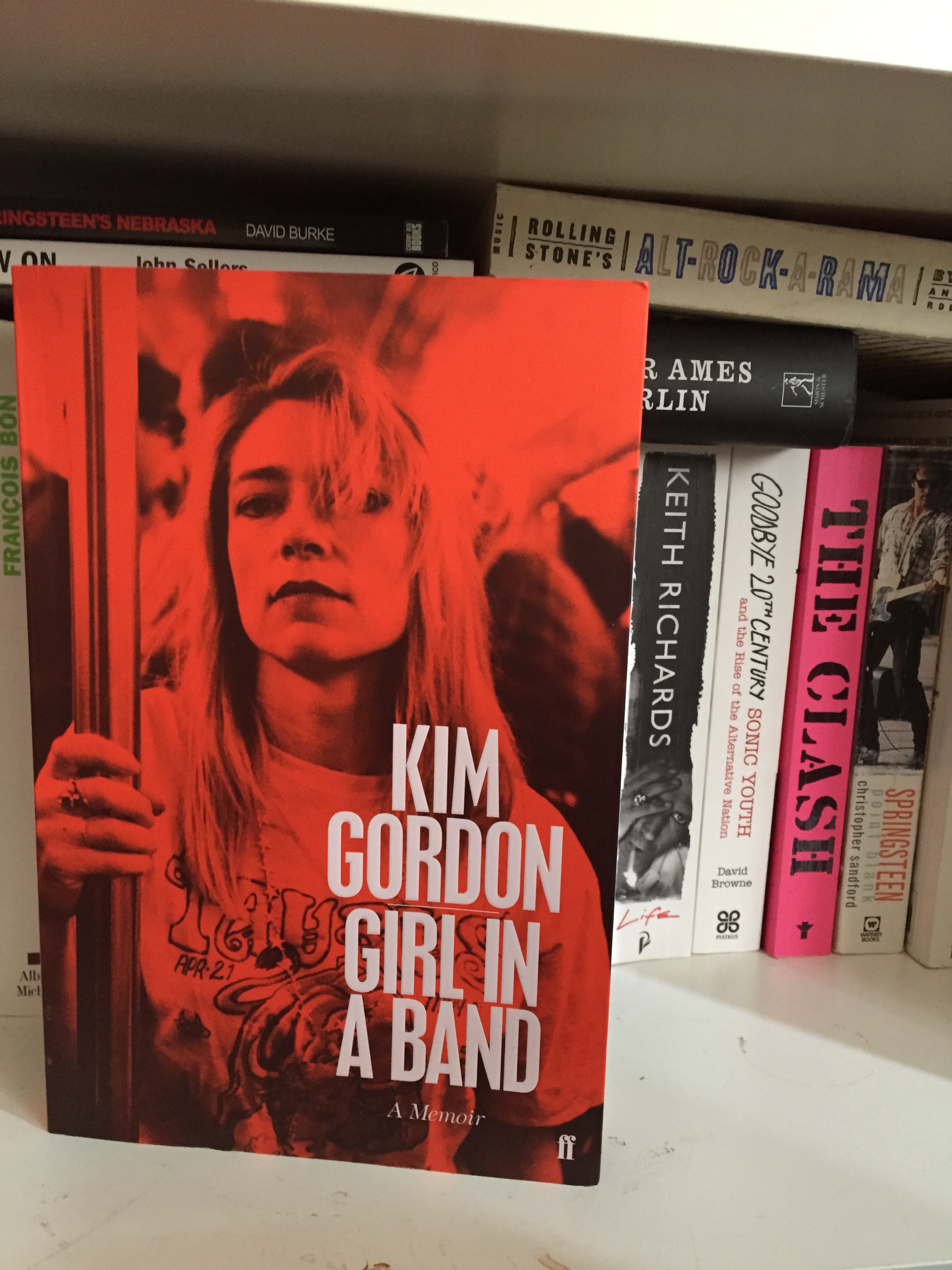
When Girl In A Band was released earlier this year I didn’t rush out and buy it. In fact, it was my wife that added this one to the collection and got to it first.
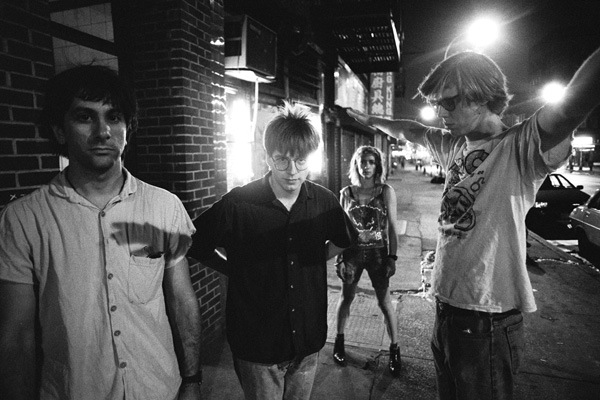
It’s safe to say that going in to this book I had mixed feelings. On the one hand; I love Sonic Youth and was anxious to gobble down more insights into the band, its working process and its body of work. On the other; Kim and Thurston’s split meant not only the end of Sonic Youth but a shift in focus whenever the band or either of them were mentioned in print. As such all press surrounding the release of Girl In A Band – including the excerpts printed in various publications – seemed heavier on that matter than the music.
It’s also safe to say that coming away from this book I have mixed feelings.
This is a memoir, after all. Says it right there in the title: Girl In A Band: A Memoir. So not an auto-biog in the traditional linear sense nor a “making of the album” type book. Further ‘nor’ is it a My Time In Sonic Youth book. No; it’s Kim Gordon’s memoir and to expect it to be solely on SY would be rude and demeaning as Ms Gordon’s life revolves around a whole lot more.
Gordon writes movingly about her early life and family – the terror inflicted upon her by her older brother and the greater terrors unleashed by his illness – and finding her way in the art world and path into music.
All that being said, though, Sonic Youth is/was a big part of Kim’s life and so does get plenty of page time too. Gordon is remarkably frank about her limited singing abilities – explaining that she asked Kim Deal to sing the harmonies on Little Trouble Girl as she, well, couldn’t – and offers insights into the writing / recording of many of SY’s tunes including my own favourite Tunic (Song for Karen).
There’s also plenty of revelations about life with the band – touring with Neil Young and its pitfalls, Kurt Cobain (a gentle yet tortured and manic soul here) and enough to suggest that Kim Gordon and Courtney Love don’t exchange Christmas Cards.
For all of the above I loved this book and would happily read it again.
Though as it’s a memoir and a recent one at that, the dissolution of Kim and Thurston’s marriage hangs heavy over the book. Hindsight often gets a few words in on recollections of earlier times and then there’s the break-up itself. It’s dealt with in, again, a remarkably frank manner – the discovery of text messages / emails from the Other Woman, attempts at counselling and repairing the marriage and, throughout, Kim’s own devastation.
It’s hard reading. Perhaps, to me, because the two had previously been more private about their relationship. When the announcement of their separation was made it was very quiet and via their label. In a world where celebrity couples can’t walk the dog alone without speculation appearing across the internet that their relationship is on the skids, it was a welcome relief for private matters to remain just that.
But then, as mentioned, this is her memoir and its her right to use the medium to set her version on the record, perhaps so as to never need do so again. It’s a little uncomfortable to read given just how open and forthright the sordid details of Thurston’s betrayal and the abrupt collapse of their marriage are laid bare – as though, perhaps, the disclosure was a little too full.
Powerful things, dreams. David F. Ross’ The Last Days of Disco is bookended by two – the teenage fantasy of Bobby Cassidy racing around Monaco and the disturbed nightmares suffered by older brother Gary following his time in the Falklands War.
Quite the juxtaposition, but then an awful lot happens between the two points as we follow the lives (and dreams) of the Cassidy boys in early-80s Kilmarnock. Bobby – don’t ask to see his tattoos – and his best mate Joey Miller aim at avoiding the dole, school and the army by setting themselves up as the new kings of the mobile disco scene, becoming caught up in conflict with the local party-entertainment-mafia kingpin. Gary, meanwhile, pursues a career in the Army (in an attempt to make his father proud), eventually being caught up in the Falklands Conflict.
I was born in 1980. As such there is zero chance that I was politically aware (or aware of The Jam) at any point during Thatcher’s reign. I do, though, have many a memory of the TV news containing phrases such as “strikes”, of the threat of the IRA and not knowing what Gerry Adams’ voice sounded like, of Simon Weston appearing on various television shows and of the image of the Iron Lady herself holding court.
Accordingly, I’m often fascinated to see and read portrayals of those times that served as a backdrop to my own childhood that fill in the blanks, as it were. To learn that it wasn’t all He-Man, Trap Door or Roland Rat on TV and that the god-awful music on Top of the Pops, and that which Bruno Brookes played on a Sunday Evening, wasn’t the only kind being listened to.
Along with plenty of references to ‘proper’ music, Ross evokes a vivid portrait of urban blight under Thatcher rule: a family of seven (soon to be eight) “all living in a three-bedroomed, mid-block council flat….. the only flat in a block of six that didn’t have the windows boarded up”, interspersed with transcripts from TV interviews and newspaper reports for increased context.
But context is really all that such ‘grey’ is for as this is no sad-sack, misery-guts, woe-is-life under the Tory Battle-Axe read. Far from it.
The Last Days of Disco is a thoroughly enjoyable, uplifting and bloody hilarious book that’s shot through with a clear and knowledgeable devotion to music (“the beauty and power of the 45rpm” as the PR summary so succinctly puts it) and a wicked, wicked sense of humour.
I come close to choking on my coffee when Hamish picked up the microphone to speak only for “a bang. A blue flash. A high-pitched shriek. And then the still unamplified but now perfectly audible ‘Ah! Ya fuckin’ bastart hoor, ye!’” Not to mention his abduction-at-urinal-point (seriously; poor Hamish comes in for such a drumming I did start to wonder if the author had something against him at times). Nor to mention the laughs I had imagining Mr King’s repeated rants of barely-repressed anger at each play of Shakin’ Stevens… “Ah’m fuckin’ agreein‘ wi’ him an’ he calls me “a cheeky wee cunt”.'”
Throughout, Ross demonstrates a real skill when it comes to rendering situations life-like, be it the brilliantly-funny first encounter with Hairy Doug and the disarray he and his ‘python’ live in to the disturbing nightmares that haunt Gary following his experience in the Falklands –
…he saw the crudely shaped limbs of what appeared to be tailors’ dummies sticking out of the marshes and the mud as he advanced – bayonet out – towards them.
As he got to them, they weren’t mannequins but real people; kids barely out of their teens just like him, crying for their mums. It was Gary’s job to silence them. As he stabbed at them they didn’t just fall and die like they did in The Longest Day. They grabbed desperately at the blade…. it took ten thrusts to silence the desperate screams of the third. All of them were so close to Gary he could feel their hot breath on his face.
A real talent with words is at work in these pages.
Location is a key character in many a novel and The Last Days of Disco is no exception. Small-town life in Ayrshire is wonderfully described with dialogue delivered in Kilmarnock vernacular adding to both sense of place and the general hilarity: “Ah’m Franny fuckin’ Duncan. Noo whit dae ye want. Ah’m in ma fuckin’ scratcher.'”
The main story arc is beautifully bolstered by a strong cast of supporting characters. From dubious party entertainers making phallic balloon animals and hapless van drivers to local gangsters (Fat Franny Duncan is one of those woefully unaware self-styled master villains so comedically-inept as to almost warrant his own novel), each with any number of laugh-out-loud moments.
Seemingly minor plot lines intersperse into one and eventually meet that of the main in a thoroughly unexpected and compelling way with Ross deftly blending together the build up of conflict in the Falklands with that of the Ayrshire mobile disco scene.
In all honesty, I did not expect a novel that started out with young Bobby Cassidy dreaming of Sally McLoy’s “tits jiggling away like jellies in an earthquake” to slowly and surely become such a multi-layered social / political-commentary with so many plot twists and turns nor for it to do so with such skill and depth, but bugger me if that’s not what it did.
In his first novel, David F. Ross has given us a heady blend of social realism, tragedy, humour and Paul Weller. There’s not a dull moment in these pages and I wholeheartedly recommend getting your hands on a copy pronto.
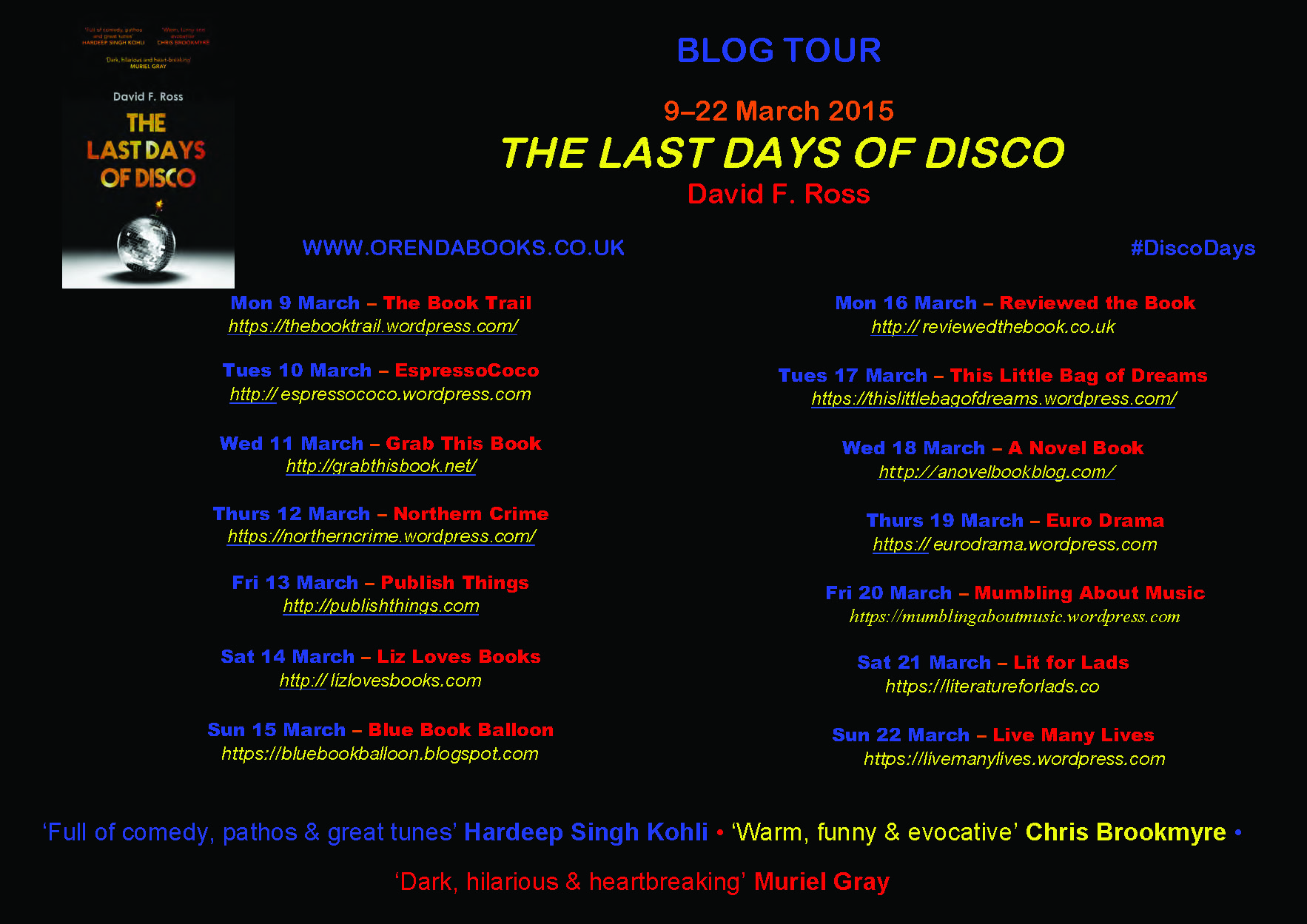
Check out the previous stop in the book tour for The Last Days of Disco at Euro Drama and keep an eye on Literature for Lads for tomorrow’s.
Thanks again to Karen at Orenda for sending me another cracking read and Liz Barnsley for inviting me to take part in the blog tour.
While a lot of my favourite bands got started in the 80’s, the term “80’s music” to me still brings back nightmare like images of Duran Duran or Spandau-fecking-Ballet on Top of the Pops (not to mention the horror of Bros). Thankfully David F. Ross put together a quality (The Human League aside) playlist of those songs that brought about the book, you can check it out here: http://t.co/Pi5ReU5V16
Following the Top Five Debut text, I recently texted two of my most music loving, list-compiling friends another simple message: “All time top five second albums?”
Only the one cross-over across the lists (Nevermind popping up on two of the three). Here, however, are mine (in no particular order, that’d be too hard):
Pixies – Doolittle
Bob Dylan – The Freewheelin’
In all likelihood still my favourite Dylan album.
Nirvana – Nevermind
Yes, I know; this is such a commercial choice… blah blah. Commercial, sell-out, whatever – the importance of this cannot be denied.
My Bloody Valentine – Loveless
Foo Fighters – The Colour and The Shape
I still don’t think they’ve bettered this. Yes this makes my list a bit Grohl-heavy but what can you do?
The second album is important. A debut album tends to be more of a compilation of songs that the artist has been living / gigging / tinkering with for years prior to a deal. A second finds them more established, a bit more at home with the idea of recording and who they are and building on those foundations laid by the debut. I think….
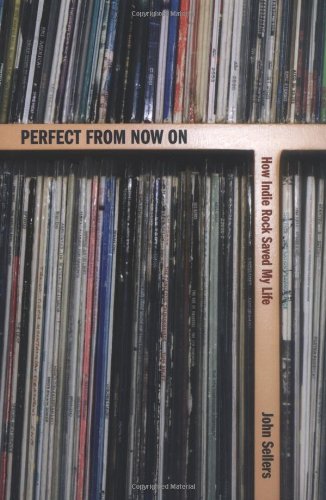
Last year I read a book called “Perfect From Now On; How Indie Rock Saved My Life”. I think I found it via a Goodreads recommendation, I’m not sure. I did think that any book with a title borrowed from a great Built to Spill song and that subtitle warranted a read – it didn’t hurt that the cover was a bank of record sleeve spines.
I’m not going to drop in a book review here (and I’m not about to start a Mumbling About Books blog either, I barely give this one the time I want to) but it wasn’t too bad a read. Nothing amazing. Plenty of amusing revelations and elements familiar to all alt-rock / indie fans, I’m sure. A little too heavy on and Guided By Voices concerned though for my liking. What the book became really warranted a different title.
The reason I bring this book onto a rarely-updated music blog is that it mentions a universal truth – that the Pixies never released a bad song (although I feel it wrongly uses the exception of Bam Thwok).
Across the woefully-short discography of Messrs Black, Santiago, Loverling and Ms Deal there’s not a single duff song. They blazed a way that inspired both exciting new bands (it’s impossible to not point out that Kurt Cobain held them up as a big influence) and pale imitations. Their songs were tightly wrapped blasts of fun, essentially. There were hallmarks – the ‘loud-quiet-loud’ dynamic, the surf-guitar, the yelps and shouts, crazy lyrics and wonderful harmonies – that nobody else could do as well and so consistently.
Plus, they wrote a song about a superhero named Tony. How could I not love a band that does that?
I did, like so many artists, come to the Pixies too late. They weren’t a functioning unit when I started listening to them. The reunion and reunion tours were good and the documentary that accompanied it still makes for fascinating viewing. However, the need for new Pixies music, the curiosity, the eagerness is something that has finally been sated. The sudden release of Bagboy caught everyone – except for the band themselves – by surprise.
This is a new song in the fullest sense. It’s not a throwaway like Bam Thwok (which I still feel is underated) or a cover (the only other song to have emerged since the reunion was a cover of the much-missed Warren Zevon’s Ain’t That Pretty at All ). This is what has been missing in both of those tunes – the Pixies of now. Not a rehash of old songs, not a tepid ‘sounds just like they did on Bossanova’ – this is a tune that shows a band that hasn’t been frozen in time, one that is making contemporary sounds (take note, Soundgarden) and music. It sounds alive and ready to go.
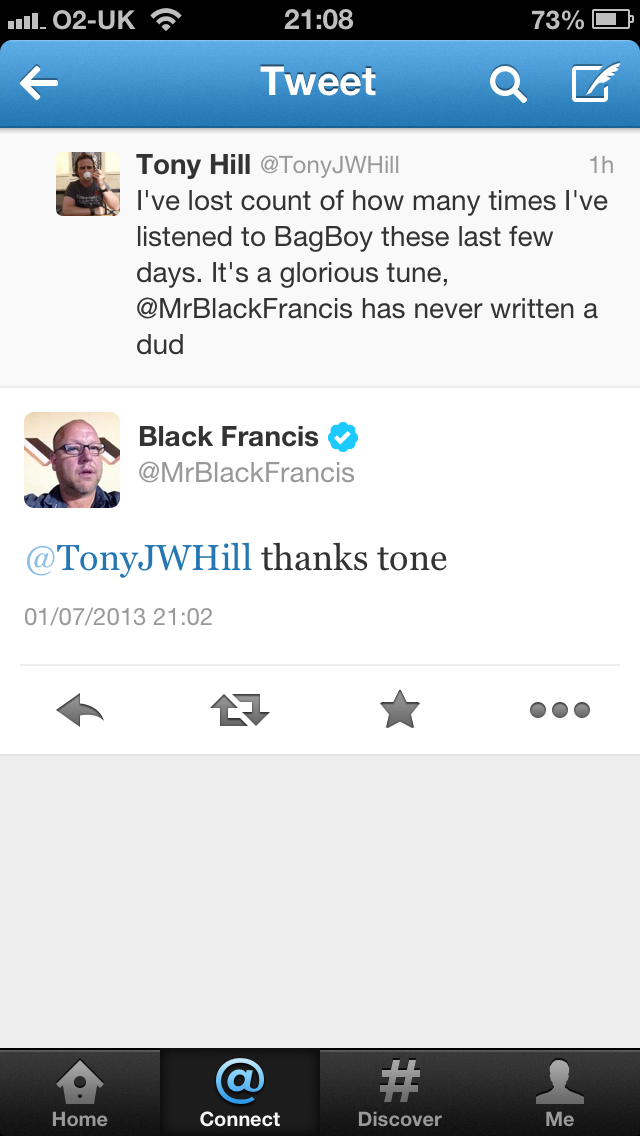
I loved this one off the bat. My adoration for the song and band has even meant I’ve ignored my longterm dislike of being referred to as Tone:
To say I’m excited, then, to hear the new EP-1 would be an understatement. I know that I can go and hear it now. I even have the download files sat in my email. But, I got in there with the vinyl order before they sold out and I’m resisting the urge (thanks to a horrendous 4-hour traffic jam and the stress involved I wasn’t even able to pay attention to the airing of Indie Cindy on X-FM this week) to hear it until I drop the needle down on side one.
Of course, that being said, I’m also excited to hear EP-2 and any that follow as the band utilise the freedom of releasing how they like thanks to not being on a label (I’m sure it also helps divert any pressure away from actually making “The New Album from The Pixies”).
I’ve been remiss in writing here. I’ve not been remiss in listening to music.
A little while ago I heard the stream of the new, self-titled, album by Chelsea Light Moving. I’ve listened to it a couple of times subsequently though I’ve yet to order up the vinyl. Something is stopping me. Tugging at me. Suggesting it might even be treacherous to do so…
Chelsea Light Moving (CLM) is the new band for Thurston Moore. He of Sonic Youth. I do own all of Mr Moore’s previous solo albums – at least the three that are readily available and not of the pure-noise variety. I even have Demolished Thoughts on vinyl – beautiful double coloured vinyl at that. But those were solo albums not ‘new band’ albums. It’s not that CLM is bad. Not at all, really, for a first effort. It bristles with all the energy that you’d expect of Thurston’s thrashier additions to an SY album and makes more noise than he ever does on his own. At least in song-mode.For the problem I have when listening to CLM is that this is as pretty clear indication as you’ll ever get that Sonic Youth should now be referred to in the past tense.
Given that the indie-rock world was thrown upside down by the news that Thurston and Kim Gordon recently announced that their marriage was over, it shouldn’t really be a surprise. Given that that they’ve been together and put out more music than any of their contemporaries, it shouldn’t be a surprise. Given that they recently parted ways with their long-term label Geffen (their going Major was one of the things that smoothed the way for Nirvana and many others to do so) and released The Immortal on an indie label as a one-time-only thing, it shouldn’t be a surprise. It’s not really a surprise. It is, though, a bloody big shame.
It’s hard to write about Sonic Youth and their music. Whenever I write about music I’m mindful of the quote that likens doing so to ‘dancing about architecture’. With such an analogy writing about Sonic Youth and their music is nigh on impossible. Others have tried, they’ve done so better than I ever could.
To me though, Sonic Youth were one of the greatest things to blow my ears apart, literally; I’m convinced that the hearing in my right ear has never been the same since I was close to front row and very close to intimate with Thurston Moore’s amps as they performed Daydream Nation in its entirety at Camden’s Round House. Listening to SY for the first time was like getting a key to a room full of ‘next-level music’. It was music that didn’t give a fuck – pure punk in that respect yet somehow effortlessly cool. No regard for tuning. No regard for form and traditional structure. No regard for anything but the feel. And it all made sense. Nobody else has been able to make music that’s so chaotic and deconstructive while still in complete control and ridiculously tight. Watching Thurston and Lee Ranaldo playing together was like watching music’s mad scientists create. And playing prepared guitar with a screwdriver? Forget it. Absolutely amazing.
It is a shame, and here’s more than a few reasons why:
Of the music I’ve been listening to lately there’s been two stand out choices and both are kind of important when looking back at 2012 musically.
I’ve been getting back into the habit of listening to classical music lately. I tend to prefer the more intense stuff, the Russians like Shostakovich and Rachmaninoff but also a bit of Bach courtesy of my wife’s appreciation for it. This year we went to see the Royal Philharmonic Orchestra’s Spanish Fiesta – a great way to remind us of our trips there this year, last and back in 2009. An amazing evening of music and a great bit of exposure to some Spanish guitar music of which this is on steady repeat on my iPod:
The part from the seven minute mark, building up to what – to me – is a euphoric moment at 08:14… absolute bliss.
The Replacements
This year – after continually reading their name in numerous bios and write-ups – I finally got around to checking out The Replacements. Holy crap balls. I feel like a complete tool for not having gotten into this band sooner or at least having been aware of them before now. Their influence is huge – I read somewhere that Nevermind was named for the track on Pleased to Meet Me – from Green Day, Goo Goo Dolls to Ryan Adams and Wilco with the likes of Kurt & Co and The Lemonheads in there too.
They came out of the early 80’s hardcore / punk scene but bought with them an undeniable sense of melody and Paul Westerberg’s ever-evolving songwriting skills. While they moved clear of the trash and poor production of their initial early years they never lost the sense of urgency and energy from it but welded it to ever-finer crafted songs.
I started out by ordering their Don’t You Know Who I Think I Was compilation and re-released Let It Be album and have rapidly added all their studio albums up to and including Pleased To Meet Me since May and – despite the recent fucker of a month we’ve been having – I never fail to find myself invigorated and charged by them.






 Mumbling About...