Epiphany Jones

Tonight I’m having sex with Audrey Hepburn. Audrey’s breasts are different from the last time we fucked; they’re bigger, not as a firm. There’s a hint of a stretch mark on the left one. The leading lady is bent over, gripping the bedpost.”

….and so begins one of the most impressive and original books I’ve read to date. Michael Grothaus’ Epiphany Jones is a blisteringly sharp and biting novel that will drop jaws with every revelation.

A precis from the jacket / pr:

IMG_9108Jerry has a traumatic past that leaves him subject to psychotic hallucinations and depressive episodes. When he stands accused of stealing a priceless Van Gogh painting, he goes underground, where he develops an unwilling relationship with a woman who believes that the voices she hears are from God. Involuntarily entangled in the illicit world of sex-trafficking amongst the Hollywood elite, and on a mission to find redemption for a haunting series of events from the past, Jerry is thrust into a genuinely shocking and outrageously funny quest to uncover the truth and atone for historical sins.

Yep; one hell of a premise. Michael Grothaus expertly treads the line between outright hilarity and darkly disturbing, maintaining sufficiently steady a balance to keep readers gripped without . That’s not to say it doesn’t shock and appal – indeed, despite the sputter-your-coffee opening this novel is definitely not one for the light-hearted. Without wanting to give too much away, Epiphany Jones runs the gamut – from celebrity-porn addiction (which if you’ve read Grothaus’ journalism you’ll know isn’t all that fictional), the vacuity of Hollywood and the obsession with celebrity culture to moments which touch upon the very worst of humanity and some that are genuinely shocking in their brutality.

It takes a very brave writer to take his audience down those roads and a very gifted one to do so in such a way as to keep them with him. From the opening chapter it’s clear that Grothaus is just such a writer. He knows how to get a reader hooked and hooked in such a manner as to hold them, no matter how dark the road is going to get. The plot leads in gently – Jerry, king of the asides, is a celebrity-porn obsessed guy who also happens to suffer from psychotic hallucinations who goes from a mundane life working behind the scenes at Chicago’s Art Institute (when he’s not taking me-time breaks with Variety) to a violent life on the run that leads him to blowing open an international child sex-trafficking ring. Humour helps (if my First Aid training didn’t teach me not to put fingers down a choking person’s throat then this book did), as does the brilliant pace and the fact that the characters are brilliantly realised and intriguing enough to get you fully invested in them. As the plot unfolds there is so much to take in that it’s impossible to not want to see it through, Grothaus baits the narrative with enough mystery and intrigue to keep you desperate for more with each jaw-dropping revelation leading to another.

Back when I took my Literature degree I took what many considered an odd choice and wrote my dissertation on the use of humour in the works of Hemingway and Steinbeck. Yeah because books like The Grapes of Wrath and A Farewell To Arms are known fodder for stand-up routines. But, you see, we need to laugh when dealing with heavy stuff. How many times do you need to hear “laughter is the best medicine” or see examples of gallows humour when we’re trying to cope with darkness? Just as Papa mixes his comedy with vulgarity or Steinbeck peppers his dialogue with left hands covered with Vasoline, in Epiphany Jones, too, the humour is key – from the dry observations to the occasional slapstick, it’s how Grothaus manages to pull you through and keep you with him. It’s how he helps lure you down into darker waters – by the time it gets real dark over the Mexico border, for example, you know you’re already in good hands –  and yet it never threatens to take away from the seriousness of just what is being exposed. It even manages to ensure that while he’s not top of the likeable list at the start of the book, the reader develops an increasing soft-spot for Jerry and will share in his devastation at the end. Indeed, don’t be fooled; when the jokes stop Grothaus can hit you with an emotional and dramatic punch like the best of them. Here, too, are occasions when you may need to put the book down to truly process what you’ve just witnessed.

Everything is in here – from gripping pace to outright shock, from murder to birth, abuse to revenge and from comedy to tragedy. Epiphany Jones is a very, very clever, tightly-knit book that delivers more depth, pacing and reading pleasure than most and an ending that leaves you with just as many questions and “now what?”s as it does conclusions. I can’t recommend it enough.

My thanks, again, to Karen at Orenda who’s selection of genre-defining novels ensures that my bookshelves and To Read pile contain brilliant books – for sending me Epiphany Jones and do check out the rest of the blogtour.

Epiphany Jones Blog tour


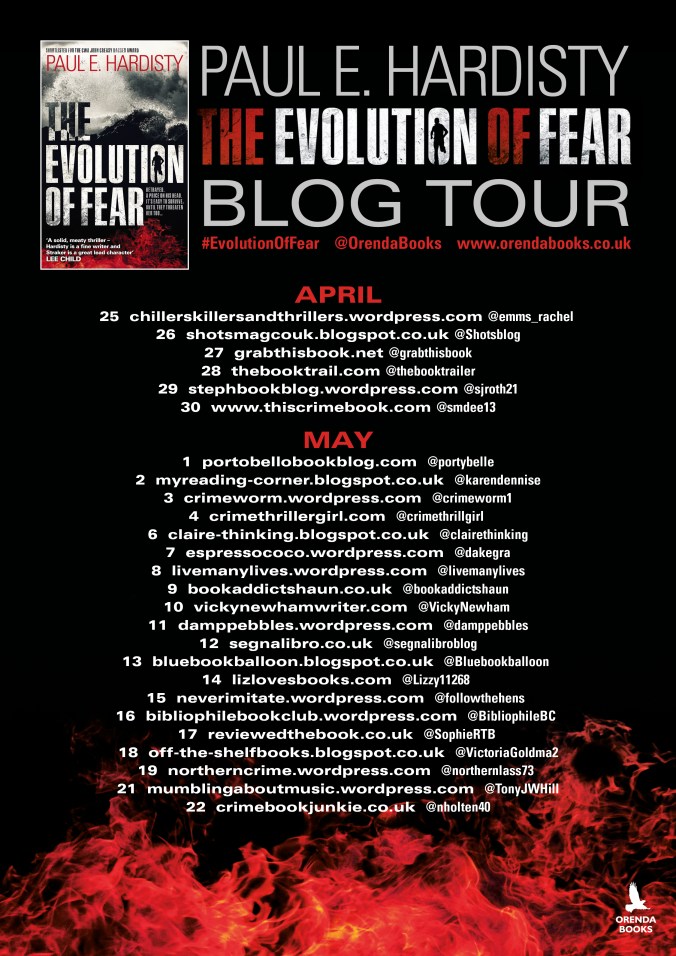
The Evolution of Fear

Clay arched his back, lined up the man’s head, and with every joule of energy he could summon, whipped his neck forward.

Clay’s forehead made contact with the man’s nose. The cartilage collapsed as if it were raw cauliflower.

Just shy of three months after the events The Abrupt Physics of Dying and Paul E Hardisty’s Claymore Straker is again fighting for his life within paragraphs of the start of The Evolution of Fear.

IMG_8434Since The Abrupt Physics… Clay has been in hiding – there’s a price on his head and he’s wanted by the CIA for acts of terrorism. However, his hiding in Cornwall is short-lived following the discovery that Rania, the woman he loves, has disappeared, his friend has been brutally murdered and the arrival of mercenaries out to claim the reward on his head means there’s nowhere to hide.

Betrayed, hunted and desperate to find Rania before those hunting him get to her, Clay makes his way to Istanbul (via an expertly detailed sea crossing) and then on to Cyrpus. This isn’t a pleasure cruise, though. Far from it; soon Clay is entangled in a complex and increasingly dangerous web of power-play, political subterfuge and land-grabbing involving some genuinely corrupt and abhorrent figures, the Russian mafia, an old enemy out to settle scores and some sea turtles. Yes, sea turtles; just as the heart that beat at the centre of The Abrupt Physics.. was about the impact of such corporate greed on the local environs and innocents, here too we’re shown to just how extreme and bloodthirsty a length power can corrupt.

The plot is incredibly well thought-out and complex – given that it’s set in 1994 I often found myself wondering if I wasn’t reading fact over fiction. There is everything in here from the aforementioned political corruption and land-grabbing to flashbacks to past war crimes and emotional drama all with twists and counter twists, yet at no point does it feel over-stuffed; Hardisty does a wonderful job of giving you just enough information at the right time to keep it detailed without bogging down in redundant trivia, thus maintaining a pace that rips along like a great thriller should.

Action sequences abound, yet here they’re great, dirty and gritty scenes – think Bourne over Ethan Hunt – compelling and convincing. The locations are described vividly enough to immerse you in them, characters are strong and well fleshed-out and Hardisty writes with an expertise when it comes to the settings and the facts around which the events are choreographed.

The thriller genre is a crowded one and stuffed to its bindings with action set-pieces and broody sods as lead characters. What elevates Haridsty above the pack is the sheer quality of his writing, the intelligence and complexity of the plot and the strong, brilliantly crafted character of Claymore Straker.

Straker is a man beset with demons and riddled with guilt over his past. Not many lead characters are as affectingly human as Clay. Yes, he’s a tough bloke and one you’d want on your side in a scrap. Yes he has a violent and morally questionable past, but – and here’s why you care about the character – Clay is trying, really trying, to do the right thing and become the honourable guy he wants to be, even at risk to his own life. Haunted by his actions in South Africa, Clay is terrified that he’s driven by the same motives of his compatriot – the brilliantly drawn Crowbar – who simply loves to kill. It’s that struggle to do the right thing, against increasingly stacked odds, that makes Clay Straker a memorable character to root for.

There’s a quote on the cover of The Evolution of Fear from Lee Child: “A solid, meaty thriller – Hardisty is a fine writer and Straker is a great lead character”.

Nobody would want to argue with the man behind Jack Reacher and on the strength of both The Abrupt Physics of Dying and The Evolution of Fear it’s impossible to do so – in fact I’m going to state outright that Mr Child has some serious competition here; Straker well and truly holds his ground against that one-man army. It beggars belief that this is only Paul E. Hardisty’s second book – this is as tough, taut, high-octane and powerful as the best and with a level of intelligence that pulls it heads and shoulders above the pack.

Once again, if stars were to be sat at the bottom of my reviews there’d be five of them right here. Sequels / second instalments are a tough act to get right, The Evolution of Fear picks up where the first book left off and turns everything up louder.

The blog tour for The Evolution of Fear is reaching its end and I’m very grateful to Karen at Orenda for asking me to take part and recommend checking out those entries that have preceded my stop as well as tomorrow’s with CrimeBookJunkie – and getting hold of this fantastic book.

Evolution of Fear Blog tour 2

With every mistake we must surely be learning

Variety is the spice of life. What constitutes a great book will vary from person to person. We all have different tastes (to this day some people still try to tell me The Da Vinci Code isn’t just something to keep at hand for when you run out of toilet roll) and some only every read within a genre. Recommending someone read The Master and Margarita won’t work if they’re only ever ‘reading’ Jojo Moyers….

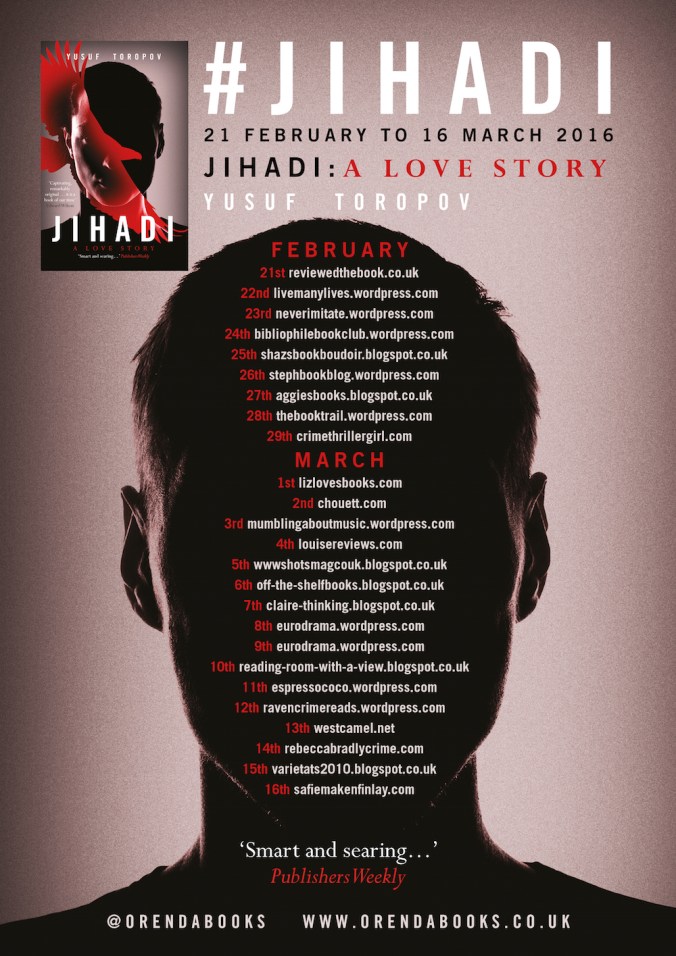
But…. every now and then that rare thing will come along – a book that is so unarguably great that you find yourself telling everyone they should read it regardless of their usual choice of paperback writer. Jihadi; A Love Story by Yusuf Toropov is just such a book.

IMG_7211The main thrust of the story is set in the fictional Islamic Republic and it’s capital Islamic City – such fictionalised generalisation of geographical particulars allows Toropov a much freer hand in painting scenarios and characters that are so worryingly real that you’re left with the impression that they may well have happened without running the risk of naysayer nitpicking over such trivialities of actual place/date/official-versions-of that would have hindered his craft had he set it in, say, Iraq or Afghanistan. Thelonious Liddell is an American intelligence operative captured, tortured and imprisoned by local authorities after a mission gone wrong in Islamic City. Fatima A is the young interpreter sent, initially, to assist in translation as he’s interrogated and, later, question Thelonious directly.

Jihadi: A Love Story is Liddell’s confession / memoir as written during his final months on paper smuggled to him in his cell at The Beige Motel –  a Federal Prison in Virginia. We know it doesn’t end well for Liddell but how he got to the point we find him as Ali Liddell is a hell of a story. It’s the story of how he went from senior agent to suspected terrorist, the story of Fatima and her family (how I wish I’d never learnt of flechettes), the actions of US Marine Mike Mazzoni, of the complex local information supply to the Directorate from shadowy sources, the weight of the past, marital and mental breakdowns, the rise of a new fundamentalist sect and how it all, piece by glorious piece, comes together in a gripping and though-provoking novel. All with a little help from the White Album and notations from R.L Firestone, the agent responsible for Liddell’s interrogation – one of the biggest questions the reader must face is who to believe, though as events unfold one version becomes increasingly unhinged while the other strives for clarity.

This is a book which raises some big questions. Questions about faith and love and, on a more pertinent and timely issue; questions on the West’s foreign policy and habits of wading into countries and cultures without any real awareness or consideration.

There’s also the question that Jihadi asks as to where the lines of ‘good guy’ and ‘bad guy’ lie given the actions of each – for all the accusations that Liddell is a ‘terrorist’ and has been ‘radicalised’, the only action he commits to have earned such treatment is so minimal in comparison to that of the supposed ‘heroes’ as to wonder where the distinction can be drawn, if it can – and that’s without considering Fatima’s supposed act of terrorism.  Living is easy with eyes closed, both sides are capable of atrocities yet we make the assumption that when we’re told by ‘the Directorate’ that Side A is Good and Side B is ‘Terrorism’ it’s correct because they say so. This book asks us to open our eyes and consider things from a different perspective. There’s no side-taking, finger-pointing or blame-allotting, the tone of the narrative is purely neutral, all sides have their arguments shown, allowing – in the case of Mazzoni vs Fatima – the reader to make their own mind up. Granted Firestone’s annotations argue that Liddell references events that he was not present for and cannot possibly know about so his word cannot be trusted… but, then again, Liddell is a senior agent; it wouldn’t be that much of a stretch for him to find information and piece events together for himself after the fact.

Some of those events are not for the faint at heart. The ridiculous “War on Terror” is just that – a war and one with very human consequences and casualties. Unfortunately many of those casualties are innocent civilians and characters in whom Toporov has breathed life to such an extent as to remove any possibility of not being affected by their fates. The fact that the tone is neutral and detached emotionally  means that some of the more harrowing and violent scenes hit just that much harder – it’s your own emotional responses you’re projecting onto the text, not the characters’ and all the more affecting accordingly. Many was the time that I had to put the book down and take a breath, hug my son and reflect with gratitude for the safety in which we live. There’s simply no way to read this and, if you weren’t already, not wonder just where we’re going as a species when we’re capable of such treatment of one another.

The nonlinear narrative is in keeping with the premise of these pages being from a memoir and keeps the pace ripping along and while those annotations may seem intrusive at first they soon present yet another compelling sub-plot. Toporov is able to sew in many more characters and plot arcs than a standard, linear narrative might allow for, and move between them so as to offer multiple view points and keep the reader hooked as they each near their boiling point, their moments arise and they intersperse.

It’s been a long time since I’ve been gripped so completely by such a multi-faceted novel and I simply cannot recommend Jihadi: A Love Story enough. I’ve seen references to Homeland and yes, there are echoes of such tight covert intelligence plots here, there are echoes of le Carré and even Vonnegut. But they’re only echoes, the loudest voice here is that of Toporov; a compelling new author with a style of his own delivering an exhilaratingly fresh, important and powerful novel so very much of its time.

Thanks again to Karen at Orenda for sending me this novel and to check out the other stops on the Blog Tour – there have been some great interviews and insights along the way -and grab a copy of Jihadi: A Love Story sharpish.

JIHADI Blog tour Banner

How To Be Brave

imageThis has probably been said a million times or more and will no doubt continue to be stated while simultaneously irritating those who have yet to realise just how true it is due to lack of personal experience, but; everything changes when you become a parent.

So much so that I couldn’t possibly attempt to describe it here. Nor would it be relevant to do so. So why do I start this post, a review of the fantastic How To Be Brave by Louise Beech with this?

Well one big shift when becoming a parent is that of self-concern giving way to an all-consuming focus and worry your child’s well-being; what if something were to go wrong? What if they were to become ill?

It’s very hard to put this into words in a manner that truly captures the feeling let alone one that does so in a way that others might want to read. Louise Beech, however, does just that. In How To Be Brave she vividly evokes the sensations of panic and dread that accompany being a parent when a child falls ill and perfectly captures the feeling of isolation from the rest of the world that occurs at such times. Not that it’s a ‘dark’ book, far, far from it.

Natalie’s nine-year-old daughter Rose collapses in the kitchen one Halloween. Following an ambulance trip to the hospital and a little diagnostic testing, Rose is confirmed as having Type 1 diabetes and will require finger-prick tests and insulin injections for the rest of her life. An extremely daunting concept to cope with.

What follows is a great story of a mother and daughter coming to terms with the illness and its ramifications. Louise Beech does a cracking job of portraying the “shut out the world”, “nation of us” feelings that pervade at times of crisis in a family with a tight bond.

It’s also the story of Natalie coming to terms with her daughter’s growing independence and realising that – as much as she or any parent would like to – she doesn’t have to hold her child’s hand all the time anymore.

But that’s not all. For within this story another two are interwoven with Natalie’s attempts to reconnect with her daughter and keep alive her love of books which, in the resultant, insulin-driven emotional fall-out of her diabetes diagnosis had threatened to vanish completely.

First is the mystical presence / visitation of Natalie’s grandfather who appears to both Natalie and Rose and how it leads them to finding another story and a way to connect by leading them to his diary and, in it, his tale of being lost at sea for fifty days following the torpedoing of his merchant ship in World War Two.

(Grandad) Colin’s story is told – via Natalie – in exchange for finger-prick test and insulin injection cooperation from Rose. Through this storytelling we travel to a small boat adrift on the Atlantic Ocean where Colin and the remaining survivors fight to stay alive in their wait to sight land or rescue.

The story of Colin and his plight is told brilliantly and the reader is kept on tenterhooks between instalments and there are times you feel as much eagerness to get back to the men on the boat as Rose does.

Beech artfully weaves the two narratives together with times of crisis for Natalie and Rose mirrored by those times of peril on the lifeboat. As Colin and the survivors are literally cut off from the world and their loved ones Natalie is cut off by the changes in her life, distanced from her daughter by the changes diabetes has on Rose’s personality and seperated from her husband, Jake, by his unit’s tour in Afghanistan. Indeed as Colin’s salvation arrives it’s clear that Natalie and Rose, too, have turned a chapter and have navigated the worst. Rose is now back to her old self and both mother and daughter are at peace with her diabetes, their relationship is restored just as Jake returns, belatedly, home (quietly matching the time at sea spreading beyond the previously calculated 30 days from land).

How To Brave is two wonderful stories wrapped into one compelling read. Louise Beech is adept at both narratives and styles and writes with a confidence and trueness of voice that can only come from experience and yet manages to turn what must have been a truly testing time in her life into a great, gripping and thoroughly rewarding read for all. She’s clearly an author to keep an eye on.

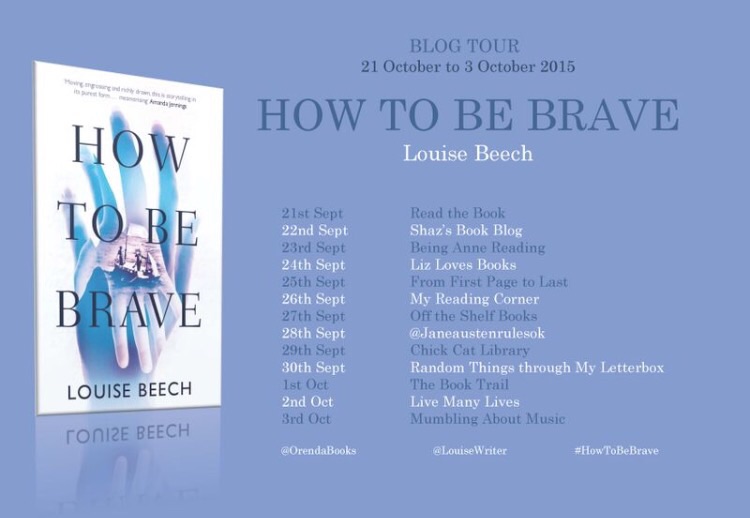
My thanks again to the wonderful Karen at Orenda Books for sending me How To Be Brave and asking me to be part of its Blog Tour. Check out Live Many Lives for yesterday’s and Welsh Librarian Blogspot for tomorrow’s stop and get a hold of the book today, you won’t be disappointed.

image

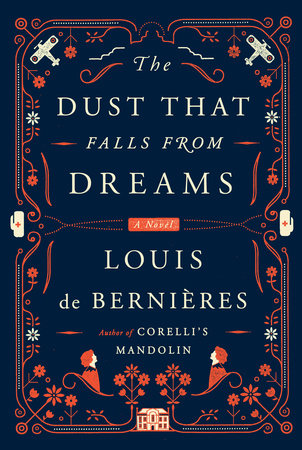
The Dust That Falls from Dreams

91e3i+vVdTLI go back a bit with Louis de Bernières. Well, I say that – like most I started reading him thanks to Captain Corelli’s Mandolin – the first few lines of which were used as discussion point in an A-level English class in – I’d guess – ’97. The perfectly self-contained opening chapter, a beautifully written piece of charming prose, a (what I know now to be) typical de Bernières style light-hearted slice-of-life scene setter with a fantastic description of an inner ear as “an aural orifice more dank, be-lichened, and stalagmitic even than the Drogarati cave”.

I took the print outs containing that first chapter (Dr Iannis Commences his History and is Frustrated) home, passed it to my father and the book was soon in our home and passed into my hands following his. It’s a novel well-known, commented upon, discussed and dissected. As such I won’t here.

There followed the discovery of and lapping up of de Bernières’ South American Trilogy, earlier novellas and plays, the stop-gap Red Dog and, my personal favourite Birds Without Wings. 

Birds Without Wings arrived some ten years after the publication of de Bernières’ previous novel. But he isn’t a writer of small books; his novels are of epic proportion and scope.

It’s not too surprising, then, that The Dust That Falls From Dreams arrived another ten years after the publication of Birds... Not that he was idle. Between times there was A Partisan’s Daughter a (somewhat smaller though nonetheless impressive) novel set in more contemporary times and familiar locales and, in 2009, Notwithstanding – a charming, if non-consequential collection of semi-linked short stories all set in an English village of a certain southern England type and charm, populated by characters of a particular eccentricity.

Perhaps, in hindsight, those stories within Notwithstanding were perhaps something of an exercise. I’m inclined to see them as de Bernières – known for novels set in Greece, Latin America and Turkey – setting out his stall in ‘middle England’, gaining confidence in the styles and character types that would populate his next saga for, as we’re now aware, The Dust That Falls From Dreams is the first of a planned trilogy.

And so, to it.

The Dust That Falls From Dreams is every bit the opus I’ve been waiting for as a fan of de Bernières. Yes, some will complain that he’s switched a setting like Cephalonia or Cochadebajo de los Gatos for Kent, but arseholes to them. This is a novel of epic proportions and every bit as “de Bernières” as his previous five “big” novels.

Kicking off with death of Queen Victoria and the commencement of the Edwardian era, we’re introduced to the McCosh family as they hold a belated coronation party with their neighbours. With a sudden time-jump we’re off to the Georgian era and slap bang on the doorstep of the First World War.

Of all the writers to task themselves with chronicling this most heinous of periods, the upheaval and destruction it wrought, there are few who could do so as well as de Bernières (Sebastian Faulks’ Birdsong is, of course, another exemplary example) – bringing all too real the events both home and abroad that bought an end to an era and threw individuals into a torrid world where the sense of the individual was lost.

CJAjyIFWcAEeatZIn The Dust That Falls From Dreams de Bernières is at his best. The plot and author play with our fears and guesses and – as those familiar with the author will expect – deliver both uproariously funny and uplifting moments with one chapter before just as skilfully delivering gut-wrenching emotional blows to the heart in the next (this is the Great War, after all). I won’t dwell and deliver spoilers as to who de Bernières casts asunder but will say I felt the final one, unrelated to any ‘cast’ member was a little uneccessary and particularly crushing, especially after the soul hitting account of the Folkestone bombings. Though, in hindsight, this too shows the author’s mastery at engaging a reader and rendering you completely spellbound.

The McCosh girls’ visit to a local medium and the scenes that unfold add a welcome touch of the fantastical, hearkening back to the author’s Latin American Trilogy, and well-chosen historical references help set a thoroughly well realised setting in both time and place, home and abroad.

At times the characters could perhaps be considered a little two-dimensional (though I don’t recall too many layers being attributed to Don Emmanuel) but this is the start of a trilogy and I have little doubt that as the whole saga of the McCosh family unfolds in de Bernières’ magnificent style, all will become fully rounded and developed.

The Dust That Falls From Dreams is a saga that encompasses three families at one of the most dramatic times the World faced. It deals with a vast array of subjects beyond the core of love and death, picking up the politics of class and gender, religion and industrialisation as it goes.

While not quite up there with Birds Without Wings this may well be the start of something amazing as the saga continues and should well be considered a fantastic novel in its own right. I await the next instalment with high expectations.

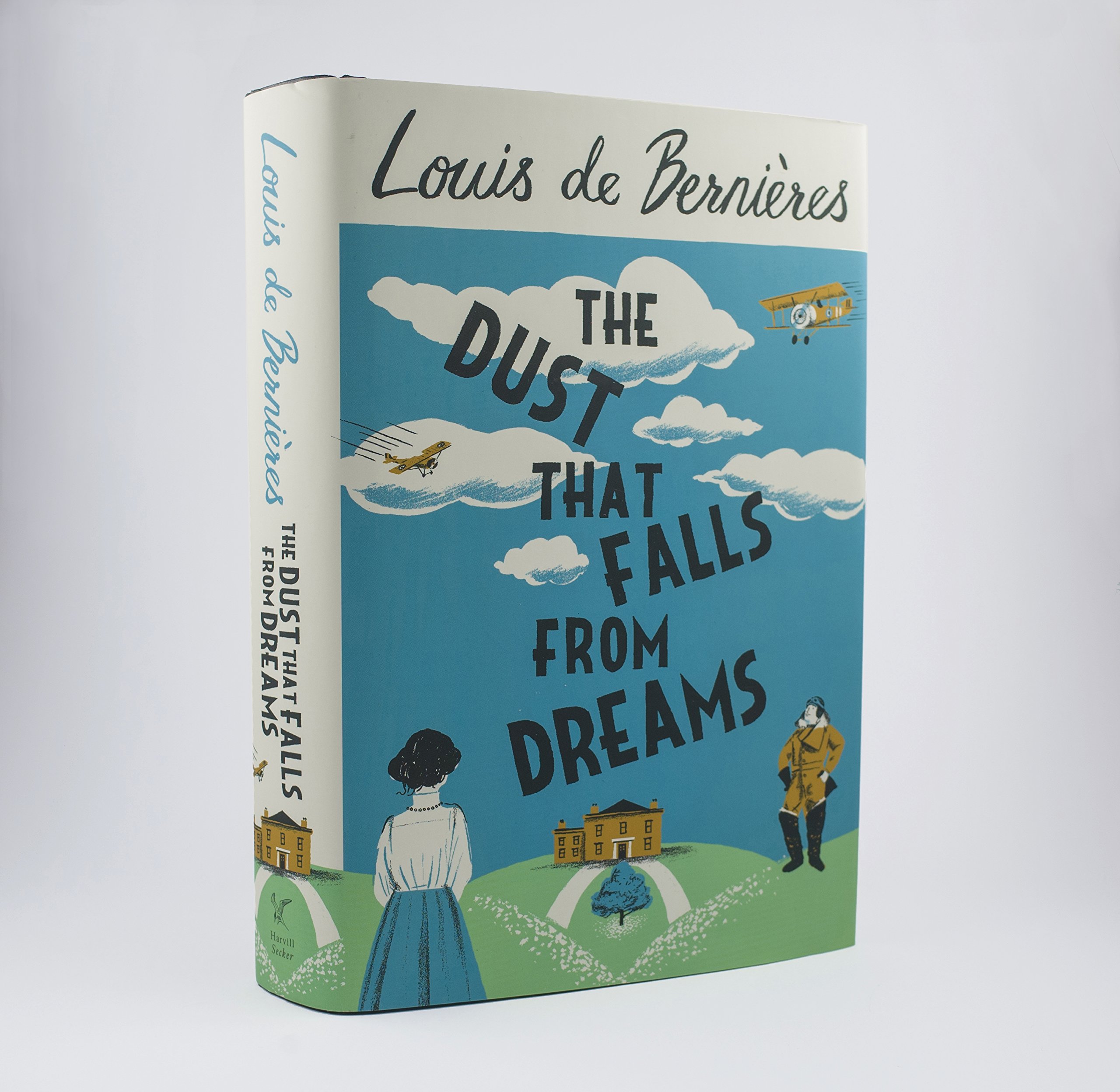
On a side note; why do we get lumped with such a cack cover image in the UK compared to the more attractive cover design they get in US?

9781101946480


Mea Culpa

There’s a very large book on my book case, not yet slipped into its correct place as I await delivery of more bookshelves to house it and those others that currently sit in the recently read and to-read piles (I find this fitting given a certain passage within this very book). Large in terms of size, epic in terms of the scale it covers and immense in its brilliance.

It’s Confessions by Juame Cabré.

I was sent it to me to read and review by the great folks at Arcadia Books.

I’ve hemmed and hawed over this review for some weeks now. That’s not to say I didn’t enjoy the book. Far from it. I loved every single word of it. It’s nothing short of a masterpiece. My procrastination was due more to wondering just what I could add to the no doubt miles of column inches that already sing its praises.

While Confessions has been compared – and rightly so – to books such as The Shadow of The Wind, The Name of the Rose and The Reader – I can’t recall the last time I read a novel as affecting as this. While it does contain similarities to the aforementioned  – neither they or any book I’ve read for some time has made me run the gamut of emotions in such a way as Juame Cabré does within these seven hundred or so pages.

At sixty years old Adrià Ardèvol, an immensely intelligent man who is now rapidly losing his mind to an aggressively advancing form of dementia. Following an abrupt realisation on his own loneliness, he decides to set down his life in words. But it’s more than the story of one man. It’s the story of Vial, a prized Storioni violin around which the lives and misfortunes of so many are wrapped. It’s also their stories and and it is in the telling of these stories that Cabre also explores the nature of evil in mankind and the power of obsession. Not to mention a certain pendant…

BxtsdMmCAAA5ii4

Within the opening pages Adrià ponders where to start, perhaps 500 years ago “when a tormented man decided to request entry into the monastery of Sant Pere del Burgal”. Instead he starts with his own childhood. Adrià’s father is a man obsessed with possessing ancient treasures and manuscripts and is an authoritarian dictator in his home. Toward his son Felix Ardèvol shows no affection. Adrià’s mother is equally aloof and cold: “Mother, on the other hand, was just Mother. It’s a shame she didn’t love me”. Alone in his own home and childhood, Adrià occupies himself by spying on his parents – a network of hiding places and peep holes – and confessing in his only companions, Black Eagle and Sheriff Carson; two small toys. Even these he has to keep hidden from his father, How.

It’s a master-stroke. Starting the narrative though the eyes of a young boy, starved of demonstrative love and driven hard by his all-controlling father, I read the entirety of the events as though seen through such innocent eyes, making all that unfurls as the stories emerge and intertwine all the more affecting.

At first the structure of the narrative can be a little hard to grasp but following the realisation that our narrator is writing as the dementia takes a grip the reasoning becomes clear – stick with it, it all soon flows together beautifully and when the links between each narrative thread are revealed it’s akin to magic – from rivalry in a medieval village and the fate of Jachiam of the Muredas after he commits murder, back further to the Inquisition and it horrors, through to the crafting of Vial and on to the 18th century and on to the wave of darkness that Nazi rule threw over Europe and the stomach-churning experiments at Birkenau.

I’ve read a number of accounts from this particular nadir of humanity both fictional and non. I don’t think any of those have hit me as hard as those in Confessions. I don’t mind admitting that I had to put the book down and stop reading at one or two points. While I’m at it I don’t mind confessing that it also bought me to tears in a number of places. Like I said: no other book has made me run the gamut of emotions in such a way.

Yes this book has its dark points but it’s also shot through with light. It’s bound by merriment and humour just as much as it’s haunted by tragedy and steered by mystery.

The various narrative threads all link together and all contain enough plot twists and revelations to drop the jaw. The characters are rich, the plots enthralling and reading Confessions feels like absorbing the most detailed and resplendent of artworks.

It is a big book but it’s an important one, every word is essential, rich and rewarding. Much like Storioni’s Vial, Confessions is the work of a true master and contains every element in perfect balance. That it’s sold over a million copies and ranked as an instant best seller in 20 languages already is no surprise. If it had sold ten times that it wouldn’t surprise either.

Mara Feye Letham most certainly had her work cut out in translating this novel and keeping its unique narrative and style yet it doesn’t show; the novel flows beautifully through her translation.

Confessions gave me something I hadn’t experienced in a while; a book hangover. It was a few days before I could do more than scan a paragraph of another book. Juame Cabré has crafted a monumental novel in Confessions, one that will linger and continue to deliver long after turning the final pages.