Page Turning – Quick Reviews

So I set myself the target of reading forty books this year. I’m still on track with seventeen cleared already and another three or four en route for completion by the end of this month.

I’m getting through some great books,  and while the population of my bookshelves has continued to grow as my to-read list builds I haven’t yet dropped full whack on a book -some I’ve been lucky enough to be sent in exchange for a review, others were gifts and many the result of second-hand book shop hauls. I’m very keen to expand my collection of works by several authors like James Ellroy and my Discworld collection is growing but I don’t like, and this is purely an aesthetic comment, so seek out their older versions.

Anywho. A few of those read so far include…

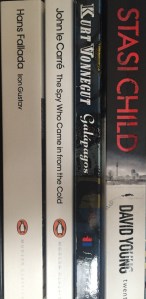
Iron Gustav by Hans Fallada

I, like many others, discovered and fell in love with the writing of Hans Fallada when  Alone In Berlin was published in English, so many decades after his death. Since then I’ve been devouring whatever Fallada book I can get my hands on, if only the publisher – aware of the demand for this particular German writer – wouldn’t price them so highly for a standard paperback.

Reading Iron Gustav is like reading a master-class in fiction. Fallada was not only an astoundingly talented writer – creating hugely intricate and tightly woven portraits of everyday people and their struggles – but also witness to some of history’s most fascinating and shocking events. Written in 1938 Iron Gustav portrays the hardships bought upon a Berlin family – as a microcosm of Germany itself – following World War One. Forced by the Nazi regime to extend its timeline to include that party’s rise and rewrite chapter, Fallada was left with little choice but to acquiesce and also rewrote the ending. This version gets as close as possible – 70 years after the author’s death –  to Fallada’s original story and is an absolute joy to read. A hugely powerful and important novel restored from the dark past. I simply cannot get enough of Fallada’s writing.

 Galapagos by Kurt Vonnegut 

Another writer of whom I simply can’t get enough is Kurt Vonnegut. It was a while before I picked up Slaughterhouse 5 but once I’d had my first sip of this master’s work I wanted the whole bloody goblet. Galapgos, another very apt satirical take on mankind’s failings, is the story of a handful of people who, stranded on the island of Santa Rosalita, become mankind’s last hope after a superbly funny series of events lead to the collapse of the World’s economy, a mass conflict and all of the planet’s women becoming infertile.  

While it’s not my favourite of Vonnegut’s work on my shelves – at this point I’d give that to Mother Night – it’s another fine addition and a real blast to read.

The Spy Who Came in from the Cold by John le Carré

Last year I read and thoroughly enjoyed Joseph Kannon’s Leaving Berlin. The combination of spy thrill and the Cold War fascinated me and I wanted more so I thought – after constantly seeing references to his work – it was time to give John le Carré a go. I read the first few paragraphs of The Spy Who Came in from the Cold a read online, was hooked so ordered the whole thing and… well…. meh.

I really, really wanted to enjoy this book. I did. The opening is a real hook and the plot itself is certainly a classic in terms of its intricacy and espionage but… I don’t know. This took me far too long to get through and at times it felt like a slog. Maybe it’s down to the main character simply not being all that much of a draw, maybe it’s the writing style feeling a little too dated or just the fact that (spoiler alert) I so dislike an ending that renders having spent the previous 300 pages becoming invested in the characters so bloody pointless that it actually made me angry. The same could be said for Dominion and that bastard was 700+ pages of drudgery.

Still, I’m not completely turned off the idea of John le Carré so may try another in time to come. Plus the Cold War still proves a fascinating era and a very potent backdrop for fiction….

Stasi Child by David Young

I was seeing this book all over the place last year – social media, book shops etc and finally got around to picking a copy up this year. And, given the statement above, and the premise how could I not; “East Berlin, 1975. When Oberleutnant Karin Müller is called to investigate a teenage girl’s body at the foot of the Wall, she imagines she’s seen it all before. But when she arrives she realises this is a death like no other. It seems the girl was trying to escape – but from the West.

Stasi Child is a very well plotted and gripping thriller. It bounds along and it’s sense of place and time is very carefully and skilfully woven in without being heavy handed with the contrast between life in the East and West very convincingly portrayed without resorting to tired cliché and tropes. Almost perfect and I’m very much looking to more from David Young – I see Stasi Wolf was published this year – and the series.

….it was a very good year

… to quote Mr Sinatra.

So, after a period of hint dropping, it was confirmed that, in a rare move, Radiohead would be revisiting their past and would mark the 20th anniversary of the game-changing OK Computer.

My copy of OKNotOK 1997 2017 as it’s called (3 LPs featuring three unreleased tracks and eight B-sides, all newly remastered) has been secured in its indies-only blue variant with my new-favourite shop and I’m sure that I’ll be talking more about OK Computer when I’ve dropped needle upon it.

However, the fact that it’s now 20 years since 1997 has seen a few of those nostalgic lists appear on various sites (Spin published a pretty solid 79 Best Alternative Rock Songs of 1997 list) and it got me to thinking that, from an alt-rock point of view at least, 1997 was a very strong year for releases. Let’s take a butchers…

Yes, kicking off with the fact that if ’97 saw Britpop killed by Oasis’ abhorrently indulgent and tuneless Be Here Now, then Radiohead’s OK Computer nailed down the coffin. I remember catching the video for ‘Paranoid Android’ on MTV2 and being blown away.

Foo Fighters would release their second (first as a band) album The Colour And The Shape, an album which is still held up as their best by so many* and contains some of their biggest tunes like ‘My Hero’, ‘Monkey Wrench’, ‘Walking After You,’ and, of course that barely-known song ‘Everlong’.

The ‘Everlong’ video was directed by Michel Gondry who also directed the video for Björk’s ‘Joga‘, which features on her album Homogenic which also came out in 1997. Built To Spill used their major label debut to mark a massive stylistic shift and dropped the sublime Perfect From Now On, Portishead released their self-titled album and, while Hand It Over isn’t the best Dinosaur Jr album (it would be the last issued under that name for some time), it features some belters in ‘Nothing’s Goin’ On‘ and ‘I’m Insane’ guaranteeing it gets pretty regular plays from me.

A chap called Elliott Smith released his third album, the beautiful and much-loved Either/Or containing some of the best songs he’d ever produce in his all too-short life.

The post-rock cannon got two very important débuts in 1997. Godspeed You! Black Emperor released their F♯ A♯ ∞ and would go on to become, to me at least, the most important band in the genre. Meanwhile, five blokes from Glasgow in a band called Mogwai released Mogwai Young Team on their way to also becoming a hugely important band in the genre.

Ben Fold Five’s Whatever & Ever, Amen, home to ‘Brick’, ‘Song For The Dumped’ and ‘Battle of Who Could Care Less’ was also released in ’97 and Pavement released Brighten The Corners.

Back into the less ‘alt’ side of things, that fella born Robert Zimmerman made a quick recovery from a life-threatening heart infection despite thinking he’d “be seeing Elvis soon” and dropped, seven years after his previous studio album, the hugely impressive return to form that was Time Out of Mind.

1997 was also the year that I started to get into Aerosmith  released a stonker of an album, even if it would turn out to be their last strong effort to date, in Nine Lives. Look at the evidence: Get A Grip in 1993 was a monster in sales terms but not that much critically speaking and not one I listen to too often. Nine Lives, however, is a powerhouse record of raw sounding rock with some real earthy tones and – for the genre – some pretty eclectic sound and instrumentation. There’s still not one song I’d skip, though I wouldn’t necessarily hold up ‘Hole In My Soul’ as exemplary the rest of the album – ‘Taste of India’, ‘Full Circle’, ‘Ain’t That A Bitch’, the Joe Perry showcase ‘Falling Off’, ‘Somethings Gotta Give…’ ‘Fallen Angels’ – is a classic. Even before they changed the artwork and it shifted like hotcakes thanks to the addition of that asteroid movie song.

There’s also… Nick Cave & The Bad Seeds’ The Boatman’s Call and, I’m sure, plenty I’m omitting that a look through over such lists will make me go “oh, of course…” but with a lot of strong albums released and the fact that I was earning a regular pay cheque  (weekend work at a supermarket) at this point to fund my growing habit, there’s an awful lot of music in my collection from 1997 that still gets a lot of play.

*I could do a Foo Fighters Least to Most…. The Colour and the Shape battles it out with Wasting Light in my mind for their best to date. Both represent their most consistent and one will have the edge over the other depending on the day.

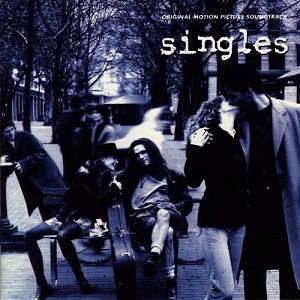
Soundtracks: Singles

The Film: 

Singles is a pretty decent little film. I say ‘little’ as it’s not one of those huge studio jobs involving comic book heros and arse-quaking explosions that are clogging up cinemas these days like so much backlogged faecal matter. No, it’s a charming film made for a modest budget ($9m), held in pretty strong regard amongst critics and fared pretty well at the box office ($19.5m) and has gone on to an even stronger after-life on VHS, DVD, Blu-ray etc.

An exploration of relationships in their bloom, chaos, flourish and collapse amongst a group of those young folks at the time called Gen X. It’s a solid and often funny film that was Cameron Crowe’s first step away from those teen-angst films such as Say Anything. It also happened to be set in Seattle, in 1992 with one of it’s characters, Cliff (Matt Dillon in a role that Crowe had tried to get Chris Cornell to play*), the singer of a grunge band – called Citizen Dick (which also featured Stone Gossard, Jeff Ament and Eddie Vedder) – and events play out against the backdrop of the then ascending Seattle music scene of which Crowe (formerly a writer for Rolling Stone) was a dedicated fan.

The Soundtrack:

So the soundtrack… it arrived a few months ahead of the film’s release and was a huge hit as these things go, going top ten and selling over two million copies. It featured new songs from Pearl Jam who were starting to break through, Alice in Chains’ ‘Would?’ made its debut on the album along with a song from Soundgarden and a Chris Cornell solo tune.

It served not just as an amazing primer to the city’s nascent music scene but features some great songs from non-Seattle bands such as Screaming Trees, Smashing Pumpkins and two absolute belters from Paul Westerberg only months after The Replacements had called it a day, ensuring, in its way, that these songs would not be shoe-boxed as ‘grunge’ but would be shown amongst the a much-wider alternative rock scene.

Noticeable by their absence among the other 3 of the Big 4 is Nirvana. Nevermind hadn’t dropped while Singles was in production and while musicians such as Ament and Cornell amongst others, were very involved in the film’s production (more to come), Kurt viewed ‘Hollywood’ as something to be steered very clear of. It’s also likely that Warner Bros – who would need to approve the soundtrack participants – didn’t see Nirvana at the time as a commercial viability. Oops. Still, they changed their mind on that front when, as studio politics and games meant the film suffered a delayed release by which time Nevermind had hit. So Warner Bros thought ‘let’s try and cash in’ and floated the idea of releasing the film under the name ‘Come As You Are’ instead. Even sending the band a copy of it to seek approval. Thankfully it never happened…

So, back to the soundtrack. It’s a killer selection of Seattle and Alt-Rock tunes, yes. But it’s not just a near-perfect mix-tape that I’ve damn-near worn out. The songs also fit the scenes they’re used in, too. As Campbell Scott’s Steve walks around Seattle it’s Cornells ‘Seasons’ that keeps him company and when he needs to let off steam he does so by going to Alice in Chains or Soundgarden shows and losing himself in the crowd.

Plus, according to Everybody Loves Our Town: An Oral History Of Grunge (a must-read), the royalties and monies received for being part of the soundtrack helped an awful lot of bands that never scaled those heights reached by Seattle’s Big Four, with some using the funds as mortgage down-payments. If I recall correctly, Mudhoney – who were late arriving to the soundtrack ‘party’ – recorded their song, ‘Overblown’, for a fraction of the pretty sizeable budget and kept the rest.

Touching back on that involvement for a second…. Three of Pearl Jam’s members featured as Matt Dillon’s Cliff’s band mates. At some point, however, they’ve ditched him and a deleted scene showed him giving it a go solo:

For a bit of authenticity Jeff Ament designed the Poncier tape. He added a handful of genuine-sounding song names to the label too*. Perhaps because he’d been unable to find time to play the role or simply because he was a nice bloke, Chris Cornell saw the list of songnames and took it upon himself to record a song for each of the titles. Of the Poncier Tape songs only ‘Seasons’** made the film and its soundtrack, initially.

Now though the Deluxe Reissue of the Singles soundtrack is with us. It collects those missing Poncier Tape songs (amongst which an early ‘Spoonman’ can be enjoyed) and couples them with a few other songs that didn’t make the cut the first time round to flesh out the included bands roster to bring in Truly and Blood Circus. For my money it’s not a bad set of additions but the single-disc will serve all brilliantly. That being said, Westerberg’s ‘missing’ songs are a welcome addition to my collection. Citizen Dick’s own ‘Touch Me I’m Dick’ isn’t what you’d call a highlight.

I’m running through a few Cameron Crowe films and their soundtracks in my head – Jerry Maguire (which made a hit of Springsteen’s ‘Secret Garden’), Almost Famous, Vanilla Sky, even Elizabethtown which was itself a bit of a dud film had a stellar musical accompaniment – and it’s a safe bet to say that the man doesn’t make a bad one and really knows how to get just the right tune into the right place. Singles, his first attempt at a more serious film, is also a perfect example of that.

*All too often in ‘music’ films the song names or actors with musical instruments are as convincingly ‘real’ as a pair of tits on Baywatch.

**For those curious it’s FCFCCF

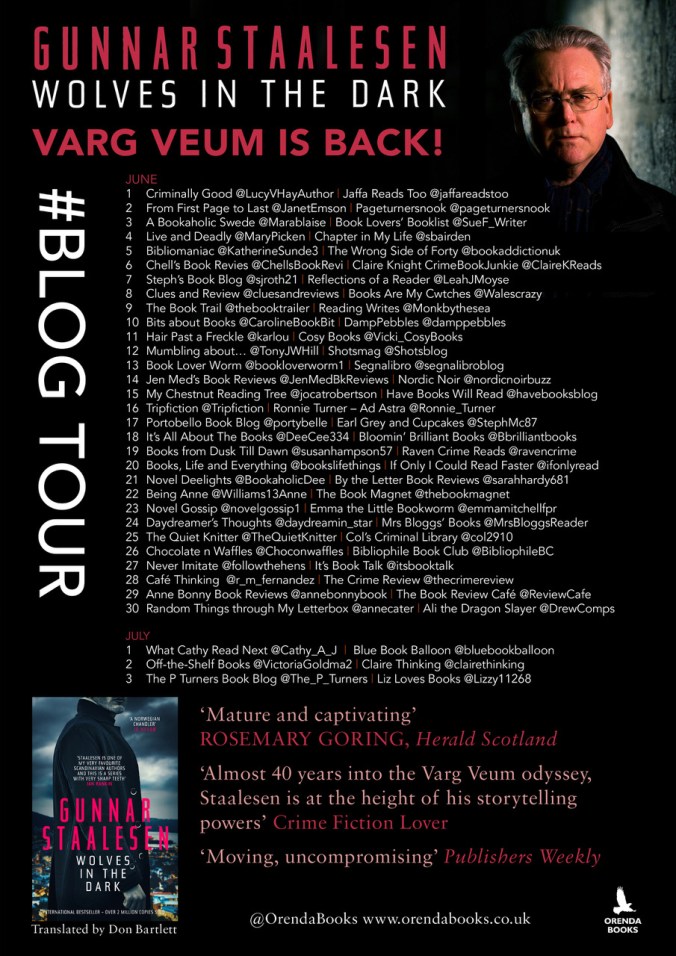
Blog Tour: Block 46 by Johana Gustawsson

From the PR: “Evil remembers

Falkenberg, Sweden. The mutilated body of talented young jewellery designer, Linnea Blix, is found in a snow-swept marina. Hampstead Heath, London. The body of a young boy is discovered with similar wounds to Linnea’s. Buchenwald Concentration Camp, 1944. In the midst of the hell of the Holocaust, Erich Hebner will do anything to see himself as a human again. Are the two murders the work of a serial killer, and how are they connected to shocking events at Buchenwald? Emily Roy, a profiler on loan to Scotland Yard from the Canadian Royal Mounted Police, joins up with Linnea’s friend, French truecrime writer Alexis Castells, to investigate the puzzling case. They travel between Sweden and London, and then deep into the past, as a startling and terrifying connection comes to light. Plumbing the darkness and the horrific evidence of the nature of evil, Block 46 is a multi-layered, sweeping and evocative thriller that heralds a stunning new voice in French Noir.”

Writing this review proved to be a real head scratcher as it’s hard to find the words to describe just how bloody good this book is.

Block 46 is a hugely affective and intense novel. A thriller that combines a gripping and chilling series of modern day murders with a backstory that delves, unflinchingly, down some of the darkest avenues mankind has walked down with action set in modern day Sweden and London and 1944 Buchenwald.

The splitting of both narratives and settings help develop  a complex and absorbing plot that slowly builds to a fantastic finale with one hell of a twist – I’m doing my utmost to avoid spoilers.

I’ve said it before and I’ll say it again; a book or author that is afraid to challenge the reader is one I don’t want to read. Writing about a subject as genuinely dark and terrifying in its actual barbarity as what occurred at Nazi concentration camps is a very bold move – it’s hard to cover such horror in a way that manages to neither shy away and thus diminish the events while at the same time portray them effectively and still deliver something that a reader can still actually bear to read. Gustawsson treads that line deftly, clearly an exceedingly talented writer. Her portrayal of Buchanwald and its prisoners never shys away from their ordeals but, instead, focuses more on the humanity of those treated like animals and is all the more affecting for it.

That sense of humanity in the face of horror shines through – thanks to Roy and Castells – in the modern day part of the story too. There were times (again I’m being careful to avoid spoilers) where I had to put the book down and take a breather. Not because the thriller element was so fast paced – and don’t get me wrong it’s an absolute ripper in that respect too – but because, in the midst of such intensity Gustawsson has placed characters so real with backstories so very moving.

In Roy and Castells Johanna Gustawsson has created two compelling leads I can’t wait to read more of. In Block 46 she has created a fantastic novel. A thoughtful and tightly plotted book that’s both moving and thrilling, an absolute page turner that delivers in spades.
Thanks to Karen at Orenda for my copy and do check out the previous stops on the blogtour.


In another perfect life….

Holy crap balls.

As the caption says “SURPRISE! Run. Our new song. Video directed by Dave Grohl. Turn it up”

Foo Fighters dropped a new song (their first new music since 2015) this lunch time – whether it’s from an upcoming album hasn’t been confirmed but after another new song was played live recently and given that the band have a very heavy touring itinerary lined up with a few festival dates in the mix it would be a very safe bet.

I’m a few repeated listens down the line already and I’m really enjoying this one. Better than anything on Sonic Highways. It’s ambitious, catchy as the flu and bloody good. The video is a blast too.


Times of Trouble

I’ve been a little numb the last few days and wondered if I should even say something about events, if there could be anything I can even add in something so seemingly self centred as a blog especially as it wanders into the more personal than music / books but…

In the wake of Chris Cornell’s shocking departure my wife sent me over an article – some years old, I should add, rather than one of those disgustingly inappropriate “wrap Eddie in bubble wrap” statements of late – on “How Eddie Vedder survived“. It’s a good article – more about how he lost the tortured element and found a sort of coping mechanism rather than getting lost. But it touched on something my wife knew nothing of: the Roskilde tragedy in 2000 when nine Pearl Jam fans were killed, crushed to death as the crowd rushed forward.

As I tried to explain the events I still found recalling them upsetting. I remember when the news broke, how I – and I’m sure all fans – felt so horrified. I’d seen the band exactly one month previous and to know that fellow fans had lost their lives in an environment in which you always felt welcome and relaxed- lost in music with fellow fans – seemed so impossible. The idea that nine people who had gone out to watch their favourite band wouldn’t be going home, that there would be nine empty beds, nine families lost beneath the tidal wave of grief… it seemed so impossible.

A horrible accident. A tragedy that shook the music loving world and nearly ended the band*. Then, a little under two years ago in Paris, a city that for a year or so was like my second home, 89 people were murdered at an Eagles of Death Metal Concert. No accident, part of a series of terrorist attacks in the city in which another 41 people would be killed.

Just a day  or two after talking about Roskilde with my wife, on Tuesday morning I woke up and, like, most other mornings, checked the news while waiting for the kettle to boil. I’ve never been to Manchester. I don’t think I’ve ever heard an Ariana Grande song but this… this shouldn’t be happening. The idea that you could go out to a music concert and not be safe, not come home…. it should be unspeakable.

Now, I’m struggling to write this because we’re now at the point where it’s gone from being 22 dead to learning the names of those people killed. Learning that an eight year old girl was taken from her family. That parents waiting in the lobby for their excited children to come out of the concert were killed. That teenagers, still children, filled with joy and love for music and the experience of seeing their favourite musician live, many experiencing a concert for the first time, were killed. It absolutely breaks my heart.

I grew up at a time when the IRA were very much active and civilians were being killed by their bombs. I remember my father trying to explain what and why these things were happening, the senselessness of it. The media wasn’t so full throttle / constant exposure as it is now but I do remember the real threat of it – they bombed Manchester, too, in ’96, the biggest bomb the UK had seen since WWII but their phone warnings ahead had meant that 75,000 were evacuated and nobody died. I remember a lack of public waste bins when the International Railway station in my hometown was opened for fear of IRA bombs being planted ( I think Prince Charles was due to open it and, since Lord Mountbatten had been killed by the IRA he was a conceivable target).

When the news broke on Tuesday morning my own young son was fast asleep and I – like I’m sure countless others – worry about the world he’s growing up in. I worry about what, when he gets just a little older, he’ll see in the news now that it’s so all pervasive and how I’ll struggle to explain the senselessness of it all. I do hope that I won’t have to but I’m not naive enough to believe that.

What I do hope, though, is that when I explain these things to him – be it as historical or, as I dread, current – that I’m able to point to how people react and respond as (aside from the usual stupid suspects) they are doing so now, and did then, in the face of terror; not with anger and violence but with a sense of coming together in support and strength. Not giving in and living in fear, shying from what we love, but in holding hands and standing up.

With such thinking I’m impressed and heartened that – just as in Paris in 2015 – in the days following, bands and artists continue to take the stage and audiences and music lovers continue to come together and experience live music. It’s a hard thing to do. The natural instinct being to hide, I suppose. I imagine every parent who’s bidding their children a “safe and fun night” as they head out to a show will do so being that little bit more anxious for a while to come.  Just as Pearl Jam still routinely call a halt to proceedings if they think it’s getting too aggressive in the ‘pit’ and implore the crowd to take a step back and make sure everyone is safe, concert goers will be more vigilante of their surroundings but it must carry on. Music and the love for it creates a community – as this and so many other blogs illustrate – and that’s never as clear or better experienced than at a concert. Long may it continue.

As Sgt Esterhaus would say,  “Hey, let’s be careful out there.”

*The band had made many a plea for the crowd to take a step back and, realising something was wrong, stopped playing. It was too late. Nine fans had been killed in the crush and bodies were being passed over the barricades. The remainder of the band’s European tour was cancelled and, for a while, they considered retiring. They couldn’t conceive how to go on after something so tragic had happened. The Danish Police even tried put the blame on the band for “encouraging the rush”. Vedder would ‘disappear’ for a year following the completion of the US leg of the tour but he and other band members would – and still do – reach out to the family members of those lost. When the band regrouped, the (not all as bad as it’s remembered) Riot Act album would feature two songs about Roskilde – ‘I Am Mine’ and ‘Love Boat Captain’ – as well as ‘Arc’ which features only Eddie’s voice, nine layers of it, as a lament for those lost.

Blog Tour: Reconciliation for the Dead by Paul E Hardisty

From the PR: “Fresh from events in Yemen and Cyprus, vigilante justice-seeker Claymore Straker returns to South Africa, seeking absolution for the sins of his past. Over four days, he testifies to Desmond Tutu’s newly established Truth and Reconciliation Commission, recounting the shattering events that led to his dishonourable discharge and exile, fifteen years earlier.

It was 1980. The height of the Cold War. Clay is a young paratrooper in the South African Army, fighting in Angola against the Communist insurgency that threatens to topple the White Apartheid regime. On a patrol deep inside Angola, Clay, and his best friend, Eben Barstow, find themselves enmeshed in a tangled conspiracy that threatens everything they have been taught to believe about war, and the sacrifices that they, and their brothers in arms, are expected to make.

Witness and unwitting accomplice to an act of shocking brutality, Clay changes allegiance and finds himself labelled a deserter and accused of high treason, setting him on a journey into the dark, twisted heart of institutionalised hatred, from which no one will emerge unscathed.”

Here we are with the third volume in Hardisty’s Straker series and let’s get this out of the way now; they just keep getting better – Reconciliation for the Dead is a massive leap forward and the best of the three and I do hope there’s more to come. Don’t misunderstand; I thoroughly enjoyed both The Abrupt Physics of Dying and The Evolution of Fear but Reconciliation for the Dead is something else both as part of the Clay Straker family and as a novel.

At this point in time we’re a little ahead of the book’s publication date so I’ll be wary of giving away too much in terms of plot or spoiler. Instead I’ll say that Reconciliation for the Dead is a real genre-defier; at times action thriller, at times political intrigue, at others social commentary and at times literary fiction but BRILLIANT throughout. Hugely gripping, deeply moving, highly intelligent, and – as is a real hallmark of Hardisty’s work – a story with heart and conscience.

As detailed in the PR, this novel sees Clay return to his native South Africa to testify in front of the Truth and Reconciliation Commission – not so much for personal absolution but to lay out the truth on behalf of those unable to tell their stories. This isn’t one for the faint of heart; there are some intense scenes involved, bold and powerful revelations  from which Hardisty does not flinch. It’s practically impossible to run through just which atrocities we’re talking about here but we’re looking at the real nadir of human behaviour that’s let loose at times of war.  That so much of it is based on real events makes it all the more affecting.

The action scenes – into which you’re thrust pretty much from the get-go – are hugely immediate and crack along at a dizzying pace while retaining an intelligence that’s not all that common in the genre. For those who have read the previous novels Clay and Crowbar are both familiar characters – the events of Reconciliation for the Dead allow a far greater an understanding, filling in the gaps of a troubled and tortured history merely hinted at before.

This is a novel of actions and their consequences, of the past and its long shadow, the importance and cost of conscience and of the weight of regret. It makes for a gripping and compelling read. Hardisty’s writing, already accomplished – in my review of his first book I wondered if he hadn’t secretly been penning thrillers for years under an assumed name – is at it’s finest here; insightful, nuanced and intelligent and courageous; asking us all to examine our humanity and the cost of our actions.

Reconciliation for the Dead is as intense, thought provoking and hugely rewarding a read as it gets. Easily one of the best books of 2017. My thanks, as always, to Karen at Orenda for my copy of this book and do check out the other stops on the blogtour.


Fell On Black Days

Shocking news. Absolutely shocking news still coming in but; Chris Cornell, leading figure of the Seattle music scene, ‘grunge’ legend: July 20, 1964 – May 18, 2017.

Bruce Springsteen – LA Sports Arena, California 1988

Just when I thought I was out… they pull me back in!

How? Well with a facebook post announcing that as it’s Mother’s Day in the US, Springsteen’s live archive series was available for half price – I’m still not sure I see the connection with the two but what the hell, I’d toyed with the idea of downloading one for a while and while the £ to $ ratio is a bit up and down depending on Maggie May or Putin’s Cock Holder, it still meant the idea of downloading a full concert for less than £4 was too good an opportunity to miss.

Which means that after something of a Bruce diet I found myself scrolling through the available shows and settling upon one from 1988 – from the Los Angeles Sports Arena, April 23rd to be precise. A 31 song setlist for less for around 10p a song.

Why this one, and not – say – the earlier peak-period concerts from, say ’75 or ’78? I reckon Hammersmith Odeon, London ’75 and the live concerts captured on The Promise: The Darkness on the Edge of Town Story, not to mention Live/1975–85 do a pretty good job of covering that era while anything post re-union I fancy hearing is also well documented with the Live In New York City and Hyde Park releases. The thing about all of those post-Tunnel Of Love releases, though, is that not a single tune from that album is represented. Given that I believe these represent some of his best, most insightful songs of his career, getting a high-quality concert from that era seemed like a no-brainer for me.

So.. with that in mind; is it any good? First thing – the sound quality is spot on and I only plumped up for the basic MP3s. And, having spent a couple of days with it now I can tell you that yes, it bloody well is good. I wouldn’t call it an essential live album but it’s a fascinating and at times brilliant concert and I would call it essential listening for a Bruce fan.

I say fascinating because the Tunnel of Love Express Tour found Bruce in a transitional phase. He was seemingly tired of the E Street and Bruuuuuce of old and was trying – perhaps in an interest to keep himself interested as much as give the audience something different – to mix things up. The venues were smaller than the megadomes of Bossmania and songs that had been setlist staples were culled in place of obscure b-sides (opener ‘Tunnel of Love’ was followed not by a crowd-shaker like ‘Badlands’ but by the weaker* ‘Be True’) and covers, band members were shuffled into different places – Max Weinberg was moved from centre to the side and Patti Scialfa was bought to a more prominent position, becoming more of a foil than Clarence Clemons. The positioning and role of Patti Scialfa caused much conversation at the time for obvious reasons.

Oh and, in a further effort to distance the work and tour from his former music, Bruce added a horn section – The Horns of Love. Those horns aren’t something I enjoy listening to, I’ll be honest. They trample all over ‘Adam Raised A Cain’ and their toots and parps over ‘Dancing in the Dark’ and ‘Glory Days’ don’t do anything for me. I reckon it would be a while before Bruce really figured out how to add the extended horn section into his live set-up**.

The shows on this tour were also stripped of on-stage spontaneity and the setlists were much more rigid. There’s also some strange moments – very rehearsed and repeated nightly – that make for odd listening. Whereas Live 1975/1985 featured the “Bruce’s Vietnam Dodge” story or tales about his relationship with his father, LA Sports Arena, California 1988 features a surreal 8-minute long ‘caper’ with Bruce and Clarence sitting on a park bench talking about ‘adult’ subjects such as marriage and kids in the build up to a horn-addled  All That Heaven Will Allow’. In fact the video below shows just that scene as well as the fact that it’s the same routine every night***.

But but but. Do not get me wrong. This is still a great live show. It’s fucking Springsteen after all and even with the sense of drama and fascinating confusion that shadow it this set is bloody good. Just check out the track listing:

Set One
“Tunnel of Love”
“Be True”
“Adam Raised a Cain”
“Two Faces”
“All That Heaven Will Allow”
“Seeds”
“Roulette”
“Cover Me”
“Brilliant Disguise”
“Spare Parts”
“War ”
“Born in the U.S.A.”

Set Two
“Tougher Than the Rest”
“Ain’t Got You”
“She’s the One”
“You Can Look (But You Better Not Touch)”
“I’m a Coward”
“I’m on Fire”
“One Step Up”
“Part Man, Part Monkey”
“Backstreets
“Dancing in the Dark”
“Light of Day”

First Encore
“Happy Birthday to Roy Orbison”
“Born to Run”
“Hungry Heart”
“Glory Days”
“Rosalita (Come Out Tonight)”

Second Encore
“Have Love, Will Travel”
“Tenth Avenue Freeze Out”
“Sweet Soul Music”
“Raise Your Hand”

Yes; that is ‘Roulette’ sitting in there rubbing shoulders with a searing version of ‘Seeds’. Yes; that’s 8 songs from Tunnel of Love and they all hold their ground with some of the heavy weights of Bruce’s catalogue, specifically the meld of ‘Ain’t Got You’ into ‘She’s the One’. Video again taken from another night but…

There’s no ‘Thunder Road’ or ‘Badlands’ and ‘Born To Run’ is the acoustic recasting that would also feature on the Chimes of Freedom EP later that year but, with his desire to present his newer music in a more serious, less Bruuuuce light seemingly sated toward the end of the second set, Springsteen’s classics deliver in the same crowd delighting way they always did and will – ‘Backstreets’ is dedicated to the fans and they react accordingly and when ‘Rosalita’ kicks in the roof is torn off (Bruce making a point by singing “you don’t have to call me lieutenant Rosie.. But. Don’t. Call. Me. BOSS”). The songs from Tunnel of Love were already well known to the audience – the album had been out a good six months by now – and cuts such as ‘Brilliant Disguise’, ‘One Step Up’ and even ‘Two Faces’  are met by rapturous applause and, with the band now well broken in on the tunes and their roles (this was still only Scialfa and Nils Lofgren’s second tour), delivered as strong as the deeper cuts. ‘Spare Parts’, once its oh-so-80s piano intro is done, rips along like the scorcher it is on record.

Tunnel of Love was a near-perfect album that captured Bruce at his most insightful and human. The tour that followed marked not only the live casting of these songs but an artist trying to recast himself too. This tour would be the last time he would play with the E Street Band until 1999, he would shortly divorce his wife and begin a lasting relationship with Patti Scialfa, spend time attending to his personal life and his inner turmoil, taking a five year break from his career in the process. As such LA Sports Arena, California 1988 makes for a fascinating and captivating listen capturing the end of an era, the closing of the first chapter of Bruce Springsteen and the E Street Band. I’ll be listening again for sure, £4 well spent.

*In comparison to the wealth of B-Sides he could’ve chosen but then I believe it was part of the ‘relationships’ theme of the show.

**I still don’t think they’re necessary. Live the E Street Band is one of the unstoppable, unbeatable things that doesn’t need padding out. It tears the roof off when in no-frills mode.

***Again, nothing that new, I read a piece in Rolling Stone from the Magic tour rehearsals that detailed that all of the gestures and interactions are pre-rehearsed rather than ad-libbed but then that’s not an 8 minute ‘bit’ involving a park bench.

New Songs from Old Friends

Crikey; I thought 2017 would be a slower one for new releases than last year but here we are while the year is still fairly young and the pre-orders for new albums are starting to tempt…

Leaving aside Radiohead revisiting OK Computer (because we’ll come to that soon enough) there’s shiny new albums (or white or indies-only clear) confirmed from a few old favourites  with new tracks already buzzing in the ears.

The National – The System Only Dreams in Total Darkness

It’s been four years since Trouble Will Find Me. Four. ‘The System Only Dreams in Total Darkness’ is, aside from a title like  Philip K Dick novel, more direct and immediate than anything on that album – no slowburn, just aggressive and urgent – and is the first release from Sleep Well Beast due in September.

Mogwai – Coolverine

Also dropping in September is Mogwai’s just-announced Every Country’s Sun. The untouchable Glaswegian post-rock legends are on a real flyer at the moment with a good five years of solid releases following 2011’s Hardcore Will Never Die, but You Will – soundtrack Les Revenants (2013), Rave Tapes (2014), compilation Central Belters (2015) and soundtrack, again, Atomic (2016) proving essential additions to my collection. Always good for track name’s Every Country’s Sun – along with the already shared ‘Coolverine’ features tracks called ‘Brain Sweeties’, ‘1000 Foot Face’ and ‘Don’t Believe The Fife’. Cannot wait.

The War On Drugs – Thinking of a Place

While there’s no album confirmed or named, it can only be a matter of time before the follow up to 2014’s hypnotising Lost In The Dream is announced. If this teaser is anything to go by it’s going to be great.

Pearl Jam – Again Today

So I’m not even familiar with Brandi Carlile but her 2007 album The Story has been covered by a variety of artists fora sort of 10 year celebration called Cover Stories with all proceeds going to War Child UK. Pearl Jam have contribute their take on ‘Again Today’. The original is a much quieter thing whereas Seattle’s finest hit it at full speed.  While it’s a cover it’s good to hear something new from Pearl Jam as the ticking clock continues to put distance between now and their last album and they’re definitely one of those bands with a knack for a good cover (almost a post in itself).