Just look at the list of Beatles songs that are his… If I Needed Someone, Taxman, I Want To Tell You, Within You Without You, Something, Piggies, that perennial herald of warmer weather Here Comes The Sun and While My Guitar Gently Weeps(!) to name but a few…
Granted, he happened to be in band with two other blokes who were quite handy with a tune so songs that would otherwise have been guaranteed single selections weren’t considered worthy enough. So instead of a scathing swipe at HMRC and a catchy-as-the-flu hook or a beauty of a tune about the dangers of overloading your brain with too many ideas at one time they released the one where the drummer intoned about living in a questionably-coloured underwater boat.
Still, after a couple of non-traditional solo releases while the band were still active, when the Beatles officially called it a day in 1970 (Lennon had called it quits the previous year) the foot had been taken off the hose pipe for George and he released the triple album All Things Must Pass – itself a gorgeous song that the rest of the Beatles had passed on (the berks) – in October.
All Things Must Pass is full to the brim with great songs, some of George’s very best are here: I’d Have You Anytime, My Sweet Lord, Isn’t It A Pity, What Is Life, All Things Must Pass, Ballad of Sir Frankie Crisp (Let It Roll) and, of course, Beware of Darkness.
Beware of Darkness has some pretty dense and dark imagery in the lyrics, wonderfully offset by some beautiful yet complex instrumentation (with a shift from G major to G sharp minor that really shouldn’t work but does so brilliantly) and George’s genuinely affirming words. Harrison was himself on a perpetual quest for peace and, religion aside, his spirituality and the solace he seeks to find within it are at the forefront in this one and whether you get on that wave yourself or not there’s no denying the sincerity of his vocal.
I can’t express how much I love this song, to be honest. It’s one of my go-to tunes when I hear that black dog barking in a far off field and is one of my own coping techniques when I worry it might get closer. I’ll drop this on and then, if it’s one of those days, follow it up with another Harrison related tune from the Python boys.
Clay arched his back, lined up the man’s head, and with every joule of energy he could summon, whipped his neck forward.
Clay’s forehead made contact with the man’s nose. The cartilage collapsed as if it were raw cauliflower.
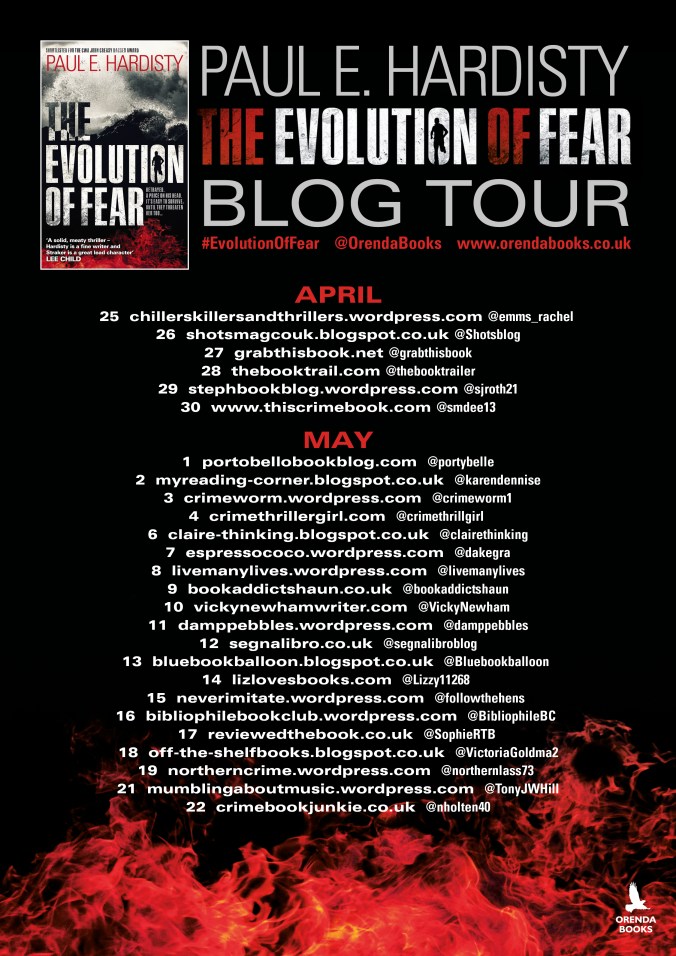
Just shy of three months after the events The Abrupt Physics of Dying and Paul E Hardisty’s Claymore Straker is again fighting for his life within paragraphs of the start of The Evolution of Fear.
Since The Abrupt Physics… Clay has been in hiding – there’s a price on his head and he’s wanted by the CIA for acts of terrorism. However, his hiding in Cornwall is short-lived following the discovery that Rania, the woman he loves, has disappeared, his friend has been brutally murdered and the arrival of mercenaries out to claim the reward on his head means there’s nowhere to hide.
Betrayed, hunted and desperate to find Rania before those hunting him get to her, Clay makes his way to Istanbul (via an expertly detailed sea crossing) and then on to Cyrpus. This isn’t a pleasure cruise, though. Far from it; soon Clay is entangled in a complex and increasingly dangerous web of power-play, political subterfuge and land-grabbing involving some genuinely corrupt and abhorrent figures, the Russian mafia, an old enemy out to settle scores and some sea turtles. Yes, sea turtles; just as the heart that beat at the centre of The Abrupt Physics.. was about the impact of such corporate greed on the local environs and innocents, here too we’re shown to just how extreme and bloodthirsty a length power can corrupt.
The plot is incredibly well thought-out and complex – given that it’s set in 1994 I often found myself wondering if I wasn’t reading fact over fiction. There is everything in here from the aforementioned political corruption and land-grabbing to flashbacks to past war crimes and emotional drama all with twists and counter twists, yet at no point does it feel over-stuffed; Hardisty does a wonderful job of giving you just enough information at the right time to keep it detailed without bogging down in redundant trivia, thus maintaining a pace that rips along like a great thriller should.
Action sequences abound, yet here they’re great, dirty and gritty scenes – think Bourne over Ethan Hunt – compelling and convincing. The locations are described vividly enough to immerse you in them, characters are strong and well fleshed-out and Hardisty writes with an expertise when it comes to the settings and the facts around which the events are choreographed.
The thriller genre is a crowded one and stuffed to its bindings with action set-pieces and broody sods as lead characters. What elevates Haridsty above the pack is the sheer quality of his writing, the intelligence and complexity of the plot and the strong, brilliantly crafted character of Claymore Straker.
Straker is a man beset with demons and riddled with guilt over his past. Not many lead characters are as affectingly human as Clay. Yes, he’s a tough bloke and one you’d want on your side in a scrap. Yes he has a violent and morally questionable past, but – and here’s why you care about the character – Clay is trying, really trying, to do the right thing and become the honourable guy he wants to be, even at risk to his own life. Haunted by his actions in South Africa, Clay is terrified that he’s driven by the same motives of his compatriot – the brilliantly drawn Crowbar – who simply loves to kill. It’s that struggle to do the right thing, against increasingly stacked odds, that makes Clay Straker a memorable character to root for.
There’s a quote on the cover of The Evolution of Fear from Lee Child: “A solid, meaty thriller – Hardisty is a fine writer and Straker is a great lead character”.
Nobody would want to argue with the man behind Jack Reacher and on the strength of both The Abrupt Physics of Dying and The Evolution of Fear it’s impossible to do so – in fact I’m going to state outright that Mr Child has some serious competition here; Straker well and truly holds his ground against that one-man army. It beggars belief that this is only Paul E. Hardisty’s second book – this is as tough, taut, high-octane and powerful as the best and with a level of intelligence that pulls it heads and shoulders above the pack.
Once again, if stars were to be sat at the bottom of my reviews there’d be five of them right here. Sequels / second instalments are a tough act to get right, The Evolution of Fear picks up where the first book left off and turns everything up louder.
The blog tour for The Evolution of Fear is reaching its end and I’m very grateful to Karen at Orenda for asking me to take part and recommend checking out those entries that have preceded my stop as well as tomorrow’s with CrimeBookJunkie – and getting hold of this fantastic book.
I’m trying not to return to the old days a post every five months – it’s just been a busy week or two and life comes first.
A quick week’s break has recharged me somewhat so I’ll be getting back into the swing soon but in the interim here’s a few of what’s been spinning on my turntable / car / iPod of late….
Weezer – Weezer (White Album)
Remember Weezer? They made a great trio of albums, a good fourth a so-so fifth album and then went on a very strange and disappointing journey that included songs with titles like “Where’s My Sex?” and “I’m Your Daddy”, collaborations with Lil’ Wayne (I still don’t really know who he is nor do I want to, thanks), album art featuring the large guy from Lost (and Becker) and something called Death To False Metal which featured a cover of “Unbreak My Heart” (again; no thanks). Just when the nosedive seemed irreversible there was a perfect, in-studio cover of Radiohead’s “Paranoid Android” as if to suggest they’d just been fucking with us all along. Then they decided to go back-to-basics again with the apologetic Everything Will Be Alright In The End. Weezer (White) continues that streak – and their colour sequence – and is the most consistently strong album they’ve done in well over a decade. It’s not quite enough to erase the memory of “The Girl Got Hot” just yet but it gets stronger with each listen.
Public Service Broadcasting – The Race for Space
This is an oddly divisive one but I’m really into this right now. I caught a bit of a session these guys were doing on the radio and was instantly hooked (song below). With a heavy but well-selected use of samples this album sets the story of the American and Soviet space race from 1957-1972 to music. I’m still fascinated by the scope and engineering complexities involved in the space race, the fact that so many people worked together with such a common goal and though it’s not immediate, the blending of music to sample really kicks in and lends an at-times majestic and stirring soundtrack to a story that gripped so many.
Radiohead – Burn The Witch
I’ve not heard A Moon Shaped Pool yet. By all accounts it’s great. I’ve pre-ordered and am anxiously awaiting needle-drop time but still loving this. It’s all about those strings.
Purple Rain – Prince
Because it’s still too hard to grasp that he’s gone.
Undoubtedly a song that’s all over the airwaves and social media today but…. this post was in the works already and it seems fitting enough to push it through now.
Heading home yesterday evening I flipped open twitter and caught the rumours of Prince’s death before confirmation from his publicist changed it into a breaking news story. Shocking doesn’t do it justice.
It’s hard to recall the first Prince song I heard / knew. He was everywhere in music in the 80’s and into the 90’s. Nobody had such a prolific period of constant hits and a career-long streak of strong music.
I do know, though, that Purple Rain remains an ice-cold slab of perfection. There’s not a track on the album I skip. From the hit singles it generated to the breathlessness of Take Me With U, the brilliance of Darling Nikki and the pure Prince audacity-fuck censorship of its lyrics there’s just so many moments of genius on it you could lose count. No wonder it’s shifted upwards of 20 million copies.
For me though, the album, and Prince’s highlight is it’s opening track – Let’s Go Crazy.
It encapsulates everything that the album holds all contained in one four-and-a-half minte track – there’s the exultant chorus, the near-gospel backing vocals, urgent synths, and, of course, Prince’s startling guitar chops (for further evidence watch the little guy in the hat break this cover out of mundaity). This has been a go-to song for me for a long time, those times when the day has been a pile of cack, it’s time for Let’s Go Crazy. It’s impossible to not be uplifted by it, with the sermonising intro with it’s “Dearly beloved…” (boy have I seen that a lot on twitter today) and it’s rousing “and if the elevator tries to bring you down… go crazy; punch a higher floor”. Yeah… Prince is probably trying to evangelisize us with this one but, fuck me, it’s as catchy and brilliant as they come. It’s a pure rush of excitement listening to it especially when – in album format – it breaks into the start of Take Me With U and its opening drum solo.
Thanks to the Purple One’s very tight hold on his copyrights and sharing etc it’s hard to find a video to put here (or one that will stay active for longer than a fart) but let’s try:
Compilations are a funny thing. You’re never going to please everyone but, in theory, you need to give a good reason for existing fans to buy (and a hastily recorded or re-recorded track not considered good enough for the previous album doesn’t count) and enough solid quality to give a career-overview for new / cursory fans to get hooked.
Some people go as far as to turn their nose up at them. Yet I’ve used a ‘Best of’ to get into a fair few bands over the years (Asides from Buffalo Tom remains one of my most-played discs).
When it comes to grabbing compilations from bands I already hold the back catalogue of, I don’t tend to go the Best Of or Introduction To route. Especially on those groups or individuals that are no longer active. Yet I’ll still want a compilation – especially for car use – for those times I don’t particularly want to listen to just one specific album. The problem is, though, that my choice of what I’d consider essential listening very rarely coincides completely with the ‘official’ compiler’s (usually because they’re doing so with a specific aim rather than just cherry picking). So that’s when the old adage “if you want a job done right do it yourself” comes into play and I’ve a fair few of these home-made comps so far.
With the use of Spotify I can even share these here.
So here we go with the first.
Oddly enough the need for a self-compiled disc of The Beatles doesn’t quite fit the ramble above. I don’t own anything from their back catalogue (with the exception of The Magical Mystery Tour). Yet their output is so large that there’s a number of different compilations out there, again each with a different purpose – 1 obviously the chart-toppers, The Past Masters and Anthology seemed too wide-ranging for a good, succinct compilation. 1962-1966 and 1967-1970 came closest but again contained a lot of stuff that I didn’t really care for and when you consider the pricing of all releases Fab Four themed… no thanks. It’s worth noting that this compilation was created before they deigned to allow their songs available via iTunes and streaming so the borrowing of CDs to create this was necessitated (and no piracy was involved) – to be honest though I’d still do so as the idea of paying the required for the whole still makes me flinch.
I’m not a huge Beatles fan. I like a lot of their songs a lot, though, and enjoy them more as I get older, yet I could quite happily never hear some of their earlier stuff again.
So, my choice of Beatles tracks, and the compilation that I’ve kept in my car for some years now also serves as a “my favourite Beatles songs” list – all wrapped around the centrepiece of the amazing While My Guitar Gently Weeps… *
*Yes; George was the best Beatle. You might argue but you’d be wrong.
Heads-up; the tiniest whiff of a spoiler may be contained in the following.
Who are you? What is it that makes you you? Is it something pre-programmed by genetics or are those things that make you ‘you’ environmental; nature vs nurture? What if the person you thought you were, those experiences that shaped you, turned out to be a lie? Would you still be ‘you’?
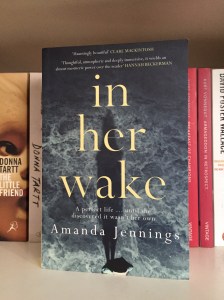
The question is one that sits at the heart of Amanda Jennings’ fantastic In Her Wake as Bella discovers that everything she thought she was is a lie…
We join Bella as she’s heading home to her mother’s funeral with her husband, David. It’s clear from the off that Bella’s childhood hasn’t been simple – with “memories of bolted doors and claustrophobic loneliness”- and that her marriage is pretty far from ideal too. Her brief interactions with her father, Henry, are short and stilted and end with his asking for forgiveness – there’s a real sense of something ominous lurking beneath the surface from the off.
When Bella finds Henry dead one morning in his study, having slit his wrists the night before, his guilt-ridden suicide note finishes with what has to be the most pedestrian manner of delivering something earth-shattering; “Elaine and I are not your real parents. We didn’t adopt you and we didn’t foster you. Your real mother is a woman named Alice Tremayne.”
I admit this bomb of a revelation spun me around – In Her Wake very quickly became a different book to what I was expecting and held me in its thrall as Bella, determined after being essentially a prisoner to one controlling influence or another all her life to find out what she’s missed out on, seeks out in search of her real life.
Reality, though, has a frustrating way of being a little out of sync with expectations and what awaits Bella is somewhat removed from the idyllic reunion she hopes for. Instead she has to come to terms with the dark reality of what having a child abducted can do to a family and her mother, who’s depression at her loss sent her into a catatonic state requiring 24/7 care from Bella’s older sister – all the while struggling to put together the dreamed-of vs reality and the identity struggle between who she thought she was, the person she could have been, actually is and wants to become.
In Her Wake is a beautifully written book. With a real sense of warmth and genuine twists and turns of plot. Utterly compelling from first page until last it is a truly original story.
Cornwall is painted with suitably loving and almost poetic prose and serves as a mirror for the positivity and light Bella feels toward her new life vs her old. Indeed when the two do clash it’s against thebackdrop of a storm.
The characters all ring true and are given a good sense of dimension and Bella is a compelling and convincing voice for the first-person narrative.
Of course, first-person narrative has it’s limitations when it comes to delivering a fully rounded take on a story. So Amanda Jennings peppers the narrative with diary-like entries chronicling just how Henry and Elaine came to take the path they took. It gives these characters a greater fleshing-out and, while not justifying or condoning, offers some form of explanation as to how two people can become so adrift as to abduct a child. I’d argue that it’s more effective than it would have been had such details been discovered first-person as it allows the reader to form their own take without that characters’ filter. It also means the reader has a greater sense of empathy for Bella, knowing just how traumatic a start she had in life and truly pulls you in, giving greater emotional resonance when viewing third-person, almost bearing silent witness to some truly shocking events – it’s so compelling and emotionally gripping that you can’t help but remain transfixed and desperate for more – more details, more understanding and more truth with each piece of the puzzle drawing a gasp as it’s revealed, especially when it comes to the final reveal about Bella.
And here’s the thing; with that final revelation about Bella, In Her Wake broke my heart. Absolutely laid waste to it. I had to stop reading for a day or so. I haven’t read something so emotionally powerful and affecting in some time. The last time I think I’ve been hit quite so hard was possibly by Juame Cabré’s Confessions.
Don’t get me wrong, though; I thoroughly enjoyed this book and for all the heartbreak it is, at its heart, a genuinely wonderful story of hope. No matter how dark the past the future can still be a bright and welcoming place.
I wholeheartedly recommend reading In Her Wake and am very grateful to Karen at Orenda for my copy and inviting me to take part in the blog tour. If I was in the habit of dropping stars against reviews there’d be five right here. Do, of course, please check out the other stops on the tour.
It was Come Pick Me Up that I heard first. Again on a monthly music magazine’s free CD. It seems a lifetime ago that I clogged my bookshelves with the print of the music press but there was some golden discoveries made there nonetheless and Ryan Adams’ first album was one.
As such I grabbed his second album Gold upon day of release. It’s one of those aiming-for-great albums that, while it doesn’t quite make it, you can’t help but feel the quality and ambition and think, fuck, there’s a whole lot of talent and potential here that’s only going to get better. But then the hype for this ‘next best thing’ derailed the train and it was some time before the dust settled, if it ever did.
Now Adams’ musical career, it’s ups and downs (though Rock ‘n’ Roll isn’t too bad), battles with Lost Highway and directions has been well and better documented elsewhere so I won’t assume that I can do is justice. There’s a few versions of Ryan Adams – there’s the alt. country of his début Heartbreaker, there’s the Cardinals-leading swagger of Cold Roses, the hushed acoustics of Ashes & Fire and even the heavy metal of Orion – all of which seemed to meld (save the latter) in the confident and hugely accessible recent, self-titled album.
For me, though, it’s those seemingly-simple but gently and subtly sneaky songs like Come Pick Me Up (with lyrics like “I wish you would, come pick me up, take me out, fuck me up, steal my records, screw all my friends….) that lure the listener in to something darker lurking beneath the surface that are his best.
My favourite is La Cienega Just Smiled.
Such a gentle, growing melody. Instantly hooking and soothing but there’s so much more there. The imagery is instantly simple and casual “on with the jeans, the jacket and the shirt” but then there’s the lines like “I’m too scared to know how I feel about you now” and “one breaks my body and the other breaks my soul”… all brushed off with “see you around”.
Ryan Adams has an arsenal of songs about being broken by love and/or drink/drugs but none of them, to my mind (and it’s my blog) as beautifully crafted and affecting as this:
It may be strange – especially as I’ve often bemoaned those that don’t read outside of or exclude genres from their reading – but the home-grown, UK-based thrillers have never been something that have appealed to me. Perhaps it’s my own mundane interaction with the local constabulary or TV shows likes The Bill or Motorway Traffic Cops (or whatever it’s called) but I’d not really seen the potential for a gripping read there in comparison to – say – an alcoholic Norwegian detective hunting murderers in the snow or – say (again) – one-man armies called Jack chasing justice in other far-flung places….
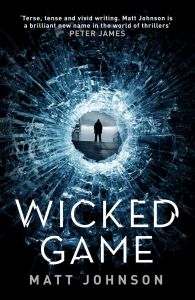
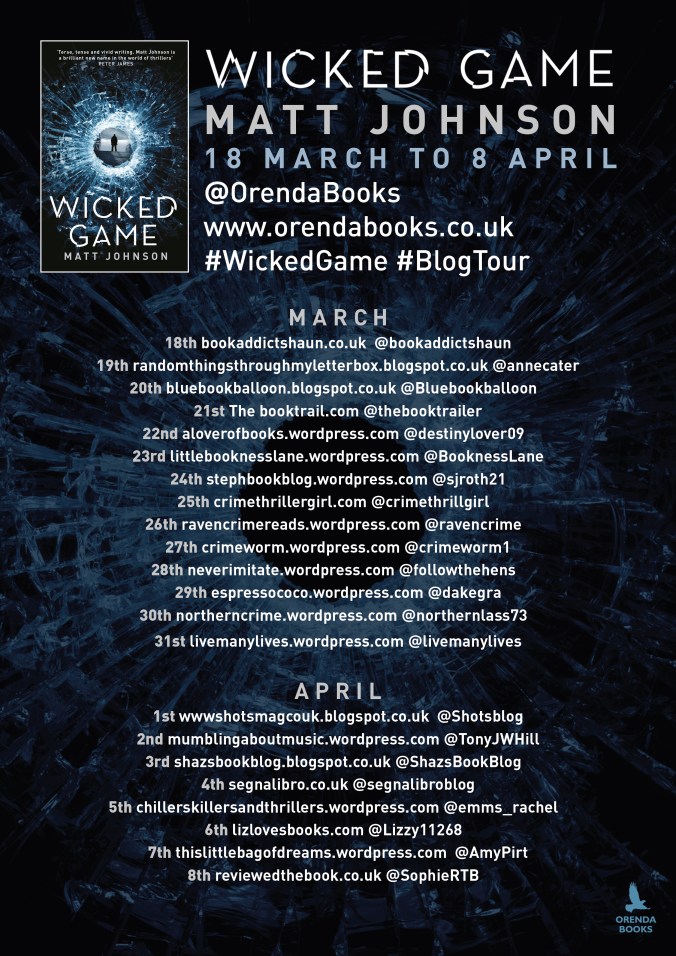
But…. then there’s Wicked Game by Matt Johnson. And it changes that preconception I’d held and it’s a wonderful thing when a book can do that.
Wicked Game finds Robert Finlay as he leaves the Royal Protection team and heads back to uniformed Police work in his search for a quiet, normal, life with his wife and their young daughter.
Let’s be honest; no character in a book or film that’s looking for such a thing gets it – we all know how many detectives get pulled into stopping Armageddon just days before retirement and are all too well aware that Sergeant Murtaugh is “too old for this shit”. We know from the off, then, that trouble is coming down the track for Robert, especially after the explosive start to the novel, and Wicked Game doesn’t disappoint when it comes to the drama. Finlay is far from the standard ex-army turned police officer he’s lead others to believe – he’s an ex-SAS officer with a troubled past that’s now kicking down the door to his longed-for quiet life and demanding his attention. Police officers are being killed. Police officers from his own SAS regiment. Secretive meetings with MI5 follow, luring him in – then there’s an attempt on his own life and it quickly becomes clear that these murders won’t stop until either Finlay or the killer are stopped…. but what’s the motive behind the murders? Why is Finlay a target and who can be trusted?
Far from a standard game of cat and mouse, Wicked Game is a surprisingly complex mystery and one that reaches back in time to bring the old enemies of the past into the terrifying now with an array of action sequences, cliff-hangers and surprises that make for a great read.
The narrative split between first and third person works well (Finlay’s voice is a convincing narration and lends plenty of emotional ballast to the story too) as well as very effective in keeping the reader gripped – especially as the tension grows and those third-person characters such as Grahamslaw are in possession of information Finlay isn’t at crucial, life-threatening points.
They say write what you know and it’s clear that Matt Johnson is writing from experience (having served as a soldier and with the Met for 25 years). When it comes to detailing the action and police-side sequences, as it were, Johnson’s knowledge and insight give the novel a real sense of authenticity. He does a great job of delivering some very real and genuine sequences populated by characters underscored by a convincing authority and precision that can only come from actually knowing those people such characters are likely composites of.
But there’s more than just that insider knowledge and attention to details at play here and it’s that which makes Wicked Game well worth a read – Matt Johnson has a very real talent and gift for thriller writing. Wicked Game cracks along at a great pace with plenty of gripping and original plot twists and turns with a finale that wouldn’t be out of place in a book with a protagonist called Reacher.
With Wicked Game Matt Johnson skilfully weaves together these two facets to create a compellingly gritty and convincingly real thriller.
Thanks to Karen at Orenda Books for my copy and do check out the other stops on the Wicked Game blog tour:
It’s a strange thing and one that’s most likely a result of the level of History taught in school during my education but great swathes of modern, post-war European history remained a mystery to me until very recently.
For entirely personal reasons I’m learning increasingly more about the history of Eastern Europe and what happened behind The Wall, as it were (on that note I sincerely recommend Revolution 1989: The Fall of the Soviet Empire) and am continually fascinated by what I discover.
One hole in my knowledge, though, is the period between the end of the Second World War and the formation of those two distinct countries that I grew up aware of: East Germany and West Germany. It may be down to education but then there’s also the fact that so little was allowed to be known about what happened in certain countries behind the Iron Curtain but there was, at least, an awareness of two distinct halves of Europe and, in particular, Berlin.
I’m oddly fascinated, for example, how the West managed to retain its ‘half’ of a capital city so deep in the Eastern ‘half’ of the country and the logistics therein.
There’s the fact that Berlin was on the receiving end of a very large battering from all members of the Allies in the closing stages of the war. There’s the period when it was divided in two like the rest of Germany and half fell under the GDR while the other ‘the west’. But there’s a knowledge hole that exists around that in between period; the time when a city was on its knees, its citizens still reeling from the destruction and the two opposing factions were still carving it up.
Leaving Berlin by Joseph Kanon goes a long way to both illuminating that period and creating an itch for more. It’s also one of those happy instances in Waterstones where you need another book to take advantage of the “Buy One Get One Half Price” deal and it the book you grab out of curiosity rather than having sought it out turns out to be a brilliant whim.
Set in 1949 Leaving Berlin finds writer Alex Meier returning to Berlin from America where he’d fled the Nazis in 1934. The official line is that – as a treasured author – he’s been invited to return by the Soviet authorities to help establish cultural future of the Socialist country. In fact he’s returned only to allow him to return to America. Persecuted for his communist beliefs during the McCarthy witch-hunts, he’s made a deal with the young CIA; return to East Berlin and act as their agent in order that he might return a patriot and be reunited with his son.
Except, of course, it all goes a bit tits-up for him from the off when his CIA contact is killed and he finds himself in a deadly game of espionage and counter espionage.
The dialogue, particularly, is great but the pacing and twists of the plot are fantastic. What stands out for me, though, is how much more compelling it becomes as a result of its setting. With the war and its events still in people’s memories normality is a distant concept and so what people did during and just what they’ll do to survive after is a huge factor. Just as the lines between the city are in a state of confusion, so too the lines between who to trust. There’s a strange sense of surrealism throughout as a new normality attempts to establish itself yet is still surrounded and hindered by the physical (large swathes of the city remain piles of rubble, there’s power outages) and psychological aftermath of the war that mirrors that of Alex upon his return to such a city after living in California, out of the way of the destruction.
I’ve not read anything by Joseph Kanon before but I’ll certainly be on the lookout to do so on the basis of this. It’s also time to find what I can to plug this hole in knowledge too.
Somewhere back in time when I started this blog I mentioned that I was toying with a post on the ultimate Pearl Jam set-list.
Pearl Jam live are a wonderful thing. Gallingly, though, I’ve only seen them live once. They seem to have now joined the list of great bands that consider playing at Milton Keynes and Leeds as a UK tour – what happened to the rest of the country? – and have given up playing at Wembley Arena (where I saw them on the Binaural tour).
A year or so back I read a great piece that stated: “Pearl Jam is known as one of the best live acts in its arena-filling weight class. After only fitfully listening to new Pearl Jam albums for more than a decade, seeing the band live reignited my interest in listening to them again. Pearl Jam will remain interesting to people for as long as it is able to tour.”
I genuinely believe that there’s not many acts that can touch them live in terms of quality, consistency and pure excitement. And, while I’m unlikely to be in the audience any time soon (their 25th Anniversary trek this year is limited to US/Canadian shows) there’s still plenty of opportunity to enjoy them live thanks to the unusual decision they took back in 2000 – the same tour I caught them on – to release an “official bootleg” of every (with a couple of exceptions) show to offer fans the opportunity to get a good-quality audio of each concert for a reasonable price.
Now…. given how many shows they play a year and that it’s been going for close to 16 years… that’s a lot of shows to choose from. I’m gob-smacked at the idea that some people own the lot.
I’ve got…. a few. Physically; just the show that I attended. I can always claim I’m on a Pearl Jam album that way.
On the iPod, however… well that’s a different story.
There’s probably a dozen or so. Some purchased legitimately and others… in the truer nature of Bootlegs. And each one of them is different and worth having in their own right. See, the thing is I got given the amazing PJ20 book one year – along with the DVD and soundtrack – and there’s mention of so many great shows that it’s impossible not to at least check some of the more significant ones out. Like the 2003 show in Uniondale when the band were heckled for their performance of Bushleaguer:
Which pisses Vedder off so much it’s apparent in the cover of The Clash’s Know Your Rights that follows.
I also have the trioofshows they played at the Tweeter Center in Boston that same year where they used the opportunity to play every song they’d played on the tour to at that point over the course of the three shows; 82 originals and 12 covers with only one repeat….
But to get to the original point; I’ve been hunting for that recording that, to me, represents the ultimate set list.
Back in 2012 (pre-Lightning Bolt), Eddie Vedder let a fan club contest winner choose the setlist for a show. Now the set that Brian Farias – for it was he – chose was pretty good. He even managed to get Vedder to play Bugs for only the second time. But it’s a big challenge, really… how to find the right balance.
I, for example, would want to hear a lot of deeper cuts. But then, looking back at the quote up top of this ramble, how would that play at a show when not all in attendance know every Pearl Jam song. So you do have to mix in the ‘hits’ as it were and – while I don’t always listen to it – Better Man always gets the crowd going and becomes something else live than on record.
Then there’s the case that Pearl Jam don’t do Greatest Hits tours and are usually touring in support of a new album. So what of the newer songs make the grade and still manage to keep the crowd going. In all honesty I wouldn’t really pluck a show from the Backspacer tour because I don’t really feel a lot of tracks from that album worked in that context.
Lightning Bolt, however, was a much stronger effort and there was a lot of stuff I was itching to hear live. Factor in the fact that the band were in great shape and playing better than ever, there’s a lot of gems to be found in the Lightning Bolt tour bootlegs.
So I think I’ve now been able to find the ‘perfect’ set list / bootleg. Well, sort of. Because there’s two.
Worchester, MA, October 15th 2013 is a 32 song strong set that packs in Leash (not as ferocious as I’d love to hear it played but I’ve yet to find a recording that does play it quite as strong as it could be and this one has a great story that precedes it), Red Mosquito and Man of the Hour along with newer cuts like Swallowed Hole and Infallible along with the tour-set-list regulars Mind Your Manners and Sirens. The energy picks up after a quieter start and there’s a great performance of Nothing As It Seems, Fatal gets a play in the first Encore and Crazy Mary makes an appearance. Oh, and Last Kiss.
(I love the moment at about 1:35 where someone realises it’s Leash and gives a joyous yelp)
Set: Release, Long Road, Elderly Woman Behind The Counter In A Small Town, Lightning Bolt, Mind Your Manners, Hail, Hail, Sirens, Even Flow, Nothing As it Seems, Swallowed Whole, Red Mosquito, Whipping, Corduroy, Infallible, Got Some, Save You, Leash, Let The Records Play,
Do The Evolution, Better Man.
Encore 1: Man Of The Hour, Yellow Moon, Fatal, Just Breathe, Spin The Black Circle, Unthought Known, Porch.
Encore 2: Last Kiss, Crazy Mary, Alive, Sonic Reducer, Indifference.
Meanwhile the tour closer at the Key Arena in Seattle on December 3rd finds the band in an even stronger form, the energy is high and they’re playing to a home-crowd. So tracks like Let Me Sleep, In My Tree and Pilate get pulled out, there’s better banter, Breath, State of Love and Trust, a story from Ed of how he was nearly lost at sea, Chloe Dancer / Crown of Thorns, Pendulum opens and Mike McCready playing Van Halen’s Eruption into Yellow Ledbetter brings the show to a close after 37 songs.
Turns out there’s a video of the whole show ‘out there’ which I’ll leave here as long as it lasts:
Set: Pendulum, Nothingman, Elderly Woman Behind The Counter In A Small Town, Interstellar Overdrive, Corduroy, Lightning Bolt, Mind Your Manners, Given To Fly, Pilate, Garden, Getaway, Even Flow, Sirens, In My Tree, Do The Evolution, Unthought Known, Black, Let The Records Play
Spin The Black Circle, Lukin, Better Man.
Encore 1: After Hours, Let Me Sleep,Future Days, Daughter, Chloe Dancer, Crown Of Thorns, Breath, State Of Love And Trust, Porch.
Encore 2: Supersonic, Got Some, Rearviewmirror, Alive, Kick Out The Jams, Eruption, Yellow Ledbetter.
So yeah; I think, between those two it’s as close to a perfect set-list / show recording as you’ll get. A good mix of the deeper cuts, the crowd pleasures, strong new material and plenty of Vedder’s stories and not a heckle in ear-shot.
Although I’ve not yet heard the show with No Code played in full or…..


 Mumbling About...