Where Roses Never Die

I’m going to come right out and say this at the start; Gunnar Staalesen is rapidly becoming one of my favourite writers and this is based purely on only the two Varg Veum books of his I’ve read – We Shall Inherit The Wind and, now, Where Roses Never Die.

With that in mind it was an absolute, relished delight to sit down at the start of May while away on holiday, overlooking a lake and armed with a fresh cup of coffee and no distractions (napping toddler), delve into Where Roses Never Die and another lesson in Nordic-Noir from the master.

IMG_9197In September 1977 a three-year-old girl, Mette Misvær is playing in the sandpit outside her home. When her mother, having been distracted, looks out the window to check on her daughter, Mette has disappeared. The tiny community – a model suburb – of Nordas is devastated. The police search everywhere but their enquiries produce nothing. Mette is never found.

Fast-forward almost 25 years and, as the statute of limitations approach, Mette’s mother approaches PI Varg Veum. She’s never been able to believe that her daughter is gone, the loss has haunted her and she’s desperate for answers. Veum is in no real shape to take a case, he’s still reeling from the aftermath of We Shall Inherit The Wind. But he takes the case – if only to rebuild his depleted bank balance – and begins to unravel a web of secrets and lies that lurk beneath the surface of a seemingly tranquil, idyllic little community.

As a parent the subject matter is a bit of an emotional punch as it plays directly into your worst fears (not the only book in Orenda’s stable to do so, I might add) but, having been writing Varg Veum novels since 1977, Staalesen knows how to navigate these waters and not let the reader drown and the energy and pull of Varg keeps it moving. It’s a haunting story and Staalesen plots it brilliantly, expertly bringing together seemingly unrelated events and characters into a revelation that’s an absolute shocker. That final revelation is a pretty dark one to say the least so I’m going to avoid going into plot for risk of giving anything away but, in the same way as the previous novel, the reveal here left me reeling. I can’t think of a more satisfying thing to get from a book than to be so genuinely floored by it.

Where Roses Never Die is superbly paced and with a story so intricately weaved together and with so many dark secrets pulled into the light you find yourself wondering what’s going on behind every drawn curtain. Characters are pulled from all shades of society and the moral spectrum and all believable – there are some for whose fate the reader can’t help but become invested in.

But these novels are more than gripping mysteries waiting to be unravelled, they’re glimpses into the life of one of Nordic-Noir’s greatest character’s; Varg Veum. If the ending of We Shall Inherit The Wind left the reader feeling battered then it sure as hell knocked Varg for six – he’s spent the years between “on the longest and darkest marathon” of his life . Veum is an immensely human and likeable character – he’s not always popular and very few are happy to see him twice but he’s driven by a sense of justice and finding out the truth, regardless of who’s feathers are ruffled. He, too, is, flawed – marked by a past and haunted his own mistakes. But even here, Staalesen’s mastery means that while there have been detectives nursing a battle with alcohol before it’s rarely so wonderfully evoked as within these pages:

Then I lifted the aquavit glass and drank deeply. For a second or two I had to close my eyes. I was sailing into a harbour I had left much too long ago, and on the quay stood people I hadn’t seen for years, who received me with cheering so quite that I could hear my pulse throbbing in my ears.

Staalesen’s prose is a master-class in efficiency, with minimal strokes he paints a complex plot that draws you into Veum’s world. Varg isn’t an all-action thriller detective, there’s no Reacher-style arms-behind-back fights here. No, Veum piece-by-piece pulls apart the web of lies, misdirection and secrets in his quest to discover what happened to Mette and as he slowly and methodically stalks the truth, so too does Staalesen’s prose until you’re immersed in a wonderful, enveloping narrative that holds you firmly in its grip until the final revelation – and long beyond finishing the last page too. More than just a personal favourite, Gunnar Staalesen is the absolute master of this genre and reading his work is a delight.

Translation is a tricky beast. It can make or break a book and Staalesen’s words are in very safe hands with Don Bartlett. With translations for Nesbo and Knausgaard to his name, Bartlett remains the translator of choice for Norwegian masters and his deft hand here ensures that Staalesen’s narrative and tone flows naturally.

There’s no question that if I were to put stars here there’d be five of them for Where Roses Never Die and, while we’re only just at the halfway mark for the year, it’s easily one of – if not the – best books of 2016.

I’m itching for more Varg Veum and will now (tbr pile allowing) make my way back through those available in English. Do get a hold of Where Roses Never Die – a big thank you to Karen at Orenda for mine – and check out the other stops on the blog tour.
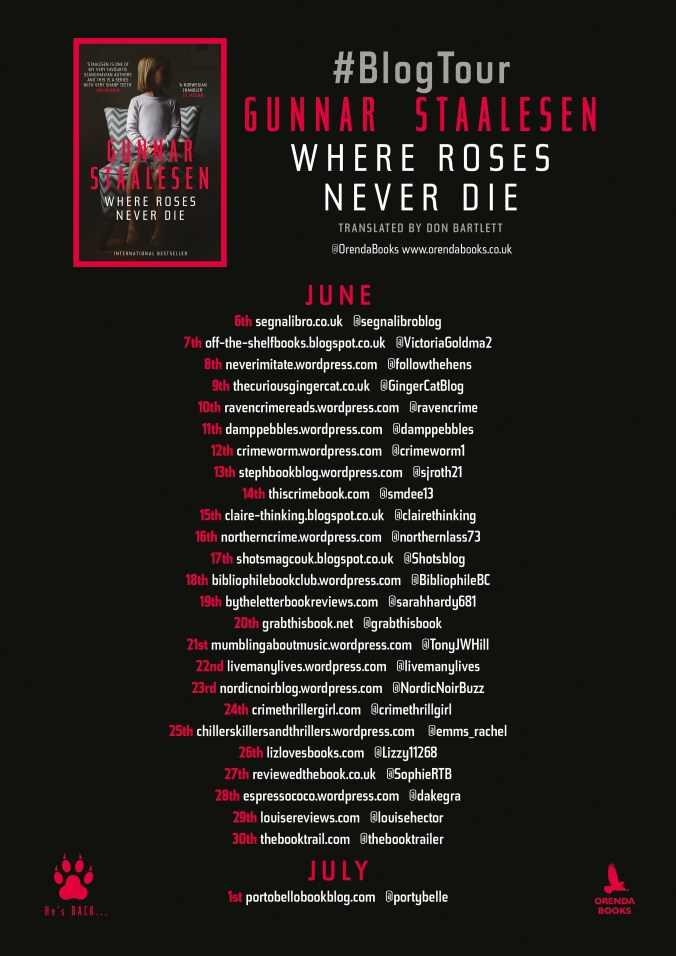
Roses Never Die Blog tour

Deadly Harvest

Last month I found myself engrossed in an article about an albino who was forced to flee his home in Cameroon because his albinism made him a target – a target for those who believe they have special powers. It means that across Africa, in countries like Cameroon, Tanzania, Malawi and others, Albinos are killed and mutilated for the parts of their body. It’s an eye-opening article, not least because, from my sheltered seat and lifestyle, I found it so shocking to believe that, in other parts of the world, people still genuinely believe in the power of the Witch Doctors and that people run the risk of being abducted and killed for muti.

IMG_9187Then Karen at Orenda Books sent me a new novel to read- Deadly Harvest by Michael Stanley. Set in Botwsana, it tackles just that subject.

A young girl on her way home gets into a car with a mysterious man – she’s never seen again. Months later Samantha Khama – a new recruit to Botwsana’s Criminal Investigation Department – picks up the ‘cold case’, suspecting the girl was killed for muti. Then another girl disappears in similar circumstances. Witness, her devastated father, is just getting over the loss of his wife and the loss of his daughter, too, proves too much and pushes him down a dark path in search for revenge – it’s a path that leads him to accidentally and unknowingly blowing open a much larger case which brings corruption, politics and the plight of AIDS into the novel’s scope . When the investigation gets personal, Samantha enlists opera-loving wine connoisseur Assistant Superintendent David ‘Kubu’ Bengu to help her dig into the past. As they begin to discover a pattern to the disappearances, there is another victim – an albino man – and Kubu and Samantha are thrust into a harrowing race to uncover the true identity of the man behind the killings and bring the murders to an end.

Don’t let me mislead – I’m eager to point out here that muti in itself is not such an evil thing. It, more often than not, is nothing more than traditional herbal medicines (and, occasionally, the odd animal product) which is likely no more offensive than something you might pick up in Holland & Barrett (perhaps even less so). Sometimes though, it does get darker and can contain human elements. That darkness runs through Deadly Harvest like a potent undercurrent. Botswana is a modern country yet here amongst those living their daily lives are many who are still in thrall to Witch Doctors, the old ways and superstition – serving as a shackle as the country tries to progress and issuing a genuine, palpable threat to so many. Without repeating myself, it’s hard to conceive of such a world from the sheltered seat of the reader yet Deadly Harvest does a great job of bringing that terror, that monster in the dark, to life. Make sure your door is locked before reading this one at night.

It is a fantastic book. That it’s rooted in a disturbing reality makes it all the more powerful and important. Events unfold at a relatively leisurely pace but are interspersed with moments of palpable tension and a sense of foreboding as the Witch Doctor tightens his grip on those in his thrall as the police begin closing in. There’s plenty of humour in here too and events in Kubu’s own family life make for a great read.

I like Detective Kubu (not just because there’s usually a pack of cookies in my desk too, which reminds me….) – he’s a genuinely warm character with a stable, loving family life that’s almost an oddity in the world of crime novels. It’s nice to see a character who is fighting a battle with his waist line rather than one with alcohol / self-destructive habits and makes him an immediately more relatable character and one I very look forward to reading more of. In fact, all characters in Deadly Harvest are well written and convincing, many of which have back stories and character arcs that you know are going to make for intriguing stories as the Detective Kubu series continues (Deadly Harvest is the fourth and the fifth – A Death In The Family – is due soon).

The writer, Michael Stanley is, in fact, the writing team of Michael Sears and Stanley Trollip. Both Sears and Trollip were born in South Africa and on a flying trip to Botswana, they watched a pack of hyenas hunt, kill, and devour a wildebeest, eating both flesh and bones. That gave them the premise for their first mystery, A Carrion Death, which introduced Detective ‘Kubu’ Bengu of the Botswana Criminal Investigation Department. I’ve read books set in many a location but never one set in Botswana. It meant that this was one of those books that sent me off to that search engine beginning with G to discover more – always a good thing. Messrs Sears and Trollip write of Botswana with an authority that places the reader firmly in the location. They do a great job of weaving in genuine social concerns both in terms of the country’s political climate, the divide between wealthy and poor and the growing threat of AIDS and its devastating impact on families. The writers have a clear gift both for story-telling and hooking a reader – I was asking myself throughout as to just how the killer had lured the girls into his car so easily and the final reveal left me going back through wondering how I’d missed those clues that Kubu had put together. A genuinely intriguing and rewarding read.

Thanks again to Karen at Orenda for continuing to send me such high-quality novels and inviting me to be a part of this blog tour for Deadly Harvest. Do get a hold of the book if my review has any sway and check out the other stops below:

Deadly Harvest Blog tour


Epiphany Jones

Tonight I’m having sex with Audrey Hepburn. Audrey’s breasts are different from the last time we fucked; they’re bigger, not as a firm. There’s a hint of a stretch mark on the left one. The leading lady is bent over, gripping the bedpost.”

….and so begins one of the most impressive and original books I’ve read to date. Michael Grothaus’ Epiphany Jones is a blisteringly sharp and biting novel that will drop jaws with every revelation.

A precis from the jacket / pr:

IMG_9108Jerry has a traumatic past that leaves him subject to psychotic hallucinations and depressive episodes. When he stands accused of stealing a priceless Van Gogh painting, he goes underground, where he develops an unwilling relationship with a woman who believes that the voices she hears are from God. Involuntarily entangled in the illicit world of sex-trafficking amongst the Hollywood elite, and on a mission to find redemption for a haunting series of events from the past, Jerry is thrust into a genuinely shocking and outrageously funny quest to uncover the truth and atone for historical sins.

Yep; one hell of a premise. Michael Grothaus expertly treads the line between outright hilarity and darkly disturbing, maintaining sufficiently steady a balance to keep readers gripped without . That’s not to say it doesn’t shock and appal – indeed, despite the sputter-your-coffee opening this novel is definitely not one for the light-hearted. Without wanting to give too much away, Epiphany Jones runs the gamut – from celebrity-porn addiction (which if you’ve read Grothaus’ journalism you’ll know isn’t all that fictional), the vacuity of Hollywood and the obsession with celebrity culture to moments which touch upon the very worst of humanity and some that are genuinely shocking in their brutality.

It takes a very brave writer to take his audience down those roads and a very gifted one to do so in such a way as to keep them with him. From the opening chapter it’s clear that Grothaus is just such a writer. He knows how to get a reader hooked and hooked in such a manner as to hold them, no matter how dark the road is going to get. The plot leads in gently – Jerry, king of the asides, is a celebrity-porn obsessed guy who also happens to suffer from psychotic hallucinations who goes from a mundane life working behind the scenes at Chicago’s Art Institute (when he’s not taking me-time breaks with Variety) to a violent life on the run that leads him to blowing open an international child sex-trafficking ring. Humour helps (if my First Aid training didn’t teach me not to put fingers down a choking person’s throat then this book did), as does the brilliant pace and the fact that the characters are brilliantly realised and intriguing enough to get you fully invested in them. As the plot unfolds there is so much to take in that it’s impossible to not want to see it through, Grothaus baits the narrative with enough mystery and intrigue to keep you desperate for more with each jaw-dropping revelation leading to another.

Back when I took my Literature degree I took what many considered an odd choice and wrote my dissertation on the use of humour in the works of Hemingway and Steinbeck. Yeah because books like The Grapes of Wrath and A Farewell To Arms are known fodder for stand-up routines. But, you see, we need to laugh when dealing with heavy stuff. How many times do you need to hear “laughter is the best medicine” or see examples of gallows humour when we’re trying to cope with darkness? Just as Papa mixes his comedy with vulgarity or Steinbeck peppers his dialogue with left hands covered with Vasoline, in Epiphany Jones, too, the humour is key – from the dry observations to the occasional slapstick, it’s how Grothaus manages to pull you through and keep you with him. It’s how he helps lure you down into darker waters – by the time it gets real dark over the Mexico border, for example, you know you’re already in good hands –  and yet it never threatens to take away from the seriousness of just what is being exposed. It even manages to ensure that while he’s not top of the likeable list at the start of the book, the reader develops an increasing soft-spot for Jerry and will share in his devastation at the end. Indeed, don’t be fooled; when the jokes stop Grothaus can hit you with an emotional and dramatic punch like the best of them. Here, too, are occasions when you may need to put the book down to truly process what you’ve just witnessed.

Everything is in here – from gripping pace to outright shock, from murder to birth, abuse to revenge and from comedy to tragedy. Epiphany Jones is a very, very clever, tightly-knit book that delivers more depth, pacing and reading pleasure than most and an ending that leaves you with just as many questions and “now what?”s as it does conclusions. I can’t recommend it enough.

My thanks, again, to Karen at Orenda who’s selection of genre-defining novels ensures that my bookshelves and To Read pile contain brilliant books – for sending me Epiphany Jones and do check out the rest of the blogtour.

Epiphany Jones Blog tour


Tracks: Beware of Darkness

Quick fact: George was the best Beatle.

Just look at the list of Beatles songs that are his… If I Needed Someone, Taxman, I Want To Tell You, Within You Without You,  Something, Piggies, that perennial herald of warmer weather Here Comes The Sun and While My Guitar Gently Weeps(!) to name but a few…

Granted, he happened to be in band with two other blokes who were quite handy with a tune so songs that would otherwise have been guaranteed single selections weren’t considered worthy enough. So instead of a scathing swipe at HMRC and a catchy-as-the-flu hook or a beauty of a tune about the dangers of overloading your brain with too many ideas at one time they released the one where the drummer intoned about living in a questionably-coloured underwater boat.

Still, after a couple of non-traditional solo releases while the band were still active, when the Beatles officially called it a day in 1970 (Lennon had called it quits the previous year) the foot had been taken off the hose pipe for George and he released the triple album All Things Must Pass – itself a gorgeous song that the rest of the Beatles had passed on (the berks) –  in October.

All Things Must Pass is full to the brim with great songs, some of George’s very best are here: I’d Have You Anytime, My Sweet Lord, Isn’t It A Pity, What Is Life, All Things Must Pass, Ballad of Sir Frankie Crisp (Let It Roll) and, of course, Beware of Darkness.

Beware of Darkness has some pretty dense and dark imagery in the lyrics, wonderfully offset by some beautiful yet complex instrumentation (with a shift from G major to G sharp minor that really shouldn’t work but does so brilliantly) and George’s genuinely affirming words. Harrison was himself on a perpetual quest for peace and, religion aside, his spirituality and the solace he seeks to find within it are at the forefront in this one and whether you get on that wave yourself or not there’s no denying the sincerity of his vocal.

I can’t express how much I love this song, to be honest. It’s one of my go-to tunes when I hear that black dog barking in a far off field and is one of my own coping techniques when I worry it might get closer. I’ll drop this on and then, if it’s one of those days, follow it up with another Harrison related tune from the Python boys.

The Evolution of Fear

Clay arched his back, lined up the man’s head, and with every joule of energy he could summon, whipped his neck forward.

Clay’s forehead made contact with the man’s nose. The cartilage collapsed as if it were raw cauliflower.

Just shy of three months after the events The Abrupt Physics of Dying and Paul E Hardisty’s Claymore Straker is again fighting for his life within paragraphs of the start of The Evolution of Fear.

IMG_8434Since The Abrupt Physics… Clay has been in hiding – there’s a price on his head and he’s wanted by the CIA for acts of terrorism. However, his hiding in Cornwall is short-lived following the discovery that Rania, the woman he loves, has disappeared, his friend has been brutally murdered and the arrival of mercenaries out to claim the reward on his head means there’s nowhere to hide.

Betrayed, hunted and desperate to find Rania before those hunting him get to her, Clay makes his way to Istanbul (via an expertly detailed sea crossing) and then on to Cyrpus. This isn’t a pleasure cruise, though. Far from it; soon Clay is entangled in a complex and increasingly dangerous web of power-play, political subterfuge and land-grabbing involving some genuinely corrupt and abhorrent figures, the Russian mafia, an old enemy out to settle scores and some sea turtles. Yes, sea turtles; just as the heart that beat at the centre of The Abrupt Physics.. was about the impact of such corporate greed on the local environs and innocents, here too we’re shown to just how extreme and bloodthirsty a length power can corrupt.

The plot is incredibly well thought-out and complex – given that it’s set in 1994 I often found myself wondering if I wasn’t reading fact over fiction. There is everything in here from the aforementioned political corruption and land-grabbing to flashbacks to past war crimes and emotional drama all with twists and counter twists, yet at no point does it feel over-stuffed; Hardisty does a wonderful job of giving you just enough information at the right time to keep it detailed without bogging down in redundant trivia, thus maintaining a pace that rips along like a great thriller should.

Action sequences abound, yet here they’re great, dirty and gritty scenes – think Bourne over Ethan Hunt – compelling and convincing. The locations are described vividly enough to immerse you in them, characters are strong and well fleshed-out and Hardisty writes with an expertise when it comes to the settings and the facts around which the events are choreographed.

The thriller genre is a crowded one and stuffed to its bindings with action set-pieces and broody sods as lead characters. What elevates Haridsty above the pack is the sheer quality of his writing, the intelligence and complexity of the plot and the strong, brilliantly crafted character of Claymore Straker.

Straker is a man beset with demons and riddled with guilt over his past. Not many lead characters are as affectingly human as Clay. Yes, he’s a tough bloke and one you’d want on your side in a scrap. Yes he has a violent and morally questionable past, but – and here’s why you care about the character – Clay is trying, really trying, to do the right thing and become the honourable guy he wants to be, even at risk to his own life. Haunted by his actions in South Africa, Clay is terrified that he’s driven by the same motives of his compatriot – the brilliantly drawn Crowbar – who simply loves to kill. It’s that struggle to do the right thing, against increasingly stacked odds, that makes Clay Straker a memorable character to root for.

There’s a quote on the cover of The Evolution of Fear from Lee Child: “A solid, meaty thriller – Hardisty is a fine writer and Straker is a great lead character”.

Nobody would want to argue with the man behind Jack Reacher and on the strength of both The Abrupt Physics of Dying and The Evolution of Fear it’s impossible to do so – in fact I’m going to state outright that Mr Child has some serious competition here; Straker well and truly holds his ground against that one-man army. It beggars belief that this is only Paul E. Hardisty’s second book – this is as tough, taut, high-octane and powerful as the best and with a level of intelligence that pulls it heads and shoulders above the pack.

Once again, if stars were to be sat at the bottom of my reviews there’d be five of them right here. Sequels / second instalments are a tough act to get right, The Evolution of Fear picks up where the first book left off and turns everything up louder.

The blog tour for The Evolution of Fear is reaching its end and I’m very grateful to Karen at Orenda for asking me to take part and recommend checking out those entries that have preceded my stop as well as tomorrow’s with CrimeBookJunkie – and getting hold of this fantastic book.

Evolution of Fear Blog tour 2

Currently Listening

I’m trying not to return to the old days a post every five months – it’s just been a busy week or two and life comes first.

A quick week’s break has recharged me somewhat so I’ll be getting back into the swing soon but in the interim here’s a few of what’s been spinning on my turntable / car / iPod of late….

Weezer – Weezer (White Album)

Remember Weezer? They made a great trio of albums, a good fourth a so-so fifth album and then went on a very strange and disappointing journey that included songs with titles like “Where’s My Sex?” and “I’m Your Daddy”, collaborations with Lil’ Wayne (I still don’t really know who he is nor do I want to, thanks), album art featuring the large guy from Lost (and Becker) and something called Death To False Metal which featured a cover of “Unbreak My Heart” (again; no thanks). Just when the nosedive seemed irreversible there was a perfect, in-studio cover of Radiohead’s “Paranoid Android” as if to suggest they’d just been fucking with us all along. Then they decided to go back-to-basics again with the apologetic Everything Will Be Alright In The End. Weezer (White) continues that streak – and their colour sequence – and is the most consistently strong album they’ve done in well over a decade. It’s not quite enough to erase the memory of “The Girl Got Hot” just yet but it gets stronger with each listen.

Public Service Broadcasting – The Race for Space

This is an oddly divisive one but I’m really into this right now. I caught a bit of a session these guys were doing on the radio and was instantly hooked (song below). With a heavy but well-selected use of samples this album sets the  story of the American and Soviet space race from 1957-1972 to music. I’m still fascinated by the scope and engineering complexities involved in the space race, the fact that so many people worked together with such a common goal and though it’s not immediate, the blending of music to sample really kicks in and lends an at-times majestic and stirring soundtrack to a story that gripped so many.


Radiohead – Burn The Witch

I’ve not heard A Moon Shaped Pool yet. By all accounts it’s great. I’ve pre-ordered and am anxiously awaiting needle-drop time but still loving this. It’s all about those strings.

Purple Rain – Prince

Because it’s still too hard to grasp that he’s gone.

Tracks: Let’s Go Crazy

Undoubtedly a song that’s all over the airwaves and social media today but…. this post was in the works already and it seems fitting enough to push it through now.

Heading home yesterday evening I flipped open twitter and caught the rumours of Prince’s death before confirmation from his publicist changed it into a breaking news story. Shocking doesn’t do it justice.

It’s hard to recall the first Prince song I heard / knew. He was everywhere in music in the 80’s and into the 90’s. Nobody had such a prolific period of constant hits and a career-long streak of strong music.

I do know, though, that Purple Rain remains an ice-cold slab of perfection. There’s not a track on the album I skip. From the hit singles it generated to the breathlessness of Take Me With U, the brilliance of Darling Nikki and the pure Prince audacity-fuck censorship of its lyrics there’s just so many moments of genius on it you could lose count. No wonder it’s shifted upwards of 20 million copies.

For me though, the album, and Prince’s highlight is it’s opening track – Let’s Go Crazy.

It encapsulates everything that the album holds all contained in one four-and-a-half minte track – there’s the exultant chorus, the near-gospel backing vocals, urgent synths, and, of course, Prince’s startling guitar chops (for further evidence watch the little guy in the hat break this cover out of mundaity). This has been a go-to song for me for a long time, those times when the day has been a pile of cack, it’s time for Let’s Go Crazy. It’s impossible to not be uplifted by it, with the sermonising intro with it’s “Dearly beloved…” (boy have I seen that a lot on twitter today) and it’s rousing “and if the elevator tries to bring you down… go crazy; punch a higher floor”. Yeah… Prince is probably trying to evangelisize us with this one but, fuck me, it’s as catchy and brilliant as they come. It’s a pure rush of excitement listening to it especially when – in album format – it breaks into the start of Take Me With U and its opening drum solo.

Thanks to the Purple One’s very tight hold on his copyrights and sharing etc it’s hard to find a video to put here (or one that will stay active for longer than a fart) but let’s try:


Self-compiled; The Beatles

Compilations are a funny thing. You’re never going to please everyone but, in theory, you need to give a good reason for existing fans to buy (and a hastily recorded or re-recorded track not considered good enough for the previous album doesn’t count) and enough solid quality to give a career-overview for new / cursory fans to get hooked.

Some people go as far as to turn their nose up at them. Yet I’ve used a ‘Best of’ to get into a fair few bands over the years (Asides from Buffalo Tom remains one of my most-played discs).

When it comes to grabbing compilations from bands I already hold the back catalogue of, I don’t tend to go the Best Of or Introduction To route. Especially on those groups or individuals that are no longer active. Yet I’ll still want a compilation – especially for car use – for those times I don’t particularly want to listen to just one specific album. The problem is, though, that my choice of what I’d consider essential listening very rarely coincides completely with the ‘official’ compiler’s (usually because they’re doing so with a specific aim rather than just cherry picking). So that’s when the old adage “if you want a job done right do it yourself” comes into play and I’ve a fair few of these home-made comps so far.

With the use of Spotify I can even share these here.

So here we go with the first.

Oddly enough the need for a self-compiled disc of The Beatles doesn’t quite fit the ramble above. I don’t own anything from their back catalogue (with the exception of The Magical Mystery Tour). Yet their output is so large that there’s a number of different compilations out there, again each with a different purpose – 1 obviously the chart-toppers, The Past Masters and Anthology seemed too wide-ranging for a good, succinct compilation. 1962-1966 and 1967-1970 came closest but again contained a lot of stuff that I didn’t really care for and when you consider the pricing of all releases Fab Four themed… no thanks. It’s worth noting that this compilation was created before they deigned to allow their songs available via iTunes and streaming so the borrowing of CDs to create this was necessitated (and no piracy was involved) – to be honest though I’d still do so as the idea of paying the required for the whole still makes me flinch.

I’m not a huge Beatles fan. I like a lot of their songs a lot, though, and enjoy them more as I get older, yet I could quite happily never hear some of their earlier stuff again.

So, my choice of Beatles tracks, and the compilation that I’ve kept in my car for some years now also serves as a “my favourite Beatles songs” list – all wrapped around the centrepiece of the amazing While My Guitar Gently Weeps… *

*Yes; George was the best Beatle. You might argue but you’d be wrong.

In Her Wake

imageHeads-up; the tiniest whiff of a spoiler may be contained in the following.

Who are you? What is it that makes you you? Is it something pre-programmed by genetics or are those things that make you ‘you’ environmental; nature vs nurture? What if the person you thought you were, those experiences that shaped you, turned out to be a lie? Would you still be ‘you’?

The question is one that sits at the heart of Amanda Jennings’ fantastic In Her Wake as Bella discovers that everything she thought she was is a lie…

We join Bella as she’s heading home to her mother’s funeral with her husband, David. It’s clear from the off that Bella’s childhood hasn’t been simple – with “memories of bolted doors and claustrophobic loneliness”- and that her marriage is pretty far from ideal too. Her brief interactions with her father, Henry, are short and stilted and end with his asking for forgiveness – there’s a real sense of something ominous lurking beneath the surface from the off.

When Bella finds Henry dead one morning in his study, having slit his wrists the night before, his guilt-ridden suicide note finishes with what has to be the most pedestrian manner of delivering something earth-shattering; “Elaine and I are not your real parents. We didn’t adopt you and we didn’t foster you. Your real mother is a woman named Alice Tremayne.”

I admit this bomb of a revelation spun me around – In Her Wake very quickly became a different book to what I was expecting and held me in its thrall as Bella, determined after being essentially a prisoner to one controlling influence or another all her life to find out what she’s missed out on, seeks out in search of her real life.

Reality, though, has a frustrating way of being a little out of sync with expectations and what awaits Bella is somewhat removed from the idyllic reunion she hopes for. Instead she has to come to terms with the dark reality of what having a child abducted can do to a family and her mother, who’s depression at her loss sent her into a catatonic state requiring 24/7 care from Bella’s older sister – all the while struggling to put together the dreamed-of vs reality and the identity struggle between who she thought she was, the person she could have been, actually is and wants to become.

In Her Wake is a beautifully written book. With a real sense of warmth and genuine twists and turns of plot. Utterly compelling from first page until last it is a truly original story.

Cornwall is painted with suitably loving and almost poetic prose and serves as a mirror for the positivity and light Bella feels toward her new life vs her old. Indeed when the two do clash it’s against thebackdrop of a storm.

The characters all ring true and are given a good sense of dimension and Bella is a compelling and convincing voice for the first-person narrative.

Of course, first-person narrative has it’s limitations when it comes to delivering a fully rounded take on a story. So Amanda Jennings peppers the narrative with diary-like entries chronicling just how Henry and Elaine came to take the path they took. It gives these characters a greater fleshing-out and, while not justifying or condoning, offers some form of explanation as to how two people can become so adrift as to abduct a child. I’d argue that it’s more effective than it would have been had such details been discovered first-person as it allows the reader to form their own take without that characters’ filter. It also means the reader has a greater sense of empathy for Bella, knowing just how traumatic a start she had in life and truly pulls you in, giving greater emotional resonance when viewing third-person, almost bearing silent witness to some truly shocking events – it’s so compelling and emotionally gripping that you can’t help but remain transfixed and desperate for more – more details, more understanding and more truth with each piece of the puzzle drawing a gasp as it’s revealed, especially when it comes to the final reveal about Bella.

And here’s the thing; with that final revelation about Bella, In Her Wake broke my heart. Absolutely laid waste to it. I had to stop reading for a day or so. I haven’t read something so emotionally powerful and affecting in some time. The last time I think I’ve been hit quite so hard was possibly by Juame Cabré’s Confessions.

Don’t get me wrong, though; I thoroughly enjoyed this book and for all the heartbreak it is, at its heart, a genuinely wonderful story of hope. No matter how dark the past the future can still be a bright and welcoming place.

I wholeheartedly recommend reading  In Her Wake and am very grateful to Karen at Orenda for my copy and inviting me to take part in the blog tour. If I was in the habit of dropping stars against reviews there’d be five right here. Do, of course, please check out the other stops on the tour.

In Her Wake Blog tour

Tracks: La Cienega Just Smiled

It was Come Pick Me Up that I heard first. Again on a monthly music magazine’s free CD. It seems a lifetime ago that I clogged my bookshelves with the print of the music press but there was some golden discoveries made there nonetheless and Ryan Adams’ first album was one.

As such I grabbed his second album Gold upon day of release. It’s one of those aiming-for-great albums that, while it doesn’t quite make it, you can’t help but feel the quality and ambition and think, fuck, there’s a whole lot of talent and potential here that’s only going to get better. But then the hype for this ‘next best thing’ derailed the train and it was some time before the dust settled, if it ever did.

Now Adams’ musical career, it’s ups and downs (though Rock ‘n’ Roll isn’t too bad), battles with Lost Highway and directions has been well and better documented elsewhere so I won’t assume that I can do is justice. There’s a few versions of Ryan Adams – there’s the alt. country of his début Heartbreaker, there’s the Cardinals-leading swagger of Cold Roses, the hushed acoustics of Ashes & Fire and even the heavy metal of Orion – all of which seemed to meld (save the latter) in the confident and hugely accessible recent, self-titled album.

For me, though, it’s those seemingly-simple but gently and subtly sneaky songs like Come Pick Me Up (with lyrics like “I wish you would, come pick me up, take me out, fuck me up, steal my records, screw all my friends….) that lure the listener in to something darker lurking beneath the surface that are his best.

My favourite is La Cienega Just Smiled.

Such a gentle, growing melody. Instantly hooking and soothing but there’s so much more there. The imagery is instantly simple and casual “on with the jeans, the jacket and the shirt” but then there’s the lines like “I’m too scared to know how I feel about you now” and “one breaks my body and the other breaks my soul”… all brushed off with “see you around”.

Ryan Adams has an arsenal of songs about being broken by love and/or drink/drugs but none of them, to my mind (and it’s my blog) as beautifully crafted and affecting as this: