Least to Most: Bruce – The River

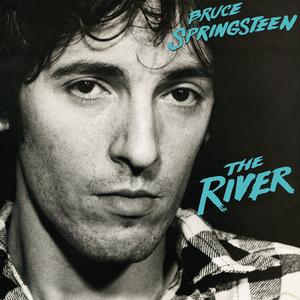
the_river_bruce_springsteen_front_coverIn 1979 Springsteen set about making the follow up to The Darkness on the Edge of Town. He had some hold overs from that album’s sessions (‘Sherry Darling’, ‘Ramrod’ and ‘The Ties that Bind’ for starters) but at this point he was  writing songs at the same frequency most pass gas.

It was meant to be a single album that lead away from the more severe sound and approach of its predecessor and showcase the breadth of styles and joyousness of his band’s live sets of the time. Ten tracks, in, out and released late 1979 with a tour to follow, of course. And it almost was. A ten song album, The Ties That Bind was prepared and ready but then… Bruce held back. Because perched at the end of that single album was ‘The River’.

It’s a monumental song. When I got into Bruce via the 1995 Greatest Hits it was this one that caught my ear and made me pay attention. It still does. As with most of the more serious songs on The River the lyrics and themes aren’t as poetic as he’d written before but it’s the belief with which he sings them, the genuine investment which he puts into them that makes them so essential – these aren’t pop songs that can just be sung or waltzed trough, the material demands presence over phoning it in and if you try to sing these songs without giving it your all it will tell. From ‘The River’ to ‘Point Blank’ there’s no argument for a second that he isn’t 100% IN these songs and even after performing them countless times, live it’s clear that this is still the case . That’s why they reverberated at the time and why they continue to do so.

Writing what would become the title track of the eventual double had opened a new avenue, and Springsteen would go on to write more songs about men and women, their relationships and coming to terms with life’s hardships and would develop a much larger album to contain what he saw as the paradoxes of life; the joy and celebration of rock ‘n’ roll, but also its hardness. He wanted an album that continued the stories and themes he’d begun writing about on Darkness but one that didn’t wallow in them and would let in the light with the music that made his concerts such a revelation. He wrote so many more songs that three of those from the original single album were consigned to vaults (including ‘Loose Ends‘ much to Van Zandt’s chagrin). *

For my money it’s a good thing Springsteen did pull back the single album. That first one didn’t contain tracks like ‘Point Blank’ or ‘Independence Day’ (both further holdovers from The Darkness on the Edge of Town) and those other songs like  ‘Fade Away’, ‘Drive All Night’ and ‘Wreck on the Highway’ rank among his finest. I’ve already said that ‘Point Blank’ is one of my favourites elsewhere so will instead leave ‘Drive All Night’ here, one that I discovered via the underrated film Copland.

As important as I think those more serious songs are, the album’s duality is what marks it out in Bruce’s catalogue. There’s nothing really like it in terms of the full-spectrum or in terms of its sound. After years of sessions, agonising over track listing and capturing the right sound in the cavernous room they were recording in, the album that arrived was something much rawer than its predecessor. Gone were the wall-of-sound theatrics of Born To Run or the tense energy of Darkness.. in their place was a looser, more raucous garage-rock style (Van Zandt with a much larger production role) with a raw, jubilant sound and some of Springsteen’s finest vocals.

While there’s a couple of less-than-classics on the first half,  (but even Crush On You has a catchy-as-a-cold riff)  kicking off with ‘The Ties That Bind’ there’s a run of pure gold on it: ‘Jackson Cage, Two Hearts, Independence Day, Hungry Heart, Out In The Street (“oh oh oh oh oh!”) that makes for a near unbeatable half-hour of listening and was his most unabashed run of rock music to date.

Even the second half of the album, home to some of Springsteen’s heaviest material (just look at the lyrics to the closing ‘Wreck on the Highway’), features some of his most out-and-out direct rock music. From ‘Cadillac Ranch’ to the most obvious, daftly joyous and infectious mission-statement he’s made:

Whenever you read those stories about Bruce turning up at local shows and getting up on stage to cut loose, you know (hope) it’s going to be with those songs that represent the lighter half of The River and his catalogue. He’s not going to get up draw out ‘Point Blank’ or ‘Ghost of Tom Joad’ he’s going to strap on the guitarist’s spare and blast through those straight-ahead, life affirming songs that he does so bloody well like ‘You Can Look (But You Better Not Touch)’ or he’ll give it the “let’s roadhouse” and kick into ‘Ramrod’ and the place will go fucking nuts.

So with so much pure Springsteen gold, why doesn’t it sit at the top? Personally, I think Bruce is at his best when focused. A double album is a lot to give attention to – twenty tracks doesn’t necessarily make for one session and the jarring nature of it can at times mean a slight stumble in flow. It’s a sod on vinyl but even when playing it in the car on CD, by the time I’ve made it through to the end of the second disc, the start of the album all the way back at ‘The Ties That Bind’ seems like a long time ago and isn’t as fresh in the ears as, say, ‘Radio Nowhere’ is come ‘Devil’s Arcade.’  However, it’s easily Top Five (and I’m sure it’s atop many a list) because what comes between those two distant points is so fucking good.

Even Steven Van Zandt admitted; “If it had been a single album, it would have been appreciated more, especially if he had put more of the pop-rock stuff on there. It would have been our biggest album. All you gotta do is throw on “The River” — that’s all the content you need. A little of Bruce’s content goes a long way. But he felt he had to do eight or ten songs like that.”

It was appreciated – critics fell over themselves to hand plaudits to its “weighty conclusions, words to live by”**, it topped the charts in the US and did well elsewhere too, going on to shift sufficient copies to sit immediately behind his two Born.. albums in terms of overall sales. Yet it’s often overlooked in his catalogue, not only because of its length but because, perhaps, it also sits between those two periods – it’s nestled between the breakout of Born To Run and Darkness and the massive explosion of Born In The USA.

With twenty tracks written and recorded at a period that Springsteen and the E Street Band were untouchable, it’s  got the lot: from the silly (‘Crush On You’) to the serious (‘Wreck On The Highway’), everything in between, including Bruce’s first Top Ten hit (‘Hungry Heart’). The River is the best one-stop slab introduction for anyone who wants to get a grip on every aspect of his writing.

Highlights: We’re well into 5 Star territory here so, as before: The whole bloody thing.

*these are far from the only songs recorded during this period consigned to the vaults. Most of Disc 2 of Tracks contained songs from this period whose omission boggled the brain and then The Ties That Bind: The River Collection set offered even more. My favourite:

**Rolling Stone, of course.

Least to Most; Bruce – I’m just around the corner to the light of day

So I’ve cleared the half way post. Hell, I’ve cleared the 75% mark and I’m about to go charging into the Top 5 like a hot stepping hemi with a four on the floor… *

As such I thought that, with 15 of 20 (given that I included both Tracks and The Promise) it was time for a quick re-cap of the order so far.

It’s been quite the challenge – a post per album and twenty total – but I’m happy to have managed thus far and have enjoyed the process, rediscovering many a near-forgotten gem or detail while listening to each one again and it’s served as a real reminder of just what a prolific and talented song writer Bruce is. Even on those albums that sit at the Least end of this spectrum there’s a good few songs that would make a compilation. Perhaps that’s the next compilation challenge – one, and only one, song from every release… In hindsight, while there’s a fair few bands / artists I reckon I could run this same format I don’t know that I’d go so far as a post per album. Then again, not so many acts have made the 20 album mark.

Again, this isn’t Worst to Best, this is purely personal preference and I could understand how an argument could be made for any one of these to be somebody’s favourite. I don’t think Bruce has mad a ‘bad’ album and even those at the tail end are better than many an artist at their best.

20. Human Touch (1992) Link

19. High Hopes (2014) Link

18. Lucky Town (1992) Link

17. Working on a Dream (2009) Link

16.  Wrecking Ball (2012) Link

15. Devils and Dust (2005) Link

14. We Shall Overcome: The Seeger Sessions (2006) Link

13. The Ghost of Tom Joad (1995) Link

12. Greetings From Asbury Park, NJ (1972) Link

11. The Promise (2010) Link

10. Born In The USA (1984) Link

9. The Rising (2002) Link

8. Tracks (1998) Link

7. Magic (2007) Link

6. The Wild, The Innocent and the E Street Shuffle (1973) Link

5. …..


*answers on a postcard.

Least to Most; Bruce – The Wild, the Innocent & the E Street Shuffle

“This boardwalk life for me is through
You know you ought to quit this scene too…”

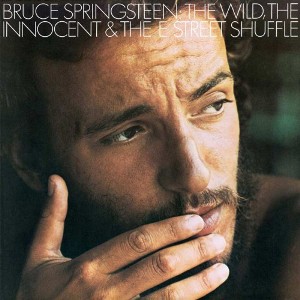
thewildtheinnocentWhat a difference six months can make. After his début failed to propel him to the dizzying heights hoped for by his signing as a ‘new Dylan’, Bruce Springsteen entered 914 Studios in New York to record his second album. This time, though, things would be a little different. For one, Bruce wanted more control of the sound and production. For another, and perhaps prompting the former, Springsteen was fired up about playing with his embryonic E Street Band and had reignited his passion for a big, full-band sound that was absent from Greetings From Asbury Park, NJ.

Everything on here is aiming for epic – the sound, the instrumentation and even the characters. Before he started singing about the less fanciful Marys, Wendys and Joes his New York and New Jersey characters were more colourful than a ‘gang meeting’ on Hill Street Blues. On The Wild, The Innocent… there’s Power Thirteen and his girl Little Angel, Sandy, Kitty, Big Pretty,  Catlong, Missy Bimbo, the Flying Zambinis, Margarita, Sampson, Tiny Tim, Spanish Johnny, Puerto Rican Jane, Billy, Diamond Jackie, Little Dynamite and Little Gun, Jack the Rabbit and Weak Knees Willie, Sloppy Sue and Big Bones Billy all amidst a maelstrom of boy prophets, Latin lovers and hard girls on Easy Street. Not to mention a certain girl called Rosie. All within just seven songs.

And what songs they are. Here Bruce ditched the rhyming dictionary and attempts to sing a novel at speed in every verse, embraced the opportunity offered by the band and delivered a set of songs with more ambition in terms of lyrics and scope than you’d have guessed possible of him just six months earlier. While personally I’ve never been hugely fond of the opening cut (it’s down to that phunk keyboard line dancing all over it like some platform-shoed drunk disco elephant) there’s no denying its quality. Other than that, every other song here gets a five star rating from me.

With its wistful tale of Madame Marie, ‘4th of July, Asbury Park (Sandy)’  alone shows the strides Springsteen took as a songwriter between albums and the benefits of road-testing songs before getting into the studio. It’s easy to see why Federici asked to play this showcase on his last performance with the band and this most romantic of Bruce’s songs remains a live highlight decades later.

‘Kitty’s Back’ is a monster of a tune, clocking in at over seven minutes and showcasing Springsteen’s guitar chops (again absent through Greetings..) and proving what a wild, R&B/Soul/Jazz/Rock powerhouse outfit his band was. I’ve heard criticism that ‘Wild Billy’s Circus Story’ takes itself too seriously but to that I say “arseholes”. It’s a cracking, fun little tune and contains a great lyric: “the runway lies ahead like a great false dawn”. It’s odd but I think that Springsteen’s lyrics often get overlooked as some of the real nuggets like this one are often missed when reflecting on the overall story of the song. At just 23 Bruce was already coming up with some great lines.

Listening back through these albums has meant I’ve been discovering little gems that I’d almost forgotten and that’s certainly true of ‘Wild Billy’s Circus Story’. It also means my young son has been getting introduced to these and along with calls for this one (the “Elephant Song” based on Gary Tallent’s tuba blasts) he’s surely one of precious-few three year old’s calling out for “Rosie!”

Ah yes, ‘Rosalita (Come Out Tonight)’. There’s no getting away from just how fucking good this song is. Described by Bruce as an early ‘Born To Run’ but with more humour, this is a real indicator as to where Springsteen’s sound was going. Just listen to the mix of sax and guitar around the 5:10 mark, you half expect “the highway’s jammed…” to come barrelling in. In this instance, it goes back to the party instead. Rolling Stone have described this song as “a raucous celebration of desire.” It is a big, beautiful and triumphant song and easily one of Springsteen’s best and does remain the album’s biggest sign post as to what’s to come both in terms of it’s “it’s time to bust out of here” and it’s sound, made especially arresting by it’s sequencing.

The prototype of Bruce’s ‘busting outta here’ song sits between his two most unabashed and wonderful epics; ‘Incident on 57th Street‘ and ‘New York City Serenade’. ‘Incident on 57th Street’ is a massive song in terms of Bruce’s song-writing. It’s like listening to the sound of all the pieces aligning properly as Bruce steps aside and delivers one of his finest – and earliest – songs sung from an observational point that’s far greater than the sum of its parts.

Why I mention sequencing, though, is that the sound of the final, gentle tickle of piano notes is quickly blasted away by the sheer force and power of ‘Rosie’, making the juxtaposition between the two styles all the more evident.

And then there’s ‘New York City Serenade’. You know there’s a few, a small few songs that I’ll listen to where the opening bar is so immediately ‘right’, so ‘spot on’ and tuned to me that it affects me to the core. It’s like an instant high. ‘New York City Serenade’ is one of those. That hammer of the piano strings, the cascade of notes that follows. Sometimes you’ll hear an intro that’s perfect and you’ll think ‘ok, how’s this gonna get marred?’ because not everything that follows can be as good. With ‘New York City Serenade’ everything works beautifully, the arrangement is so perfectly put together that every element just flows into the next in a way that makes it seem like effortless poetry. There’s not a single bum not or misstep in the entire song. Bruce Springsteen was 23 when he wrote and arranged ‘New York City Serenade.’ When I was 23 I though it was a good idea to call a band ‘Wookie Cushion’*. I’ve played this song to people who thought they knew what to expect from a Springsteen song and they’ve always had to question whether it was really “that Born in the USA guy”.

One of my all-time favourite songs.

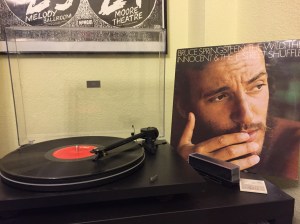
img_1456 What this also means is that Side B of this album might just be the finest 25 minutes of music put to vinyl.

Easily Springsteen at his most expansive, poetic and romantic, The Wild, the Innocent & The E Street Shuffle is a beautiful embrace of and gentle kiss goodbye to his boardwalk life as he takes his characters and breaks them out of their surroundings in pursuit of a new dream.

Oddly, though, his record label didn’t agree that the album was up to scratch. When Springsteen handed it in, the allies he’d had at Columbia were no longer in place. Instead of receiving the great feedback he’d hoped for, Bruce was instead told that the players were sub par and it was suggested that he re-cut the majority of it with professional studio musicians. Of course, this wasn’t an option. Unfortunately, sticking to his guns meant that Columbia buried the album. No release fanfare, no promotion, little distribution. Bruce would play shows in towns where they had no idea the album had even been released.

Thankfully, though, Bruce still had what it takes to cut it live and lay down a killer show. This lead to two things. The first was catching the eye of Jon Landau and the infamous  “I saw rock and roll’s future and its name is Bruce Springsteen,” review that would lead to the pair’s friendship and Landau becoming Springsteen’s manager.  Secondly, Springsteen took to taking aim at his record company during his on-stage patter. One particularly embittered voicing of his frustration happened at a college where the son of the label’s boss happened, unknown to Bruce, to be in attendance. Legend has it he called his father, explained just how much of an amazing act Springsteen was and what was being said and the head of the label soon sat down with his charge and said words along the lines of “what can we do to get this working?”

With Landau and his record label supporting him, it would be time to shed the mythic tales and follow The Wild, the Innocent & the E Street Shuffle with a last chance power drive…

Highlights: ALL OF IT


*You’d sit on it and it would go “Aaaaaaaaaaaaaaaarrrgh!”

Least to Most; Bruce – Magic

“I tried to combine personal and political, so you can read into the songs either way. You can read the record as a comment on what’s been going on, or you can read it just as relationship songs.”

bruce_springsteen_-_magicIn December 2016 Bruce sat down with Brendan O’Brien at his home, handed him a book of lyrics and then played the tunes on his guitar, offering the producer the pick of the litter. The two then decamped to Atlanta again and with a core band of Springsteen, Weinberg, Bittan and Tallent, laid the basic tracks for the album. Other band members were called in to lay down their parts as needed and sessions were complete within two months. Another example of the pair’s more precise recording practice, it meant that without the opportunity to spend protracted amounts of time exploring alternative avenues and ideas, all effort and concentration focused on the one group of songs and bringing them to perfection. Shorn of the fiddles of Seeger Sessions and the acoustic dirge of Devils and Dust, the resulting Magic is the high benchmark of Springsteen’s second chapter and bursts with a fire and passion that sets a lot of his work in the shade.

I’ll be clear – as if it wasn’t already – I fucking love this album. The songs here are harder and sharper than on The Rising, the E Street Band – during its late peak – is playing tighter than a duck’s arse and the result is a joy to behold. The sound is ridiculously lush and there’s more revealed with every listen; the mandolin on ‘Magic’, Federici’s organ on ‘Livin’ In The Future’, the moody atmospherics of ‘Devil’s Arcade’ but I’m jumping ahead….

It starts with guitars. A thousand guitars and pounding drums, as ‘Radio Nowhere‘ leads an impassioned, energetic blast of all the E Street’s finest qualities and Bruce growling out his call to arms “Is there anybody alive out there?” against a thumping beat and euphoric blast from Clarence Clemons’ sax. Magic is Bruce and the E Street tuned in and meaning business as they bore through a new Springsteen classic and straight into ‘You’ll Be Coming Down’ which sounds like a blast of Bruce’s sound from earlier decades:

Indeed, Bruce spoke of how for this album he tried to get back to his earlier, romantic sounds last heard on Born To Run and there’s a wealth of nostalgia in the sound*.

“There’s some classic Sixties pop forms. California-rock influences –Pet Sounds and a lot of Byrds. I wanted to take the productions that create the perfect pop universes and then subvert them with the lyrics – fill them with the hollowness and the fear, the uneasiness of these very uneasy times.”

Take ‘Girls In Their Summer Clothes’ – which, apparently, Bruce had little interest in but O’Brien pushed for its inclusion – as an example of this; the doubling up of Bruce’s voice for the first time in goodness knows how long against a gorgeous backdrop (and a great rhythm guitar part) . Or the horns of ‘Livin In The Future’ that blast like a Freeze-out on a certain avenue. Or the out-and-out joy of ‘I’ll Work For Your Love‘.

But even here, the fire lurks beneath the surface. Bruce is angry and the pain and disbelief are shot through every song no matter how much he may have tried to allow the songs to be taken without them. There’s the groundskeeper who “opened the gates and let the wild dogs run” in ‘Livin..’ or  how the “city of peace has crumbled, our book of faith’s been tossed” in ‘I’ll Work For Your Love’, there’s no getting around it and it makes for some of his finest and most pointed lyrics in a long time. Certainly the best of Bruce V.2

I’ve mentioned before that  ‘Gypsy Biker’ shares a lot of ground with ‘Shut Out The Light’. The earlier track was one of Springsteen’s Vietnam tunes, ‘Gypsy Biker’ is one of a more modern war – Johnny gets to pull out his Ford and polish up the chrome in the former, the biker in the latter is coming home in a coffin; “Sister Mary sits with your colors”. It’s one of his best.

I remember at the time of release, Magic was referred to as being about “love in the time of Bush” **. There’s no direct references here, no mention of specific wars or Bush (though it may well be his “boot heels clickin’ like the barrel of a pistol spinnin’ round” on ‘Livin In The Future’) but he doesn’t need to.  The threat he felt in 2006 is there throughout.  Perhaps its most telling on the beautiful title track. Quiet, gentle guitar and chamberlin undercut with strings and Van Zandt’s mandolin make for a soothing, hypnotic stroll or dance as Springsteen lists ‘magic’ tricks but then it’s there in the last verse:

“Now there’s a fire down below
But it’s comin’ up here
So leave everything you know
And carry only what you fear
On the road the sun is sinkin’ low
There’s bodies hangin’ in the trees
This is what will be, this is what will be.”

If there was any doubt left about this album’s thrust it’s obliterated by what comes next. ‘Last To Die‘ takes it’s lyrics from John Kerry’s testimony on Vietnam (“How do you ask a man to be the last man to die in Vietnam? How do you ask a man to be the last man to die for a mistake?”) and straps it to a howling, fierce track.

The album’s closing track*** ‘Devil’s Arcade’ is a dark bruiser of a tune that’s perhaps the most literal on it. A lover’s recall of portentous earlier memories and passion before her love enlists and winds up being wounded “the cool desert morning, then nothin’ to save, just metal and plastic where your body caved” and in a hospital while she waits for his touch –  Weinberg hammers home the rhythmic thump against the repeated “The beat of your heart, the beat of your heart”.

Again; it’s one of the finest things Springsteen has written and this album is chock-full of them. It’s strange to listen to this album again (though it’s rarely out of rotation) now as we find ourselves staring down even darker corridors than GW had lead the world. Then, as now, this album’s warmth and spirit remain a lighthouse; there is love, there is light and it needn’t be the monsters that call the tune, we have the choice.

Highlights: ‘Radio Nowhere’, ‘Livin In The Future’, ‘Your Own Worst Enemy’, ‘Gypsy Biker’, ‘Magic’, ‘Last To Die’, ‘Devil’s Arcade’.

*Something which would lead to a burst of writing just as the Magic sessions wound down and form the basis of Working On A Dream.

**Not the working title of a late-night Gabriel García Márquez adaptation.

***Officially. Following the death of Springsteen’s long-time assistant Terry Magovern, ‘Terry’s Song’ was added.

Least to Most: Bruce – Tracks

“The alternate route to some of the destinations I travelled to on my records.” Bruce Springsteen

“Every song on Tracks is a lost argument”. Steven Van Zandt.

Strap in, this one is a long one…

bruce_springsteen_tracksIn 1998, with eleven studio albums to his name, close to 75% of Springsteen’s work remained in the vaults. His mammoth studio and recording sessions from Darkness on the Edge of Town onward meant that he’d essentially written four albums worth of material for every one that was released. His production and arranging partner for much of this time, Steven Van Zandt, would get frustrated by this practice – especially when he had to work so hard for his own songs – as many of his favourite tracks would end up shelved despite being the sort of thing other acts could make a career from but has referred to this period as Bruce’s “hundred song phase”. Not many artists are capable of such sustained writing periods, let alone when the material was so solidly strong.

When Tracks was released in 1998 it had already been whittled down from six discs of material to four and the 66 tracks ran from Springsteen’s 1972 audition tapes for Columbia through roughly chronological order to the late 90’s, divided up (as illustrated by the covers given to each of those discs inside the box) into what Bruce saw as the sections of his song-writing arc. Given that it came at the end of an otherwise sparse decade for Bruce fans, it was embarrassment of riches; of the songs included a handful had been released as B-Sides, some had leaked out on bootlegs and some had been heard live but never released. Plenty of them though had never even been heard of.

Those audition tapes kick proceedings off but, given the bare-bones approach to their released versions, don’t offer anything other than a passing interest and ‘Bishop Danced’ isn’t all that good if I’m honest. The first disc is made up of out-takes that, for the most part, it’s clear to see why; the songs are good ideas but don’t really make for strong contenders. I couldn’t imagine much debate went into ‘Zero & Blind Terry’ vs ‘Incident on 57th Street’ but the songs are good examples of Bruce working out ideas in the studio, with many a part stripped from one and dropped into another – albeit a couple of decades later with ‘Seaside Bar Song’s “the highway is alive tonight” lyric. But that’s because, up to, and including, the Born To Run sessions, Bruce’s writing hadn’t hit its stride (in terms of prolificacy not quality) and I imagine the constraints put upon him by the record label meant the time to do so wasn’t afforded to him in the way the Appel lawsuit would force it. For once the first disc reaches ‘Rendevous’ and the sublime ‘Iceman‘  we’re jumping into songs from Bruce’s most fertile period and the quality kicks up into a different gear. The leap is noticeable between ‘Linda Let Me Be The One’ and ‘Don’t Look Back’.

Now, in the same way the The Promise represents a lost album, the second and third discs of Tracks are nigh on faultless and could easily make up three classic albums from tracks completely omitted from The River and Born In The USA. Just take the breathless joy of Disc 2 opener ‘Restless Nights’ as Danny Federici whips up a dervish on his keys before Bruce’s guitar rips into it a minute and a half in:

Tracks like ‘Roulette‘, ‘Dolls House’, ‘Where The Bands Are’, ‘Loose Ends‘, ‘Living on the Edge of the World’ are pure, perfect three/four minute pop songs. Van Zandt was aghast that these were shelved – believing an album of these, plus ‘The River’ would be been a great thing. He’s not wrong. ‘Living on the Edge of the World‘ perhaps sounds strange but that’s because Bruce would take a few of it’s lines and strap them to altogether different beats for Nebraska‘s ‘Open All Night’ and ‘State Trooper’. Oh and there’s the absolute classic ‘Take ‘Em as They Come’ which just bounds along on a stellar beat that surpasses many a released song.

Slipped just before ‘Take ‘Em..’ is a Born In The USA out-take whose existence was previously unknown;

‘Wages of Sin’, another Bruce classic, is the first hint of what’s to come on Disc 3; a wealth of tunes that were recorded between 1982 and 1984 in that protracted recording period that lead to Bruce’s biggest-selling album. As big as that album was, the tracks that didn’t make the cut could easily be put together into an alternative album that would’ve been as good if not better. Just picking a handful of those tracks, say: ‘Wages of Sin, ‘Rockaway the Days‘, ‘Shut Out the Light’, ‘This Hard Land’, ‘Frankie’, ‘A Good Man Is Hard to Find (Pittsburgh)‘, ‘Lion’s Den’ will give you a strong album, if you were to add ‘My Love Will Not Let You Down‘, which breezes and rocks past plenty like on Born In The USA then you’ve got a classic and that’s without even mentioning another previously unheard of song – ‘Brothers Under The Bridges ’83’:

More than an ‘alternate route’ there’s alternate albums here. Oddly enough, Bruce even toyed with yet another album approach between Nebraska and …USA. Buoyed by the positive reception Nebraska‘s stripped-down sound received he headed back and laid down a few more tracks in a similar bare-bones, minimal approach before abandoning and heading back into the studio with the full band. Of those recorded during those sessions the soft tribute to Elvis, ‘Johnny Bye Bye’ and ‘Shut Out The Light’ would end up released as b-sides for ‘Born in the USA’ and ‘I’m On Fire’ before their inclusion on Tracks.

It’s not only ..USA that could’ve taken a different theme – just take a look at the difference in themes on those songs recorded during the Tunnel of Love sessions. ‘The Wish‘ is perhaps most known of these- a song Bruce wrote for his mother but felt unable to release officially given its sentimentality – while ‘The Honeymooners’ (a home-recording with the sound of dog barking captured in the background), ‘Lucky Man’ and ‘When You Need Me’ give a different insight to the men & women relationships that album tended to lean toward. Hell, ‘When You Need Me‘, similar in its uncomplicated sentiment as ‘Two For The Road’ is as content as Bruce would get this side of Lucky Town: “When you need me call my name, ’cause without you my life just wouldn’t be the same”.

The final disc loses the momentum a little with a lot of bass-heavy songs cut during the Human Touch sessions weighing it down. “I wrote about half a record on the bass, where you had a note and you had your idea. The only one that made it to release was ‘57 Channels,’”… indeed, and on Disc 4 there’s the remainder of those cuts – all exploring similar themes (internal dialogues working out psychological or relationships as Bruce himself was at the time) but none that really stand out as worthy of going further. That being said I’d rather something like ‘Gave It  A Name‘ or ‘When The Lights Go Out’ had seen release over the aforementioned Human Touch cut itself.

There’s still plenty to enjoy, though. In ‘Songs’ he explains that to shake off his writer’s block, Bruce started sessions for Human Touch by experimenting with different styles he “had always liked: soul, rock, pop, R&B”.  If you ask me, removed from much of the heavy-handed production that spoilt that album, they shine brighter here. One such song ‘Sad Eyes‘ is a cutting tune that’s better than most released on that album (and features David Sancious who also plays on ‘Part Man, Park Monkey’), ‘Seven Angels’ is back to the rock but undercut with more humour and looseness than anything that made the cut and ‘Gave It A Name’ – the master take couldn’t be found so Bruce and Roy Bittan recut the track in ’98 – is masterful in it’s minimalism. Oh, and there’s also ‘Happy’ the sole out-take from Lucky Town omitted only, I guess, because it shared the “gold and diamond rings…drug to ease the pain that living brings” line with the superior ‘My Beautiful Reward’.

The box is rounded out by the then-latest omissions. ‘Back In Your Arms‘ features the E Street Band and was recorded during the Greatest Hits sessions – like ‘Secret Garden’ it was originally one intended for Bruce’s shelved ‘Philadelphia’-style album – while ‘Brothers Under The Bridge’ is a beautiful out-take that was, exasperatingly when you considered what it could’ve replaced, omitted from The Ghost of Tom Joad and brings the set up to what was then Bruce’s most recent studio sessions. A story about a homeless Vietnam veteran living “who has a grown daughter that he’s never seen, and she grows up, and she comes looking for her dad. And what he tells her.” It would be performed live after ‘Born in the USA’ or ‘Shut Out The Light’ to place it within Bruce’s Vietnam arc and its one of those songs (like ‘The Promise’) whose live rendering meant fans were puzzled by its omission from the record.

Not everything on Tracks is brilliant but a lot of it is, much of it is very strong and some of the songs are absolute Bruce classics that stand above many in his catalogue. That’s why it’s on this list and why it’s on this list in this place; if I were talking to a Bruce newbie I’d recommend many of the songs on here well before a lot in his catalogue.

While many box-sets merely curate already-released material with a smattering of live cuts or offer up b-sides that are clearly inferior to their As, Tracks represents a much deeper fleshing out of the Springsteen narrative and emphasises just how strong a songwriter he is; even those tracks omitted from his albums piss all over many artist’s hits. Four discs and 66 songs is a lot to get through but it’s worth it. If you’re pressed for time then Discs 2 and 3 contain enough gold to make sure the box is worth of inclusion as an essential addition to a Springsteen collection / discussion.

Highlights: ‘Iceman’, ‘Don’t Look Back,’ ‘Restless Nights’, ‘Roulette’, ‘Take ‘Em as They Come’, ‘Shut Out the Light’, ‘My Love Will Not Let You Down’, ‘Frankie’, ‘Rockaway the Days’, ‘Brothers Under the Bridges ’83’, ‘Seven Angels’, ‘Gave It A Name,’ ‘Happy’, ‘Brothers Under The Bridge’

Not-so-highlights: The omission of ‘The Promise’. This actually lead to many a complaint from fans. A new recording of it would be slapped on the single-disc-sampler/cash-in 18 Tracks along with another couple of ‘new old’ tracks – ‘The Fever’ and ‘Trouble River’. 18 Tracks, intended for fans who didn’t fancy the full box, actually fared worse than Tracks in terms of sales and charting; Tracks was something of a hit for Bruce, hitting the Top 30 and shifting plenty of units, defying expectations for a Box Set in much the same way as Live: 1975-85 had a decade earlier.

Least to Most: Bruce – Born in the USA

“You end up like a dog that’s been beat too much
Till you spend half your life just covering up”

bruceborn1984Bruce at his largest in terms of both commercial appeal and sound, this was the spark that ignited ‘Boss Mania’ and saw Springsteen go from playing to packed arenas of the faithful to selling out stadiums and play-acting himself to newer audiences against a screen that projected his newly pumped-up image punching his fist into the air, ushering in the final verse of the misappropriated title-track to his then-new album Born in the USA to the cheap seats at the back of the crowd.

Thirty million (and still counting) sales, seven top ten hits. That cover. That Ben Stiller parody. Born in the USA is Bruce’s biggest selling album and, probably, his most well-known.  Yet commercial heights do not always equal creative heights. There’s always a sacrifice, a deal with the devil to achieve those numbers. For my money, the production and sound on this blockbuster meant that the details that make for a great Bruce song were sacrificed somewhat.

But let’s not get confused, though. At this point in the list we’re really getting into the quality end of the spectrum, the wheat has been separated from the chaff and we’re down to lining up in order of personal preference and anything from here on in will likely regularly feature on any stereo and may well top other ‘favourite / best’ lists.

The title track is inescapable, even on this side of the Atlantic, whenever Bruce is mentioned. That’s not necessarily a bad thing, it’s a belter of a song. Let’s skip over the way in which it was misinterpreted as that’s been discussed ad nauseam. I think what fascinates me is just how different this version is from the original demo cut around the Nebraska sessions is (perhaps this was the key to the sacrifice – in its original form it would not have been so misunderstood yet would never have reached such a wide audience) and that the version on the album is only the band’s second take at it – Max Weibnerg didn’t even know Bruce was going to count the band in for another punch at the four-and-a-half minute mark but The Boss has praised ‘Born in the USA’ as his drummer’s finest recording*.

That being said, I dont’ always listen to it when I play the album so over-exposed did it become and it was one of those songs that put me off Bruce initially. Listening to Chapter & Verse recently it sounds so out of place sat between ‘My Father’s House’ and ‘Brilliant Disguise’ as to almost sound like the work of a different artist. Almost.

Perhaps it was a cultural thing – Reagan harped on about a new morning in America while that country’s cinema heroes of the early 1980’s were muscle-bound and jingoistic, here we were had Thatcher and mining strikes (cinema audiences dropped to an all-time low in ’84) so a bicep-baring Bruce singing heartland rock against a backdrop of the Stars and Stripes was never going to be as huge here as it was in the US** and I don’t think this one has quite the lasting appeal in comparison to his other work.

I think that those songs at the start of the album are the ones I enjoy least and rarely listen to. I’d struggle to quote a lyric from ‘Darlington County’ say, or easily recognise ‘Working On The Highway’ if played live. The recording of Born In The USA dates back to 1982 and many of the tracks were written at the same time as those that appeared on Nebraska**. Bruce himself has said that “if you look at the material, particularly on the first side, it’s actually written very much like Nebraska – the characters and the stories, the style of writing – except it’s just in the rock-band setting.” Given that the fabled ‘Electric Nebraska’ has yet to see the light of day I can see why, the songs just don’t suit the sound – in my own humble.

Perhaps its another one of those results of a protracted recording period. Sessions for the album were spread over so many months (years even) that it can seem a little disjointed and with so many songs recorded it would be hard to find the perfect balance and he toiled with it for a long time. At one point in 1982, with the demo tape that would become Nebraska ready for release and a record of band material also ‘ready’ he toyed with releasing the two as a double album; one solo, one ‘band’ with a tracklisting ready as:

BORN IN THE U.S.A
MURDER INCORPORATED
DOWNBOUND TRAIN
DOWN, DOWN, DOWN (I’m Goin’ Down)
GLORY DAYS
MY LOVE WILL NOT LET YOU DOWN
WORKING ON THE HIGHWAY
DARLINGTON COUNTY
FRANKIE
I’M ON FIRE
THIS HARD LAND

Yet then he released Nebraska as a stand alone (no tour, no real fanfare) and took a break before picking up recording again in early 1983 with newer songs coming up and wouldn’t conclude until February of 1984. As such a wealth of material was recorded and never released – you could easily pick a dozen of any such songs and create an album that would still be considered a classic. So the protracted recording, agonising and umming and erring (toying with releasing different selections and demos as is) as Bruce searched for that elusive ‘binding factor’ means that perhaps this record isn’t as consistent as it deserves to be.

But… but BUT. This album contains a wealth of such strong material that even if I tend to skip a few tracks a the start there’s enough here to warrant its inclusion in the top half of this list. Even limiting myself to two tracks from each album when I compiled my own Top 20 Springsteen songs was a tough one with this album and those I chose weren’t released as singles.

‘Downbound Train’ remains one of my favourite Springsteen songs and one I feel is criminally overlooked.

‘I’m On Fire’ gets many a play as does ‘Bobby Jean’. And then there’s ‘Dancing In The Dark’. When Landau listened to Born in the USA his reaction was “we don’t have a single” and told his charge to go home and write one. Legend has it a guitar was thrown at this point. However, Bruce set about writing about his frustration about writing – “It went as far in the direction of pop music as I wanted to go – and probably a little farther.” His biggest single to date (with it the album actually had seven) and one which initially wasn’t popular with the band. Van Zandt has said “It was much, much, much more produced. I didn’t like that song when I first heard it.”*** While it may still have its detractors I still really enjoy it a lot more than some of the album’s other singles like ‘Glory Days’.

Overall Born in the USA is something of a grab-bag album. Certainly affected by over-production in its unabashed reach for the maistream (no qualms here, if any artist is going to shift thirty million copies of an album I’d rather it a Springsteen than a Beiber) it nonetheless contains more than its fare share of solid Springsteen tunes that carry the album into the higher quality end of his catalogue.

Highlights: ‘Downbound Train’, ‘Bobby Jean’. ‘I’m On Fire’, ‘Born In The USA, ‘No Surrender’, ‘Dancing In The Dark’.

*While Weinberg is fond of the song for the same reasons, his favourite of these sessions, ‘This Hard Land’ was shelved like so many of the 80(!) recorded.

**It was a hit, though, nonetheless, topping the charts and shifting just over a million. I don’t feel though that it had quite the same cultural impact as it did for Bruce at home.

***Van Zandt would leave the E Street band in 82 (though this wasn’t really announced until after the recording of Born in the USA) and Nils Lofgren would join in time for the tour. The official line being that he’d joined in order to help see Bruce rise to success and, job done, it was time to focus on his own music.

Least To Most: Bruce – “halfway to heaven and just a mile outta hell”

Ok, so I’ve just looked at my (much revised, scrawled over and rewritten) list and realised we’re at the half way point in my rambling about Bruce’s albums in Least to Most Favourite order. We’re ten down with ten to go and that feels like a good point to take a breather* and talk about some Springsteen songs (a couple of favourites amongst them) that wouldn’t otherwise get a mention and take a look at those releases that don’t qualify for the list.

Compilations 

Bruce was twenty three years into his recording career before he decided it was time for a compilation. 1995’s Greatest Hits oddly didn’t get the best reviews – many felt that by omitting anything prior to Born To Run, Bruce was cutting out an important part of his history (“no Rosalita?!” was a common cry in reviews I’ve found in archives**) and others suggested that these songs simply didn’t belong together and performed better in their original album sequencing… though isn’t that the case with all such compilations? Seems like a trite comment to make.

Personally, this was my introduction to Bruce Springsteen so I’m a little biased. I was a little put-off by the sounds of ‘Born In The USA’ and it’s kin (this was 1995, after all, and such sounds weren’t ageing well) but there was no denying the draw of songs like ‘The River’ and ‘Atlantic City’ which were the big hook for me.

I’ll also make a fight for the new songs included here that many a critic argued were weak. I think ‘Blood Brothers’ remains an essential Bruce Springsteen song and both ‘Streets of Philidelphia’ and ‘Secret Garden’ are strong tracks and that’s without the dusted-off and revisited ‘Murder Incorporated’ (which saw Steven Van Zandt return to the fold for the video and would become a real blazer on the Reunion Tour) and ‘This Hard Land’ – both Born In The USA cuts that didn’t make selection, the latter of which was Max Weinberg’s favourite tune. For a one-stop sampler of Bruce Springsteen V1***, Greatest Hits is still a damn good start for any Bruce newbie.

Strangely enough, just two studio albums later and with the successful launch of Bruce Springsteen V2 cemented, it was time for another compilation.

This time more space was allotted to it and the selection was allowed to span out across two discs so that The Essential Bruce Springsteen kicked off with ‘Blinded By The Light’ and wrapped it up with cuts from Live In NYC and The Rising making sure to include ‘Rosalita (Come Out Tonight)’, all the hits, some fan favourites like ‘Jungleland’ and ‘Nebraska’. Of course, the fans would already have all of these so a limited run with a third disc of rarities was offered and some of those are none-too shabby either. I particularly enjoy Springsteen’s live take on ‘Trapped’:

Odder still, in 2015 the track listing was revised. Out went ‘Jungleland’ and ‘Tunnel of Love’ and in came ‘Tenth Avenue Freeze Out’ and ‘One Step Up’ and a handful of other tracks were shuffled / cut in order to make space for a couple of bolted-on post-The Rising tunes. Bonkers, if you ask me; cutting ‘The Darkness On The Edge of Town’  to make space for something from High Hopes?! Why bother?

On the ‘Why Bother’ list is the 2009 Greatest Hits which was billed to Bruce and The E Street Band (is that only their second billing? Though they didn’t get the US cover) which strips it all back to one disc and adds a couple of newer tracks – presumably released to catch the newer casuals after Superbowl and festival appearances.

Chapter & Verse was released this year to coincide / accompany Bruce’s Born To Run book. It’s somewhat linear and obvious in its song selection and only really stands out in as much as being more ‘personally’ selected than the above comp and featuring a handful of pre-Columbia Recording Artist Bruce. The best of which being ‘Ballad of Jesse James’. I’ve yet to add this to the shelves as they’re not what you’d call ‘required listening’ for anything other than an intro to the origins story.

Live

In terms of live albums, while there’s certainly a couple listed on Bruce’s discography, Live 1975-85 is inarguably the best way to get a take on what makes Springsteen live so legendary. Sure, Live In NYC is a good capture of the reunited E Street Band (and the best place to hear its new songs) but it’s strange sequencing and fading out have hampered it and interrupt the flow.

Live 1975-85 contains 40 songs recorded with the band in its prime, a wealth of classics, Springsteen pre-song story telling and, in ‘Seeds’ another great original:

It’s only downfall – and one that was much picked up on by fans I’m given to understand – was that it didn’t include ‘Prove It All Night’ in the live reshaping (or at all, in fact) that had acquired a massive fandom. So here it is:

Worth mentioning that Bruce is more than savvy to the current musical buying trends and has made many a current and classic concert available for download at http://live.brucespringsteen.net/

EPs

1988’s Chimes of Freedom was released to tie-in with the Human Rights Now! tour. The live rendition of ‘Tougher Than The Rest’ is suitably girded by the E Street Band’s backing, ‘Be True’ is a decent enough tune but the flip side with Bruce’s take on Dylan’s ‘Chimes of Freedom’ and the acoustic ‘Born To Run’ and still captivating stadium-size crowds is the strongest, in my opinion:

Blood Brothers originally came with the film of the same name (in a very limited pressing) that documented the mini-reunion of the E Street Band. While the tracks included are certainly interesting there’s nothing really here other than curiosities – like the ‘alt’ version of the title song.

Which brings us to the last release of new Bruce Springsteen material – American Beauty. Now, if High Hopes was made up of songs that didn’t make the cut for The Rising or Wrecking Ball then an ep of songs that didn’t make the cut of THAT might be stretching it a bit….  Indeed it is. Nothing on here is particularly essential in its listening and there’s chunks of all that were salvaged and better used elsewhere, it’s release remains something of a mystery to me, almost an example of a big artist and major label slapping something together to cash in on Record Store Day and it pains me to say that as a fan. That being said, ‘Hey Blue Eyes’ is a very good song and I do play it a fair old bit on stream. One of Springsteen’s angry Bush-era political songs that isn’t mired by over-production – almost demonstrating in on four-track EP how clearly Brendan O’Brien is the better set of hands for Springsteen’s songs over Ron Aniello.


*Whether I’ll manage to finish this series by the New Year remains to be seen.

**Bruce made reference to this in the linear notes for The Essential and, if you watch the accompanying ‘Blood Brothers’ DVD, there was plenty of discussion against the inclusion of earlier tracks

***Bruce Version 1 extends from his debut up to the conclusion of The Reunion Tour. The Rising marked the emergence of Bruce Springsteen Version 2.0

Least to Most: Bruce – Greetings From Asbury Park, N.J

“Madman drummers bummers and Indians in the summer with a teenage diplomat
In the dumps with the mumps as the adolescent pumps his way into his hat
With a boulder on my shoulder feelin’ kinda older I tripped the merry-go-round”

Pardon?

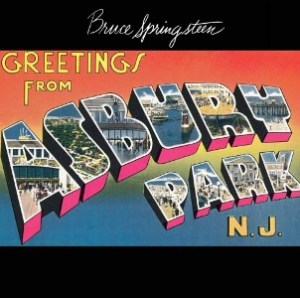
greetings_from_asbury_park_njGreetings From Asbury Park, NJ feels exactly like a debut album should: it’s full of energy, enthusiasm and awash with ideas – essentially what happens when an act has been working up these songs long before getting a deal and let into a recording studio. So here we find Bruce Springsteen at the tender age of 23, in thrall still to his idols, making his recording début not as a frontman for a rock band but, essentially, a solo artist with a few band members on a couple of tracks.

Indeed a bit of a dispute arouse very early in as Bruce wanted more tracks with his band (at that time featuring Vini ‘Mad Dog’ Lopez, Garry Tallent and David Sancious) whereas Mike Appel and John Hammond wanted more of the solo artist, acoustic feel. Not only that but Hammond’s boss, Columbia Records president Clive Davis,  didn’t feel there was a single on the album and sent his new signing back to work.

So Springsteen, proving his craft, wrote two – ‘Spirit In The Night’ and ‘Blinded By The Light’* (which would mark Clarence Clemons’ entry into Bruce’s catalogue). Neither would prove a hit for Bruce but Manfred Mann’s Earth Band would take ‘Blinded…’ to the top of the charts. The two songs pushed a trio of ‘solo acoustic’ songs off never to be heard from again. I’ve never been this song’s biggest fan, to be honest. I don’t like what I feel is wordplay for the sake of wordplay and I still can’t fathom the meaning of lines like “And go-cart Mozart was checkin’ out the weather chart to see if it was safe to go outside, And little Early-Pearly came in by her curly-wurly and asked me if I needed a ride, Oh, some hazard from Harvard was skunked on beer playin’ backyard bombardier”… it’s almost as though he’s just going for rhyme over reason… but that’s just me.


But then if – after seventeen studio albums – your début was still considered your best you’d have to wonder what you’re doing wrong, right? He’d later start finding his own voice and stripping away all the wordiness and start matching his poetry to more muscular, tighter rhythms that really worked together. At the time, though, I think he was desperate to get his foot in the door. I think he’s even explained that he’d sit on the bed with a rhyming dictionary to help with the lyrics. It’s a fun anecdote now but I think it does kinda harm the music – Jon Landau and his editing hand were still a way off.

I think the only reason I don’t spend as much time with this as I do with later albums is probably down to the production / guiding hands behind it. The whole ‘New Dylan’ tag that Columbia was marketing Bruce behind meant that  it landed somewhere between folk and rock and not firmly in either, in amongst some that don’t really leave much of an impression are some great songs on here that would later go on to become fleshed out monsters live restrained by their studio rendering –  as though Bruce wasn’t being allowed to really bust loose with his own material. When he’d play the final album to a friend, the question was “where’s the band?”

For my money the album’s stronger tracks are those which most prominently feature a band – ‘Lost In The Flood’ is an immense song for someone in their early twenties to have penned (and features Mr Van Zandt clobbering Springsteen’s Danelctro amp to get the opening sound) remains a favourite and I’m sure it’s not just one of mine, and marks the start of those ‘story’ songs that would continue on up to ‘Jungleland’.

As I’ve said, we’re already into real strong territory on this list so I won’t say anything on Greetings is bad, more that the kitchen-sink attempts don’t always work and songs like ‘Mary Queen of Arkansas’ and ‘The Angel’ don’t really hold long in my memory after listening. There’s just not much about them to kinda hang your hat on – they don’t have the melody / hook of ‘Growin’ Up’ or ‘It’s Hard to Be a Saint in the City’ which, although it’s almost drowned in the Dylanesque lyrical flood, points as to where he’d be going with his next effort in just a few months.

One of this album’s fans included David Bowie – who actually covered ‘It’s Hard to Be a Saint in the City’. Initially, though, it was meant to feature on his Young Americans album but, according to Tony Visconti, after they played the cover to Bruce, David and The Boss had a tense, private chat after which work on the song was abandoned (later released on Bowie’s 1989 box set).

I think what I really love about Greetings From Asbury Park, N.J – aside from the music – is the sheer journey it started. It’s amazing to listen to this and associate it the the same artist who, just a decade later, would be muscle-bound and singing about how he “had a brother at Khe Sahn”. Here he is in all his youthful, bearded glory, searching out the avenues his music would later stride down, a little in awe to the poetry of his idols over his own voice but still, unquestionably, massively talented.

Highlights – ‘Lost In The Flood’, ‘Growin’ Up’, ‘It’s Hard to Be a Saint in the City’.

*Jon Landau would pull the same method just a decade later, sending Bruce back to come up with a ‘hit’ as he felt that Born In The USA lacked one. Turns out that with the resulting ‘Dancing In The Dark’ it had seven singles in it.

Least to Most: Bruce – The Promise

“When the promise is broken you go on living
But it steals something from down in your soul
Like when the truth is spoken and it don’t make no difference
Something in your heart goes cold”

Three years separated the release of Springsteen’s star-making Born To Run and its follow-up Darkness on the Edge of Town. If you look at it on paper, even factoring in the long tour for BTR, that’s a big chunk of time for an artist that needs to prove he’s more than a Newsweek and Time double cover and hype. But, due to legal and contractual malarkey with his former manager Mike Appel, Bruce was forbidden from entering a recording studio and releasing new music.

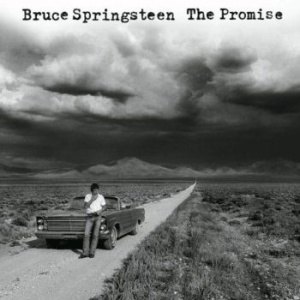
bruce_springsteen_-_the_promiseFrustratingly, this was also right at the point that Bruce was hitting his prolific stride in terms of song writing. So when, four days after his lawsuit with Appel was finished*, he finally hit the studio in May 1977 he was over-flowing with ideas and laid down eight songs in the first night alone. The take of ‘Something in the Night’ from this first session made the album. By the time recording for Darkness on the Edge of Town finished in January 1978 , Jimmy Iovine estimated that some thirty songs had been recorded and readied for release (and probably just as many in a less-refined state) – a huge increase in output when you consider that there were perhaps seven out-takes for BTR and albums prior, most of which only ever made it to raw mixing stages.

So what happened to those other songs? For a long time nothing. Some (‘Don’t Look Back’, ‘Hearts of Stone’, ‘Iceman’, ‘Give the Girl a Kiss’) were released twenty years later on Tracks. ‘The Promise’ was played live a couple of times and caused uproar when it wasn’t released on that box set (Bruce recorded a ‘new’ version in 1999 for 18 Tracks as partial recompense) along with a handful of others which became solid bootleg items but, for the most part, nobody outside of the group heard ’em.

Until 2010 when, while putting together a slightly-late retrospective package for Darkness on the Edge of Town, the songs were revisited. Most of the 22 (there’s an uncredited one at the end) are presented as-is, some had new vocals added and one was completely re-recorded by Bruce and the Darkness era E Street band, making the chiming, delightful ‘Save My Love’ the final recording session for Clarence Clemons.

‘The Promise’ was written as something of a sequel to ‘Thunder Road’ and appeared on likely track listings for Darkness almost until the last minute. One of his most-revered out-takes, Bruce felt it too soon after the release of ‘Thunder Road’ and that it threatened to over-shadow the rest of the album as well as not finding it in tune with the general theme of Darkness.

Originally released as part of  the box set The Promise: The Darkness on the Edge of Town Story, then later as a stand-along (though the box set is well worth investment) The Promise is more than a compilation of ‘lost songs’. More a ‘lost album’ in my opinion – it’s not only packed with previously unheard gems but really shows the evolution of Bruce’s songwriting. The choices he’d make in terms of cutting and refining down to get the sound he wanted for Darkness as well as showing the range of directions he could’ve gone down and just how comfortable he was with each.

There’s gorgeous pop songs in ‘Gotta Get That Feeling’, ‘Rendezvous’ and ‘The Little Things (My Baby Does)’ that must’ve been a massive delight for Steven Van Zandt when they finally saw the light of day. The slashing guitar player believes it’s “just full of some of my favorite things ever in Bruce’s history. That is now neck-and-neck with my favorite E Street album, which is the second disc of the Tracks box set”.

There’s the old-school R&B feel with songs like ‘Ain’t Good Enough for You’ (with a shout out to the up & coming Iovine) and even his recording of the the song he wrote for Elvis Presley – ‘Fire’ – which he and Steve jammed up in about 20 minutes (The Pointer Sisters would have a huge hit with it) and his own ‘Because The Night’.

This album also showcases just how much of a craftsman Bruce is – the early versions of songs that would make Darkness here demonstrate just how determined he was to work a song to get it to perfection. Take ‘Racing in the Street ’78’ as an example, how many other artists would release the version included here once they’d hit it? Not Bruce; he refined this further, working on the details until a line like “Other guys do it cause they don’t know what else they can do,  well and they just hang around in an empty home, waking up in a world that somebody else owns, and tonight tonight the strip’s just right…” became that beautiful punching line “Some guys they just give up living and start dying little by little, piece by piece. Some guys come home from work and wash up, and go racin’ in the street”.

It’s also a real insight into the creative process to hear ‘Candy’s Boy’ as something of an E Street waltz before Bruce took his axe to it and turned it into the turbo-charged (really been listening to a lot of The Boss’ car songs) ‘Candy’s Room’ for Darkness or the ‘Come On (Let’s Go Out Tonight)’ would be similarly parred down into ‘Factory’. Not only that but, in the same way as Tracks would reveal, Bruce would take a ‘discarded’ song and strip it for parts when he needed to make another song work. Any fan listening to ‘Spanish Eye’s for example is going to sit up in their car seat (or comfy chair) and say “hang on a bloody second”**…

But… but BUT. Here’s the thing. They all work in these versions too. The Promise is a fantastic album not just because it shows the different paths Bruce and these songs could’ve taken after Born To Run but because these songs are so fucking good as they are; they’re peak-period Springsteen songs recorded and mixed to a releasable state backed by one of the finest bands of its time. They could all just as easily made up an album and it would still be a solid contender. I’ve had this album spinning in my car again for the last week and I still keep stumbling across moments that make me go “shit, how did I miss that on first listen?”

While the songs here certainly point the way to what Darkness on the Edge of Town would become, they represent a ‘lost’ album, highlighting what was a very productive time for Bruce. It really isn’t just a collection of off-cuts, it’s a real insight into a creative genius hitting its stride and I’d gladly recommend that any ‘Springsteen newbie’ check out the songs on these two discs to discover what he’s all about than many a weaker studio album ‘proper’.

Highlights: ‘Racing in the Street – ’78’, ‘Gotta Get That Feeling’. ‘Wrong Side of the Street’, ‘Save My Love’, ‘It’s A Shame’, ‘Breakaway’, ‘The Promise’.

Not-so highlights: Again, pretty much into solid gold rankings now.


*Appel got $800,000 and retained 50% of rights to songs from up to and including BTR.

** or the less-British version. Interestingly the lyrics listed for this one on Springsteen’s site are nothing like the version on The Promise which begs the question as to how many versions of ‘Spanish Eyes’ there are.

Least to Most: Bruce – The Ghost of Tom Joad

“Shelter line stretchin’ ‘round the corner
Welcome to the new world order
Families sleepin’ in their cars in the southwest
No home, no job, no peace, no rest”

I’m starting to think that the poor reception that greeted Human Touch and Lucky Town kinda knocked Bruce’s confidence a little heavier than he’d let on. Going by the fact that, at the time, he was still actively fighting depression and going through a lot of personal changes, it’s not that big a surprise. One could imagine that, were he feeling more resilient mentally he may have said “nuts” to the negative reviews, gone back to the woodshed and kicked it up a notch. Instead, during the period between the end of what’s now called ‘The Other Band’ and the start of the E Street Reunion tours precious little of what Springsteen wrote saw the light of day (pun intended).

the_ghost_of_tom_joadNow to me – and I hope others – this is a real burr because what recorded material from 1994 onwards has reached the eager ears of listeners is gold and does show that the man was more than capable of saying “nuts” and going back to work. There’s an entire album’s worth (close to two*) of material that was shelved and will likely never be released. There’s been some hints as to what it contains – like the E Street reworking of ‘Waiting on the End of the World‘ – but it’s likely to remain unheard save a (much prayed for) Tracks 2**emerging and all you need to is cast a look at the material Bruce did release from that era, all with a certain understated charm, to know why we’re missing out: ‘Streets of Philadelphia’, ‘Secret Garden’, ‘Blood Brothers’ (the latter two written during a run of inspiration ahead of and during the E Street reunion for Greatest Hits), ‘Missing‘, ‘Lift Me Up‘, ‘Dead Man Walking’, even ‘Without You‘ has a joyful charm, ‘Nothing Man’ originated during this period… and then there’s this thing he wrote called ‘The Ghost of Tom Joad’.

‘The Ghost of Tom Joad’ was written around the time of Greatest Hits and Bruce even took the band through a few takes but, much like elusive ‘Electric Nebraska Sessions’, it wasn’t right. So, instead of the presumed course after that compilation’s reunion, Bruce took a sharp left: he assembled a group of songs about the American South West and, for the most part, embellished them with little more than his voice and some delicate guitar patterns weaving through the odd keyboard drone (something that started with ‘One Step Up’ and featured heavily in his 90s output to good effect).

And what a group of songs they are***. More restrained and narrow focused than his earlier solo (masterpiece) Nebraska, these songs actively incorporated silence and hushed phrasing (so much so that the tour that followed was often referred to as the ‘Shut the Fuck Up’ tour) to create memorable and affecting stories that lingered. Listening back to this one I’d forgotten just how powerful some of these are, take the tale in ‘Sinaloa Cowboys’ as an example:

Here the stories are perfectly succinct and the delicate touches of instrumentation mean that in their simplicity they achieve what the over-worked attempts of Devils & Dust failed to: stories with bite with music as a subtle backdrop rather than focus.

There are four songs on The Ghost of Tom Joad, title track included, for which Bruce assembled a small backing band – including Gary Tallent and Danny Federici – to add a little colour to the sonic palette and these serve as beautiful counterpoint to the otherwise stark, bitter-sweet beauty of songs like ‘The Line’. ‘Straight Time’ and ‘Dry Lightning’ may not linger as much as, say, the powerfully stark ‘Highway 29’ which could slot right at home on Nebraska, but the title track and ‘Youngstown’ are both essential Bruce songs.

‘Youngstown’ has become such a torch-burning, electrically recast centre-point of E Street band shows since the Reunion tour that it’s easy to forget just how strong the original is:

The other reason Ghost of Tom Joad is an essential part of Springsteen’s catalogue is that it finds him rediscovering his voice. Not the hushed tones of the vocals but the no-linger inward focus. This was Bruce looking for inspiration outside of the men vs women themes he’d used for the previous three (released, that is) albums, but looking at the struggles of others – as he says; ““the songs on it added up to a reaffirmation of the best of what I do. The record was something new, but was also a reference point to the things I tried to stand for and still wanted to be about as a songwriter.””

Received to slighter commercial success but pretty strong reviews with Rolling Stone reckoning it “among the bravest work that anyone has given us this decade”  (and a Grammy for Best Contemporary Folk Album), it perhaps receives a harsher view in retrospect from some corners than it deserves. Some criticisms fired at this album focus around the hushed, minimal delivery or the lack of fire and brimstone given to the recorded versions of songs like ‘Ghost of Tom Joad’ and ‘Youngstown’ compared to their now live rendering but, if you ask me, they’re missing the point. The songs on this album (something of a concept album in that respect) all focus on the- as  his own website puts it – ” poverty, immigration and the brittle troubles of Americans and Mexicans in the Southwest.” The desert can be a cold, bleak place with vast empty spaces. The Ghost of the Tom Joad, sonically, is the sound of these oft-broken characters staring into that space after a day in the cruel, blinding light of its heat with acceptance / surrender of the inevitable. It’s not a time for boot, stomping rock and, in the brittle, fragility of its delivery of these stories Ghost of Tom Joad remains an understated and captivating masterpiece.

Highlights: ‘Ghost of Tom Joad’, ‘Youngstown’, ‘Highway 29’, ‘Sinaloa Cowboys’, ‘The Line’, ‘Galveston Bay’.

Not so highlights: The exclusion of ‘Brothers Under The Bridge’ which could’ve elevated this album to virtually unimpeachable. But then everybody needs a ‘Blind Wille McTell’.

*Depending on how much different side-men know: Bruce has spoken about an album of more relationship songs in the minimal ‘Streets of Philadelphia’ style, Shane Fontayne has given interviews that hint at yet another. Could just be crossed wires, could be another well of unheard material. He was certainly clocking up recording sessions during this period.

** At the time of Tracks 75% of Bruce’s material was unreleased. Even the number of songs settled on for Tracks was then culled from 100 to 66. What was on those extra two discs? Surely more than went on to make up The Promise and The Ties That Bind?

***Here, again, though he wrote some 22 songs. There’s tales of two albums’ worth of songs – one with the band backing – being recorded. Some would pop up on tour, some never to be sung again. FFS.