I don’t think I’ve really delved into a long ‘series’ of posts on here before. However, after reading Bruce Springsteen’s Born To Run I was thrown into revisiting his albums, almost one-by-one as the book progressed and decided to try to share my thoughts on each – in a series.
It’s an undertaking as this is likely to include some twenty posts so thought I’d first offer up an intro so I can, with the next instalment, get straight to the chase. Now, any musician with a such a long career and discography and varied output is bound to have a number of “worst to best” type lists on them doing the rounds on various websites and Bruce is no exception.
This isn’t intended to be one of those. I’m not a music critic, this isn’t a site of critique more of personal thoughts and opinions. As such I’m going to be running through, in order (though not necessarily uninterrupted), my Least to Most Favourite Bruce Springsteen albums. It’s just that, personal favourites – I don’t lay claim to my judgement of one album’s quality to being universal or true. It’s supposed to be fun after all.
It’s also worth noting that as a Springsteen fan, while it might be among the ‘least’ end of the spectrum, any such album is still likely to be played a fair bit by me and held in overall good standing.
In my Born to Run post I mention how, when it came to the rebirth of the E-Street Band, Bruce Springsteen was hesitant almost until curtains up.
He needn’t have been. Obviously. That tour was a scorcher and set the stage (excuse the pun) for a resoundingly successful second-era for him and his band. It was captured and released on the Live In NYC album but I always felt that CD was a little on the short side.
I also mentioned that in preparing for the tour, Springsteen was building set lists that pulled heavily from previously unreleased material on the then-new Tracks and how I’d have loved to hear some of those deeper cuts. Well… while reading some early reviews of that show today I found increasing mentions of songs that were played during that tour but not captured. Given how much the reinforced E-Street Band (four guitars strong at that point and Max Weinberg hitting harder than before) added to songs like ‘Youngstown’ and ‘Lost In The Flood‘ I was delighted to find that that tour’s recasting of ‘The River’ was often followed by a re-reading of one of my favourites from that album; ‘Point Blank’.
Having found audio of it, I’ll share it here:
However….
The real gem of my search is this… the full concert from the Staples Center, Los Angeles, CA from October 1999 with a set list that varies pretty wildly from the tour’s official release and includes some fantastic cuts including my own favourite Tracks highlights ‘Take Em As They Come’ and ‘The Promise’ and also features the first play ‘Incident on 57th Street’ in close to 20 years!
While it’s not as polished or refined as it would become as the tour progressed and the arrangements tightened, it’s all the better for it’s rough and ready nature and WELL worth a listen:
I tell you, moving house knocks it out of you. Still, sometime between my birthday a couple of weeks back and popping it back up on a new shelf, I found the time to tear through Bruce Springsteen’s autobiography Born To Run (it was never going to be called anything else, was it?).
It is an absolute blast to read. Written completely solo and without the assistance of a ghost-writer, the voice is clearly that of Bruce – at times cuttingly honest, at others poetic and then written as though delivering a sermon from the stage on the LIFE SAVING POWERS OF ROCK AND ROLL!!! (yes, the caps-lock button is Bruce’s friend). Contained within its five hundred or so pages is the story of how a young man from a poor, working class family in the town of Freehold, New Jersey, fell in love with music, got a guitar, learned how to make it talk, refined his craft and cracked the code. It’s fascinating and joyous stuff.
This being a memoir / auto-biography, the story is going to be somewhat one-sided. This is Bruce’s version. So while in Born To Run, Bruce describes the recording of Tunnel Of Love, for example,by writing that Bob Clearmountin ‘tidied up’ his playing so it sounded as if he knew what he was doing, it’s Peter Ames Carlin’s 2012 Bruce that fills the picture out by pointing out that Bruce and Bob actually used samplers, drum machines and synths to create a lot of the music and then bought in members of the band to “beat the machine” – if they did the part was recorded, if not… well not every member of the E-Street featured and not every member of the band were impressed by the process but then Bruce is the Boss, a fact he gently underlines on a number of occasions in the pages of his own book; “I’d declared democracy and band names dead after Steel Mill. I was leading the band, playing, singing and writing everything we did. If I was going to carry the workload and responsibility, I might as well assume the power”.
The part of the book that deals with the period before the release of Born In The USA is both the largest and juiciest. There’s a wealth of information about the source of Bruce’s art, his influences and his decisions. These were lean times – it wasn’t until after The River tour that Bruce had anything resembling financial success thanks to lawsuits and recording costs inflated due to his infamous perfectionism – and there’s a huge amount of detail as to what drove him to take certain choices with his music. While there’s no real breakdown of what inspired each and every song (that already exists in Songs) there’s a great amount of revelations to be found.
Bruce is surprisingly candid when it comes to more personal elements too. I was a little surprised by some of his descriptions of his fellow E-Streeter’s – especially the late Danny Federici – but then his undeniable love for these band-members is also evident as his heartbreak at their passing.
Many of the column inches covering this book in the press have been at pains to mention that Mr Springsteen is equally revealing when it comes to his struggles with depression. Having managed to suppress what he describes as a consequence of the same mental plagues suffered by his father through years of working and touring, Bruce’s own depression came jumping up into his face . He is very open with his fight with and its effect on both him and his loved ones. As a fellow sufferer of that Black Dog it’s inspiring to read. His relationship with his father as a young man – while hinted at in song – is revealed in a much deeper and, at times, darker light and there’s a real sense of emotion and release when, post diagnosis with Paranoid Schizophrenia, Bruce’s father becomes a softer man and the two find some form of closure.
Part of not embracing the full ‘rock star lifestyle’ means that there’s not a huge amount of rock star stories to be found here and you’d be forgiven for skimming a go-nowhere Frank Sinatra story or those chapters (yep) dedicated to horse riding and Bruce’s equestrian escapades. Indeed, post-USA the structure is more vignettes than linear bio and some of those don’t really feel all that vital but, then, Bruce spent the larger part of that time period between E-Street lives building and raising his family and seeking a sense of calm that had previously alluded him so I’d hardly argue that this is a fault.
But there is still plenty to enjoy in the latter section of the book including some real eye-openers even post-USA. Bruce shines a little more light on the ‘missing’ album from the period between ‘Streets of Philadelphia’ and Greatest Hits – it was another ‘men and women, relationships’ themed album but steeped in that minimal, loops and beats sound he’d employed for SoP. During a drive with Roy Bittan, his trusty piano player mentioned that perhaps it was the lyrical content of this new music that audiences were having trouble connecting to. Unable to find a unifying voice and sound for it, the album was shelved “and there she sits” – ‘Secret Garden’, ‘Missing’ and ‘Nothing Man’ would see the light of day. Bruce may have shot The Professor down but it dawned soon enough – he’d lost his ‘voice’. Post Greatest Hits he went to find it and that’s why Ghost of Tom Joad is more of an important album than that subtle masterpiece may have been considered: “the songs on it added up to a reaffirmation of the best of what I do. The record was something new, but was also a reference point to the things I tried to stand for and still wanted to be about as a songwriter.”
Particularly interesting and surprising – given how logical and inevitable it must have seemed to all outside of Bruce’s head – is that up until the last minute, he still doubted whether reuniting the E-Street Band was the best move – not feeling the fire despite the band’s force, initially building a set list that drew heavily from Tracks and eschewed hits and classics (fuck but I’d love to hear that set!) It wasn’t until the fifty or so fans that had stood outside the rehearsals trying to hear the sounds drifting out were let in to watch that Bruce felt the spark.
Given the level of detail assigned to the writing and recording of earlier works, it’s a little surprising and perhaps disappointing that the post E-Street reformation era isn’t deemed sufficiently interesting to warrant the same treatment. The Rising onwards saw Bruce’s career and popularity reborn after a lacklustre nineties yet the six albums recorded since are breezed over – with the exception of Bruce noting how disappointed he was that Wrecking Ball did not garner the impact and attention he felt these songs warranted. From my point of view and deviating slightly that’s down to the fact that his and Ron Anellio’s attempts to sound sonically relevant and ‘now’ detracted from the quality of the song writing. That being said it was surprising to read the candour with which Bruce realised that, after years of doing so, he simply wasn’t the right person to record or produce his music any more.
Despite the slightness of its third act – I guess if he’d been as thorough here the book would’ve been simply too long as well – Born To Run is, without question, one of the best musician’s autobiogs I’ve read. Hugely insightful, informative and written with a trueness of voice that equals Bruce’s finest music, it’s an essential read for any fan and a bloody important one for anyone with even a passing interest.
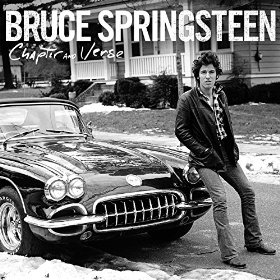
Released to accompany the album is Chapter and Verse. Given that it took close to twenty-five years and eleven albums for Bruce to release his first Greatest Hits and in the twenty years that followed there were another three such compilations to the six studio albums… it’s hard to believe that another new compilation were needed to do so, it does kinda reek of cash-grab.
Of the eighteen tracks on Chapter and Verse, thirteen have already been released many in the same order on other compilations. That’s not to say the songs aren’t required listening – any album that contains ‘The River’, ‘My Father’s House’, ‘Born To Run’ and ‘The Rising’ is easily going to stand strong. In some respects the running order here is more beneficial than other instances – lifting ‘Long Time Comin” from it’s sandwiching on Devils And Dust‘s weaker tracks really allows it to shine. But, given that fans will already have either the existing compilations, the albums these tracks are culled from or both, it’s hard to argue a case for their recompiling.
So – the big USP of Chapter and Verse comes down to this; the first five songs have not been released previously and pre-date Bruce’s recording career with Columbia. But are they worth shelling out for? In a couple of words, sorry but not really…. These songs are notable for the progression they represent (even the jump in style between the two cuts from Springsteen’s first band The Castiles) but, ultimately are only being heard because who one of their members went on to be. The Steel Mill song ‘He’s Guilty (The Judge Song)’ is a standard southern-blues stomper recorded in San Francisco as the band tried to use California to break out of Jersey-only stardom but highlights what Bruce himself realised; for every Allman Brothers Band there were a hundred Steel Mill’s and there’s little here to distinguish them above the pack. The exception, though, is The Bruce Springsteen Band’s ‘The Ballad of Jesse James’ which, of the five ‘new’ tracks is the keeper.
For myself, and I’d wager a few others, I’d rather the previously-unreleased material shone some light on either the E-Street Band’s take on Nebraska (that the fabled Electric Nebraska exists in its entirety is confirmed in Born To Run) or Bruce’s shelved album from the nineties… so I’ll drop one such track here – ‘Waiting On The End of the World’, written for that album and taken a stab at with the E-Street Band at the time of Greatest Hits which, for my money, is still the best Springsteen comp.
If you are still looking for music to ‘accompany’ the reading of Born To Run, there’s a Spotify playlist that Bruce (or someone on his team, most likely) put together containing all songs referenced and important:
I’ve been finding comfort in familiar sound recently so those newer releases by the Pixies etc haven’t really been given a listen. But, here’s an idea of the current playlist:
Jack Rose and his mastery and innovation of the acoustic is actually a new discovery for me. I think the lack of vocals made it easier for me to get into over the last couple of weeks. A huge body of work still to hear for the first time as Mr Rose made a lot of music before his untimely passing but this, from the brilliant album I Do Play Rock and Roll is hypnotisingly awesome.
Because I’m still gobbling up House of Cards
I don’t think I’ve even mentioned Mr Petty on here… odd. Anthology; Through The Years is one of those rare compilations that’s absolutely perfect and, after starting to watch Runnin’ Down A Dream on Netflix, is now back in rotation in my car. Eddie Vedder says, at the start of the documentary, “The first time you hear a new Tom Petty song is sounds like, you know, a classic song.” – he’s not wrong. If you only have the aforementioned compilation you’ll know just how many sheer belters the man has written.
Going back to an earlier discussion on Dire Straits… I’ve been listening to Making Movies the last couple of days, in particular this opening track (and Skateaway). It’s made me wonder something though; in 1980 Mark Knopfler borrowed both a producer (Jimmy Iovine – having loved the production sound of Patti Smith’s ‘Because The Night’) and band member (Roy Bittan) from Bruce Springsteen to make what was the band’s breakthrough third album (Iovine had a thing for making third albums). A few (seven to be precise) years later Bruce dropped his own (and arguable one of his finest) album and song called Tunnel of Love. Where Knopfler’s track featured lines like “Come on and take a low ride with me girl, on the tunnel of love”, Bruce used “Cuddle up angel cuddle up my little dove, we’ll ride down baby into this tunnel of love”… Now, while both album’s dealt fairly prominently with love’s broken promises, Bruce’s album and lyrics were significantly different, more nuanced and the sound very much of his own but… I have to wonder; surely Bruce must’ve heard what his piano player and produce had been moonlighting on and did that plant a seed that, over a few years, grew into one of his most brooding and significant albums?
Could be because – following an unexpected dance along in HMV – my son has adopted Glory Days as his current favourite and I end up putting it on in the car in the mornings and so listen on after dropping him off. Could be. Could also be that (High Hopes aside) there’s such a volume of great songs that not many an artist can compete.
Today it’s all about American Skin (41 Shots).
It’s a funny one, or three, really.
Live In NYCwas probably the first ‘new’ Springsteen album I bought after getting into him. While not the most comprehensive live album it’s a great snapshot of the reunited E-Street Band at the peak of their performance for that tour and captures one of his then most contraversial songs, American Skin (41 Shots) in the most appropriate of settings – Amadou Diallo was gunned down by police officers in New York.
It’s an important song both socially and in terms of Bruce’s catalogue. Prior to it’s debut the only ‘new’ music played on the tour that wasn’t from Tracks was familiar Brooooce territory – Code of Silence, Land of Hope and Dreams and an early Further On Up The Road – but for American Skin (41 Shots) found the socially aware voice that he’d been lacking. It’s angry, it’s well crafted, it’s bitter and brooding, it’s tight, it’s got a fantastic guitar lead and solo from Bruce and explodes in all the right places and stands amongst his best tunes to this day.
It went down one of two ways – fans loved it. The police were pissed off. They called for a boycott of his shows after he premiered it in Atlanta. Fuck ’em; he bought it to Madison Square Garden with him and it was recorded on the accompanying album.
Then in order to get it played he recorded a studio version of the song in 2001 for radio (when it was still a relevant outlet). It’s a strong version. For one thing it’s the E-Street Band as was that first bought the song to life. It lacks the spark and passion of the live version but that’s to be expected. It’s still solid, though, and convincing in it’s message and sentiment and still has Bruce’s lead guitar:
Then, bafflingly and frustratingly to many, he stated that and so re-cut it for High Hopes. When I say re-cut I really mean that in letting Ron Aniello over-egg the pudding with needless he pulled the passion out of it, allowed Tom Morello to staple a piss-poor 80’s power ballad solo in place of his own and had Clarence Clemons’ sax swapped out for one performed by C’s nephew Jake. He stated that the song had never been ‘presented’ officially on a studio album. And I believe that everybody said “so?!” Neither has Seeds but he didn’t let Morello wreck that. It’s got the same structure, the same lyrics and build up but it just feels like a pale imitation, especially when it comes to the climax.
The 2000 studio version is streets ahead of the High Hopes version but the ultimate take is still the live recording from NYC….
Ugh. It almost pains me to write this. Especially when I consider that this will be the second time I mumble about a Springsteen album and the second not-so-favourable. I say this now because I do love a bit of Bruce Springsteen. My collection is stuffed with Boss. Nebraska, Tunnel of Love, Magic, Darkness and both Borns get heavy rotation. However….
Earlier this year Bruce Springsteen released his eighteenth studio album. Eighteenth. Saying that, two of the songs have seen release previously and three of the remaining are covers.
Before I get into this too much and why am I getting into this now….
This weekend, while doing a bit of tidying up and keeping the little man company, I found and put on Springsteen’s Blood Brothers DVD. It documents the slightly awkward and touch-too-soon mini reunion of the E-Street Band to record a few new tunes for Bruce’s first Greatest Hits (I should note here that I got that CD on its release and it served as my introduction to Springsteen and from there on…) .
Two things came from watching Blood Brothers that feed into this post. The first is a moment where, suddenly, the discomfort and ill-at-ease Bruce felt in front of the camera seems to fade as he discusses the implications of a string arrangement that had been created for Secret Garden. Talking of the song as a narrative, Springsteen explains to the gathered co-producers and mixers that the song is a narrative. If any arrangement or sounds distract from that “we’re fucked.” The second element of note is that the 1995 session captured also found Bruce and the band cutting into Tim Scott McConnell’s High Hopes for the first time.
That version of High Hopes was released as a B-Side to Secret Garden. Which, really, is where it should have stayed.
Let’s skip forward to 2014. Post 2000 Springsteen is a different proposition to that of ’95 model Bruce. Now willing to trust others with production work, Bruce has seen his music produced, with varying results, by Brendan O’Brien (who should have taken a bow after Magic and not gone for the victory-lap with Working On a Dream) and, lately, Ron Anellio. Credit to him for this decision. If he’d stayed working away on his own, we may not have had the rebirth and revitalising of his and the E-Street’s sound that came with The Rising. Going on past lessons and biographical revelations, he may still have been in his home studio labouring away on the one album. Self-producing rarely works. It’s key to get a good collaborator in that can bring out an artist’s best and encourage them to shine.
So what’s the problem? Well I’d say Bruce has gotten a little lost lately in a seemingly ill-fated determination to sound fresh and vital. Just look at the cover. Sorry Bruce but is the double denim and popped collar really the best fit for you in 2014?
In the past, Bruce has had a very tight quality control. Not letting anything out that he wasn’t 100% happy with or didn’t fit the feel / story of an album. That’s what archival releases like Tracks and the Darkness box are for. Working On A Dream marked a turning point. There should have been more use of “no” in the studio on that one… “supermarket beeps and a song about fancying the girl on the checkout while doing your shopping? Sure thing Boss!”
Fuelled by social circumstances again and looking to vent, for Wrecking Ball Bruce came up with some of his tightest and most direct, angry lyrics yet. However, the collaborators bought in to furnish these songs took them the wrong way and did exactly what Springsteen previously voiced such determination to avoid – they detracted from the lyrics and the songs.
Unfortunately the songs on High Hopes suffer the same fate at the same hands. This is not a studio album in a true sense. Long-term Springsteen ally/collaborator/sidekick Stevie Van Zandt has often said that on any one day, Bruce will have at least half an album of songs on him. With High Hopes we discover what would happen if that half-album of songs were taken into the studio, recorded with selections of the E-Street Band, it’s latest quasi-addition Tom Morello shoved in awkwardly, mixed with another half-album of left overs from the last decade, warmed up by over-production and served as a ‘fresh’ dish.
That’s not to say that the album is devoid of good music. Frankie Fell In Love, Heaven’s Wall, The Wall, This Is Your Sword… all top-draw Springsteen material, even the brooding Harry’s Place feels like some of the cracking, darker material Springsteen wrote (though never truly released) in the early 90’s. Even it, though, is over-worked. Heaven’s Wall is nearly drowned in over-the top choir arrangements. Those heavy handed arrangements blight too much of the strong material here and are used far too much to prop up the lesser songs.
Morello is, frankly, out of place here. His guitar parts, the scratchy sounds that were once new and compelling, are both now and here tired and overplayed. They sound clunky when added to the title track and trample all over songs they have no business being near. Just take the title track as an example. It’s said that this project was born after Morello hearing High Hopes while preparing for the Australian leg of the Wrecking Ball tour and proposed it join the set list, from there the studio beckoned for a ham fisted bounce over a song that was only suited to B-Side status (let alone lead-single).
See:
We didn’t need a second take on Ghost of Tom Joad and as for the recasting of American Skin (41 Shots)? The live version of this was compelling, tight and full of well-directed anger with a searing solo from Springsteen himself. It came at a turning point for Springsteen – pre-9/11 and on the back of the reunion tour, a relative drought of quality new material in the 90’s and here, suddenly, was a glimpse at new material that bristled over with the force of old material. Guitars like teak bolted onto socially-aware lyrics and furnished with delicate, perfectly fitted arrangements from the E-Street Band. A precursor to The Rising and a return to form after a decade of almosts.
Bruce has said that he never felt it got presented properly. So, as with Land of Hope and Dreams on Wrekcing Ball, it was given a new studio arrangement. Surely it would be a winner. Relevant again with the shooting of Trayvon Martin and back in the set list, a slow burning tune that builds to a thundering climax and release. Surely it would be a winner. Surely…. Except it isn’t. Instead that same song is flat (albeit with the exception of Clarence Clemons’ sax giving us one last treat from beyond), layered with cheap-sounding production effects and, in place of Springsteen’s own guitar, ruined by a solo from Morello that’s bad-80’s-power-ballad by numbers.
With Nebraska, Bruce took his raw, home-made demos to the E-Street Band. They tried them on for size and found the songs didn’t fit in the band setting. Springsteen released them as was. The result is one of his most loved and praised albums.
Secret Garden: Bruce tried a few grander arrangements, added layers, different string parts. Didn’t work. The original arrangement was released. But, the other arrangements, rather than scrapped, did see release as B-Sides and soundtrack additions.
With High Hopes…. it’s the heavy handed, overworked and near-drowned in effects versions of the songs that have been released.
In a way, High Hopes is best looked at as a “what if” album rather than a legitimate ‘new’ studio album. What if some of these songs – Frankie Fell In Love, Heaven’s Wall… been given that little bit longer to gesticulate. What if some of these had been included in place of the clukers on Working On A Dream? What if Down In The Hole had been used in place of its very-close sister Paradise on The Rising? Sadly it’s not as intriguing or rewarding a listen as the “what-ifs” of Tracks’ second, third and even fourth discs.
To me, now, nearly ten months later and with Mr Springsteen assuming radio and road silence again, it’s a case of not only what-if but please, when the next album emerges we find the quality control of old back in place.
Let me kick this post off with a couple of statements, in a ‘don’t get me wrong’ manner. Firstly, I love a bit of Rage Against The Machine and the first Audioslave album was an absolute monster musically – the other two had their highlights too. I’m also a huge Springsteen fan, many of his albums are perpetually in my car’s multichanger or playing through my iPods. It’s easy enough; I have them all, some in multiple formats and even a few of the boxsets.
Accordingly, my point is even stronger than an unbiased few as I admire both men as artists and some of their songs have featured in key moments in my life. One of the things that I really don’t like is hypocrisy and I can’t help but think they’re both guilty of it to a large extent at the moment.
Let’s take Wrecking Ball as an example. It is a fine album. It’s certainly a lot stronger than Working On A Dream. It’s tight, it’s cohesive and sounds vital and packs a real punch – surprising given the lack of cohesion in the assembled musicians (there’s no real band more different groupings of musicians) which speaks volumes about the writing and production. We Take Care of Our Own, Jack of All Trades, Land of Hope & Dreams, Rocky Ground and even the title track are belters that will no doubt be setlist staples on the next few tours (Land… has been for the last decade already but the newer version is tighter than a duck’s arse). Death To My Hometown is a corker of a song that sounds like Bruce swallowed the songbook he’d been sniffing at for Seeger Sessions, chugged down some rocket fuel, strapped a guitar on and let fly (I sniffed a musical-criticism-cliche book before writing this).
The thing that stops me loving this album as much as Magic (of his recent splurge of productivity Magic and The Seegar Sessions sit up there with Darkness, Born To Run and Tunnel) is the inclusion of a couple of clunkers. I’m not talking about We Are Alive or You’ve Got It (every classic Boss album has a track or two like that but you know they’ll eventually grow on you in the same way as the jokes in a Hemmingway novel stop you getting overpowered by the weight of the drama). It’s the songs of ‘anger’, the songs that address the State of the Nation – you know, a financially and morally bankrupt America (not that the U.S of A is alone in such a state but Bruce’s Jersey is New not of the Channel Islands) – that irk me.
Yes, Bruce is at his best when he’s ‘angry’ and brooding. Look at Nebraska, Darkness and even USA. Hell even Tunnel of Love is a record of despair. But that negativity is more of a personal one – it’s his father, his soon-to-be ex-wife or even the Talk Show Stations on the radio. On ..USA, yes, there’s anger at the way the government is treating veterans and a few stabs at the system in Downbound Train but…. But my problem is that here Bruce Springsteen now is singing as if one of the ‘99%’ as the Occupy Movement have come to regard those of us that don’t have a few million in pocket change on any given day.
Bruce who is worth a rough $200 million or so. Mr Springsteen who has sold more albums than the entire Occupy movement has used markers for their placards. On Wrecking Ball’s weakest tracks (musically they’re diamonds cut from the same rock that spawned Seeger Sessions) Shackled and Drawn and Easy Money, Bruce sings about how:
“workingman pays the bill
It’s still fat and easy up on banker’s hill
Up on banker’s hill, the party’s going strong
Down here below we’re shackled and drawn”
Or how he’s going out on the town in search of that ‘easy money’. Now these are admirable lyrics. They are. For someone who can be beleived to be the character in those songs. I desperately wanted to catch Bruce and E-Street Band when they come to town this year but I was put off because I’d be facing a nice £200 cost just for me and my wife to catch the show. Anyone with ticket prices that high is already up on ‘banker’s hill’. If this were the Bruce that sang of operas being played out on the Turnpike and the streetlife of Asbury park circa 1972 it would be believable but for the multi-millionaire musician of 2012 to be singing as if cap-in-hand is as appropriate as Kirk Lazarus having a skin pigmentation procedure to play Sgt Osiris.
Tom Morello - leave it at home mate
Let me reiterate one of my earlier points – Wrecking Ball is a good album. It’s bloody good. One of the highlights is the guitar work (though it’s nowhere near as it good or fiery as it couldshould be) of Tom Morello – not to mention Swallowed Up In The Belly of a Whale which is a dark, broody monster that creeps into your ears and should have replaced Easy Money. The two musicians are pretty close lately and have been popping up together wherever a need to stand on a makeshift stage and sing This Land is Your Land in a real ugh-inducing way – does a 70 year old Woody Guthrie folk song really sum up the problems faced by ‘the 99%’? – presents itself.
Indeed, Mr Morello is seemingly trying to become Guthrie – his guitar painted with whatever cliched slogan pops into his head and singing ‘protest’ songs at every opportunity while doing his damndest to become the champion of the Occupy Movement. Once again, this smacks of hypocrisy to me. How big were Rage? How many millions did they sell? Shitloads. Not only that but how many times have the band members gone “kerching!” to festival appearance requests since reuniting a few years back? How can you speak for the 99% (I should point out that I hate that phrase in itself) when you’re so far from being amongst them?
The only person who was able to imitate Guthrie without being so hideously ham-fisted about it was Bob Dylan but that was in 1962 and even he gave it up quickly – in fact, he never even claimed to be a protester. For multi-millionaire musicians whose talents lie in creating music of a far different beast to be suddenly finding their inner dust-bowl just reaks of cash in.
Bruce recently said that he would never be as active politically as he had been in the run-up to Obama’s victory, saying that artists should be “the canary in the cage.” Absolutley, couldn’t agree more. However, there’s a difference between lending your support and voice to a group and trying to be one of that group. Especially when the gap between their message and your circumstances is so severe. Christ, we’ll have Bon Jovi singing from the point of view of starving Africans next.
To rectify this malaise, stick the first RATM album or Battle of Los Angeles in your CD player – those are real songs of anger and power – or get hold of Wrecking Ball. I still love it but then I’ve adjusted the tracklisting thusly:
We Take Care of Our Own
Death to My Hometown
Jack of All Trades
This Depression
Swallowed Up (In The Bell of the Whale)
Wrecking Ball
You’ve Got It
Rocky Ground
Land of Hope and Dreams
American Land
We Are Alive
Bonus Tracks:
Easy Money
Shackled and Drawn
Like I said, it’s a great album and Bruce is better when he’s packing a punch (I really don’t want another Lucky Town / Human Touch or Queen of the Supermarket) but this way there’s a little less “I’m one of the people” cheese.