Least to Most: Pearl Jam – Riot Act

“Take the reigns, steer us toward the clear…”

A lot can happen in two years. I’ve written on the time between Binaural and Riot Act before but, to summarise: nine fans were killed during the band’s performance at the 2000 Roskilde Festival – an abrupt full stop which found Pearl Jam questioning if they could continue, friend and fellow ‘grunge’ icon Layne Staley died, Eddie Vedder went through a divorce and, external to the band, the terrorist attacks of 9/11 and the Bush administration shifted America’s landscape drastically.

Ahead of their first show following Roskilde, Eddie Vedder sat alone in his hotel room writing a song to “reassure myself that this is going to be all right.” ‘I Am Mine’, as Matt Cameron said, “has all the elements this band is known for: strong lyrics, strong hook, and a good sense of melody. It wasn’t a really tough decision to have that be the starting point for the record.”

Following the Binaural tour cycle, Pearl Jam took a short break – Matt Cameron’s Wellwater Conspiracy dropped it’s third album, Stone Gossard released the first ‘solo’ album from a Pearl Jam member (which he was in New York promoting on 9/11) and Vedder – having played five shows with Neil Finn and other musicians (later captured on the worth-checking-out Seven Worlds Collide) – disappeared off the grid for a year on a remote Hawaiian island where he connected with Boom Gaspar who was playing B3 at a musician’s wake. The two hooked up again a few days later and very quickly wrote an eleven minute tune that would become another key album track, ‘Love Boat Captain’.

When it came time to recording their new album, Pearl Jam chose to do so with Adam Kasper (who’s credits to that point included two albums for Foo Fighters, a Queens of the Stone Age album amongst others) at the suggestion of Matt Cameron as Kasper had also produced Soundgarden’s last album, Down on the Upside.

The resulting album is one of the lost gems in Pearl Jam’s catalogue. Riot Act has still – 16 years on – shifted less copies than Vs did in its first week alone. I know Pearl Jam fans who don’t know more than the couple of tunes that remain in modern setlists. As I’ve argued before and will continue to do so – they’re missing out. Stronger than BinauralRiot Act benefits from Vedder having banished his writer’s block and having a much broader and emotional range of subjects to draw on and, frankly, get angry about -though Vedder has said that “If you think about it, it’s all very confusing and overwhelming to try to grasp it and put it all down.”

The album kicks off with ‘Can’t Keep’ – a tune that Vedder had played on the ukulele during a couple of solo shows (and would record as such on his own Ukulele Songs a few years later) that Gossard heard and enthused would be “killer” with the full band treatment and became a slow-burning thumper with buzzing, treated guitars that feels like a No Code song and leads into what is now a quite rare thing: a full band composition, ‘Save You’.

With lyrics that tackle addiction and the pain and frustration of seeing a close friend waste their life, ‘Save You’ is Mike McCready’s only writing credit on Riot Act and came about when he was sitting down with Stone Gossard (who contributed a fair bit song-writing wise) and “had two ideas, and one idea I worked really hard on and thought it was totally great and then I played it for him, and he goes, ‘Well, that’s not…well that’s okay. You got anything else?’ And so, the other thing I had was the “Save You” riff, and he goes, ‘Oh, that’s cool.’ Ya know, so it’s…I was really built up to wanting to play this other song, and uh, nobody seemed to be very excited about it…”

‘Save You’ leans into the relentless, hard-edged rock sound that would blend seamlessly alongside tracks from Vitalogy as would the propulsive-beat driven ‘Green Disease.’ ‘Thumbing My Way’, meanwhile, is an acoustic ballad that showcases a change in direction for Vedder’s writing and is a clear signpost for what was to come with Into The Wild while ‘You Are’ is a personal favourite. Born out of expirmenting with a new drum machine that Matt Cameron had gotten hold of, it’s another great example of the band taking one member’s ideas and creating something memorable.

It would be impossible to talk about Riot Act without giving at least a passing mention to ‘Bu$hleaguer’. A dark, weaving satirical swipe, this was Pearl Jam at their most unambiguous politically and – while not much touched since – would regularly draw boos and jeers from certain clusters of the crowd when played live. Though even before the record was released there was no way to think Pearl Jam were Bush supporters so you’ve gotta wonder about the ‘shock’ it created.

Riot Act could very easily have been Pearl Jam’s greatest record. Reinvigorated and with a wealth of inspiration to draw on, there are some fantastic tunes on their seventh album (and there’s not many bands you can say that about). But… they should’ve taken a break. They sound a little tired and songs like ‘Ghost’ and ‘Help Help’ even sound tired. As much as I love the majority of Riot Act there are still 5 of its 15 songs I’ll skip more than listen through to and while that’s still a pretty signal to noise ratio (to borrow a phrase), when stacked against other works – it means it doesn’t quite reach the heights it could have done.

The odd thing is that had you cut those 5 songs and thrown in the ‘B’ sides recorded during these sessions – ‘Down’, ‘Undone’, and the brilliant ‘Otherside’ instead then Riot Act would have been one of their greatest albums.

However, there’s a sense of finality about Riot Act. In many ways it marks the end of a chapter for Pearl Jam – it would be four years before they’d release another album and, with Riot Act they completed their ‘studio’ obligations to Sony Music’s Epic Records with whom they had signed as Mookie Blaylock ahead of recording their debut Ten and, following their next tour, would take a much-needed break.
Least to Most: Pearl Jam – Lightning Bolt

“It’s a fragile thing, this life we lead
If I think too much I can get over-
Whelmed by the grace
By which we live our lives with death over our shoulders”
Sirens

Four years seperated the release of Backspacer and Lightning Bolt, Pearl Jam’s tenth (and, currently, most recent) studio album. A band that used to release an album every 18 months or so like clockwork had learnt to slow down and catch their breath between releases and tours.

In those four years the band was far from idle. There were re-releases / expanded editions of Vs and Vitalogy, a live album and the whole Pearl Jam Twenty celebration / lap of honour that included a Cameron Crowe helmed documentary, book, compilation (all very very good), two day festival and tour.

Oh – and a plethora of solo activity: Jeff Ament formed RNDM with Joseph Arthur and released and album as did his other side-project Tres Mts, Stone Gossard dropped a couple of Brad albums, Matt Cameron slipped back onto the drum seat for a little-known Seattle band called Soundgarden’s reunion, Mike McCready got in on a Mad Season reunion-of-sorts and formed Walking Papers with Duff McKagan (yes, that Duff McKagan) and even Eddie dropped a solo album, again ‘of sorts’, with Ukulele Songs (which is fine depending on your appetite for half an hour of Eddie and his uke).

Why do I mention all these solo projects in a review of a Pearl Jam band album, I don’t hear you ask. Well, for all the claims that these side projects help the band members bring more into album sessions and that may have been true in the 90’s when the band had couldn’t stand up for ideas falling out of their arses, I think it’s now the opposite case. When sessions for Lightning Bolt were delayed and interrupted by these commitments and solo tours I can’t help but feel that creative and energy levels were actually drained than recharged and the band’s tenth studio album kind suffered as a result.

But does that matter? Let’s face it: Pearl Jam are in a pretty unique position that few bands or acts reach. Twenty-two years into their life as a band they’re one of the greatest live draws still regularly touring, can sell out arenas, stadiums and ball-parks across the globe, their place and legacy are sealed and were – in 2013 and now – at the point where as long as their new album didn’t stink the place up like Pepé Le Pew and contained a good few songs to mix into the live set, will continue to be able to do so for years to come and keep their legacy intact even if it’s unlikely to bring any new fans into the fold.

Sill “everyone’s a critic looking back up the river” as the first words that ushered in Lightning Bolt point out and there’s a lot of strong material and a willingness to experiment and push boundaries within these forty-seven minutes that show Pearl Jam aren’t quite ready to rest on their laurels and are still trying to push their songwriting forward.

Lyrically, these are some of Vedder’s most accessible and direct, an extension of the approach begun on Backspacer (“For years, it was playing word games and expressing those emotions, but doing it in such a way that was cryptic and where Mark Arm from Mudhoney would still have some modicum of respect for me. But nowadays, it’s more like sitting down and writing a song, and whatever comes out, comes out.”) and musically it’s a lot more diverse than their previous album, with Stone Gossard referring to  “a slight return to some of the more sort of peculiar things we did, say, between No Code and Binaural.”

I really dig a huge chunk of Lightning Bolt and love that diversity in their sound, aptly beefed up by the physicality of Brendan O’Brien production. Take ‘Pendulum’ – how often to you get to hear Mike McCready using a bow on his guitar? – for a good start:

It’s a dark, broody beast that really doesn’t feel like the ‘by the numbers’ Pearl Jam you’d expect of a band this far into their recording career and works great live. It was a Gossard add Jeff Ament composition that even they didn’t expect Eddie to latch on to and work up into a band song. While we’re in the mid-section, ‘Pendulum’ is preceded by another Ament & Gossard composition and highlight, ‘Infallible’, whose groove and progression are like noting else in the PJ catalog and I love the directions the melody veers off in, with near-Beatles like passages :

A lot of attention pre and post release was given to ‘Sirens’ with due course. It’s one of the band’s finest. From a musical point of view, it’s a Mike McCready compostion (which I can never have enough of) inspired after attending a stop on Roger Waters’ ‘The Wall’ tour and wanting “to write something that would have a Pink Floyd type feel”. You can tell pretty much exactly which song he was cribbing from but when paired with Vedder’s most open and direct lyrics it’s elevated beyond ‘power ballad’ territory to a yearning ode on the fear of life’s fragility and our own mortality.

Of course, there are some more expected leanings on Lightning Bolt. ‘Mind Your Manners’ is a ripping, Dead Kennedys inspired rocker that finds Vedder back in angry mode and plays to their strengths, as does ‘Let The Records Play’ which threads a ‘power of spinning vinyl’ theme around a tasty Stone Gossard (this is very much a record for Stone fans) riff with great results.

Instead of a couple, Lightning Bolt produced a good half dozen songs that really add to Pearl Jam’s setlist (even if they’re not the ones that Ed scrawls onto a piece of paper ahead of a show) and any PJ playlist – including the one which will follow this series*. However, there are a few that don’t make the cut.

I still haven’t really clicked with ‘My Father’s Son’ and while ‘Lightning Bolt’ and ‘Getaway’, for example, are fine songs they don’t particularly add anything to pull this album further up in terms of its ‘go to’ placement in the band’s overall catalogue.

Vedder said of the writing that they’re continually trying to ” make not just the best Pearl Jam record, but just the best record.” While Lightning Bolt may not be the one, it is stronger than you’d expect of a band’s tenth album and finds the band not only playing to their strengths but still pushing in unexpected directions. As long as they continue trying to do so it’s worth checking in and always worth getting to a Pearl Jam show when they come to town.

Oh, and in terms of album closers, though, they went with a beauty on Lightning Bolt with ‘Future Days’.

Highlights: ‘Mind Your Manners’, ‘Sirens,’ ‘Infallible,’ ‘Pendulum,’ ‘Let The Records Play,’ Yellow Moon,’ ‘Future Days’.

Not-so highlights: ‘My Father’s Son, ‘Sleeping By Myself’.

*At this rate that may be a Christmas special

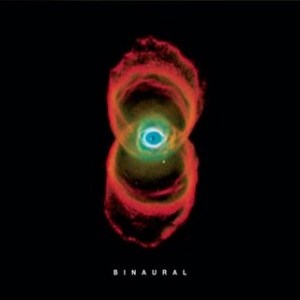
Least to Most: Pearl Jam – Binaural

“We’d rather challenge our fans and make them listen to our songs than give them something that’s easy to digest. There is a lot of music out there that is very easy to digest but we never wanted to be part of it.”

I have a real soft spot for Binaural: I got into the band a year after Yield so this was both the first Pearl Jam album I bought on day of release – as well as the singles for ‘Nothing As It Seems’ and ‘Light Years’ – and the album they were touring behind when I caught them live.

Not only that but I do genuinely believe that there are some real gems on Binaural that, due to its relative low commercial performance, don’t get the recognition they deserve. So much so that I’ve already blogged about this album in a lot more detail here.

But, for all that, in terms of where it sits in preference levels to the rest of the band’s discography – not all that high. Of the highs – this album has an unimpeachable mid-section of ‘Light Years’, ‘Nothing as it Seems,’ ‘Thin Air’ and ‘Insignificance’ but that section is buffered by some pretty dense sounds.

Some of this was on purpose, with the band’s decision to change things up with Tchad Black (as the band moved away from producer Brendan O’Brien for the first time since Vs) recording many of the album’s songs employ two microphones to create a 3-D stereophonic sound.

On some songs – notably ‘Of The Girl’ this layered, textured sound works wonders. Elsewhere, the sound quality and mixes just don’t feel right. Looking back, even band members have come to regard Binaural as an album marked by distractions and missed opportunities, a lack of focus that meant the album lacked the power it could have had.

Gossard, for his part, feels that they should’ve gotten more out of new drummer Matt Cameron – “It should have devastated in a way that Temple of the Dog devastated”. They just weren’t writing with him in mind. Jeff Ament goes further, believing that in cutting songs like ‘Sad’ and ‘Education’ “we look back and think we didn’t put some of the best songs on it.”

But, it was the band’s first venture into the studio with Matt Cameron and, while he made an immediate contribution to songwriting with ‘Evacuation’ (not one of the album’s strongest) and a few tracks left on the cutting floor, the in-studio chemistry wasn’t quite there. They were working with a new producer for the first time, Mike McCready was battling an addiction to painkillers that saw him absent from many a session and Vedder – also in the middle of a marriage breakdown – was plagued by a case of writer’s block that got so bad he had to be stopped from picking up an instrument and writing more music until he had completed lyrics to those songs already piling up and waiting for them. As the man himself told Spin magazine following the album’s release:

“It’s bad when you have writer’s block in the studio and you’ve got three songs without words and four days left. It pretty much happened on the last record. And the worst part was they were songs that I had written. I had written the music to “Insignificance” and “Grievance”. I just wasn’t happy with what I had so I kept working on it and scrapping it and staying up at night, playing piano melodies to make it be the best thing. And it worked, finally. That causes hell in a relationship, that’s all I’ll tell you”

Unfortunately, none of these are ingredients for a great album.

On the plus side – this meant more opportunity for contributions from other band members than on previous albums with three songs and lyrics written entirely by Gossard  ‘Thin Air’, ‘Of the Girl’ and ‘Rival’ alongside Ament’s ‘God’s Dice’ and ‘Nothing As It Seems’.

Binaural is, in many ways, a missed opportunity. Pearl Jam, for all their ‘year or no’ decisions that lead to a cessation of music videos, a reluctance to give interviews or -for a large chunk of time – playing at Ticket Master rep’d venues,  were still in the album-tour-album-tour-album cycle. It would be a while before they’d learn to take a break and I can’t help but wonder if, had they taken just a little longer between Yield and their next album to attend to their own personal lives and breath a little, if Binaural wouldn’t have been their greatest. The ideas are all here, the parts are all right there with em but the final execution just misses the mark.

But – it’s still very very much worth a listen and is one of the few albums for which I’ve broken my ‘if I already have it on CD I won’t by it on vinyl too’ rule for. Oh, and it also introduced Ukulele Ed with ‘Soon Forget’ – a song that, when he was still a baby, I would sing quietly (minus the uke) as a lullaby to my son at nights and, so, ranks as a real personal favourite.

Highlights: ‘Light Years, Nothing As It Seems, Thin Air, Of the Girl, Grievance, Sleight of Hand, Soon Forget

Not-so highlights: ‘God’s Dice’, ‘Evacuation’.

Least to Most: Pearl Jam – Backspacer

“But I am up riding high amongst the waves
Where I can feel like I
Have a soul that has been saved
Where I can feel like I’ve
Put away my early grave”

Let’s kick this off with a reminder of this series’ caveat – this is not a critical ‘worst’ situation and I can well imagine any of these albums being cited as a favourite by others.

In many ways it pains me to start this series off with Backspacer but it has to start somewhere and the band’s 2009 album is probably the least-played of their discography in casa Hill.

Why does it pain me? Like many I was very much hyped to grab this one when it dropped. The build up to it painted a strong picture of a revitalised band about to release an album that could sit amongst their strongest. 2006’s Pearl Jam (or ‘Avocado’) seemed to find Messrs Ament, Cameron, Gossard, McCready and Vedder back on focus and  firing on all cylinders and even the fickle media was back in their corner.

In fact, press leading into the recording dropped even more fuel for anticipation – for the first time since Yield Brendan O’Brien was at the helm. O’Brien had produced Pearl Jam’s cover of ‘Love, Reign o’er Me‘ for the (pretty pants) Adam Sandler film of similar title. They had a blast together and when it came time for a new studio album, the choice was a no-brainer. According to O’Brien, Pearl Jam “were ready to be, for lack of a better word, “produced” again” while Vedder told Rolling Stone “In the past, Brendan would say, ‘It’s a great song, but I think you should do it in a different key,’ and we’d say no. But now that we’ve heard Bruce has listened to his suggestions, I think we will too.”

It all pointed to ‘great’. And there is a lot of great stuff on Backspacer. Take first single ‘The Fixer’ as an example – it’s  pure hook, it’s almost pop-like in its sensibility. It’s fast, immediate and one of their best songs.

It’s also a great example of Pearl Jam’s collective song-writing chops. It takes its basics from a Matt Cameron demo (hence the odd timing signatures) which was worked up by Stone and Mike before Ed then worked on the arrangement ‘to get the parts he needed in the right place’ and tackled the lyrics. As such it’s one of only two tracks on the album with music composed by more than two members – Vedder wrote the lion’s share of Backspacer; all the lyrics and music for five of its eleven tracks.

According to Ament “Whatever wave Ed caught with [his soundtack for] Into the Wild has taken him to different places.” Those sole-Vedder creations areare among Backspacer‘s strongest – ‘Just Breath’ (which takes the opening chord from Into The Wild instrumental ‘Tuolumne’ and builds from there), ‘Unthought Known’, ‘The End’ and ‘Speed of Sound.’

Vedder’s lyrics on Backspacer are markedly more optimistic and politic-free after at least two previous records filled with barbs at the administration*. “I’ve tried, over the years, to be hopeful in the lyrics, and I think that’s going to be easier now,” Ed would tell press – whether that was down to a sense of calm in his personal life or a reflection on the end of the Bush era and the beginning of the Obama administration or both… it’s no bad thing. There’s a real joy and lightness that soars through some of Backspacer‘s finest moments that make it one of Pearl Jam’s easiest and most accessible albums to date.

So with all this good stuff to be said…. the reason Backspacer sits at the Least end of this list?

Essentially  – while this is true of a lot of albums in general – my version of it is a lot shorter than the actual album. There’s a good number of tracks that just don’t linger in the memory and as this is Pearl Jam’s shortest album, that doesn’t leave a whole lot left to spin. On average I’d say there’s five songs on here that are guaranteed a listen every time, possibly six which – on an 11 track album – splits it right down the middle.

There’s nothing ‘wrong’ with those songs but ‘Got Some’, ‘Supersonic’ etc are of the type that Pearl Jam have done better elsewhere in their catalogue and don’t offer sufficient hook to stick and, I’m sure, are cues to head to the bogs during concerts.

As for ‘Johnny Guitar’ – it’s the worst song Pearl Jam have committed to tape if you ask me (and it’s my blog so… ).  Ed was ‘inspired’ by seeing a Johnny Guitar Watson album cover… on the wall of a bathroom. If you ask me there should be a rule for songs about things you see in the crapper and that rule should be: don’t. Just don’t.

Backspacer arrived at an interesting time for Pearl Jam. Reinvigorated by the response to their 2006 album the band were on the cusp of their 20th Anniversary ‘lap of honour’ which had already begun with the re-release of Ten earlier in 2009 and would soon see further re-issues (expanded versions of Vs and Vitalogy) a new live album, a Cameron Crowe helmed documentary and soundtrack and a series of ‘summer’ tours that would focus on the band’s legacy rather than new material. Not that it wasn’t deserved, more that for a time, new music felt more of an afterthought. It would be four years before their next album.

Highlights: ‘The Fixer’, ‘Just Breath,’ ‘Amongst The Waves,’ ‘Unthought Known,’ ‘Speed of Sound,’ ‘Force of Nature.’

Not-so highlights: ‘Johnny Guitar’.

http://www.youtube.com/watch?v=1iIGCgw5yxQ


*I was very excited about the possibility of a righteously angry Pearl Jam album being the sole positive of a Trump presidency and still am even after ‘Can’t Deny Me‘.


Least to Most: Pearl Jam (Intro)

Am I really about to kick off a potentially lengthy series after what has been a year of sporadic posts at best? You bet your bollocks I am.

I’ve been toying with a way to pick up where my earlier posts on Pearl Jam’s ‘lost’ years left off and cover the band’s rise and ‘glory’ years in a way that didn’t simply regurgitate what had been written so many times before – and lining up another candidate for a Least to Most series* so, as the meme asks, why not both?

As per previous and future Least to Most this is not my attempt at a critical “worst to best”,  as this isn’t a site of critique. It’s mumblings of personal thoughts and opinions relating to music. As such I’m going to be running through, in order (though certainly not uninterrupted), my Least to Most Favourite Pearl Jam studio albums.

Of key importance to note with this series is that as a massive Pearl Jam fan, even if they’re among the ‘least’ end of this rundown, it’s a fair bet that there’s usually at least two of these albums in my car or on rotation at a given time.

Let’s spin those black circles…


*Pink Floyd will be up to bat soon… depending on how soon I can a) listen to Saucerful of Secrets and b) decide whether Piper At The Gates of Dawn really counts as a Pink Floyd album.

Love is a tower: Pearl Jam’s “Lost Years” 2000-2005 (Part Two)

A little over month on from the tragedy at the 2000 Roskilde Festival, Pearl Jam returned to the stage as the North American leg of their Binaural tour got under way. In a hotel room ahead of the first post-Roskilde show in Virginia, Vedder wrote a song  called ‘I Am Mine’ to “reassure myself that this is going to be all right”.

It’s a Pearl Jam playing to its strengths song – strong hook and melody with affirming lyrics. As Mike McCready says: “It’s kind of a positive affirmation of what to do with one’s life. I’m born and I die, but in between that, I can do whatever I want or have a strong opinion about someting.”

The tour – which would include a Tenth Anniversary show in Las Vegas featuring the debut of Vedder’s take on Mother Love Bone’s ‘Crown of Thorns’ – would wind down back in Seattle in November. The Binauarl tour also saw the commencement of Pearl Jam’s on-going Bootleg series – every show (with the exception of Roskilde) would be recorded and released as “official bootlegs” in a move designed to prevent fans being fleeced for inferior recordings of their shows. It’s move that’s since been taken up my many an artist. Instead of going back to work on a new album, Pearl Jam took a year off.

2001 saw Vedder join a list of musicians in playing five shows with Neil Finn (later captured on the worth-checking-out Seven Worlds Collide), Matt Cameron’s Wellwater Conspiracy release its third album and  Stone Gossard break cover as the first member of Pearl Jam to put out a solo album under their own name. Bayleaf was released on September 11th, Gossard was in New York doing press for it when to hikacked airliners were crashed into the World Trade Center.

When Pearl Jam returned to action in 2002 the world had changed both internally and externally. The band wanted to address these themes in their music even if “Universal themes aren’t easy to come up with when you’re just a guy and a typewriter and a guitar.”  In the aptly named Riot Act they would do their damndest and created a record full of great tunes that received barely any attention even amongst Pearl Jam fans. I know many a fan who can cite every lyric on Vitalogy but wouldn’t know a word of ‘Green Disease’ and it’s a real shame as there’s a direct line between the two.

Riot Act is an album that clearly benefits from having five songwriters with strong contributions from all. Vedder had returned from his place in Hawaii with both a mohawk (which worked perfectly for his induciton of the Ramones into the Rock ‘n’ Roll Hall of Fame*) and a new band member – Boom Gasper – with whom, on their first night of playing together he had written ‘Love Boat Captain’.

For my money the Adam Kasper produced Riot Act is a stronger album than Binaural. It’s tougher, it’s heavier with hook and Vedder is clearly pissed off. Take ‘Green Disease’ – a propulsive, guitar driven rocker that would’nt have been out of place on Vitalogy that tackles the culture of greed. Or ‘Can’t Keep’ – a tune that Vedder bought in as a ukelele demo that became a multi-layered slow burner with buzzing guitars that brings back memories of No Code while the punk-edged ‘Save You’ is thrashed along on a Mike McCready riff while  Eddie Vedder sings of the anger felt watching a loved one losing themselves to addiction.

For me other highlights are ‘Bu$hleaguer’,  ‘You Are’ and Vedder’s ‘Thumbing My Way’. It’s a clear signpost to where Ed was heading as a songwriter and mark the acoustic-driven direction that would come to fruition on the Into The Wild soundtrack and songs on Backspacer and Lightning Bolt that would allow the songwriter the confidence to be direct and open in his lyrics. Stone Gossard feels the song is his bandmate “getting into an acoustic singer-songwriter thing in a way that you always knew that he could. ”

You Are‘ is one of the strangest sounding songs Pearl Jam have put to tape. A really different vibe that was born out of expirmenting with a new drum machine that Matt Cameron had gotten hold of, it’s another great example of the band taking one member’s ideas and creating something memorable.**

The reception to Riot Act wasn’t that positive when it dropped in November 2002. Press was less than luke-warm and sales weren’t strong. Without a radio-friendly ‘hit’ airplay for those songs released as singles was blink-and-you’ll-miss-it. Nonetheless, in 2003 the band headed out onto the road for the first time in close to three years.  With setlists that changed nightly and made use of their extensive back catalogue and covers repetoire, the tour was a success by any measure but, for the first time, saw the band court contreversy and receive more than a few boos thanks to the inclusion of ‘Bu$hleageur’. I’ve covered this before but it’s a noteable – this dark, weaving satirical swipe at George W Bush drew negative reponses and walkouts through the tour (seriousy – did you think Pearl Jam were fucking Republicans who like blind marching to war?) but it reached a head at the Nassau Coliseaum in Uniondale:

Jeff Ament: “I was totally fine with it. I was ready to go out and open up with that fucking song every night I wasn’t going to be a part of something and then take it back. We recorded the song and put it on a record, and that’s how we felt.”

Riot Act was Pearl Jam’s last studio album for Epic Records. They rounded out 2003 with the release of Lost Dogs – a compilation of b-sides that featured many fan favourites and strong songs from the era covered in these posts such as ‘Down‘ and ‘Otherside’ – as part of their contractual obligations.

In 2004 Pearl Jam joined the VoteFor Change Tour in support of John Kerry. Live At Benoraya Hall, a mainly acoustic (thankfully McCready doesn’t seem to have gotten that memo and bought his full arsenal) set recorded the previous year was released in July and features songs from Binaural and Riot Act sitting alongside deeper cuts and ‘hits’. In this setting these songs shine and their place in Pearl Jam’s back catalogue feel established rather than those of albums that are outliers in the discorapthy as they’re so often regarded.

The final release of this period for Pearl Jam was, fittingly, a summary; the obligatory (again likely contractual) Greatest Hits. A neat little package that rounded up the rockers and the ballads in an Up disc and a Down disc with some tasty remastering of Ten tracks by Brendan O’Brien. It’s a solid compilation and I’ll still drop it in the car fairly regularly – but started a trend that continues to this day much to the chagrin of many a fan; the cropping of images to remove Dave Abbruzzesse from the picture.

2005 saw the band break the album-tour-album-tour cycle and head out for a tour without new music to promote. Just getting out and playing to audiences for the fun of it. It was a master stroke. While work was underway on the album that would become 2006’s Pearl Jam (then the longest period between albums), Pearl Jam are one of the greatest live bands still actively playing and while radio interest and sales may never recover from the 2000-2005 lull and changing mainstream, as long as they continue to put out albums of strong songs that delight live they’ll be relevent to a very sizeable audience.

I’ll finish here with the ‘new’ song on Benoroya and Greatest Hits. Written for Tim Burton’s ‘Big Fish’ it was a pretty moving song in its orginal context but after personal events last year I can’t listen to it without getting a little moist in the eye.  That’s got to be the sign of a good song if it’s that affecting and from 2000 – 2005 Pearl Jam wrote a shit load of good songs.


*Vedder, clearly drunk, doesn’t give a fuck. In a speech that’s just brilliant he rags on Disney and tells the crowd to fuck themselves. I can’t recall where but someone said when Jann Wenner dies his afterlife will consist of being stuck in the audience for eternity https://www.youtube.com/watch?v=8Oi-SKOqVHA 

** ‘The Fixer’, Pearl Jam’s most instantly accessible and lyrically direct song from Backspacer is another example of a Matt Cameron riff becomming something else in the band’s hands.


And wherever we might go: Pearl Jam’s ‘Lost Years’ 2000-2005 (Part One)

In February 1998 Pearl Jam released Yield. It marked something of a comeback for them; it was more straight-ahead than the wilfully restrained No Code, saw the band release their first music video since 1992 and, with the Ticket Master battle lost, marked a return to full-scale touring (documented on Live On Two Legs, released that November). At one sound check that autumn they recorded a song for that year’s fan club Christmas single*. When it began picking up airplay on radio the following year Pearl Jam’s cover of ‘Last Kiss’ soon went into heavy rotation and ended up hitting No. 2 on the charts, giving them their biggest hit to date.

They ‘d be entitled to take a break at this point, to catch their breath and attend to life off the road but then at this point they hadn’t quite learnt how to do that** and they carried on into the new millennium and a period which would see acclaim and sales diminish further than they had with the release of No Code and events that nearly marked the end of the band.

As companies the world over and religious sects and cults realised that the ticking of the clock into a new millennium meant neither massive technological meltdowns, raptures or Armageddons weren’t happening, all was not well in the Pearl Jam camp. The band’s not-so-secret weapon Mike McCready was battling addiction to painkillers and sessions for Binaural were marked by his absence as well as Eddie Vedder – who, though intensely guarded about his personal life, was experiencing both the worst case of writer’s block he’d encountered and divorce. As such, Vedder has since referred to the recording of Binaural as being “a construction job”.

Perhaps they should have taken that break. I mean, after all, Binaural shifted less than Yield and has still to make the million mark and Riot Act has still moved less than half of what Vs shifted in its first five days alone. Are they that bad? No, in short, they’re not. In fact I’m here to argue that for both the uninitiated and the initiated (I still know Pearl Jam fans that haven’t listened to Riot Act), there’s some real gems to be found in this era.

I’ll hold up Binaural‘s first single ‘Nothing As It Seems’ as an example. Written by  bass player Jeff Ament, it started as a very dry, basic demo. He took it to McCready and told him that for the song to happen, the guitarist would need to go to town on it. He did.

Now perhaps I am a little biased in my views as Binaural was the first ‘new’ Pearl Jam release since I’d gotten into the band but I do love this song and while it’s most definitely a headphone album (thanks to the binaural recording technique you’ll need both buds in), live this one, like so many others, comes into its own and McCready’s work on it is guaranteed a rapturous response.

For my money – and I remember the surprised face on the tube on the way to see the band at Wembley when I voiced this opinion to those I was travelling with – Binaural is very much a second-half album. The faster songs that open it don’t quite suit the recording technique even with Brendan O’Brien’s mixing efforts but the second half, from ‘Light Years’ (itself a lovely song and one I’m always surprised by when it comes up on playlists – ‘how could I forget this one?’) on contains some of the juiciest things the band have put to tape.

Insignificance‘ is up there with ‘Corduroy’ as one of the band’s best mid-tempo rockers and I remember it ripping the roof off Wembley Arena. ‘Soon Forget’ marked the introduction of Vedder’s ukulele and cleared his writer’s block, ‘Of The Girl‘ – which started out as a bluesy riff from Stone – is the best use of the binaural recording technique on the album and ‘Sleight of Hand’, a mediation on being stuck in a routine and dissatisfied with one’s life,  is the realisation of the band’s most art-rock aspirations with its effects and wall-of-sound blasts in the chorus:

In hindsight the band have come to regard Binaural as an album marked by distractions and missed opportunities, a lack of focus that meant the album lacked the power it could have had. Gossard, for his part, feels that they should’ve gotten more out of new drummer Matt Cameron – “It should have devastated in a way that Temple of the Dog devastated”. They just weren’t writing with him in mind. Jeff Ament goes further, believing that in cutting songs like ‘Sad’ and ‘Education’ “we look back and think we didn’t put some of the best songs on it.”

Indeed – released later on Lost Dogs – songs from the sessions like ‘Fatal‘, ‘Education’ ‘Sad’ would certainly have added a different angle to the album than, say, ‘God’s Dice’.

Upon release  Binaural was received pretty favourably by the press and while the sales weren’t what they were used to be and radio had already shifted what little focus it had given the band to acts incorporating the scratch of turntables into rock, Pearl Jam did what they’ve always done – headed out onto the road. A tour of North America was lined up but, first, they’d venture to Europe to play a series of arena shows – I caught them when they played Wembley in May –  and festivals including Pinkpop in the Netherlands and to Denmark to play the Roskilde festival.

During ‘Daughter’ the 50,000 strong crowd continued to surge forward. The band had made many a plea for the crowd to take a step back and, realising something was wrong, stopped playing. “It was chaos,” Vedder has said. “Some people were yelling ‘thank you.’ Others, who weren’t in bad shape, were running up and saying ‘hi.’ Then someone was pulled over, laid out and they were blue. We knew immediately it had gone on to that other level.”

Eight young men aged between 17 and 25 had been killed in the crush and bodies were being passed over the barricades as the band and fans stood and watched in horror. A ninth man would die in hospital five days later.

The remainder of the European tour was cancelled and, not knowing how to move forward, the members of Pearl Jam considered retiring. 


*Since 1991 the band have released a fan-club-only single every holiday season (with the exception of 1994)

**When Jack Irons joined the band he was both impressed and surprised by their work ethic. Work on No Code had kicked off during a heat wave and immediately after a massive show. Iron’s was understandably knackered and, frankly, fancied a rest. The band didn’t yet know the importance of doing so and were too keen to keep pushing forward with the momentum and energy of the tour.

25 Years of Alive

Blimey… 25 years?

Where does time go? Anyway, a quick share in between editing other posts: I’m loving this video that  Kevin Shuss (Pearl Jam’s videographer) put together to celebrate Pearl Jam’s induction into the Rock and Roll Hall of Fame (thoughts here).

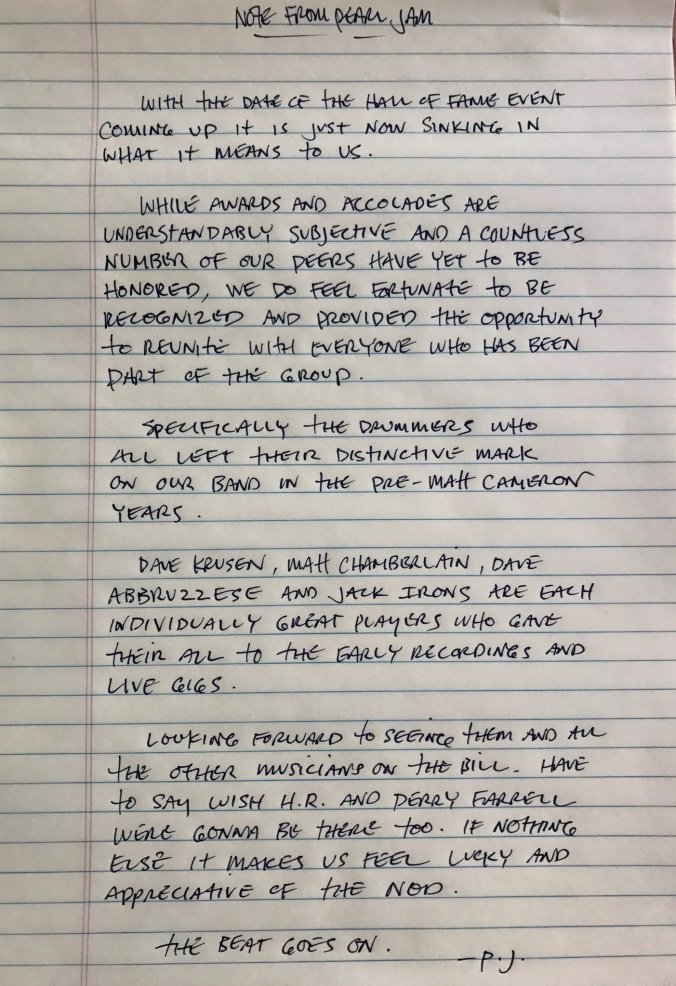
Pearl Jam are right up there at the top of my Unimpeachables list (I ought to write that list down really). I’ve been listening to the Vs/Vitalogy box (and the live album included) in the car for the last week or so and given that I believe this era  represents peak Pearl Jam I was most definitely heartened by the band’s published response to the ‘drummer debacle’ that had been stirred by their induction*:

This brings three things to mind:
1. Just how many years I’ve been loving this band.
2. They are a decent bunch of guys really
3. It’s been three and a half years since Lightning Bolt! What the fuck, guys? Get your arses in the studio already ffs.

*Though I, and many, are certainly not impressed by their cropping out of former drummers when it comes to photos on social media etc.

We got the means to make amends… Pearl Jam and the Rock & Roll Hall of Fame

Warning: rant incoming.

The Rock and Roll Hall of Fame is a strange thing. From where I sit it seems like a lot of back-slapping and congratulating from industry-types with very little real merit. Does it mean something to be a “Hall of Famer”? Does it add all that much credence anymore? Perhaps it means more in the States than it does here where a UK Music Hall of Fame sputtered, stalled and stopped before anyone paid it any attention.

Let’s spin back a bit to 1983; the Rock and Roll Hall of Fame was set up by Ahmet Ertegun (he of Atlantic Records) to “recognize and archive the history of the best-known and most influential artists, producers, engineers, and other notable figures, who have each had some major influence on the development of rock and roll” (Wikipedia) and began inducting such artists in 1986 with the first group of artists including Elvis Presley, Sam Cooke and Chuck Berry.

Since then each year a group of artists are nominated, voted for and inducted in a ceremony – again; from where I sit – that seems overly long on speeches and pretty short on the ‘rock and roll’. With each year there’s criticisms about who is and isn’t nominated (chief amongst which being that those controlling nominations, as a small group, are not musicians and nominate based on personal taste) and then there’s plenty of column inches and website debate and pages handed over to the ‘drama’ of which members from a certain band will be inducted, will attend, will tell the HoF to shove it…

From those Bozos in Makeup to Axl Rose’s tantrums, the question about which ex-members should be in alongside the nominees seems to draw more debate than discussing that band’s lasting impact. The cynical side of me (which seems to only get more so after a decade in marketing) certainly thinks that this is a deliberate act by the HoF in order to stir the pot, get more attention and create more buzz than the ceremony would otherwise get, nominating bands for whom the real question will be “will they induct that member who played tambourine on their first album or…?”

Nirvana had it in 2014 when those members inducted included Dave Grohl and not the four drummers that had sat on the stool pre-Nevermind. Would they induct Chad Channing or the first drummer, Aaron Burckhard? For, you see, there’s a criteria for getting in: “artists will first become eligible for the Rock Hall 25 years after the release of their first record (LP, EP or single)”. Bleach was released in 1989 (with Chad Channing on drums and Jason Everman on guitar*) but Nevermind, the first record Grohl drummed on, came out in 1991. It really adds weight to the idea that the HoF is after the popular vote more than anything – everyone loves a bit of Dave Grohl, nobody knows who Chad Channing is. There was, of course, a lot of online hubbub about the ‘snub’ of Chad.

Being the perennially nice guy of rock that he is, of course, Dave praised those drummers that had hit the skins before him in his speech and the band invited Channing to attend.

This year that question and the online buzz falls upon the collective shoulders of Pearl Jam. A band with a huge and dedicated following who forged a path for many to follow. Few can touch them live or match their unique set lists and they’re certainly the last men standing when it comes to the ‘Seattle Scene’. Their place in the Hall, even in the first year of eligibility, isn’t likely to be questioned. They’re also a band who, for the first half of their career, had a Spinal Tap scenario with their drummers**.

Released in August 1991, Ten featured Eddie Vedder, Stone Gossard, Mike McCready, Jeff Ament and, on drums, Dave Krusen. Krusen, though, had left the band in May due to alcoholism. His replacement, Matt Chamberlain only hung around for a handful of shows before heading off to join the SNL band. He suggested a guy to take his place; Dave Abbruzzese. Abbruzzese played drums through the rest of the tour supporting Ten, on Vs. and Vitalogy before he was fired in 1994.  During which time the band would tour extensively, Abbruzzese would write the music for ‘Go’, ‘Last Exit’ and ‘Angel’ and defined the band’s sound at the time with his ferocious drumming. The harder sound he bought helped them move away from being pigeon-holed as another clone.

If you ask a Pearl Jam fan what the band’s ‘peak’ period was I’m willing to lay money on a large percentage saying 1991-1994. Abbruzzesse was a key part of that sound. The problem is, he enjoyed it too much. I’m not talking piles of cocaine and claims of being a Golden God, no; he just loved it all and smiled too much. Rumours swirl as to why Abbruzzesse was actually let go but it boils down to the fact that he was obviously having fun. Vedder was, at this time, at his most serious and ‘punk’, it wasn’t ‘cool’ to be enjoying your success and, as the front man, he took most of the attention and it was a lot to handle. While the band withdrew from the spotlight, Dave would give interviews (albeit to drum magazines, not Spin or Rolling Stone). While the other members would go the Volvo or battered old truck route, Dave bought a Lexus. He didn’t really care about the famous Ticket Master Boycott either. Apparently the final straw for Dave’s tenure came when he accidentally broke the neck of one of Vedder’s guitars during Vitalogy sessions and didn’t hang around to tell Eddie or apologise. He wouldn’t be in the band when it came time to tour the album he’d helped create, he was let go – Vedder wouldn’t do it, the task fell to Stone Gossard.

Pearl Jam

Jack Irons, formerly of the Red Hot Chili Peppers*** was then in the saddle for four years and two albums before he ducked out (not happy with touring) in 1998 and then-former Soundgarden drummer Matt Cameron took the seat he still occupies. Now, Cameron is certainly the stick man with the longest tenure and its clear that he’s considered a full member of the band – Vedder continues to praise him and has credited his joining with keeping them together – but I don’t think I’m alone in seeing him as an outsider even some 19 years and five albums later.

Now of all their six drummers, only one, technically, qualifies: Dave Krusen. He played on Ten, twenty-five years ago. By all accounts he’s quite surprised at the nod. The Rock and Roll Hall of Fame, however, is also inducting Matt Cameron. And nobody from the period between the two.

Now, out-dated and bloated an institution as it may be, if the Rock and Roll Hall of Fame are recognising Matt Cameron then they sure as shit should recognise Dave Abbruzzese.  As much of a deliberate poking of a hornet’s nest as the snub is, it’s also pretty unfair to then place the onus of dealing with the question onto Pearl Jam (ever-shy of such publicity and awards) to be the ones to deal with it. Dave, obviously riled himself, has said plenty, chiefly:

“I have always thought that every award given to a band that celebrates the bands lifetime achievements should be awarded to every person that was ever a debt incurring, life sacrificing, blood spilling, member of that band. Maybe the Hall should reevaluate the need to put all the monkeys in the same cage in order to boost revenue, and instead let the history of the band be fully and completely represented as they were and as they are. …leave it up to the group to show their true colors as they celebrate their own history in a manner of their choosing…

I will admit to wanting to look out over my drum kit at the faces of Jeff, Stone, Mike and Eddie. Looking to my left at my drum tech, the mainest of mellow, Mr. Jimmy Shoaf and seeing him give me that look that dares me to destroy my cymbals and kick the songs ass, the bands ass and the crowds ass… The idea of counting it off and giving the band, the music & the people all that I have to give, as I always have without compromise or hesitation… The sound of the people singing along… Making eye contact with the person air drumming their ass off right before the big drum fill, so we can do it together…
I loved it.
I loved it every single time.”

Pearl Jam have always marked themselves out as a band of integrity and honest values. They’re continually raising money and awareness for important causes and fighting the good fight. Again, it’s unfair of the HoF to put this on them but it is gonna be down to them to decide how to deal with the Dave question. History gives no real clue – their 2004 compilation Rearviewmirror featured photos cropped not to include him yet in 2016 the band performed his composition ‘Angel’ for the first time since 1994 with Vedder stating it ” was written by the guy who was our drummer. Dave Abbruzzese, We wish him well.”

How it’s dealt with come the night, though, we’ll have to see. And that’s how the Rock and Roll Hall of Fame keeps getting people to pay attention. And, damn it, they’ve suckered me in to giving a damn too. The rat bastards.


* albeit in name only and his image was ‘tastefully’ removed from the album cover come the 20th Anniversary re-release. Everman would go through a musical life of ups and downs which would include a blink-and-you’ll-miss-it stint on bass for Soundgarden before cutting his hair and joining the army where he would serve with the Rangers and Special Forces – it makes for a fascinating read.

** You can’t dust for vomit.

***and was inducted into the HoF in 2012.

Currently Listening

In any shooting gallery where promises are made….

I’ve been finding comfort in familiar sound recently so those newer releases by the Pixies etc haven’t really been given a listen. But, here’s an idea of the current playlist:

http://www.youtube.com/watch?v=1NdtBS829XY

Jack Rose and his mastery and innovation of the acoustic is actually a new discovery for me. I think the lack of vocals made it easier for me to get into over the last couple of weeks. A huge body of work still to hear for the first time as Mr Rose made a lot of music before his untimely passing but this, from the brilliant album I Do Play Rock and Roll is hypnotisingly awesome.

Because I’m still gobbling up House of Cards

I don’t think I’ve even mentioned Mr Petty on here… odd. Anthology; Through The Years is one of those rare compilations that’s absolutely perfect and, after starting to watch Runnin’ Down A Dream on Netflix, is now back in rotation in my car. Eddie Vedder says, at the start of the documentary, “The first time you hear a new Tom Petty song is sounds like, you know, a classic song.” – he’s not wrong. If you only have the aforementioned compilation you’ll know just how many sheer belters the man has written.

http://www.youtube.com/watch?v=611Wxihk9vk

Going back to an earlier discussion on Dire Straits… I’ve been listening to Making Movies the last couple of days, in particular this opening track (and Skateaway). It’s made me wonder something though; in 1980 Mark Knopfler borrowed both a producer (Jimmy Iovine – having loved the production sound of Patti Smith’s ‘Because The Night’) and band member (Roy Bittan) from Bruce Springsteen to make what was the band’s breakthrough third album (Iovine had a thing for making third albums). A few (seven to be precise) years later Bruce dropped his own (and arguable one of his finest) album and song called Tunnel of Love. Where Knopfler’s track featured lines like “Come on and take a low ride with me girl, on the tunnel of love”, Bruce used “Cuddle up angel cuddle up my little dove, we’ll ride down baby into this tunnel of love”… Now, while both album’s dealt fairly prominently with love’s broken promises, Bruce’s album and lyrics were significantly different, more nuanced and the sound very much of his own but… I have to wonder; surely Bruce must’ve heard what his piano player and produce had been moonlighting on and did that plant a seed that, over a few years, grew into one of his most brooding and significant albums?