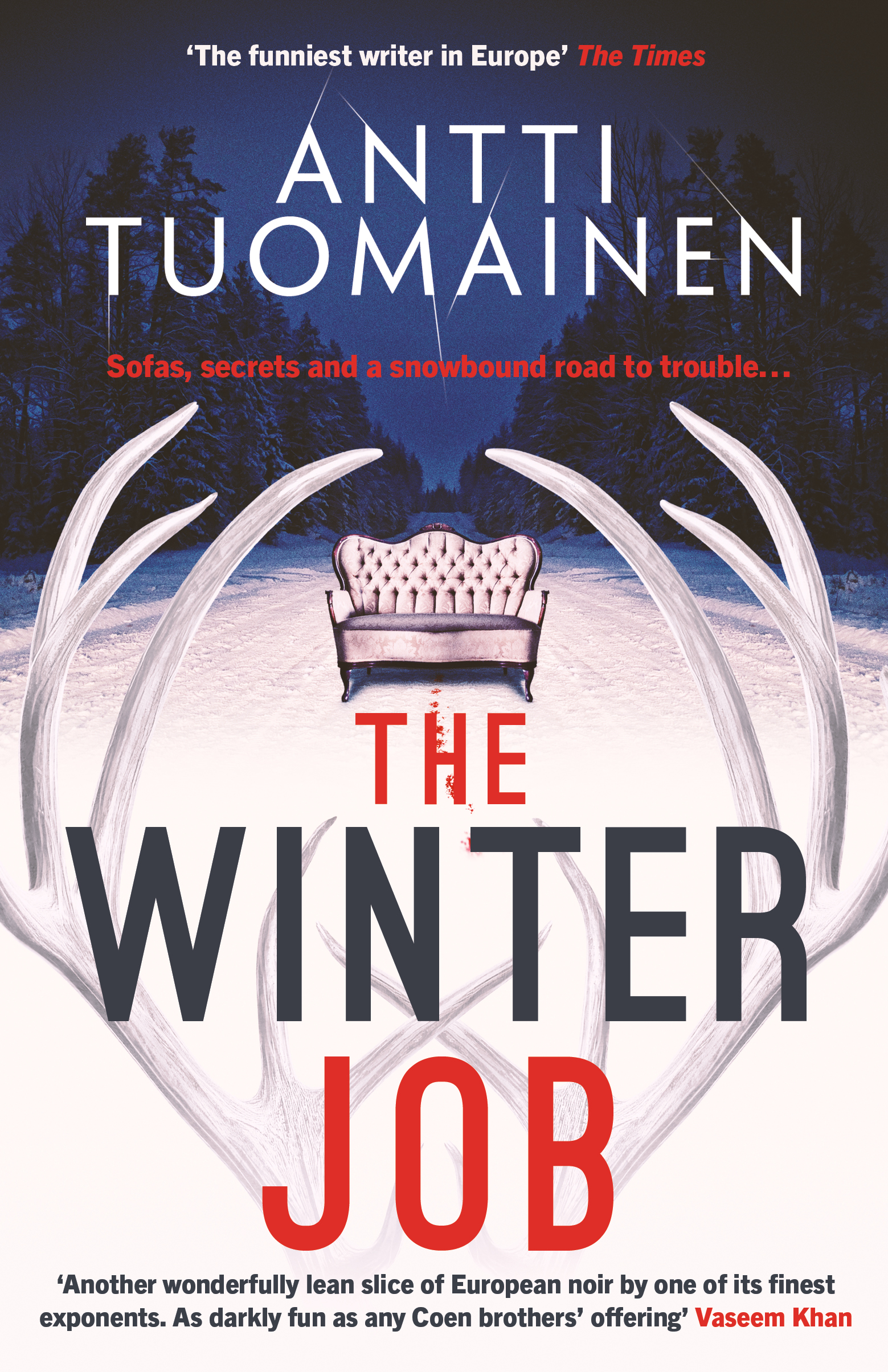
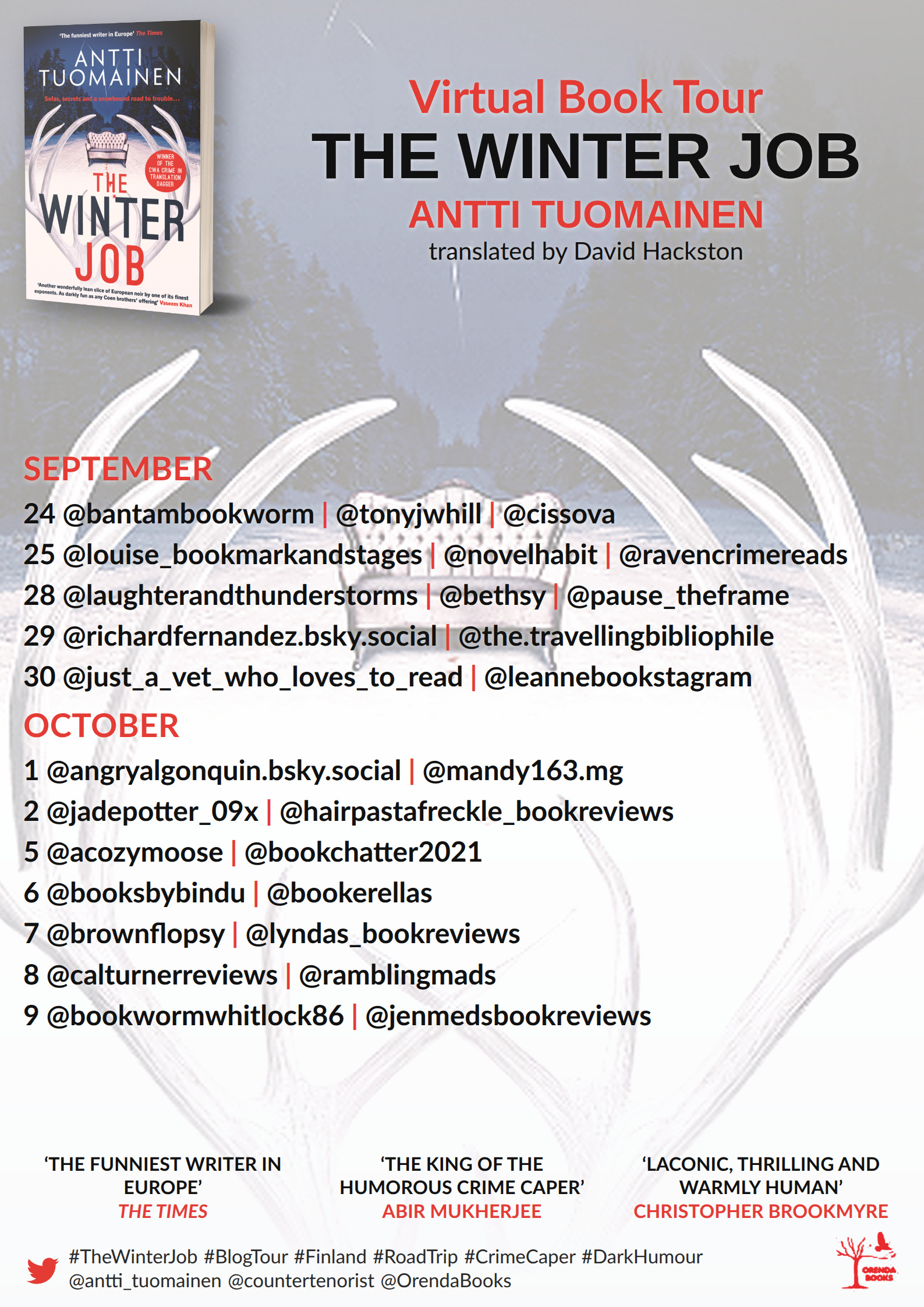
The Winter Job by Antti Tuomainen

From the PR: “Helsinki, 1982. Recently divorced postal worker Ilmari Nieminen has promised his daughter a piano for Christmas, but with six days to go – and no money – he’s desperate.

A last-minute job offers a solution: transport a valuable antique sofa to Kilpisjärvi, the northernmost town in Finland. With the sofa secured in the back of his van, Ilmari stops at a gas station, and an old friend turns up, offering to fix his faulty wipers, on the condition that he tags along. Soon after, a persistent Saab 96 appears in the rearview mirror. And then a right-yellow Lada.

That’s when Ilmari realises that he is transporting something truly special.

And that’s when Ilmari realises he might be in serious trouble…”

A quick scan back through my reviews of his work has revealed to me that I’ve been reading Antti Tuomainen for a decade now, which while a slightly alarming realisation in itself shows that time flies when you’re having fun. The first of his books I read was The Mine, a dark, complex and intelligent thriller that dealt with some pretty heavy themes and had me practically up to my knees in Finnish snow by the time I’d finished it. A year later came The Man Who Died and, well, that was something else entirely.

It was still a thriller, still dark, but it was also ridiculously funny. I loved it enough that it found its way into my 50 Great Reads the following year and, thankfully, Tuomainen clearly enjoyed making that switch as much as I enjoyed reading it. Since then I’ve happily followed him through Palm Beach, Finland, Little Siberia and The Rabbit Factor, with that mixture of crime, increasingly bizarre situations and very dark humour becoming something I’ve come to look forward to whenever a chance to read another of his books appears. Hence it being an absolute no-brainer to say ‘yes please!’ with The Winter Job – which might be the most fun I’ve had with one yet.

I absolutely tore through this book. It’s ridiculously addictive and, once Ilmari and Antero set off across Finland in their clapped-out old Thames van, I felt as though I’d climbed in alongside them and could practically feel the seat under my bum. Admittedly, “tore through” applies more to my reading than their progress; the van isn’t exactly built for speed and that’s before you throw Finnish winter roads into the equation. But somehow, that makes it even better – another cassette going into the player, miles of snow-covered road ahead and an increasing number of reasons to keep checking what’s behind us.

Which kinda brings me back to something I’ve been saying about Tuomainen for years. When I reviewed Little Siberia I called it “a Nordic Noir directed by the Coen Brothers”, and The Winter Job gave me that feeling again in spades. As Ilmari and Antero’s journey becomes increasingly complicated, the confrontations more dangerous and the whole thing just that little bit more absurd, I could – in between fits of laughter – practically see the film playing out in my head. It’s dark, frequently tense and very, very funny, often all at the same time. Credit too, to David Hackston’s translation because comedy is bloody hard enough to get right in one language, let alone another.

But but but but BUUUUT, this is something Tuomainen has always been really good at; stealthily sneaking in addictive characters and real heart beneath all the comedy. I’ve called his books funny before and I’m doing the same again here yet they’re never simply comic crime novels. There’s always something human underneath the increasingly bizarre situations he puts his characters into and here that’s very much Ilmari and Antero. For all the stuff going on around them, I think I’d have happily spent considerably longer in that knackered van listening to cassettes and watching Finland pass by outside. Ilmari and Antero spend much of the journey seemingly on the verge of making some kind of breakthrough, both about their shared past and themselves. They get close to conversations that feel like they might actually take them somewhere, only to be interrupted by the slightly more pressing matter of being ambushed by communists in a Lada or stalked by an increasingly unhinged psychopath with Eye of the Tiger blaring from his car stereo.

Yet, with every mile, you get the feeling they’re getting there. Slowly but surely, like the Thames itself. Beneath all the chaos there’s something genuinely warm about watching these two men gradually chip away at things that have been left unsaid for far too long. I became as invested in that as I did in whether they could actually survive the journey and get the couch – and its contents, about which I’m saying absolutely nothing – safely to where it needs to go.

In the end it feels as though Ilmari and Antero have travelled considerably further than the distance between Helsinki and Kilpisjärvi, and I was genuinely sorry to see the journey come to an end. Thankfully, Tuomainen leaves us with a hint that this may not have to be the case… if there is more from this ‘special delivery firm’, then I’ll be there in a heartbeat with my own bag of cassettes.

My thanks, always, to Karen at Orenda Books for my copy and Anne Cater for inviting me to take part on this blogtour.
I think it’s poetry and magic, something too big to have a name…. Five More from Wilco

Let’s get back to it and pick up the thread from my Five from Wilco (Part One) post a few months back. There I struggled to select five songs from their first ten years… now I’ve set myself up with the unenviable task of finding five tracks that cover the next nineteen years. Seems logical.

On the one hand is the fact that there’s eight albums to choose from in that era. On the other, there’s the fact that two of those –Star Wars and Schmilco seem slight and throw-away enough (though not devoid of good songs, more in comparison with the rest) that that kind brings it down to six. I’m not yet up to speed with 2023’s Cousins which brings it to five… so let’s get moderately mid-tempo rocking:

You Are My Face

Wilco’s first album since their now in-stone lineup coalesced during the A Ghost Is Born tour, Sky Blue Sky is one of my favourite of their albums. I’ve already ticked off a couple of the album’s highlights elsewhere so let’s get ‘You Are My Face’ the coverage it deserves.

You Never Know

Seven albums in seems an odd time to go the self-titled route. Then again they were savvy enough to add the parenthesis to Wilco (The Album) as well as ‘Wilco (The Song). Wilco feels like a deliberate lightening-up (underlined by the choice of a camel as a cover star) and less experimental in sound than the last couple of albums had been. ‘You Never Know’ feels like a joyous George Harrison pastiche.

Art of Almost

Then again… let’s get experimental once more. The Whole Love – the first on their own album – is another favourite and an edgy, dissonant builder of a song is always going to score highly with me.

Hold Me Anyway

In 2015/2016 Wilco released two albums. Star Wars – which was initially given away as a free download – and Schmilco were both born of the same recording sessions and felt like two sides of the same coin. One felt very much like a band trying anything and going wherever the muse took them and the other, Schmilco, with a throwaway title and artwork that belied its sombre nature. Star Wars – which has as much to do with George Lucas’ saga as the cat on its cover – was already geared up to be renamed Cease and Desist just in case. A happy by product of the odd title is that when that streaming service that fucks over artists decided to give that film’s soundtracks a special feature, Wilco’s album also got the fun progress bar:

Anywho, after all that they took a break and a bit of a hiatus. When they came back with 2019’s Ode To Joy they seemed to have regained the focus that was missing from the aforementioned albums. ‘Hold Me Anyway’ feels like a wonderful companion piece to Sky Blue Sky’s ‘Either Way’ and its just delicious.

Bird Without a Tail / Base of My Skull

On Cruel Country, Wilco went country… except not in the ‘return of the twang’ vibe many were expecting. It’s country, sure, but not like that. This is mostly-acoustic and more country-inspired folk than it is a return to A.M (phew). A quietly majestic album full of highlights, for me hearing ‘Bird Without a Tail / Base of My Skull’ unfold and the space it allows all members to weave around each other is as good as it gets.

The Prince of Pauper’s Pond by Lars Elling

From the PR: “1985. Nineteen-year-old Filip spends his days playing football, listening to music on his Walkman and drawing, searching for something he cannot yet name. He lives in a large family house shared with his grandparents, where an old rift between his grandfather Arnstein and Arnstein’s brother Truls still governs the atmosphere. The cause appears trivial, an apple tree dropping fruit across a boundary fence, but the bitterness between the brothers speaks of something far older and deeper.

1912. With Europe on the brink of upheaval, Arnstein and Truls are sent into the forest for the summer by their stern father, determined that his sons should learn to endure hardship. Left to fend for themselves among travellers, log drivers and Forest Finns, the brothers live from the land, fishing, hunting and roaming the vast woodland. Cold and hungry, yet bound together by fierce loyalty and affection, they crown themselves the Princes of Pauper’s Pond, rulers of a world defined by freedom, imagination and shared struggle.

Until, back home, their father makes a decision that will change everything.

Spanning generations, The Princes of Pauper’s Pond is a vibrant, magical and deeply affecting novel about brotherhood and belonging, about finding joy and love in the open landscape, and about those single moments that can seal a family’s fate … forever…”

Sometimes it’s hard to know how to review a book. Not because it’s a bad book – hell, it’s easy to do that. But when a book is so good that it stays in your mind long after, it’s hard to know how to put into words the effect it has on you. Lars Elling’s The Princes of Pauper’s Pond is one of those books. It’s such a beautiful and deeply affecting novel that I don’t really know where to start.

I’m a man that enjoys simple pleasures you can luxuriate in: a mellow cup of coffee in a good mug that keeps it warm long enough to enjoy at the right pace; the process of setting a record on the turntable and absorbing it in one sitting, including getting up and flipping to Side B; a novel that gently draws you in and completely absorbs you in its world as it leisurely unfolds around you. The Princes of Pauper’s Pond gave me exactly that feeling, and I absolutely loved it.

I’ve read a lot of novels from Norwegian authors – quite a few courtesy of Orenda Books – and I can’t think of a time when one has rendered the country quite as evocatively as The Princes of Pauper’s Pond. Yes, Lars Elling is a well-respected visual artist, but to be able to take the skill with which he renders a scene on canvas and somehow translate that to the page is something else entirely. The forests and landscapes of early 20th century Norway become so vivid and tactile that. more than simply being told where these people lived, Elling makes you feel as though you’ve spent time there.

Then again, it’s not just the landscape and setting that Elling has captured so brilliantly. The characters live and breathe on these pages to the point that you begin to feel less like you’re reading about the family and more like you’ve somehow been admitted into it. Whether it’s the “modern day” (well, 1985) with Filip and the family – from the apple wars to the father/son dynamic and those conversations with the Old Man – or Arnstein taking us back into his youth with Truls and life under ‘The Kaiser’, every little detail makes these people feel utterly real. At times you get the sensation that you’re sitting in that downstairs room yourself, hanging on to every laboured breath from the Old Man and waiting for the next part of his story.

That manner of telling of the story is important, too, because so much of The Princes of Pauper’s Pond is concerned with memory… what we remember, what we choose to tell and how the stories we’re told about our families become part of our own lives. The movement between Filip in 1985 and Arnstein’s childhood never feels like the novel jumping backwards and forwards for the sake of filling in a history. You’re listening along with Filip, gradually piecing together a life and a relationship between two brothers that existed long before he did.

It’s that relationship between Arnstein and Truls that gives the novel real emotional weight. Again, I’m not going to go too far into details because so much of the pleasure of the book is allowing Arnstein’s story to reveal itself at its own pace… but Elling captures something incredibly tender about childhood, brotherhood and the way those early relationships continue to shape us long after the events themselves have passed. There’s real warmth and humour here, but also sadness, and knowing that these are an old man’s memories gives even the happiest moments a slight ache.

Elling captures the weight of passing time beautifully, along with that strange sense of loss that can come from looking back at the person you were and the relationships you once had. The young Arnstein we come to know is so heavily contrasted with the Old Man telling his story more than seventy years later that at times it feels as though he’s gazing back at something impossibly far away and yet still immediately close to him.

That contrast is perhaps most affecting in his relationship with Truls. As boys they’re thick as thieves, sharing a childhood and experiences that bind them together completely. In 1985, however, they’re about as distant as two brothers can be despite remaining physically close to one another. We know that that distance exists as Arnstein tells us how inseparable they once were, and it hangs over those memories without Elling needing to keep pointing towards it. There’s something painfully recognisable in the idea that someone can have been the centre of your world at one point in your life and, decades later, become almost a stranger.

What makes all of this work so magically is that Elling never seems determined to wring emotion out of any of it. For all the melancholy that hangs over Arnstein’s recollections, this isn’t a gloomy book. It’s frequently funny, occasionally strange and full of the sort of small adventures, rivalries and moments of mischief that make the childhood sections such a pleasure to spend time in. The sadness is there because we know where these two boys eventually end up, but Elling keeps that knowledge sitting quietly in the background rather than using it like a blunt hammer.

There’s also something almost fable-like about Arnstein’s childhood world. It’s completely convincing as a place, but at the same time seems just slightly removed from reality, populated by characters and incidents that become larger through the act of remembering them. Perhaps that’s simply what childhood memories are like: the places are bigger, the adults stranger and the things that happened to us carry an importance they could never have again.

I finished The Princes of Pauper’s Pond a few weeks ago now and I’ve found myself returning to it in my head ever since: to Arnstein and Truls, to Filip sitting with the Old Man, to those forests and lakes and long-ago summers. I started this review by saying that sometimes the hardest books to review are the ones that affect you most and I’m still not sure I’ve managed to put my finger on everything this one did to me. What I do know is that I absolutely bloody loved spending time in its world and, more importantly, I wasn’t quite ready to leave it when the final page came.

My thanks to Orenda Books for my copy of The Princes of Pauper’s Pond and Anne Cater for inviting me to take review as part of (in fact, looks like I’m kicking it off) the blog tour.

Tracks: All I Need

The Air section of my record shelves has grown quite considerably over the last couple of years. To be fair, that’s not hard as there wasn’t really one at all until 2024, when I added the first three albums. Since then they’ve been joined by singles and, helped considerably by the recent run of reissues, more of the studio albums. The just-announced reissue of Love2 was immediately pre-ordered, with any luck we’ll get a repress of their last – Le voyage dans la lune – soon enough and I can complete the set.

Moon Safari alone, though, now accounts for four records in the collection. There’s the original album, the Live & Demos release from Record Store Day a couple of years back, this year’s RSD’s Moon Safari Live and Vegyn’s Blue Moon Safari remix/reimagining. I know; quite the deep-dive on Moon Safari.

There’s undoubtedly something about Air that appeals to the Francophile in me, but that alone doesn’t explain why I keep coming back to them or why that section of the shelves keeps expanding. Mostly it’s because Nicolas Godin and Jean-Benoît Dunckel are just bloody brilliant musicians and because, even after all this time, I’ve never been entirely able to place their music anywhere. There’s so much in there that feels familiar, music that recalls different styles and different eras without ever really belonging to any of them. There are analogue synths, film soundtracks, electronica, easy listening and bits of the sixties and seventies floating around, but somehow the result has always seemed to stand slightly outside of time. Moon Safari is 28 years old now but it doesn’t really sound like an album from 1998 in the way that so many records I love from that year immediately do.

It’s also pretty much unimpeachable as far as I’m concerned. There are albums where, however much I love them, I’ll acknowledge the weaker track or the one that hasn’t aged particularly well. I’m not sure I could find one here. Perhaps because it felt ageless at the time and free of era-specific affectations that usually age an album. Even among all of that, though, All I Need has long been something more than simply my favourite track on Moon Safari. It’s one of my favourite songs full stop. Hence it’s inclusion in this series – which is slowly (thanks to my intermittent commitment to it) on its way to becoming a playlist of my favourite songs.

A large part of that is the almost instant calm it brings with it. There’s something about those opening seconds, the bass line and then Beth Hirsch’s voice coming in, that seems to physically slow everything down. Wherever I happen to be when I hear it, in my head the song feels like I’m standing on a beach on a summer evening. The heat of the day has gone but it’s still warm, everything has quietened down and I’m watching the tide breathe in and out, able to drift along with it for a few minutes without particularly caring about anything else.

Hirsch herself seems such an integral part of the song that it’s difficult to imagine All I Need without her. Though, you can get a strong impression of it from the track ‘Les professionnels’ on Premiers Symptômes, their first ep, that clearly contains the basis of that song.

Her involvement with Air, however, came about in a suitably casual, lassez-faire way. An American singer living in Paris at the time, she met Godin and Dunckel there (they were also living in Montmarte at the time) and ended up writing the lyrics and vocal melody after they gave her the music to work with. She would ultimately appear twice on Moon Safari, she’s also on You Make It Easy, and Godin later described her addition to Air’s sound as making them something akin to “space-age Carpenters”.

That’s actually a pretty decent description of All I Need. For all the electronics and Air’s particular brand of French retro-futurism, there’s something wonderfully old-fashioned about the song underneath it all. Hirsch’s vocal is intimate and un-showy while the music around her is doing far more than it initially appears to be doing, and there’s a slight melancholy running through everything that stops all that warmth ever becoming overly sweet.

Perhaps that’s also part of why it’s never dated for me. I can put on plenty of music from the late nineties and immediately be transported back to a particular period of my life. Sometimes that’s exactly why I’m putting it on in the first place. All I Need doesn’t do that, though. Despite having known it for years, I don’t associate it particularly strongly with being younger or with 1998 or even with when I first heard Moon Safari. It somehow still feels entirely present.

As the number of Air records occupying the shelves continues to increase, there are obviously plenty of other songs of theirs I love. I could probably make a fairly convincing case for several of them being among their best, and I’m sure I’ll eventually mumble about one or two of those as well elsewhere here. All I Need, though, remains the one I return to most often. There’s something about being able to disappear into that warmth, watch that imaginary tide for four-and-a-half minutes and allow everything else to slow down with it that I’ll never tire of.

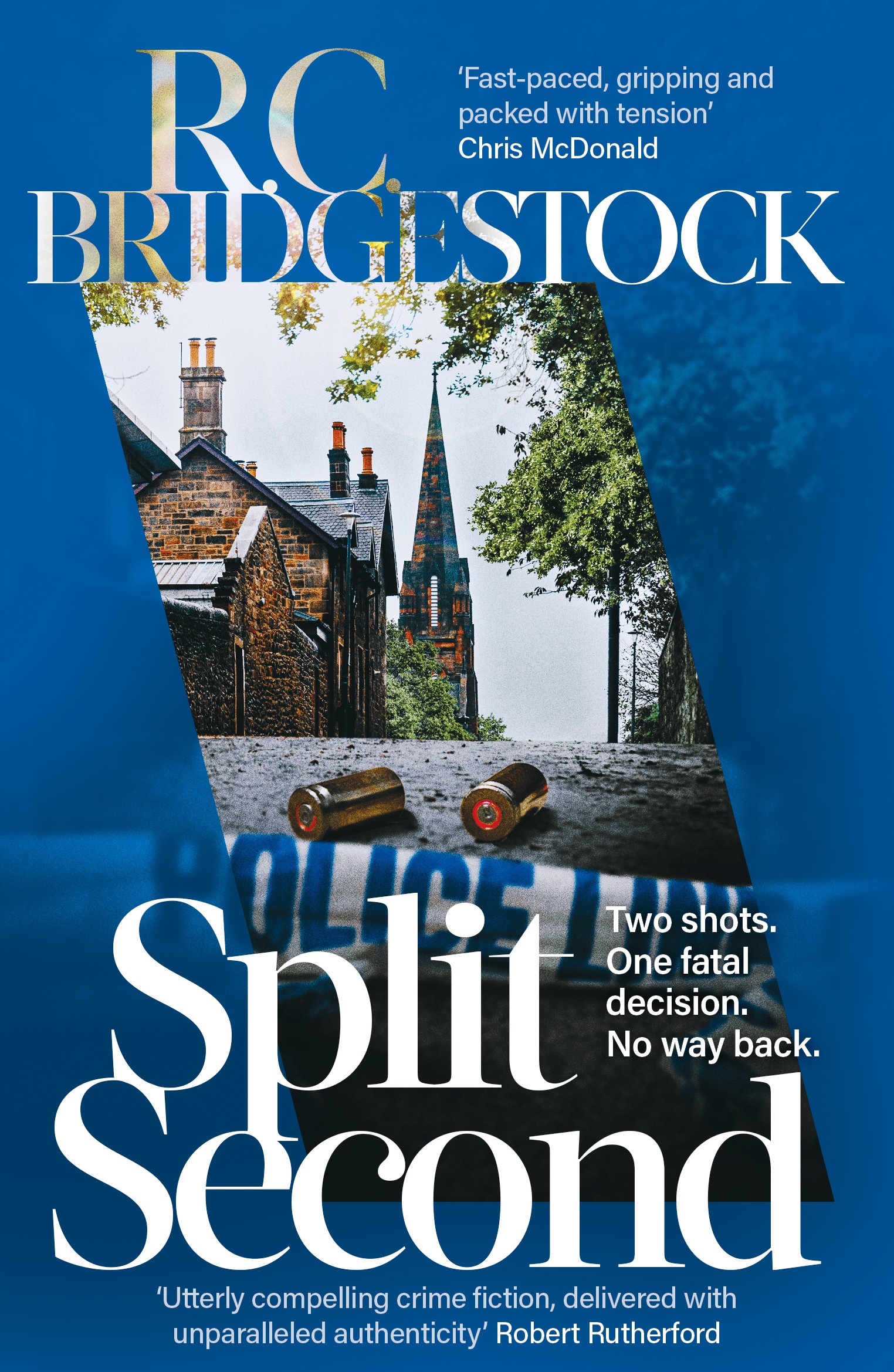
Split Second by R.C Bridgestock

From the PR: “What if one moment – one split second – changed everything?
When a firearms officer shoots a suspect dead and wounds another, who later dies in hospital, the official line is that the sun was in her eyes. Her body cam failed. Known only as Officer X, her anonymity is meant to protect her – until a judge releases her name and a media storm erupts.

Detective Superintendent Jack Dylan and DI Charley Mann are called in to determine whether it was a justifiable use of force – or something darker. And when it’s revealed that Officer X knew the victim, and her brother died of a drug overdose linked to the same woman, the case becomes charged with personal and political tension.

As pressure mounts, a vulnerable witness dies and a lost phone surfaces with a photograph and a message that could unravel everything – and reveal the truth about what happened that day. Split Second brings Dylan and Mann together for the first time, in an investigation that will test their instincts, their loyalties and the limits of justice itself, as both detectives must decide how far they’ll go – and what they’re willing to sacrifice – to uncover the truth.”

This book gave me sunburn. Well, maybe not directly but it sure enough contributed to it. I blasted through this in two sittings, the first of which was on a beach in Brittany where ‘just one more chapter’ meant reapplying sunscreen slipped my mind. It’s just such a monumentally gripping book. Those two sessions absolutely flew by – Split Second is so immensely addictive and satisfying that there’s no real question of finishing it as soon as you pick it up.

That doesn’t mean, though, that this is a novel without depth or substance, far from it. This is an intensely rich and detailed story with plenty of twists and populated by great characters. There’s no doubting that R.C. Bridgestock know what they’re talking about. Husband-and-wife writing team Carol and Bob both worked for West Yorkshire Police – Bob eventually becoming Head of CID – and that experience is apparent throughout Split Second. Procedure isn’t simply something sprinkled around the edges to make everything look convincing; it informs the way the investigation develops, the decisions people make and, perhaps more importantly, the consequences of those decisions. There’s a weight and credibility to it that’s too often sacrificed in crime fiction in the rush to get to the next body, revelation or conveniently timed car chase.

This is probably a good point to admit that, historically, the home-grown British police thriller hasn’t been particularly high on my reading list. That may seem slightly odd given how often I’ve complained about people who simply declare entire genres off-limits, but hypocrisy comes for us all eventually. Perhaps it’s the familiarity of it. Years of mundane interactions with the local constabulary and seemingly endless television programmes involving police officers standing beside wet roundabouts have never quite offered the same escapism as, say, a semi-alcoholic Norwegian detective pursuing murderers through the snow, or a one-man army called Jack arriving in some unfortunate town shortly before half its population requires medical attention. Which, given how much I bloody loved this book, may have been something of a mistake.

I’m also going to mention here that I came to Split Second knowing absolutely nothing about R.C. Bridgestock’s previous books. Detective Superintendent Jack Dylan and DI Charley Mann may be the protagonists of two established series – and their coming together here may well mean considerably more to existing readers – but both were complete strangers to me. Happily, that proved no obstacle whatsoever. There’s no sense that you’ve arrived late to a party and are expected to know who everyone is, nor any requirement to head off and read any previous novels before being allowed through the door. Split Second works perfectly well as a thriller in its own right, and a highly addictive one at that. In fact, it’s so bloody addictive that I’m now impatient for the follow-up. Without venturing anywhere near spoiler territory, Split Second doesn’t so much finish as pull the rug out from underneath your feet and disappear.

It does, however, mean R.C Bridgestock have managed something I really wasn’t expecting when I picked this one up. Not only have they completely dismantled my own, admittedly ill-founded, reluctance toward the British police procedural, they’ve left me invested in characters I’d never encountered before and am impatient to find out where they’re going next.

More importantly, Split Second is simply a cracking read. It’s intelligent without ever getting bogged down in its own detail, authentic without endlessly pointing at the research behind that authenticity and ridiculously difficult to put down. I went into it knowing nothing of the writers or their existing characters and came out the other side wanting more of them all – just need to ensure that next time I remember the sunscreen.

My thanks to Orenda Books for my copy of Split Second and to Anne Cater for inviting me to review as part of the blog tour.