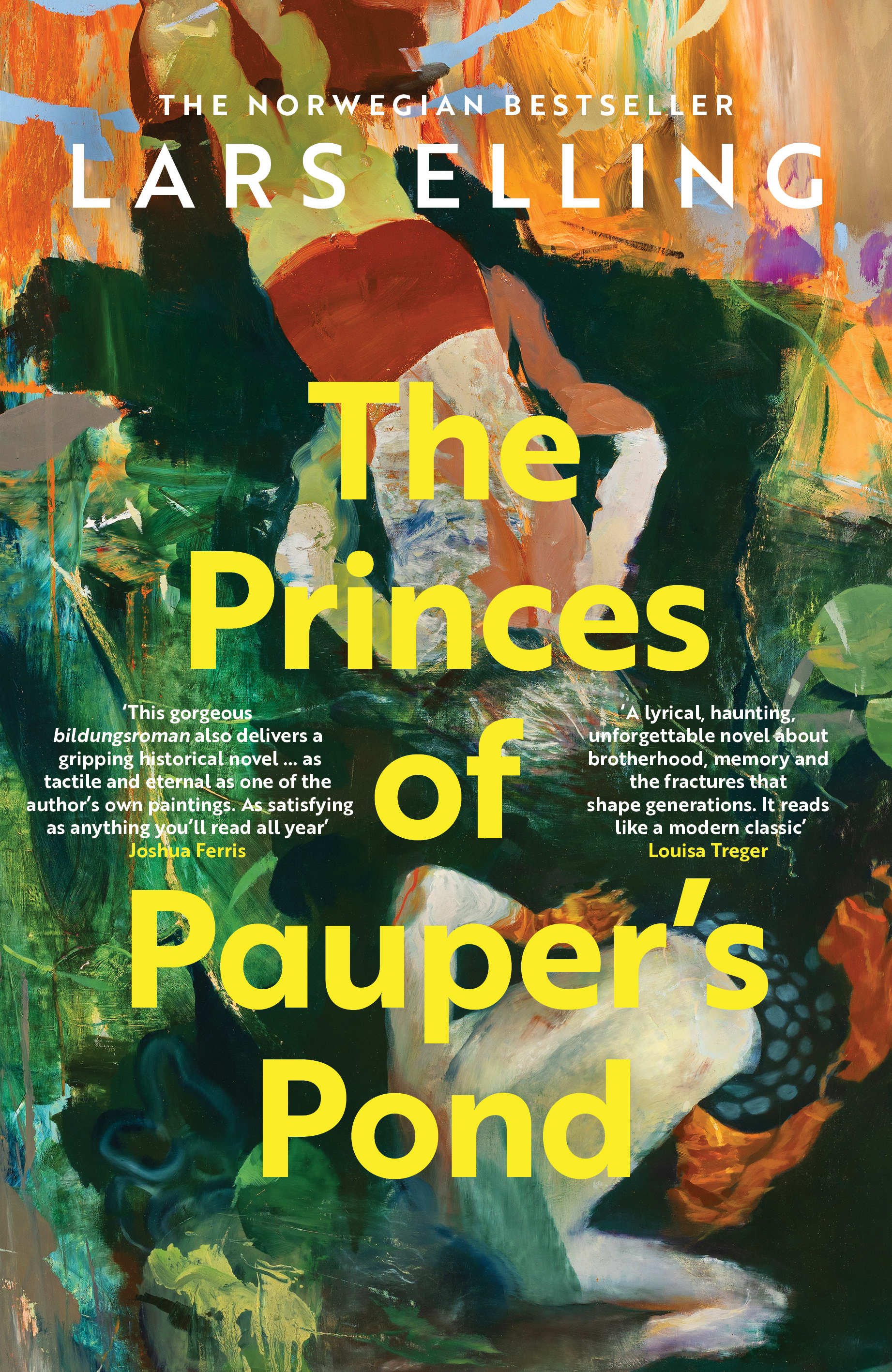
From the PR: “1985. Nineteen-year-old Filip spends his days playing football, listening to music on his Walkman and drawing, searching for something he cannot yet name. He lives in a large family house shared with his grandparents, where an old rift between his grandfather Arnstein and Arnstein’s brother Truls still governs the atmosphere. The cause appears trivial, an apple tree dropping fruit across a boundary fence, but the bitterness between the brothers speaks of something far older and deeper.
1912. With Europe on the brink of upheaval, Arnstein and Truls are sent into the forest for the summer by their stern father, determined that his sons should learn to endure hardship. Left to fend for themselves among travellers, log drivers and Forest Finns, the brothers live from the land, fishing, hunting and roaming the vast woodland. Cold and hungry, yet bound together by fierce loyalty and affection, they crown themselves the Princes of Pauper’s Pond, rulers of a world defined by freedom, imagination and shared struggle.
Until, back home, their father makes a decision that will change everything.
Spanning generations, The Princes of Pauper’s Pond is a vibrant, magical and deeply affecting novel about brotherhood and belonging, about finding joy and love in the open landscape, and about those single moments that can seal a family’s fate … forever…”
Sometimes it’s hard to know how to review a book. Not because it’s a bad book – hell, it’s easy to do that. But when a book is so good that it stays in your mind long after, it’s hard to know how to put into words the effect it has on you. Lars Elling’s The Princes of Pauper’s Pond is one of those books. It’s such a beautiful and deeply affecting novel that I don’t really know where to start.
I’m a man that enjoys simple pleasures you can luxuriate in: a mellow cup of coffee in a good mug that keeps it warm long enough to enjoy at the right pace; the process of setting a record on the turntable and absorbing it in one sitting, including getting up and flipping to Side B; a novel that gently draws you in and completely absorbs you in its world as it leisurely unfolds around you. The Princes of Pauper’s Pond gave me exactly that feeling, and I absolutely loved it.
I’ve read a lot of novels from Norwegian authors – quite a few courtesy of Orenda Books – and I can’t think of a time when one has rendered the country quite as evocatively as The Princes of Pauper’s Pond. Yes, Lars Elling is a well-respected visual artist, but to be able to take the skill with which he renders a scene on canvas and somehow translate that to the page is something else entirely. The forests and landscapes of early 20th century Norway become so vivid and tactile that. more than simply being told where these people lived, Elling makes you feel as though you’ve spent time there.
Then again, it’s not just the landscape and setting that Elling has captured so brilliantly. The characters live and breathe on these pages to the point that you begin to feel less like you’re reading about the family and more like you’ve somehow been admitted into it. Whether it’s the “modern day” (well, 1985) with Filip and the family – from the apple wars to the father/son dynamic and those conversations with the Old Man – or Arnstein taking us back into his youth with Truls and life under ‘The Kaiser’, every little detail makes these people feel utterly real. At times you get the sensation that you’re sitting in that downstairs room yourself, hanging on to every laboured breath from the Old Man and waiting for the next part of his story.
That manner of telling of the story is important, too, because so much of The Princes of Pauper’s Pond is concerned with memory… what we remember, what we choose to tell and how the stories we’re told about our families become part of our own lives. The movement between Filip in 1985 and Arnstein’s childhood never feels like the novel jumping backwards and forwards for the sake of filling in a history. You’re listening along with Filip, gradually piecing together a life and a relationship between two brothers that existed long before he did.
It’s that relationship between Arnstein and Truls that gives the novel real emotional weight. Again, I’m not going to go too far into details because so much of the pleasure of the book is allowing Arnstein’s story to reveal itself at its own pace… but Elling captures something incredibly tender about childhood, brotherhood and the way those early relationships continue to shape us long after the events themselves have passed. There’s real warmth and humour here, but also sadness, and knowing that these are an old man’s memories gives even the happiest moments a slight ache.
Elling captures the weight of passing time beautifully, along with that strange sense of loss that can come from looking back at the person you were and the relationships you once had. The young Arnstein we come to know is so heavily contrasted with the Old Man telling his story more than seventy years later that at times it feels as though he’s gazing back at something impossibly far away and yet still immediately close to him.
That contrast is perhaps most affecting in his relationship with Truls. As boys they’re thick as thieves, sharing a childhood and experiences that bind them together completely. In 1985, however, they’re about as distant as two brothers can be despite remaining physically close to one another. We know that that distance exists as Arnstein tells us how inseparable they once were, and it hangs over those memories without Elling needing to keep pointing towards it. There’s something painfully recognisable in the idea that someone can have been the centre of your world at one point in your life and, decades later, become almost a stranger.
What makes all of this work so magically is that Elling never seems determined to wring emotion out of any of it. For all the melancholy that hangs over Arnstein’s recollections, this isn’t a gloomy book. It’s frequently funny, occasionally strange and full of the sort of small adventures, rivalries and moments of mischief that make the childhood sections such a pleasure to spend time in. The sadness is there because we know where these two boys eventually end up, but Elling keeps that knowledge sitting quietly in the background rather than using it like a blunt hammer.
There’s also something almost fable-like about Arnstein’s childhood world. It’s completely convincing as a place, but at the same time seems just slightly removed from reality, populated by characters and incidents that become larger through the act of remembering them. Perhaps that’s simply what childhood memories are like: the places are bigger, the adults stranger and the things that happened to us carry an importance they could never have again.
I finished The Princes of Pauper’s Pond a few weeks ago now and I’ve found myself returning to it in my head ever since: to Arnstein and Truls, to Filip sitting with the Old Man, to those forests and lakes and long-ago summers. I started this review by saying that sometimes the hardest books to review are the ones that affect you most and I’m still not sure I’ve managed to put my finger on everything this one did to me. What I do know is that I absolutely bloody loved spending time in its world and, more importantly, I wasn’t quite ready to leave it when the final page came.
My thanks to Orenda Books for my copy of The Princes of Pauper’s Pond and Anne Cater for inviting me to take review as part of (in fact, looks like I’m kicking it off) the blog tour.
 Mumbling About...