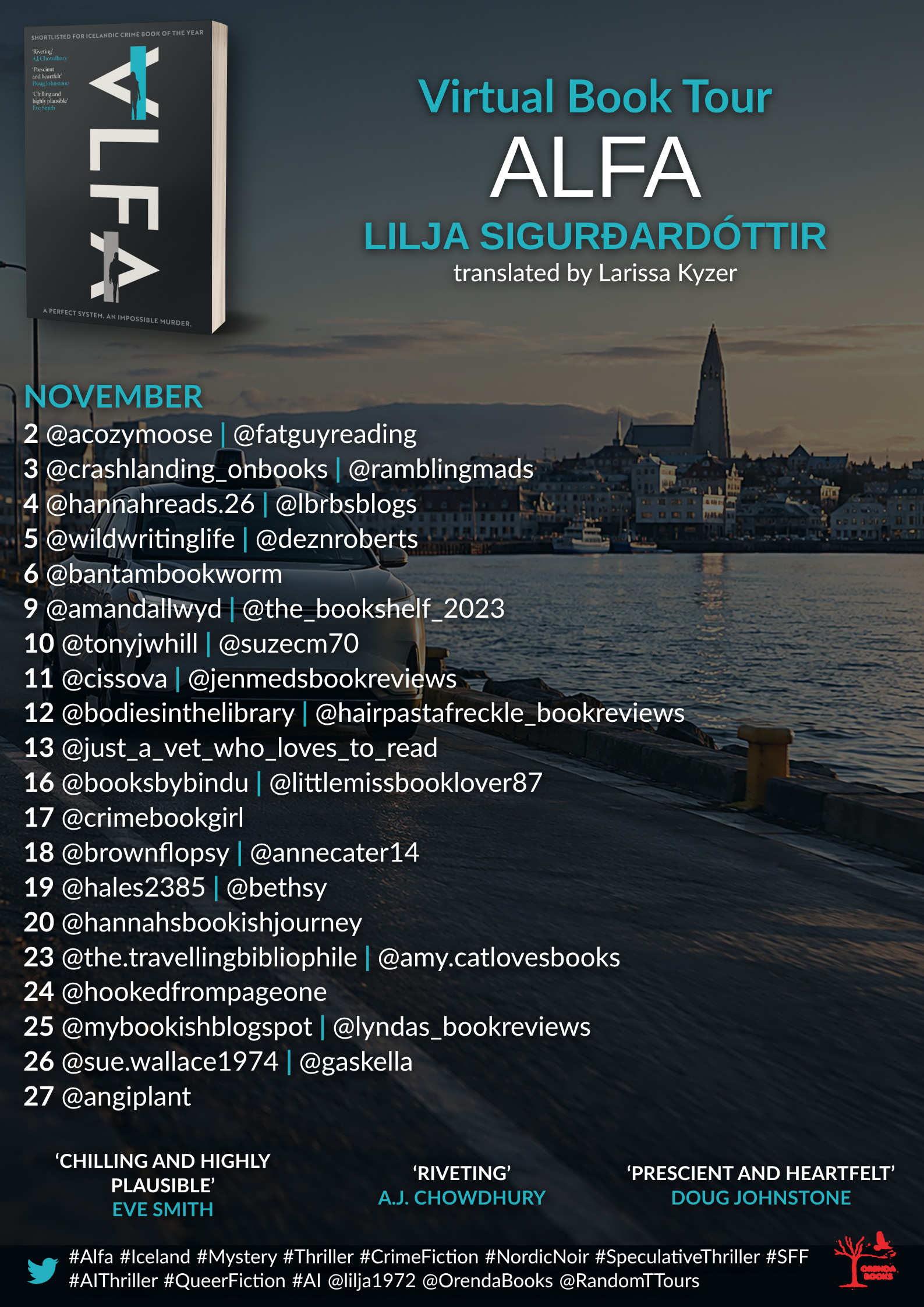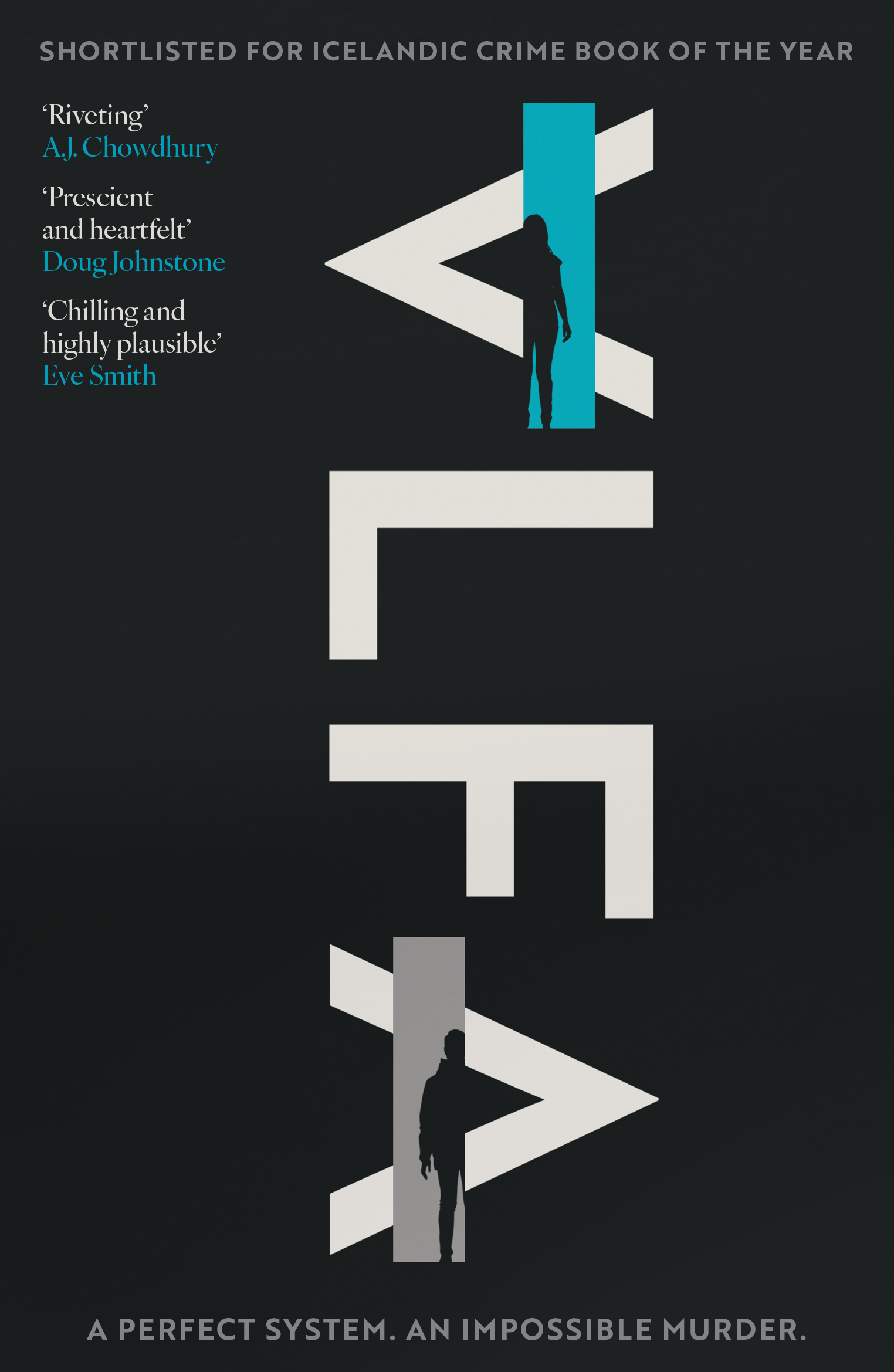
From the PR: Reykjavík, 2052. Europe is peaceful, prosperous and almost crime-free, governed by Ɐlfa, the artificial intelligence that manages infrastructure, safety and daily life. Mekkín works at the Ministry, close to the core of the system that keeps society running. She lives with her partner, Sabína, an artist.
When Sabína’s brother Birkir, a committed dissident who lives beyond the reach of Ɐlfa, is found brutally murdered, that fragile sense of order begins to fracture. Violent crime has effectively been eliminated, and Birkir’s death is not just shocking, but inexplicable. What was he involved in, and who would dare to commit murder in a world designed to prevent it?
As the investigation unfolds, Sabína is drawn ever deeper into the case. Mekkín’s position at the Ministry brings scrutiny she cannot escape, their relationship begins to fracture, and their teenage son’s recent integration into the system places him uncomfortably close to the forces now circling the family.
As Sabína pieces together Birkir’s final days, the answers begin to point far closer to home than either of them ever expected, forcing her to decide what she is prepared to sacrifice to uncover the truth…
Wow. Oh, okay, maybe starting a book review with ‘wow’ isn’t the most original but it’s the word that (along with another swearier one) that I uttered after finishing Ɐlfa. Wow; this is a book with kick, a book that lingers, a book that delivers a real level of detail and intricate plot. Wow; this is a fucking great book.
What makes ⱯLFA quite so unsettling is how entirely possible Lilja Sigurðardóttir makes this version of the future feel. We’re only in 2052, after all. That’s 26 years away, and given the speed at which AI has gone from something most of us barely thought about to something being enthusiastically shoehorned into practically every corner of our lives, it doesn’t seem an enormous leap to imagine us ending up somewhere like this. The technology might not be quite there yet, but the enthusiasm for handing over more and more decisions to it certainly seems to be.
The really clever trick to it is that, on the face of it, life under Ɐlfa sounds fairly decent. Society is peaceful, people are prosperous, crime has all but disappeared and the big decisions are being made by something supposedly free of the prejudices, greed and general stupidity of human beings. But there’s something about it all that doesn’t quite sit right as Lilja deliberately sows this nagging sense of unease throughout the story, with little things that don’t work quite as they should, questions that don’t seem to have satisfactory answers and a persistent feeling that something isn’t quite right, even if you can’t put your finger on what it is. It’s like looking at an AI-generated image or watching one of those increasingly convincing videos. At first glance everything seems perfectly normal, but then something catches your eye, or a movement feels slightly unnatural, then you notice the lifelessness behind the eyes and suddenly you’re questioning the whole damn thing and every picture you look at for a while after. Lilja manages to create much the same sensation with Ɐlfa’s supposedly perfect society, keeping you just slightly off balance without ever letting you get a proper handle on why. When it all goes properly tits up it was not only half-expected but I was loving it with every part of me that heralded the warning signs of Terminator 2.
Speaking of films… I kept thinking about the film Don’t Look Up while reading this one. Not because there’s anything particularly similar about the stories themselves, but because of that awful sense of watching humanity sleepwalk towards something potentially catastrophic while the warnings are either dismissed, ignored or drowned out by people telling us how wonderful everything is going to be. There are plenty of people raising perfectly reasonable concerns about AI right now, and plenty more who seem determined to plough ahead regardless. We’re already being encouraged to trust these systems with increasingly important parts of our lives, often without much understanding of how they work or what happens when they get things wrong. Lilja takes that uncomfortable feeling and runs with it, creating a future that seems sufficiently removed from our own to be fascinating but close enough to make you wonder whether we’re already taking the first few steps towards it.
For all the technology, the enormous questions about power and control and the rather terrifying implications of the world she’s created, the people living in it feel completely real. Mekkín and Sabína’s relationship, their family, the tensions between them and the increasingly difficult positions they find themselves in give the whole thing a genuine emotional weight. I cared about these people, even when I wasn’t entirely sure I liked them or agreed with what they were doing, and that makes everything happening around them feel so much more consequential. They’re people trying to live their lives in a world they’ve come to accept as normal, and Lilja does a brilliant job of making you understand why they might put their faith in the system, even as she gives you more and more reasons to question it.
And then there’s the plot…. another wow. I thought I had a reasonably good idea of where Lilja was taking us, only to discover that I was nowhere near as clever as I thought I was. What starts with a murder that shouldn’t be possible becomes something considerably more complicated, with revelations that make you question things you’d previously accepted without a second thought. I’m not going anywhere near spoiler terrirtory here but the those final twists and turns are absolutely stunning, even when I was felt like shouting out the answer, I was proven wrong in a way I did not see coming. Delicious.
Lilja Sigurðardóttir has written a genuinely gripping thriller that also manages to ask some pretty uncomfortable questions about the world that some want us to get building, and she’s populated it with people whose lives and relationships matter more than the bigger ideas. Credit, too, to Larissa Kyzer’s translation, which carries all of that so well.
It’s been a while since I finished ⱯLFA and I’m still thinking about it. The characters, the world Lilja has imagined, the implications of what happens and that ending. There aren’t many books that have me revisiting them in my head quite so often after I’ve put them down, and even fewer that leave me quite so stunned when I reach the final page. Again, I’m still not sure I’ve properly got across just how much I enjoyed this one but hopefully I’ve explained the ‘wow’ I started with.
My thanks, as always, to Karen at Orenda Books for my copy, and to Anne Cater for the opportunity to read and review it as part of the blogtour.