Dreaming, dreaming of how it’s supposed to be
But now this tunic’s spinning – around my arms and knees
I feel like I’m disappearing – getting smaller every day
But when I open my mouth to sing – I’m bigger in every way
I’ve mentioned before how huge Sonic Youth are/were for me. Every now and then I still get bummed when I realise that I won’t hear ‘new’ material from them again. That being said it’s not as though there’s a shortage of songs to listen to; 15 studio albums, 9 SYR instalments and a number of post-dissolve releases trickling through.
It’s close-to impossible for me to choose a favourite Sonic Youth album but when it comes to an individual song it’s always Tunic (Song for Karen). I can’t recall my first hearing of it – I have some idea it involved something being smoked – but I know I was instantly hooked.
Yes; it’s a song about Karen Carpenter. Kim Gordon has said ‘I was trying to put myself into Karen’s body. It was like she had so little control over her life, like a teenager – they have so little control over what’s happening to them that one way they can get it is through what they eat or don’t. Also I think she lost her identity, it got smaller and smaller.’ In the instrumental breakdown in the middle of the song Kim and J. Mascis are singing Carpenters songs – it’s buried deep in the mix but on the demo version (included in the 2005 Deluxe Edition) you can hear this more clearly.
The music certainly carries a dark edge appropriate to its subject matter but it’s pure hook and driving rhythm pinned down with guitar squeal. The collapse in the mid section, pulled out by the re-start of the drums and rhythm, is heaven to my ears.
..he ducked his own hand under his own coat, grabbing at nothing but air, but the two guys didn’t know that, and like the good range-trained shooters they were they went for their guns and dropped into solid shooting stances all at once, which braced their feet a yard apart for stability, so Reacher stepped in and kicked the lefthand guy full in the groin.
I was late getting to the Jack Reacher party. Perhaps because I took a long break from reading books that could be slotted into the ‘thriller’ genre or perhaps because I’m sometimes wary / sceptical of such one-character driven series. Of course that changed when I did pick upKilling Floor. I also admit I got into it the wrong way round having watched the Jack Reacher film first.
There’s been a lot said about Lee Childs’ character and a pretty good article that also covers why, perhaps, I was hesitant in picking up my first Reacher books (is it ‘low taste’?) but I am now hooked. I’ve since cleared seven and there’s an eighth sat on my bookshelves lined up as my next-but-one read.
I’ve got a couple of weeks holiday rapidly approaching so went on the hunt for some holiday reading and there isn’t really much better for that than Lee Childs’ work. So I grabbed Make Me and Nothing To Lose – I’m not reading them in order, really – but ended up making the mistake of scanning the first page of the latest. It’s a mistake as you really only need to scan the first paragraph and Child will have your attention and interest piqued. I hadn’t picked it up sooner as I’d thought it may be better to read the earlier books first and, honestly, wasn’t hugely taken with the prior effort, Personal. Either way, a couple of days later and I’d finished Make Me – number 20 in the Jack Reacher series.
Having not read even half of the series I can’t really pull the “best of the lot” or really cite favourites (though Persuader would take some beating) but I will say that Make Me is a bloody decent instalment and really does improve on Personal. It feels like a good solid Reacher novel and adds a lot more to the character than I was expecting and moves the character on in ways that have previously been missing.
Make Me starts off in what is now standard routine – Reacher finding himself, by chance, in the middle of a situation to which his sense of justice and skills and experience lend themselves. In this instance he’s climbed off the train at a town called Mother’s Rest out of idle curiosity over the town’s name. From here he’s pulled into another mystery, aided by another (in a long line) of women that he also takes a romantic interest in.
To be honest, though, that’s where the ‘norm’ finishes. The mystery in Make Me is a genuinely intriguing one and ends up going down some very, very dark roads. The humour is also a lot sharper and it did give me a good chuckle to find the one-man-army that is Reacher trying to get to grips with modern technology.
But, and here’s the thing, the Reacher of Make Me is a lot more human than previous entries have shown. There’s hints of, perhaps, a long-lasting relationship with Chang that perhaps even the author hasn’t decided where to take (given that Child writes without knowing exactly where the story is going and that the next Reacher novel is a step back in time) and we learn that Reacher can be injured in a fight by a single adversary.
Perhaps Child is aware that an audience can only see Reacher deliver the same lines (how often has Reacher had to explain his lack of permanent abode) and moves (there are, realistically, only so many ways to describer a head butt) so many times before losing interest. Perhaps he too wants to add more to the character and give him something other than an endless road and line of adversaries to smack about. Regardless, I thoroughly enjoyed Make Me and am looking forward to see where Child takes his character next. I’ll have to wait for the follow up to Night School to find out, I guess. Still with a new Reacher-per-year timetable, the wait won’t be too long after all.
EDIT: In looking back at this post I discovered that I had listed Gypsy Biker twice (a result of careless Copy and Pasting).
This is Jim’s fault. Specifically Jim at Music Enthusiast who recently, in what seems like one of those blog tags, ran up a list of his own twenty favourite Springsteen songs. It’s good list (and a blog well worth reading) and I think we share a few – it got me to then try and whittle down my own version. Then I looked at it and edited it. Then I looked at it again and edited again….
I did decide to limit myself to a maximum of two tracks from any one album and have omitted cuts from Tracks etc (I could easily put together a list of best non-album tracks). I don’t think this list is necessarily order-specific or concrete as it’s been adjusted a few times. But, right now….
Youngstown – Some of Bruce’s best works have a real sense of both time and location and they don’t get more specific than the “Here in north east Ohio, bank in eighteen-o-three” of Youngstown, the best track on The Ghost of Thom Joad and one that Nils Lofgren would set alight live come the reunion tour.
New York City Serenade – There were so many characters and street scenes thrown into Bruce’s first two albums that it’s hard to pick one stand-out but the sheer ambition of this track and its instrumentation, for anyone let alone a singer-songwriter on his second album, leaves my mouth open.
Worlds Apart – Another strong cut from The Rising, I love the blending of Middle Eastern vibes, Qawwali singersand the E-Street at full power, the thickness of the guitars under Brendan O’Brien’s production and the urgency of it all.
Gypsy Biker – I’ve written about this one before – and it’s call back to Shut Out The Light– but there’s something about this that, to me, means that of all Bruce’s later tracks enthused with anger at Bush etc this is the stand-out.
Downbound Train– Born In The USA is an odd album. It’s not Bruce’s best but then it does contain some of his best songs. Rubbing shoulders with I’m On Fire and No Surrender is this one. Bruce has many down-on-their-luck songs but this is one of my favourites.
Tunnel Of Love – Limiting choices from Tunnel of Love is as tough as limiting choices from Darkness On The Edge of Town. Both 5 Star albums. There’ll be some in honourable mentions but I’m a sucker for the line “Fat man sitting on a little stool”. As befitting a title track this one kinda contains the themes that run through the album as Bruce wrestled with the reality of his first marriage – “you me and all that stuff we’re so scared of” – and had the audacity to use it to power some of his most evocative songs. The gifted bastard.
Bobby Jean– One of the last songs written for Born In The USA – supposedly about his friendship with Steve Van Zandt, who was leaving the band… ” just to say I miss you baby, good luck goodbye”.
State Trooper – In 1999 I went and bought my second Springsteen album (after Greatest Hits had sat un-listened to for some time) – Nebraska. I’d just heard State Trooper play out over the credits of an episode of The Sopranos. It opened me up to what I’d missed about Springsteen the first time around and I’ve been hooked since.
Point Blank– Completed in ’78 and the first song Springsteen wrote after Darkness On The Edge of Town, Point Blank has been brilliantly described as “a song of shadows, of lives going nowhere, of broken relationships, and broken promises” and I can’t improve on that description.
Magic – The album, Magic, was a very strong late-career one for Bruce and a great follow up to The Rising. If only he and Brendan O’Brien had finished here. It was loaded with anger and barely-veiled hostility to the George W Bush era. This, then, is such a beautiful, slight and simple tune as to almost seem out of place. I’m also a sucker for Van Zandt’s mandolin on this.
Candy’s Room– One tricky part of this list was not going for every track on Darkness On The Edge of Town. Leaving aside the title track and Badlands, I love the tempo, the menace and the guitar on this track.
Jungleland – Was this Bruce’s last story song? I’ve got a suspicion that future such sagas would be written from a more personal perspective. Either way it’s arguably the best if only for the Big Man – especially when you imagine the agony of getting that take ‘just’ so.
Paradise – Bruce has a way of being able to evoke a real sense of pain and yearning. I don’t think it was there in his earlier work, as his voice changes he’s finding more ways of using it I guess. Thinking around this tracks like The Wall and Danny Federici tribute The Last Carnival come to mind. Paradise is so evocative of that yearning that I couldn’t listen to it for a while as I’d been misinformed as to just what it was about (somehow I’d been given the idea that it was specific to a man grieving for a drowned son) A song on the theme of loss – “I thought, ‘What do you miss?’ You miss the physicalness and the ability to touch somebody” – against the barest of backdrops serves to make this a late-career gem.
Lost In The Flood – The first in what I think of as a continual development on a theme that begins here, develops further with New York CitySerenade and concludes with Jungleland.
American Skin (41 Shots) – The caveat here being that it has to be the version from Live In NYC album, complete with Bruce’s “we need some quiet” when its message was painfully fresh and cutting and before Tom Morello got his hands on it and cut the tracks balls off.
One Step Up – That melody. That naggingly simple and catchy melody. “Mmm she ain’t lookin too married, and me well honey I’m pretending”. The best track on The Tunnel Of Love.
Born To Run – Because without this song or the album its from I doubt anybody would be compiling Best Of Bruce lists. That and the line “The amusement park rises bold and stark” is just ridiculously good.
Racing In The Street – “Some guys they just give up living, and start dying little by little, piece by piece. Some guys come home from work and wash up and go racing in the street”… I mean fuck that’s a lyric and a half there. Back that with the heavy, haunting melodrama of that piano and this one is unimpeachable. The ’78 version that graced The Promise is not only a belter in its own right but also serves to show just how much craft went into this track.
The River – Even before I went back to Nebraska and it all ‘clicked’ into place I loved The River. It’s just one of those songs that will always appear at the higher echelons of Springsteen lists.
Blood Brothers – In the early nineties Springsteen’s stock wasn’t at its highest; Human Touch and Lucky Town and the ‘other band’ tours hadn’t gone down as favourably as he’do hoped. There’s a mythical whole album that was recorded and scrapped. Then in 1994 he won an Oscar for Streets of Philadelphia and figured it was as good as time as any for a Greatest Hits album and got the E-Street Band back together to work up some older songs for it and a couple of new songs. Though fans would have to wait a few more years for a proper reunion and tour the sessions did yield two great news songs in Secret Garden and my favourite Springsteen track – Blood Brothers.
I was always a bit bemused by Bruce’s take on it in the linear notes: “It was good to see the guys”
Honourable Mentions: This Hard Land, Spare Parts, Thunder Road, She’s The One, Radio Nowhere, For You, Fade Away, I’m On Fire, With Every Wish.
In 1989 after touring behind Bug, escalating tensions and frustrations lead to Lou Barlow being booted out of Dinosaur Jr. He should have seen it coming; when the group first played together they were called Mogo and the seemingly shy and reticent guitar-shredder Mascis wasn’t upfront, the frontman was Charlie Nakajima who lasted precisely one show after using that stage as a platform for a lengthy anti-police tirade. Appalled by Nakajima’s actions but “too wimpy to kick him out” (J’s words not mine), Mascis instead asked drummer Murph and bassist Barlow to form a new band without Nakajima.
Despite his slacker vocals and aforementioned demeanour, Mascis was something of a control-freak with whom communication was a continual burr. By the time of Barlow’s dismissal they’d created a trilogy of legend-forming and hugely influential albums and had begun to scratch at commercial success with songs like Freak Scene and their cover of the Cure’s Just Like Heaven. What followed for Dinosaur Jr was a major-label deal, the subsequent change in mix/production dynamics with lyrics and vocals being pushed higher in the sound, getting caught up and buoyed forward by the changed landscape formed by Nirvana’s Nevermind, the departure of drummer Murph, their most commercially successful album and song in Without A Sound and Feel The Pain before the seemingly inevitable drop-off in sales, major-label disinterest and J’s retiring of the band name in 1997.
After a few solo Mascis records (under the name J Mascis and The Fog) and Barlow taking swipes at J in numerous Sebadoh songs, the unexpected happened; the “classic” line-up reformed in 2005 for a tour promoting the reissue of their first three albums. Even more unexpectedly; the reunion held all the way to the studio for release of the first album of Dinosaur Jr’s Third Act; Beyond. Whether it be down to the mellowing out that time, age and even parenthood bring, better communications or just the ease in pressure that comes from realising they’re not expected to make a “Smash Hit Album” but they’ve now outlived both their first ‘classic’ run of ’84-’89 and the band’s major label period of ’90-’97 and are still going strong.
Give A Glimpse Of What Yer Not – as with the three albums that have preceded it – makes a formidable mix of the band’s early heaviness and the tighter, song-oriented structure that came with the major label sound to create a perfect balance off fuzz-heavy riffs and deft melodies all underpinned by J’s trademark soloing and softly-spoken, stoner-like vocals.
Stripping back a touch on the spread of sound featured on 2012’s I Bet On Sky, Give A Glimpse Of What Yer Not is a much taughter and fiercer sounding affair. Opener Goin’ Down tears through at break-neck pace and the following Tiny rips along at a cracking pace and clocks in at just 3:12 of precise intent – cramming in heavy riffs, rolling bass lines, thundering drums and J’s solo without an inch to spare.
Those Mascis solos do take the spotlight throughout but with due cause and never sounding too heavy-handed in their placing. When I mumbled about I Bet On Sky I mentioned that albums of Dinosaur Jr Act 3 are of a formula, with anticipation for the inevitable guitar break but that “his guitar tone is beatific. His phrasing and fluidity mean that when each song breaks it’s more like being wrapped up in a warm blanket.” This still holds; Mascis’ guitar is still the star attraction on Give A Glimpse Of What Yer Not, especially on I Walk For Miles and I Told Everyone.
In the interests of democracy or as proof as to how far they’ve come in terms of dissipating tensions – Barlow gets a couple of his tracks on each of the band’s latest albums. Here Love Is… stands out as the strongest, it’s structure calling to mind Led Zep’s III era folkiness before giving way to Mascis’ guitar while it and the album closer Left/Right are both stronger, more comfortable-sounding tunes than any of his which have graced albums since Beyond. Whereas on previous albums they’ve been something of a sore thumb and almost halted the flow, here they slip in gel more cohesively than every before.
The band are clearly getting on well and working together better than ever before and while the ‘if it ain’t broke’ adage can certainly apply to many of the tracks here, songs such as Lost All Day and, particularly, the changing dynamics of Knocked Around show that Dinosaur Jr remains a band willing to stretch its sound and try new ground rather than generate a few more tracks to drop in between Forget The Swan and Lung during the payolah tours.
I’ve yet to catch them live – I wondered recently how they tackle the subject of playing those songs recorded during Barlow and Murph’s absence from the band. Do they include them or do they go the Van Halen route of pretending a huge part of the band’s history and it’s most commercially successful and wider-known tracks don’t exist (in my mind and a little off-topic I’d call this route as stupid a decision as getting Roth back in the fold in the first place was but then the idea of Diamond Dave trying Right Now is as farcical as any part of his hammy vaudeville act) or do they let bygones be bygones and go for the crowd-pleasers? I was very glad then, to see, thanks to SetListFM, that their set lists from recent tours include a good mix of old, mid and new era tracks. I suppose it’s further testament to just how well they’re getting on.
I digress…
I’ve had this album for just a couple of days now but it hasn’t left my CD player since then (I’ll have to wait a little longer for the vinyl) and cannot see a way this doesn’t make the Best Of 2016 list.
Don’t know why this one has been going around and around my head the last couple of days. Could be down to having the phrase “Black Out” in there after putting a book review together and it morphing into “back out” in my head and just as likely down to having been spinning the new Dinosaur Jr album today.
Either way there’s something hugely addictive about this track and the ease with which J Mascis blends into Kevin Dew’s song that I can’t shake and haven’t been able to for some eight and a half years now since it dropped in 2007.
Blimey…. 2007 doesn’t feel like it should be nine years ago. For context it made it onto Rolling Stone’s Best 100 Songs of the Year list which also included the then-new Radiohead track ‘Weird Fishes/Arpeggi’, Arcade Fire’s ‘Keep the Car Running’, Springsteen’s ‘Long Walk Home’ yet also had Rhianna’s ‘Umbrella’ at number 3. Go figure.
Oh well.
Anyway, the most frustrating thing about having this stuck in my head is that I cannot for the life of me find it in my collection. Whether I (or toddler-sized fingers) accidentally knocked it out of my iTunes or the CD has done a bunk, I don’t know.
Think of Iceland and you’ll no doubt think of geysers, calm, tranquil fjords… perhaps even volcanic eruptions. Crime and murder will probably not be one of those connections that springs to mind. The same is certainly true for Evan Fein, an American tourist, as he searches for Grettir’s Pool, an ancient stone-flagged hot bath, down narrow roads and scanning country lanes and farm gates. What awaits Evan, though, isn’t a relaxing dip in steaming water, it’s a dead body, a man brutally beaten to the point that he is “practically unrecognisable,” “where there had been an eye, there was now an empty socket.”
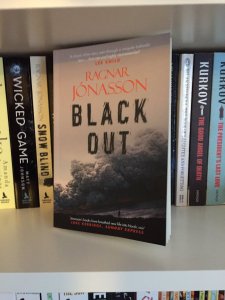
This is the start of Black Out, the latest instalment in Ragnar Jónasson’s Dark Iceland series to be translated into English and published by Orenda Books and it’s bloody good to be back in Siglufjörður once again. Black Out sits second in the Dark Iceland series and picks up after the events of Snow Blind; Ari Thór, while now more at peace in the town, is dealing with the fallout of his confession of infidelity to his girlfriend, Kristín who herself is now living a short distance away in the neighbouring Akureyri. The Inpector, Tómas, is debating his own future in the town after his wife’s move south to Reykjavik and Hlynur is dealing with the chilling consequences of his past.
It’s into this state of distraction that the news of the murder is dropped and Ari Thór and Tómas set about investigating the victim’s connections to the town – the only real starting point is that the victim, Elías, was part of a crew working on the new tunnel. Tómas is far from thrilled at the opening of the tunnel, worrying what it will bring into the town. Strangely enough, the more that Ari Thór digs into the storied past of some of the residents it’s clear that even without infrastructure upgrades, Siglufjörður holds many a disturbing secret. Some people know exactly what Elías was involved in but nobody is talking and so much remains hidden despite the 24-hour light of the Arctic summer that the police are in the dark.
That contrast of tones – darkness in the shadows of an otherwise idyllic scene – is what makes that creeping sense of dread so much more powerful and chilling as, piece-by-piece, the clues come together and the quiet town of Siglufjörður becomes the epicentre of a taught, methodically plotted story involving money laundering, sex-trafficking, child abuse, rape and murder. Be warned – Black Out gets very dark.
This time around it’s not just the Siglufjörður police that are trying to crack the case; Isrun, a news reporter is also chasing down and finding her own leads as she races for an exclusive. The introduction of Isrun means that Jónasson is able to add further elements to the story and take the reader further afield to Reykjavik (shrouded in a volcanic ash cloud) and the politics and rivalries of the newsroom. I’ll avoid going further in terms of Isrun’s involvement in the investigations or her own motivations to avoid spoilers but I will say that it was a genuine surprise and a welcome change up, further evidencing that Ragnar Jónasson’s writing is anything but formulaic. She’s also another thoroughly great and compelling character.
Jónasson has a gift when it comes to crafting memorable characters. Ari Thór, while not always likeable, is given increasing depth and dimension with every instalment and his relationship with Kristín gives greater insight as well as further developing her own character. Somewhat sadly, of all the threads surrounding the main narrative, it’s the sub-plot surrounding Hlynur that is perhaps the most gripping and while having already read Night Blind means I knew where it would lead, was nonetheless genuinely affecting and moving.
Weaving together all the sub-plots of such a multifaceted story could prove challenging yet Ragnar Jónasson makes it seem effortless – while his history of translating Agatha Christie novels into Icelandic means he’s no stranger to mystery writing, it’s his own voice and skill that makes Black Out and the Dark Iceland series one of the most compelling and rewarding additions to the thriller genre. Each instalment delivers more and leaves the reader in eager anticipation for the next. The first snippet of the next instalment (included at the end of Black Out) had me checking the door was properly locked and bolted. Not something I’ve done since I read The Snowman. A series and author well deserving of the highest praise. Very much looking forward to more.
Huge thanks once again to Karen at Orenda Books for my copy and I do wholeheartedly recommend Black Out.
Last night I closed my eyes and watched the tracers fly
Through the jungle trees
Like fireflies on a windy night, pulled up and onward by the breeze…
Kids In Philly remains a high water mark for Marah, and it was only their second album. Marah are one of those bands that shoulda, woulda, coulda been so much more but, following their second album, they were dogged by line-up changes and the ever-diminishing press interest and promotion that comes from a band that sign to a seeming merry-go-round of record labels. Back in 2000, though, the band with the Bielanko Brothers Serge and David at its core were coming off the enthusiastic critical response to their début Let’s Cut The Crap & Hook Up Lateron Tonight – which saw them signed to Steve Earle’s now-defunct label – when they released Kids In Philly. The response was hugely positive.
Upon release critics lauded the band and the album for its originality and recasting of musical touch stones. References to Springsteen abounded along with phrases such as “imagine The Clash taking on Born to Run” documenting the album’s energy and lyrical call outs. Calling the album relentlessly infectious, AllMusic calls it stunning “in its diversity, and even more stunning in its ambition. The album forges its own confident, note-perfect rock & roll sound, while practising the type of effortless stylistic hopping that hadn’t been executed to such wonderful effect since the heyday of the Fab Four.”
Kids In Philly is an absolute blinder of an album and one that makes my own Essential 100 list (which I’m still miles from returning to let alone completing). It’s not only compellingly addictive in its urgency and song-writing craft but the lyrics come across as hugely authentic and miles away from the phoned-in, play-acting that was rife in so music at the time – 2000 was peak landfill-indie on the radio. Rolling Stone cited how the album “lives and breathes the streets where it was made.”
I found it, as with so much music at the time, via one of Uncut Magazine’s Unconditionally Guaranteed cds glued to the cover (I wonder if I ought to start buying that magazine again). I’ve got an odd soft-spot for these war story songs (Goodnight Saigon serves as another example and even Stand Ridgway’s Camoflauge for other reasons) that try and put something so inhuman into a human context. It’s tricky, though, to get it right – find the balance between affective lyrics, a good tunes and a song that works in its own right. In that respect Round-Eye Blues exemplifies everything that makes the album it’s from great; instantly catchy, full of hook, biting lyrics and great craftsmanship in both the tune and the lyrics.
Somehow these guys manage to make a bitter tune sung from the point of view of a Vietnam vet (another little nod to Bruce) convincingly genuine despite the fact that they would only have been in their early 20’s at the time – “But late at night I could still hear the cries of three black guys I seen take it in the face, I think about them sweet Motown girls they left behind and the assholes that took their place.”
From here it was a bit of a stalling, down hill tumble for Marah. Their follow-up was made by Owen Morris (who was known for producing Oasis so Be Here Now should have served as a red-flag in terms of suitability), the over-produced (so much so that they later released a “de-constructed” version) and aimless Float Away With The Friday Night Gods failed to capitalise on the doors opened by Kids In Philly (or the practically-buried cameo from Springsteen himself) and led to the previously mentioned label-hopping and line-up changes. I stuck around for a few more albums hoping for a return to form but, while they remained capable of turning out the odd little reminder of their song-writing charm the energy and urgency of Kids In Philly eluded them and lack of effective record distribution made it harder to get hold of their work. Still, I understand that they’ve since ‘reformed’ to celebrate the album’s 15th anniversary so who knows.
Another couple of months and another chunk is taken out of the continually growing TBR pile.
Time doesn’t appear to be my friend of late for blogging larger reviews (life takes priority) so I’m gonna try and wrap up a few of those books whose spines I cracked over the last month or so.
The Amber Shadows is a 2016 release (it’s not all that often I read books so close to their publish date) that I found via the author’s twitter – Lucy Ribchester’s book (her second) is set in 1940’s Bletchley Park and she’d been sharing some of those once-classified documents from home of Britain’s codebreakers during World War II that had served as research for the novel. That’s enough to get my interest. The Amber Shadows is certainly well-researched and manages to give a very convincing account of the time and place without over-doing it to the point of stereotyped clichés as some do. The plot – Honey Deschamps works in Hut 6 transcribing decrypted signals from the German Army when she begins receiving mysterious packages of amber – is certainly promising and the writer is able to keep the reader guessing. The conclusion left me a little unsatisfied but, in retrospect, it’s certainly in keeping with the period in which it’s set in terms of how, with the second world war raging and life having taken on a different value, it may well have played out.
The Sisters Brothers by Patrick DeWitt had been sat on my shelves for at least a year before I picked it up at the start of the month. I’d seen it in the hands of numerous travellers a few years back on a cruise and in many a list at the time so thought nothing of grabbing it for £1.99 in Sainsburys. Though I obviously didn’t think to read it either. I can only say I was stupid. It’s a brilliant book. A real ripper that I tore through hungrily. Many a review have likened it to a noir-ish Coen brothers story and I’d happily agree. Another book I’m glad I finally got around to reading and just in time it seems as Mr DeWitt has a new book out.
Jo Nesbo’s Harry Hole is, I guess, a name that isn’t one typo away from being obscene in its native Norwegian. The Redbreast is my third Harry Hole read (well out of sequence) and fifth Nesbo novel. I was hesitant to read this after my disappointment with Head Hunters but I needn’t have been. While not as genuinely terrifying as The Snowman or quite in possession of its writer’s realised style, this third Hole novel not only works as a good stand-alone instalment but also serves up plenty of fodder for the Oslo detective to tackle in later novels and it’s a good indication as to how both the character and series develop- having now read three of which at random I do know think I’ll be better served reading them in order, though.
Reading things in order brings me to the couple of Discworld novels I re-read last month. My gradual rebuilding of my Terry Practchett collection is going nicely – I’ve also finally added and reread Men At Arms and travelled back via Guards! Guards!– if slower down to my decision to purchase and read on a less specific order than chronological. As such I’m not merely going to Waterstones and buying new (not to mention my disliking of the new cover art) but popping into used book stores and looking for specific titles – Pyramids is next on my list – or seeing what they have (there seems to be an abundance of The Hogfather). I hadn’t read either Mort or Sourcery more than the one reading I gave them at least a decade and a half ago. As such it was great to rediscover how delightfully dark the humour in Mort is and laugh as Death attempted to understand what it is to be human. I can’t, in all honesty, say quite the same for Sourcery as it took me a few false-starts to get through this one. It lacks the spark and momentum that his earlier and later novels would have and, looking at where it sits in publishing order, perhaps Sir Terry was reaching the point where he was running out of fuel for the Wizards / Witches / Rincewind stories. Indeed he’d soon branch out into other character and story arcs to populate the Disc. That’s not to say Sourcery is without its charms or humour but I’d be surprised if it was listed as anyone’s favourite of the Discworld novels.
Oddly enough I like the idea of doing a split, two-parter post as it gives me something resembling a structure to post on rather than ramble – especially when current events are something I need to stay away from if only for the sake of my blood pressure and keeping that black dog at bay.
Earlier this week I got the Pre-Milk Spillage Aerosmith compilation up having been inspired by Jim over at Music Enthusiast’s post-trilogy on the Toxic Twins. Turns out that one was the easiest of my original comps to recreate on Spotify and share. For some reason Falling Off isn’t included on the streaming version of Nine Lives (I guess it was cut from international versions of the album) which meant I head to substitute it for the lesser Walk On Down and Can’t Stop Messin’ has been culled from Get A Grip but once you start substituting….Well, I wanted to get something from the latest Music From Another Dimension on there and Out Go The Lights seemed the only one to fit (I guess because the tune has its origins from the Pump era) which meant I was able to slice out some of those awful ballads that I’d no longer want to hear (and clog up most of Big Ones).
But then with an extra minute or three do any of the tracks from the period between Nine Lives and Music… warrant selection? Well, no. I, like Mr Perry (2010: “I don’t think we’ve made a decent album in years. Just Push Play is my least favorite. When we recorded it there was never a point where all five members were in the room at the same time and Aerosmith’s major strength is playing together. It was a learning experience for me: it showed me how not to make an Aerosmith record”) don’t care for Just Push Play. And, yes, I open with three from Pump and even include two more including the only one of their ballads that I can still enjoy (if you’ve seen them live and been part of the crowd that sings along to the start so loudly it shuts Steven Tyler up you’ll have a soft spot for it too) but Pump is to their latter-day period what Rocks is to their initial run; unimpeachable.
So, it was possibly the trickiest to compile and is by no means perfect but if I were to compile for CD length, tunes from the Post-Rehab (I can’t really call this one Post-Milk Spillage as I’ve selected nothing from Done With Mirrors) now it would probably look like this:
“I think I read that we get more information in one day in modern times than people in the 1700s used to get in a whole lifetime. So if you’re every feeling crazy or overwhelmed or insignificant or frustrated or beaten down, there’s a fucking reason. It’s impossible to keep up. There’s a lot of tragedy in the world; we just didn’t used to hear about all of it… it all goes into being overwhelmed and there’s no better song than this one.”


 Mumbling About...