Page Turning – Another Three

Crikey, here we are already with September under way and autumn barrelling down on us with the onset of cold mornings and the tug of breezes forgotten.

I’m currently 26 books down on my 40 Books challenge for 2017 and the 27th underway. As has become the norm, here’s a few of those that have been read of late – a couple of which took a little longer than the usual week / week and a half that I can usually pace for reasons that will be discussed.

The Black Dahlia by James Ellroy

There is no way of reading Ellroy without fully immersing yourself in his rich, enveloping and truly unique prose. I finally discovered the wonder of Ellroy’s writing in 2015 with Perfidia and it formed part of the first of these Turning Pages posts. Knowing that Perfidia was a prequel of sorts to Ellroy’s ‘LA Quartet’ I was keen to read more but read them in order and The Black Dahlia did not disappoint. As CB over at Cincinnati Babyhead points out; Ellroy “nails the whole under belly L.A. thing” and there’s nothing like wallowing in his world. My habit of sticking my nose in charity bookshops has borne fruit and I now have a copy of The Big Nowhere sat on the TBR list so I can continue walking those mean LA streets.

The Leopard by Jo Nesbo

A Christmas or two ago my wife gave me Jo Nesbø’s The Snowman to feed my growing appetite for Nordic Noir. I found it insanely addictive and chilling (I have zero faith the upcoming film will do it any justice) and have sought out other Harry Hole (pronounced: HOO-LEH so not quite one letter away from a real cultural hiccup) novels since though – as I was going back in the timeline and Nesbø’s career I didn’t find them quite as rewarding.

So I was happy to grab a copy of The Leopard at good second-hand price as it’s the next instalment in the series. I get the impression that it’s around this time in his writing career that Nesbø perfected his style. The earlier novels are bloody good, mind, but all the elements really seem to have come together; the writing is tight and focused, the plot is intricate and well weaved and the suspense and mystery are genuinely gripping.

The back-story of police corruption that was found in novels leading up to Nemesis has faded more into the background and the focus – aside from the murders – is firmly on Harry as he tries to overcome his own scars and wounds from the events of both a long and hard career and those of The Snowman – in this instance I’d say that readers would be at a loss if they hadn’t read that novel first. With both Phantom and Police sitting on my TBR pile I very much look forward to reading more of Harry Hole’s adventures.

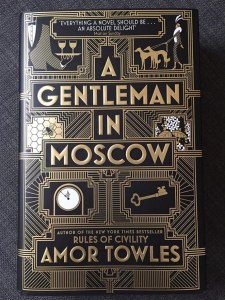
A Gentleman In Moscow by Amor Towles

For all the hype that surrounds it I found, in my first year of membership, Amazon’s PrimeDay to be something of a disappointment. While my son occasionally (as is the whim of toddlers) takes delight in his LED flashing shoes, precious little else interested me. With the exception, that is, of the cover of A Gentleman in Moscow. I mean, I know you’re not supposed to judge a book by such things but… it’s a hell of a great looking book jacket. Not only that but the description:
“On 21 June 1922 Count Alexander Rostov – recipient of the Order of Saint Andrew, member of the Jockey Club, Master of the Hunt – is escorted out of the Kremlin, across Red Square and through the elegant revolving doors of the Hotel Metropol.

But instead of being taken to his usual suite, he is led to an attic room with a window the size of a chessboard. Deemed an unrepentant aristocrat by a Bolshevik tribunal, the Count has been sentenced to house arrest indefinitely.

While Russia undergoes decades of tumultuous upheaval, the Count, stripped of the trappings that defined his life, is forced to question what makes us who we are. And with the assistance of a glamorous actress, a cantankerous chef and a very serious child, Rostov unexpectedly discovers a new understanding of both pleasure and purpose.”

It was practically begging me to read it! Well, turns out it’s one of the best things I’ve read all year. Ridiculously well written, every single page was a delight to read and a lesson in craft and style. Rostov is a character for real literature lovers and the level of storytelling and sub plots are surprisingly complex given the initial premise and form a deliciously rich and vital background, giving real weight, humanity and warmth to a novel that could so easily have been the slightest of things.

A Gentleman in Moscow works as both a fantastic novel full of humour, charm and heart as well as a deviously funny allegorical take on Russia’s not too distant past. Reading this novel I had to keep reminding myself that it was published just this year – with its classic style, insightful observations and supporting cast of characters and the impact of historical occurrence, it genuinely felt at times as though discovering a well-loved classic and the ending…. is just sublime. Much in the same vein as Antony Doerr’s All the Light We Cannot See (another novel I picked up based on the cover and hook of the blurb), A Gentleman in Moscow is easily one of the best novels published in recent years and much deserving of a place on a discerning bookshelf.

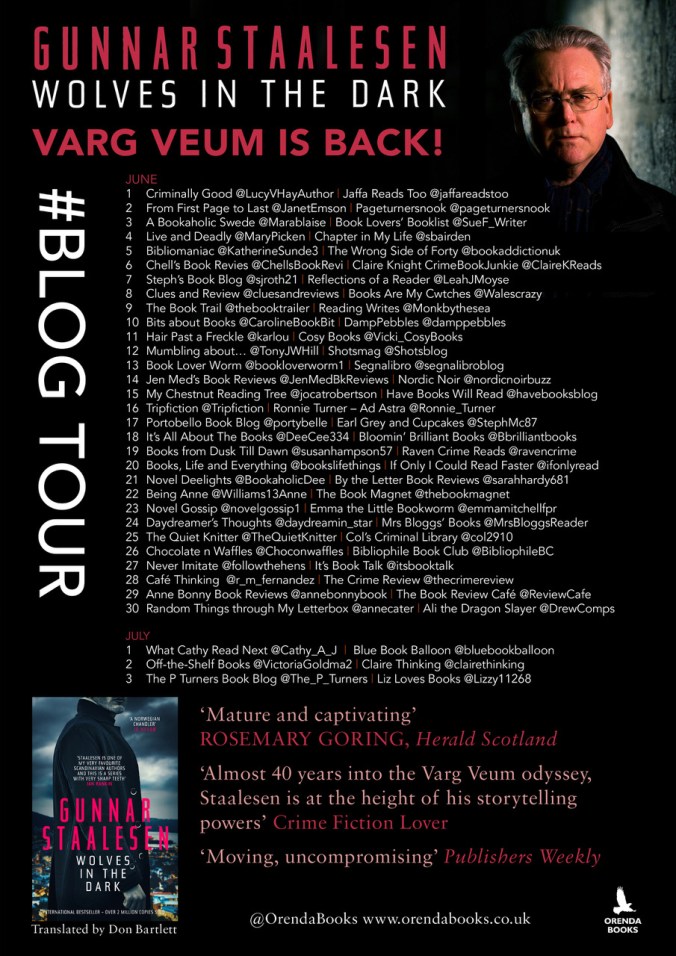
Blog Tour: Wolves In The Dark by Gunnar Staalesen

From the PR: “Reeling from the death of his great love, Karin, Varg Veum’s life has descended into a self-destructive spiral of alcohol, lust, grief and blackouts. When traces of child pornography are found on his computer, he’s accused of being part of a paedophile ring and thrown into a prison cell. There, he struggles to sift through his past to work out who is responsible for planting the material … and who is seeking the ultimate revenge.

When a chance to escape presents itself, Varg finds himself on the run in his hometown of Bergen. With the clock ticking and the police on his tail, Varg takes on his hardest – and most personal – case yet. Chilling, shocking and exceptionally gripping, Wolves in the Dark reaffirms Gunnar Staalesen as one of the world’s foremost thriller writers.”

Right now I don’t think there is a writer whose new novels I look forward to as much as Gunnar Staalesen. And I’ll probably say this every year with every new novel; Wolves In The Dark is the best Varg yet! It’s just so fucking good I never wanted it to end.

I cannot recommend the Varg Veum series enough, Staalesen is the sitting King of Nordic Noir and this, the 21st (!) in the series puts Bergen’s finest into his most challenging and dangerous case to date.

Woken up by the police knocking on his door, Veum is shocked to find himself arrested and lead out to a waiting police car for the worst crime imaginable; possessing, sharing and even creating child pornography “of the must repugnant kind.” Having spent a number of the almost-four years previous lost in grief and his alcoholic coping method following the events of We Shall Inherit The Wind, Varg begins slowly pulling together threads of memory and seemingly random cases he’d worked on in the ‘fog’ of those years to try and work out just who might have sufficient a grudge (and ability) to put him in the frame – turns out it’s a pretty long list. When a chance presents itself Veum escapes from the police and sets about investigating for himself.

I read a news story not so long ago about a man whose life was completely ruined after a mistake (an error in one police force’s writing down an IP address) led to him being arrested under child pornography charges and placed on the sex offender’s list. A devastating account of a life turned upside down – his job was lost, he was traumatised, his relationships and family suffered – all because of an error. Turns out there’s a few of these. It seemed stranger than fiction and fascinating – where would you even begin, how could you hope to fight such a case?

I’d like to believe I’d be incensed and able to fight enough to clear my name. But then what about the impact on your life, on your person? To know that so many people – including, in some cases, those near and dear believe you capable of such horrors? Will people ever look at you the same? And these are innocent people. Rendered criminal and untrustworthy, monstrous even, by a mistake.

In Varg’s case it’s not a mistake – the material is on his computer but who put it there? Who has deliberately thrown him to the wolves to be shredded in public? The more he investigates the more he uncovers, the more he shakes the tree the more potential enemies fall out each baring him ill and each with the ability to implicated him via his computer.

The chase, as Varg tears through Bergen as both hunter and prey (to his increasing list of enemies as well as the police) is the most thrilling and gripping in pace as I’ve read from Staalesen; Veum is very much against the clock and working within strict confines of both geography and tool set as he has to evade detection. In previous Staaleson novels I’ve loved the almost leisurely, calm and confident manner in which Veum slowly and methodically pieces together his cases – like a Zen master who knows his craft. Here, though, as much as he knows his craft the shattered state of his memory almost leaves him clutching at straws with thoughts and fragments coming back out of the ether and it’s an absolute joy to read as Veum is forced to work as frantically as possible against the odds.

But what about the human element? The effect of being accused of such horrendous and unspeakable crimes? Well, I’ve said this before and I’ll save it again: Staalesen is the master. He paints an intelligent, detailed and thoroughly convincing portrait of a man on the edge, plagued and sickened (physically) by both the accusation and the crimes themselves (let’s not forget Varg was a Social Services man before a PI) and torn at the prospect people believe him capable of such inhuman crimes.

The underworld of Norway never fails to prove a complex and riveting backdrop in Nordic Noir and Staalesen spins a delightfully well plotted story that delivers a hugely satisfying read as all the strands come together toward a denouement that left this reader gobsmacked.

Again: I cannot recommend Staalesen enough and even though it’s only June, Wolves In The Dark may well be the best book I read this year.

Thanks again to Karen at Orenda for my copy, do check out the other stops on the blogtour and get your hands on a copy of Wolves In The Dark.


Blog Tour: Faithless by Kjell Ola Dahl

From the PR: “Oslo detectives Gunnarstranda and Frølich are back … and this time, it’s personal…

When the body of a woman turns up in a dumpster, scalded and wrapped in plastic, Inspector Frank Frølich is shocked to discover that he knows her … and their recent meetings may hold the clue to her murder. As he begins to look deeper into the tragic events surrounding her death, Frølich’s colleague Gunnarstranda finds another body, and things take a more sinister turn. With a cold case involving the murder of a young girl in northern Norway casting a shadow, and an unsettling number of coincidences clouding the plot, Frølich is forced to look into his own past to find the answers – and the killer – before he strikes again.”

Caution- a whiff of slight spoiler may be ahead…

So… today is my stop on the BlogTour for Kjell Ola Dahl’s Faithless and I’m not really sure where or how to start with a review for this one because it is so fucking good.

I suppose I could start by pointing out that I have zero prior familiarity with Kjell Ola Dahl’s work or the Oslo Detectives series into which this novel slots but it’s safe to say it’s not required. At no point while reading did I feel as though I was missing out on something vital in terms of plot or character arcs as Faithless has been so ridiculously well crafted as to work not only, I assume, as a fantastic continuation of a series but as a bloody strong stand alone novel too.

As for the plot… gripping and so brilliantly pieced together as to leave no question that this book would be put down until finish. Frølich, tired after an all-night surveillance pulls over a person of interest and discovers she’s carrying cocaine. She’s booked, reveals nothing, pays a fine and is set free. Frølich then meets her again when it turns out she’s engaged to an estranged friend with whom he’s recently reconnected. When she’s murdered just days later it’s all a little to close to home. The disarmingly calm and methodical investigations reveal a complex web that may or may not connect it to a decades-old murder and comes with plenty of surprises and twists.

The stately prose and style is that of a master (expertly translated by Don Bartlett); precise and clinical without a spare word and packing plenty of punch.

When it comes to the characters… as I said – I have no prior knowledge of this series (something I desperately need to fix) but in no way felt I was missing anything; Frølich, Gunnarstranda and all are perfectly rendered and genuine characters for whom any reader will root and find common ground.

To say Karen at Orenda has impeccable taste would be an understatement right now. A couple of years ago she introduced me to the work of Gunnar Staalesen, “one of the fathers of Nordic Noir” , and now here we are with yet another master of the genre on her list. Unbelievable amount of talent and beautiful prose. A real must read that I cannot enthuse enough about. Many thanks, again, to Karen for my copy and do check out the other blogs on the tour:

Blog Tour: Cursed by Thomas Enger

img_2005From the PR: “When Hedda Hellberg fails to return from a retreat in Italy, where she has been grieving for her recently dead father, her husband discovers that his wife’s life is tangled in mystery. Hedda never left Oslo, the retreat has no record of her and, what’s more, she appears to be connected to the death of an old man, gunned down on the first day of the hunting season in the depths of the Swedish forests. Henning Juul becomes involved in the case when his ex-­‐wife joins in the search for the missing woman, and the estranged pair find themselves enmeshed both in the murky secrets of one of Sweden’s wealthiest families, and in the painful truths surrounding the death of their own son. With the loss of his son to deal with, as well as threats to his own life and to that of his ex-­‐wife, Juul is prepared to risk everything to uncover a sinister maze of secrets that ultimately leads to the dark heart of European history. ”

“It’s like having a gun to your head”, being a dad, according to Henning Juul: “You go around being frightened the whole time. Frightened that something might happen… And you think that all the awful stuff you read about in the papers – it won’t happen to you and your child; it only happens to other people’s kids.” Juul, you see, is living every parent’s nightmare – his son was killed. As Henning and his son slept the apartment they were in was set alight as a warning – Juul’s investigations having come too close to some presumably powerful and truly nasty people. All of which, I understand (and please correct me if I’m wrong) happened before the events of the first Henning Juul novel, Burned.

So here we are with Cursed, the fourth entry in the Henning Juul series and it’s an absolute belter that cost me a fair bit of sleep in my reluctance to put it down. I’ve not read the previous novels in this series but I never felt that I was lost or missing anything for having not yet done so (only that I now need to go back and start at the beginning as this was such a good read) as Thomas Enger does a great job of bringing you up to speed without being heavy handed.

As Juul continues to search for the man who set alight his apartment and delve deeper into Oslo’s dark underbelly with some memorable scenes and characters, his ex-wife Nora is asked to investigate the disappearance of Hedda Helberg.

Having discovered the motivations and back story behind Juul’s investigations I honesty didn’t expect Nora’s case to be able to compete in terms of either drama or grip, but then I do like to be surprised by a book and the supposed missing-person case of Hedda Helberg soon becomes just as demanding of attention as slowly but surely a web of deceit and lies surrounding one of Norway’s wealthiest families is pulled apart.

Both of these investigations and narratives have the slow-burning, intricate and meticulous plotting that I so enjoy in a good thriller and that the two gradually become linked as they gather both pace and intrigue mean there’s zero chance of putting it down. The switch between narrative focuses proving a great device as it allows for a fuller view of each of the characters.

It’s hard to read Cursed and not be moved by the loss that Nora and Henning have endured while also noticing the difference between the two characters and how the death of their son has affected them both. Nora slowly but surely moving forward in life, back to work and in a new relationship, all the while carrying a ball that their son played with in her bag. Juul – presumably blaming himself in many a way – is  driven by nothing but finding justice for his son, his entire being devoted to the cause. The tragic and heartbreaking (seriously where is the Orenda Gut Check warning on this one?) back story makes this novel all the more compelling.

Cursed just about has the lot; intrigue from the off,  tightly weaved plots that pull you right in, plenty of twists, gritty and scarred lead characters and enough emotional heft and resonance to floor come the final reveal – all underpinned by a back story and over-riding story arc that ensures the Henning Juul series demands attention.

A complex, taught and thoroughly gripping read, Thomas Enger’s Cursed is a first-rate character-driven thriller that doesn’t disappoint.

Many thanks to Karen at Orenda for my copy and do check out the other stops on the Cursed Blog Tour.

cursed-blog-tour

2016 Between Covers

Here we are once again amongst the closing days of another year. This is certainly one year I’ll be glad to see the back off. I won’t go off-topic here or cross that line into putting too much of the personal up here but I will say 2016 was an utter bloody farce of a year.

However, as the days before the fat man with a beard drops down the chimney diminish, it’s also that time to share what I think were the best things I read during 2016.

Once again – save for a few weeks where I simply couldn’t read / take anything in – I read a lot this year – some amazing fiction new and old and plenty of fascinating non-fiction. There are some I’ve started but not finished (I do aim to finish Life and Fate in 2017) and some that still sit on the To Be Read pile.

This list, then, is my take on the best written word I consumed during 2016 and is in no particular order with the obvious exception…

Fiction

IMG_7211Jihadi: A Love Story by Yusuf Torpov

One of the first books I read this year and one that’s stayed with me throughout. Echoes of great writers can be found throughout but it’s truly marked by the unique voice of Yusuf Toropov who here has written an important novel of our time. In my review I said that  its a rare thing to find “a book that is so unarguably great that you find yourself telling everyone they should read it regardless of their usual choice of paperback writer. Jihadi; A Love Story by Yusuf Toropov is just such a book.” I stand by that.

Leaving Berlin by Joseph Kanon

A spy thriller set at the very start of the Cold War, as divisions and sides are drawn in a country still beset by the scars of war and trying to rebuild itself amongst the rubble. As much as I was fascinated by the historical element the plot equally gripped my attention and has sent me off down another path of reading with a couple of Cold War thrillers already en route to my letter box. Original review.

For Two Thousand Years by Mihail Sebastian

For completely personal reasons this book would already make the top ten. It was purchased while spending ten hours waiting for a plane at Gatwick airport ahead of a family holiday where it was hungrily consumed. I’d been searching for Sebastian’s work in English and this, published this year, did not dissapoint. Beautifully written and deeplu insightful and evokative. The knowledge of the tragedies that lay in store for Mihail Sebastian only make it all the more poignant. Original review.

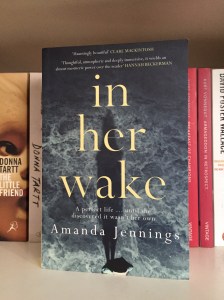
imageIn Her Wake by Amada Jennings

This book absolutely broke my heart. This book was so far from what I was expecting and so gripping that I honestly can’t see how it wouldn’t make this list. If everything you knew about yourself turned out to be a lie, that your whole life was built around a crime so devestating that lives have been ruined, what would you do? In Her Wake, is a real story of hope and courage. And, yes, the final revelation about Bella still guts me many months down the road.

Notes on a Cuff by Mikhail Bulgakov

Finding this book last year, and finally reading it in this, was such a joyous experience. I thought I’d read all that was available so to discover the stories in Notes on a Cuff was like stumbling upon gold dust. These stories, written in the early 1920s, show a real master finding his voice and revelling in the art and joy of writing. There are elements here that he’d perfect later in his career but it’s amazing to see just how brilliantly formed his work already was.

Purity by Jonathan Franzen

On each occasion (and it’s always an ‘occasion’) that a Franzen book is published I can’t help but think it won’t be as good as his previous novel. On each occasion I’m proven wrong. Easily his most accessible and equally amongst his finest work.

The Bickford Fuse by Andrey Kurkov

I’ve written before on just how much I love Kurkov’s work. Something of a cross between Bulgakov and a Ukranian Vonnegut, he weaves near-absurdist, satirical novels of the highest calibre. The Bickford Fuse from what I can tell, is an earlier book than any he’s yet published and was written in the final days of communism. A look at ‘Soviet Man’ told through a series of somewhat connected stories and characters that, while clearly written by the same author, is completely unique amongst his work printed thus far. Ambitious, multi-layered and hugely rewarding to read.

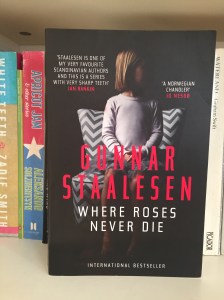
IMG_9197Where Roses Never Die by Gunnar Staalesen Favourite Fiction of 2016.

I read this in circumstances almost as perfect as possible yet I’m sure that had I read it in the middle of a cesspit as I sank down to the bottom I would have loved it just as much. Hugely gripping, deeply evokative and written without a spare word, Gunnar Staalesen is like the samauri of Nordic Noir – every masterful, well-practiced and skilful word strikes home hard. Staalesen is the master of his craft and it’s a big credit to the translation that there’s never any question of this when translated into English from the native Norwegian. Original review.

Non-Fiction

A book about the intelligence war was never not going to be my cup of coffee and when you factor in that it’s written by Max Hastings, The Secret War couldn’t get much better. Some real shockers in here and written in such a way as to ensure it never gets dull. It’s strange as it never caught my attention in school (more down to the education system at the time) but the Second World War has become the subject I’ve probably delved into most in terms of personal education. While I always enjoy a personal account – my interest being how normal people find themselves in extraordinary circumstance that I can’t comprehend rather than the ‘guns and glory’ stuff – the intelligence and spy / espionage war really fascinates me and this book is packed with detail.

In theory that should mean this would be the best NF book I picked up in a year but, then, this was the year that Bruce Springsteen published his autobiography.

Born To Run is the memoir every Bruce fan could have hoped for. He could’ve phoned it in. He could have gotten a ghost-writer to assisst and turn it into pristine prose. He didn’t. A deeply personal book, there’s more insight here than any such auto-bio I’ve read and all told in Bruce’s own voice. Revelations, inspiration and the salvation of music is all in here like one of his greatest songs. Original review.


Honourable Mentions…

The Dark Iceland series by Ragnar Jónasson is one of the most compelling and rewarding additions to the thriller genre and this year’s Black Out and Night Blind were both excellent – but impossible to choose a favourite.

I delved deeper into the Jack Reacher series this year with a good five books under my belt including the new (in paperback) Make Me which was a real strong contender and shake up of the character.

Yann Martell’s books are always going to suffer in comparisons to his famous book with the tiger but The High Mountains of Portugal was a good effort, if a little wayward at times, with a beautiful, heartbreaking evocation of absolute grief.

Epithany Jones by Michael Grothaus and The Exiled by Kati Hiekkapelto really should be on this list too…

The Bird Tribunal

From the PR: “Two people in exile. Two secrets. As the past tightens its grip, there may be no escape… TV presenter Allis Hagtorn leaves her partner and her job to take voluntary exile in a remote house on an isolated fjord. But her new job as housekeeper and gardener is not all that it seems, and her silent, surly employer, 44- year-old Sigurd Bagge, is not the old man she expected. As they await the return of his wife from her travels, their silent, uneasy encounters develop into a chilling, obsessive relationship, and it becomes clear that atonement for past sins may not be enough…”

the-bird-tribunal-a_w-v4When I think of short books there’s many a favourite read that springs to mind – Pereira Maintains, Mother Night, Of Mice And Men… These are novels that manage to deliver  a cracker of a plot, great characterisation and plenty of punch without ever feeling rushed. There’s not a wasted full stop. And now I’m going to add The Bird Tribunal by Agnes Ravatn to that list.

They say you shouldn’t judge a book by it’s cover but I’d been eagerly anticipating this book since its cover was revealed back in April – there’s something mesmerising about that boat, empty and adrift on the fjord that’s not only intriguing but most certainly helps set the tone – after all, we all know what lurks beneath such still waters.

I wasn’t disappointed – I hungrily devoured this book in two sittings. It’s an intensely captivating read.  The Bird Tribunal is an intense, beautifully written book which pulls you in with its chilling atmosphere, weighted with an undertone of menace and barely-concealed dread as the initial calm and tranquillity is soon consumed by the darkness in the shadows, leaving you absolutely gripped as it builds to its thrilling conclusion. 

The pacing is superb, the characters and their motivation captivating, the plot gripping and original and the atmosphere – making full use of the stark, imposing nature of its remote Norwegian setting – is chillingly beautiful and spell-binding.

If there were stars at the bottom of these reviews this one is an easy five.

Thanks again to Karen at Orenda for sending this to me and do check out the other stops on the The Bird Tribunal blogtour:

bird-tribunal-blog-tour-poster

Black Out

Think of Iceland and you’ll no doubt think of geysers, calm, tranquil fjords… perhaps even volcanic eruptions. Crime and murder will probably not be one of those connections that springs to mind. The same is certainly true for Evan Fein, an American tourist, as he searches for Grettir’s Pool, an ancient stone-flagged hot bath, down narrow roads and scanning country lanes and farm gates. What awaits Evan, though, isn’t a relaxing dip in steaming water, it’s a dead body, a man brutally beaten to the point that he is “practically unrecognisable,” “where there had been an eye, there was now an empty socket.”

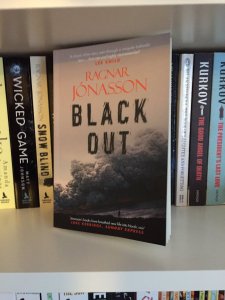
CnGralHXgAA9a6pThis is the start of Black Out, the latest instalment in Ragnar Jónasson’s Dark Iceland series to be translated into English and published by Orenda Books and it’s bloody good to be back in Siglufjörður once again. Black Out sits second in the Dark Iceland series and picks up after the events of Snow Blind; Ari Thór, while now more at peace in the town, is dealing with the fallout of his confession of infidelity to his girlfriend, Kristín who herself is now living a short distance away in the neighbouring Akureyri. The Inpector, Tómas, is debating his own future in the town after his wife’s move south to Reykjavik and Hlynur is dealing with the chilling consequences of his past.

It’s into this state of distraction that the news of the murder is dropped and Ari Thór and Tómas set about investigating the victim’s connections to the town – the only real starting point is that the victim, Elías, was part of a crew working on the new tunnel. Tómas is far from thrilled at the opening of the tunnel, worrying what it will bring into the town. Strangely enough, the more that Ari Thór digs into the storied past of some of the residents it’s clear that even without infrastructure upgrades, Siglufjörður holds many a disturbing secret. Some people know exactly what Elías was involved in but nobody is talking and so much remains hidden despite the 24-hour light of the Arctic summer that the police are in the dark.

That contrast of tones – darkness in the shadows of an otherwise idyllic scene – is what makes that creeping sense of dread so much more powerful and chilling as, piece-by-piece, the clues come together and the quiet town of Siglufjörður becomes the epicentre of a taught, methodically plotted story involving money laundering, sex-trafficking, child abuse, rape and murder. Be warned – Black Out gets very dark.

This time around it’s not just the Siglufjörður police that are trying to crack the case; Isrun, a news reporter is also chasing down and finding her own leads as she races for an exclusive. The introduction of Isrun means that Jónasson is able to add further elements to the story and take the reader further afield to Reykjavik (shrouded in a volcanic ash cloud) and the politics and rivalries of the newsroom. I’ll avoid going further in terms of Isrun’s involvement in the investigations or her own motivations to avoid spoilers but I will say that it was a genuine surprise and a welcome change up, further evidencing that Ragnar Jónasson’s writing is anything but formulaic. She’s also another thoroughly great and compelling character.

Jónasson has a gift when it comes to crafting memorable characters. Ari Thór, while not always likeable, is given increasing depth and dimension with every instalment and his relationship with Kristín gives greater insight as well as further developing her own character. Somewhat sadly, of all the threads surrounding the main narrative, it’s the sub-plot surrounding Hlynur that is perhaps the most gripping and while having already read Night Blind means I knew where it would lead, was nonetheless genuinely affecting and moving.

Weaving together all the sub-plots of such a multifaceted story could prove challenging yet Ragnar Jónasson makes it seem effortless – while his history of translating Agatha Christie novels into Icelandic means he’s no stranger to mystery writing, it’s his own voice and skill that makes Black Out and the Dark Iceland series one of the most compelling and rewarding additions to the thriller genre. Each instalment delivers more and leaves the reader in eager anticipation for the next. The first snippet of the next instalment (included at the end of Black Out) had me checking the door was properly locked and bolted. Not something I’ve done since I read The Snowman. A series and author well deserving of the highest praise. Very much looking forward to more.

Huge thanks once again to Karen at Orenda Books for my copy and I do wholeheartedly recommend Black Out.

Where Roses Never Die

I’m going to come right out and say this at the start; Gunnar Staalesen is rapidly becoming one of my favourite writers and this is based purely on only the two Varg Veum books of his I’ve read – We Shall Inherit The Wind and, now, Where Roses Never Die.

With that in mind it was an absolute, relished delight to sit down at the start of May while away on holiday, overlooking a lake and armed with a fresh cup of coffee and no distractions (napping toddler), delve into Where Roses Never Die and another lesson in Nordic-Noir from the master.

IMG_9197In September 1977 a three-year-old girl, Mette Misvær is playing in the sandpit outside her home. When her mother, having been distracted, looks out the window to check on her daughter, Mette has disappeared. The tiny community – a model suburb – of Nordas is devastated. The police search everywhere but their enquiries produce nothing. Mette is never found.

Fast-forward almost 25 years and, as the statute of limitations approach, Mette’s mother approaches PI Varg Veum. She’s never been able to believe that her daughter is gone, the loss has haunted her and she’s desperate for answers. Veum is in no real shape to take a case, he’s still reeling from the aftermath of We Shall Inherit The Wind. But he takes the case – if only to rebuild his depleted bank balance – and begins to unravel a web of secrets and lies that lurk beneath the surface of a seemingly tranquil, idyllic little community.

As a parent the subject matter is a bit of an emotional punch as it plays directly into your worst fears (not the only book in Orenda’s stable to do so, I might add) but, having been writing Varg Veum novels since 1977, Staalesen knows how to navigate these waters and not let the reader drown and the energy and pull of Varg keeps it moving. It’s a haunting story and Staalesen plots it brilliantly, expertly bringing together seemingly unrelated events and characters into a revelation that’s an absolute shocker. That final revelation is a pretty dark one to say the least so I’m going to avoid going into plot for risk of giving anything away but, in the same way as the previous novel, the reveal here left me reeling. I can’t think of a more satisfying thing to get from a book than to be so genuinely floored by it.

Where Roses Never Die is superbly paced and with a story so intricately weaved together and with so many dark secrets pulled into the light you find yourself wondering what’s going on behind every drawn curtain. Characters are pulled from all shades of society and the moral spectrum and all believable – there are some for whose fate the reader can’t help but become invested in.

But these novels are more than gripping mysteries waiting to be unravelled, they’re glimpses into the life of one of Nordic-Noir’s greatest character’s; Varg Veum. If the ending of We Shall Inherit The Wind left the reader feeling battered then it sure as hell knocked Varg for six – he’s spent the years between “on the longest and darkest marathon” of his life . Veum is an immensely human and likeable character – he’s not always popular and very few are happy to see him twice but he’s driven by a sense of justice and finding out the truth, regardless of who’s feathers are ruffled. He, too, is, flawed – marked by a past and haunted his own mistakes. But even here, Staalesen’s mastery means that while there have been detectives nursing a battle with alcohol before it’s rarely so wonderfully evoked as within these pages:

Then I lifted the aquavit glass and drank deeply. For a second or two I had to close my eyes. I was sailing into a harbour I had left much too long ago, and on the quay stood people I hadn’t seen for years, who received me with cheering so quite that I could hear my pulse throbbing in my ears.

Staalesen’s prose is a master-class in efficiency, with minimal strokes he paints a complex plot that draws you into Veum’s world. Varg isn’t an all-action thriller detective, there’s no Reacher-style arms-behind-back fights here. No, Veum piece-by-piece pulls apart the web of lies, misdirection and secrets in his quest to discover what happened to Mette and as he slowly and methodically stalks the truth, so too does Staalesen’s prose until you’re immersed in a wonderful, enveloping narrative that holds you firmly in its grip until the final revelation – and long beyond finishing the last page too. More than just a personal favourite, Gunnar Staalesen is the absolute master of this genre and reading his work is a delight.

Translation is a tricky beast. It can make or break a book and Staalesen’s words are in very safe hands with Don Bartlett. With translations for Nesbo and Knausgaard to his name, Bartlett remains the translator of choice for Norwegian masters and his deft hand here ensures that Staalesen’s narrative and tone flows naturally.

There’s no question that if I were to put stars here there’d be five of them for Where Roses Never Die and, while we’re only just at the halfway mark for the year, it’s easily one of – if not the – best books of 2016.

I’m itching for more Varg Veum and will now (tbr pile allowing) make my way back through those available in English. Do get a hold of Where Roses Never Die – a big thank you to Karen at Orenda for mine – and check out the other stops on the blog tour.

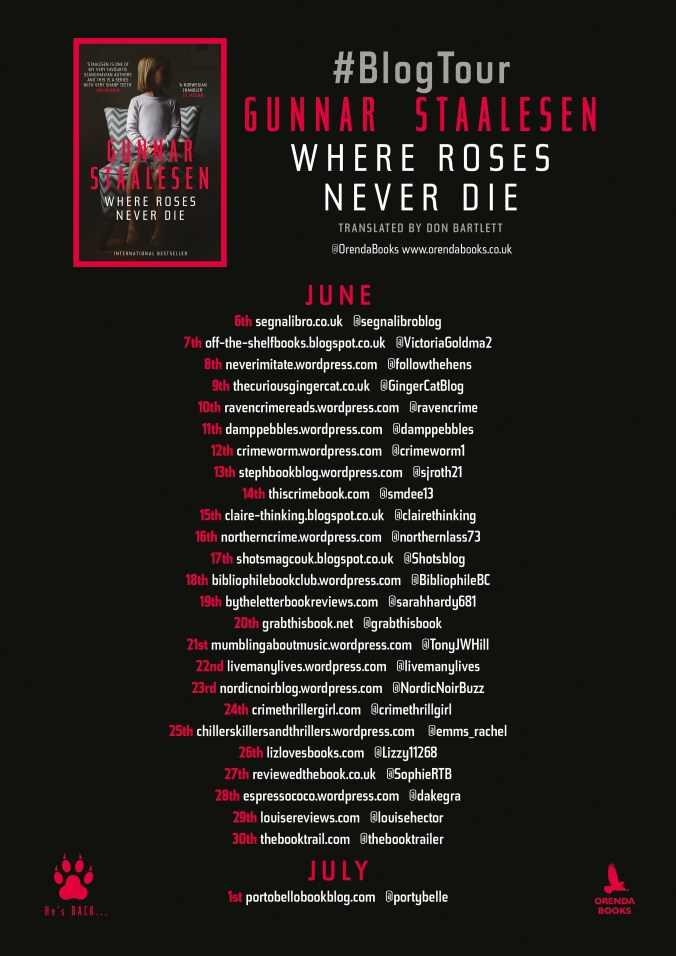
Roses Never Die Blog tour

Night Blind

Ragnar Jónasson knows how to get a reader hooked. The first chapter of Night Blind finds police inspector Herjólfur following up a tip off at a house on the edge of town. It’s got all the classic ingredients in place for one hell of an opening- the house itself is not only remote and isolated but it practically hangs over a cliff, even its walls are “leaden and foreboding”, it’s dark and the rain is pouring, beams of torchlight peer out from inside. Only the edge of your seat will be needed before the chapter’s finished and it’s all too late for the inspector; “that was when he heard the shot, deafening and deadly.”

IMG_7059I’d been gripped by this opening chapter for close to a year before I got to read any further. It was included at the end of Jónasson’s first class début Snow Blind. The next instalment in the Dark Iceland series, Night Blind takes the reader back to the remote Siglufjörður, catching up with Ari Thór Arason five years on from the events of the first book. While it’s not essential to have done so before picking up Night Blind, I’m aware that not everyone will have read Snow Blind (and why not?!) so I’ll do my utmost not to drop any spoilers.

Ari Thór has settled somewhat since last we met- he and his girlfriend Kristín now have a young son – yet Siglufjörðu still holds plenty of discoveries for him. Preparing to return from an extended paternity leave and a battle with the flu, Ari Thór receives a concerned call from the new Inspector’s wife and soon discovers the likely-fatally wounded Herjólfur. Finding himself alone in the police department and unable to investigate the attempted murder of his boss, assistance soon arrives in the form of Ari’s former boss Tómas and we’re very quickly back into a taut, gripping and beautifully crafted murder investigation.

All the ingredients are in place for a great detective story. Yet Night Blind goes beyond the confines of any simple whodunnit. Layered within the mystery are sub-plots involving local political corruption, drug dealing, the opening up of a small community to the outside world (and its increase in crime), relationship challenges, a decades-old mystery and domestic assault; all of which Jónasson handles brilliantly, creating some genuinely memorable and affecting scenes that go beyond the slow-burning detective story of Snow Blind and show a talent that can cross genres.

The issue of domestic assault in itself is a tricky one, in a lesser-writer’s hands this could be so easily clumsily written and riddled with clichés. Not here though. Jónasson handles the subject deftly and manages to show a real ability when it comes to victim psychology. He can also write a bloody good action piece – the climatic scene between Elín and her ex had me gripped like a Jack Reacher action sequence yet with a genuine concern and sense of fear for the outcome.

Just as Snow Blind was interwoven with a narrative from the past and the question of how it connects to the present, Night Blind is interspersed with the diary entries of a young man held in a psychiatric hospital against their will for a seemingly violent incident – who is this young man and how does this relate to the shooting of  Herjólfur?

The final reveal and the connection between the two is, as with Snow Blind, a gob-smacker. The number of times I thought I’d sussed the answer out only to be shut down by the next chapter is too many to count, the reveal catching me so off-guard I had to go back and wonder how I’d missed the breadcrumbs. I’m not sure I’d like to play Mr Jónasson at chess, clearly a man who thinks more moves ahead than I.

One of the most wonderful things about Night Blind to me is just how many doors are so subtly opened, how many potential focus points for other stories are gently hinted at, but leave enough of a question mark, a hook in your interest as to leave you wanting more, much more of the Dark Iceland series. There’s the “wait, what?” moments of revelations including why the Siglufjörður police department is now under-staffed, the opening up of political influences on the department – and the interfering of shady locals, characters that are begging for larger roles in scenes to come and, of course, the thought that Ari Thór does his best to ignore; with Herjólfur shot, does this mean he’ll now be in line to become Inspector?

It’s here in these sly peeks at the depth of potential in the Dark Iceland series and the sheer number of elements at play in Night Blind that Jónasson excels; the subtle crafting of the story, with it’s intricate and overlapping plotlines and detailed characters coupled with a slow and genuinely surprising, out of left-field-reveal demonstrate a supremely confident and talented writer clearly revelling in his art.

It’s rare that I get quite so invested in the personal lives of characters in crime stories (often times they’re painted almost as side-shows and cursory / obligatory scene padding) but I was genuinely gutted (perhaps as my own son is still so young), though not entirely surprised, by the departure of Kristín  – yet even here Jónasson lays teasing ground-work for future developments. It’s also testament to Jónasson’s ability to create such genuine and fully-realised characters – it helps not only in keeping the reader hooked but adds a real depth and sense of community to these fictitious inhabitants of Siglufjörðu.

Snow Blind was one of my favourite reads of last year and Night Blind, an even stronger novel, will no doubt sit high atop the list of 2016’s best reads. To expand a little upon my original summary…..

Capture231

….. Night Blind is a compelling, multi-layered masterpiece that breathes fresh life into the genre. Breaking beyond the confines of the traditional whodunnit, Ragnar Jónasson has delivered an intriguing, intelligent crime novel that leaves the reader open-mouthed wanting more (well, this one at least). Clearly an author to follow, he seems to have pulled off the not-so-easy task of creating a series that only gets deeper and more interesting as it goes.

A translation can make or break a book and here the translation is, again, in the very capable hands of Quentin Bates. There is no point at which Night Blind feels like it was written in anything other than English; the flow, pace and charm of the book are all captured perfectly. A cracking job.

I was delighted to take part in this Blog Tour for Night Blind and my thanks again go to Karen at Orenda Books (which has nothing but quality bearing it’s logo on the spine). Do check out the rest of the tour and today’s other, eye-opening, instalment at Mrs Peabody Investigates.

Nightblind Blog tour


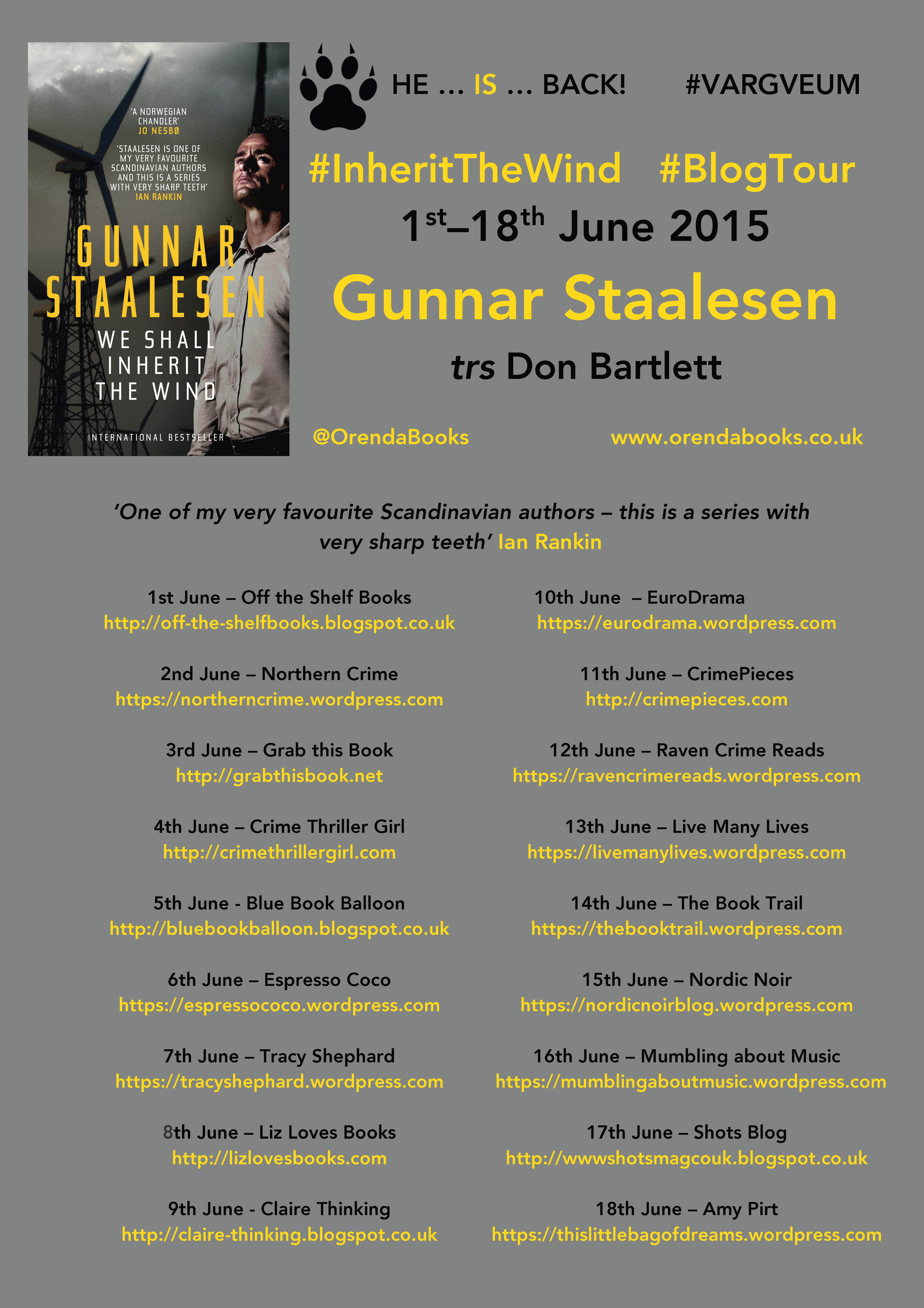
We Shall Inherit The Wind

Having gotten a taste for Nordic Noir I’ve now been given the opportunity to read the man hailed as one of the fathers of the genre – Gunnar Staalesen.

First published in 2010 in Norway, We Shall Inherit The Wind is the 18th novel in the Varg Veum series and now published in English by Orenda Books (if ever there’s a publisher to follow devotedly it’s Orenda Books) with translation by Don Bartlett.

We Shall Inherit the Wind BF AW.inddSet in 1998, Staalesen’s private investigator Varg Veum sits at the hospital bedside of his long-term girlfriend Karin as she battles life-threatening injuries bought about by the events surrounding Varg’s latest investigation.

From here Staalesen takes us back – by “barely a week” – to re-trace those events (when I re-read that line for this review I had to read it twice as so much is packed into just a few days). Given how we know where they lead, the edge of the seat is pretty much all you’ll occupy from here on in.

This ominous start leads us into a missing-persons case, with Veum pretty certain that the missing man – Mons Mæland – is already dead. Veum’s initial digging into Mæland’s affairs opens up a Pandora’s Box of questions with no clear answers. Every clue seems to point toward a more complex mystery which becomes all the more thrilling when Mæland is found dead – in a most dramatic fashion – and the plot thickens.

Location is key. While Veum operates out of Staalesen’s own Bergen, most of the action takes place on the fictitious Brennøy and nearby islands. We’re a little outside of the comfort-zone here, you got the sense that you’re out in the wilds on each occasion that Veum leaves Bergen behind, with civilisation just a little too far over the horizon – indeed, law and order needs to arrive via helicopter.

From experience I know how stunning Norway can be but this isn’t a summer holiday; this is autumn and Staalesen uses the isolation afforded by the setting to up the chill-factor. From the off, almost, the remote locations hang heavy with foreboding:

…the trees stood like dark monuments to a time when not only the mountains had to be clad but every tiny scrap of island skirted by the fjord. Accordingly spruces lined long stretches of the Vestland cost. No one had thinned the striplings, and no one had cut down the trees except the cabin owners who had desperately tried to clear themselves a place in the sun. It looked as if they had given up here ages ago.

So much to love in that paragraph alone… “dark monuments”…. “desperately tried”…  “given up here ages ago”… you almost have the “abandon all hope” sign nailed to the start of the chapter.

Far from being a run-of-the-mill who-dunnit, We Shall Inherit The Wind is an intense read, pulling in eco-terrorism, religious fanaticism, corruption both at corporate and local-government level, plot twist after plot twist and a cast of characters with plenty of secrets and hidden connections. Two, three, four times I thought I’d sussed out who was behind Mæland’s murder only to be left utterly open-mouthed by the final reveal with Veum keeping his cards close to his chest right until the bitter end. I’ll admit I also felt like I’d been emotionally sucker-punched come the end, having been so caught up in the mystery as to be left open for the impact of the human consequences.

Varg means “wolf” in Norwegian and the novel approaches the plot just as a wolf its prey; elements come together piece-by-piece, as the wolf slowly and assuredly stalks it prey Varg is a wise hunter, patiently letting events unfold with delicate pacing. Rather than rushing in and barrelling along at a frantic pace there’s long drives and ferry rides (the novel is set in the fjords of Norway, not down-town LA afterall), a stealthy gathering of every shred of evidence (and a lot of people’s cages rattled) before going in for the violent and bloody climax.

Gunnar Staalesen is clearly a master-at-work by now, having first introduced the world to Varg Veum back in 1977. The prose is richly detailed, the plot enthused with social and environmental commentary while while never diminishing in interest or pace, the dialogue natural and convincing and the supporting characters all bristle with life.

A multi-layered, engrossing and skilfully written novel, there’s not an excess word in We Shall Inherit The Wind. It’s a slow-building exercise in suspense that’s 100% addictive, one that gets you in the wolf’s jaws with the first few lines, sinks its teeth in and won’t let go until long after the finale.

After my first dip into the world of Varg Veum I’m left wanting more. With We Shall Inherit The Wind I’ve been afforded a snap-shot into the life of a very complex but nonetheless endearing and relatable character and anxiously await the next two instalments from my favourite publisher. Though I may search out the earlier two novels to have made it into English.

I’m one of the last stops on the blog tour for this novel so do check out those that have come before me including yesterday’s great interview with Staalesn at Nordic Noir and get your hands / kindle / e-reader / whatever on a copy of this hugely rewarding read via Orenda.

We Shall Inherit the Wind Blog Tour