Book Review: The Mountain In My Shoe by Louise Beech

“A book is missing.

A black gap parts the row of paperbacks, like a breath between thoughts.”

love that opening.

Last year saw publication of Louise Beech’s How To Be Brave on Orenda Books. A thoroughly moving book that made my reads of the year list. What impressed me most was how its writer was unafraid to tackle emotional areas from which others might blanch while combining such insightful writing with a compelling story. She’s done it again.

I was more than happy and eager to read The Mountain In My Shoe when it was so kindly sent to me by Karen at Orenda. Life and this year being the utter shit that it has been, though, means I couldn’t do so straight away. My stop on the blogtour for this one was kindly populated by the author herself with a piece on adversity that’s well worth a read, here.

Now, though, I’ve not long turned the final page on this one and it’s time to get down my thoughts and I’ll try to do so without giving away too much. If I can…

From The PR: “A missing boy. A missing book. A missing husband. A woman who must find them all to find herself …

the-mountain-in-my-shoe-copy-275x423On the night Bernadette finally has the courage to tell her domineering husband that she’s leaving, he doesn’t come home. Neither does Conor, the little boy she’s befriended for the past five years. Also missing is his lifebook, the only thing that holds the answers. With the help of Conor’s foster mum, Bernadette must face her own past, her husband’s secrets and a future she never dared imagine in order to find them all.

Exquisitely written and deeply touching, The Mountain in My Shoe is both a gripping psychological thriller and a powerful and emotive examination of the meaning of family … and just how far we’re willing to go for the people we love.”

I seem to recall Louise Beech saying that in The Mountain In My Shoe she’d ‘accidentally’ written a thriller. If this is an accident then I’d be first in line to see what happens were she to set out to do so. I was thoroughly gripped and found myself turning through the pages with a speed that ought to have worried the binding. Contained within is a book that encompasses psychological thriller, emotional drama and gripping mystery.

As with How To Be Brave, there’s more than one voice telling a story in The Mountain In My Shoe: Bernadette, an abused housewife on the verge of leaving her controlling husband; Connor, a young boy who’s spent his life in the care system and The Book – Connor’s ‘life book’. The Life Book is Connor’s story updated by those that care for him – foster parents, social workers, teachers. I found this exceptionally moving – having just rediscovered my young son’s ‘My Story’ type book after moving and realising that, for Connor (and so many like him) life can deal some pretty harsh cards. A masterful touch from Mrs Beech.

The changing narratives and perspectives add a great depth to the story and each are handled convincingly and ring true. The Book is especially moving, upping the empathy for Connor and the suspense. It makes for painful reading at times but I’ve said this before and I’ll no doubt say it again; woe betide the author that goes for comfortable.

How To Be Brave and The Mountain In My Shoe are very different books and while there’s a few similarities (a diary and lifebook as narrative devices), there’s one undeniable thing they have in common; Louise Beech writes with an emotional honesty and bravery that elevates her work from the crowd. She writes in a way that just manages to cut to the core – especially as a parent – every single time. Brilliant.

Worth the wait, very highly recommended and thanks again to Karen at Orenda for another great book. Seriously, though, Karen; every time I think I’ve got my ‘Top Reads of the Year’ list sorted I open another book with the Orenda logo on its spine.

 

A Suitable Lie

I saw her curled up in a chair. Fast asleep. Even in the weak light I could make out the silted lines of mascara that ran from her eyes and down the pale expanse of her cheeks, almost past her nose.

She had obviously fallen asleep waiting for me.

And that was the first time I thought about murder.


From the PR: “Andy Boyd thinks he is the luckiest man alive. Widowed with a young child, after his wife dies in childbirth, he is certain that he will never again experience true love. Then he meets Anna. Feisty, fun and beautiful, she’s his perfect match … and she loves his son like he is her own.  When Andy ends up in the hospital on his wedding night, he receives his first clue that Anna is not all that she seems. Desperate for that happy-ever-after, he ignores it. A dangerous mistake that could cost him everything.

A brave, deeply moving, page-turning psychological thriller, A Suitable Lie marks a stunning departure for one of Scotland’s finest crime writers, exploring the lengths people will go to hide their deepest secrets, even if it kills them…”

A Suitable Lie AW.inddI’ll put my hands up; after the initial hook, most certainly an attention grabber, I started to wonder where this one was going… the courtship of Andy and Anna makes for a pleasant and often humorous read but not one that I was expecting after the opening quoted above.

But then… well, then I realised just how crafty Michael Malone is. All the gentle domesticity, all the loved-up courtship and redemption for Andy -the average guy trying to raise his son after the devastating loss (and here Mr Malone writes with a convincing and affecting sense of emotion) of his wife…. it’s just the lure to get you on the hook because this book.. this book is a sneaky bugger; lulling you into a false sense of security before delivering a read stuffed with a palpable sense of dread and tension and one which is, more frequently than not, a disconcerting and terrifying read.

Sitting at the core of this novel is the theme of domestic abuse and here Michael Malone takes a familiar trope and flips it on its head in a way that many have tried before but few have done with such startling and genuinely harrowing results. Malone deals with a very difficult topic with both sensitivity and boldness, delivering scenes of raw emotion and – frankly – horror which manage to skilfully tread the line between exploitation and being shocking realistic. There are scenes in this novel that make for an uncomfortable read but a story that doesn’t challenge the reader isn’t worth the paper it’s printed on and A Suitable Lie both challenges and rewards.

I don’t want to give anything resembling a spoiler away here as I’d rather recommend all to go out and read but I will say that there are parts of this story that left my mouth open. The conclusion is both heartbreaking and gripping in its intensity and twist – to use an oft-overused phrase – a real roller-coaster.

Michael Malone has a clear and unarguable talent when it comes to prose and story and A Suitable Lie is an engaging read  that will remain with you long after the final page has been turned – it went very quickly from being a “where’s this going?” to costing me sleep as I simply had to find out.

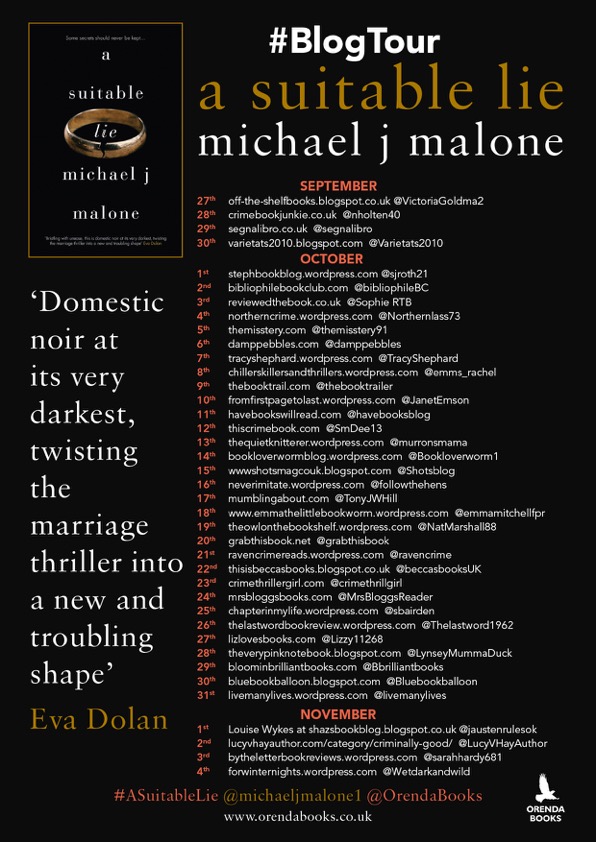
Huge thanks once again to Karen at Orenda Books for sending me yet another great read and do check out the other stops on the BlogTour:

suitable-lie-blog-tour-poster

Make Me

..he ducked his own hand under his own coat, grabbing at nothing but air, but the two guys didn’t know that, and like the good range-trained shooters they were they went for their guns and dropped into solid shooting stances all at once, which braced their feet a yard apart for stability, so Reacher stepped in and kicked the lefthand guy full in the groin.

I was late getting to the Jack Reacher party. Perhaps because I took a long break from reading books that could be slotted into the ‘thriller’ genre or perhaps because I’m sometimes wary / sceptical of such one-character driven series. Of course that changed when I did pick up Killing Floor. I also admit I got into it the wrong way round having watched the Jack Reacher film first.

There’s been a lot said about Lee Childs’ character and a pretty good article that also covers why, perhaps, I was hesitant in picking up my first Reacher books (is it ‘low taste’?) but I am now hooked. I’ve since cleared seven and there’s an eighth sat on my bookshelves lined up as my next-but-one read.

I’ve got a couple of weeks holiday rapidly approaching so went on the hunt for some holiday reading and there isn’t really much better for that than Lee Childs’ work. So I grabbed Make Me and Nothing To Lose – I’m not reading them in order, really – but ended up making the mistake of scanning the first page of the latest. It’s a mistake as you really only need to scan the first paragraph and Child will have your attention and interest piqued. I hadn’t picked it up sooner as I’d thought it may be better to read the earlier books first and, honestly, wasn’t hugely taken with the prior effort, Personal.  Either way, a couple of days later and I’d finished Make Me – number 20 in the Jack Reacher series.

Having not read even half of the series I can’t really pull the “best of the lot” or really cite favourites (though Persuader would take some beating) but I will say that Make Me is a bloody decent instalment and really does improve on Personal. It feels like a good solid Reacher novel and adds a lot more to the character than I was expecting and moves the character on in ways that have previously been missing.

Make Me starts off in what is now standard routine – Reacher finding himself, by chance, in the middle of a situation to which his sense of justice and skills and experience lend themselves. In this instance he’s climbed off the train at a town called Mother’s Rest out of idle curiosity over the town’s name. From here he’s pulled into another mystery, aided by another (in a long line) of women that he also takes a romantic interest in.

To be honest, though, that’s where the ‘norm’ finishes. The mystery in Make Me is a genuinely intriguing one and ends up going down some very, very dark roads. The humour is also a lot sharper and it did give me a good chuckle to find the one-man-army that is Reacher trying to get to grips with modern technology.

But, and here’s the thing, the Reacher of Make Me is a lot more human than previous entries have shown. There’s hints of, perhaps, a long-lasting relationship with Chang that perhaps even the author hasn’t decided where to take (given that Child writes without knowing exactly where the story is going and that the next Reacher novel is a step back in time) and we learn that Reacher can be injured in a fight by a single adversary.

Perhaps Child is aware that an audience can only see Reacher deliver the same lines (how often has Reacher had to explain his lack of permanent abode) and moves (there are, realistically, only so many ways to describer a head butt)  so many times before losing interest. Perhaps he too wants to add more to the character and give him something other than an endless road and line of adversaries to smack about. Regardless, I thoroughly enjoyed Make Me and am looking forward to see where Child takes his character next. I’ll have to wait for the follow up to Night School to find out, I guess. Still with a new Reacher-per-year timetable, the wait won’t be too long after all.


The Evolution of Fear

Clay arched his back, lined up the man’s head, and with every joule of energy he could summon, whipped his neck forward.

Clay’s forehead made contact with the man’s nose. The cartilage collapsed as if it were raw cauliflower.

Just shy of three months after the events The Abrupt Physics of Dying and Paul E Hardisty’s Claymore Straker is again fighting for his life within paragraphs of the start of The Evolution of Fear.

IMG_8434Since The Abrupt Physics… Clay has been in hiding – there’s a price on his head and he’s wanted by the CIA for acts of terrorism. However, his hiding in Cornwall is short-lived following the discovery that Rania, the woman he loves, has disappeared, his friend has been brutally murdered and the arrival of mercenaries out to claim the reward on his head means there’s nowhere to hide.

Betrayed, hunted and desperate to find Rania before those hunting him get to her, Clay makes his way to Istanbul (via an expertly detailed sea crossing) and then on to Cyrpus. This isn’t a pleasure cruise, though. Far from it; soon Clay is entangled in a complex and increasingly dangerous web of power-play, political subterfuge and land-grabbing involving some genuinely corrupt and abhorrent figures, the Russian mafia, an old enemy out to settle scores and some sea turtles. Yes, sea turtles; just as the heart that beat at the centre of The Abrupt Physics.. was about the impact of such corporate greed on the local environs and innocents, here too we’re shown to just how extreme and bloodthirsty a length power can corrupt.

The plot is incredibly well thought-out and complex – given that it’s set in 1994 I often found myself wondering if I wasn’t reading fact over fiction. There is everything in here from the aforementioned political corruption and land-grabbing to flashbacks to past war crimes and emotional drama all with twists and counter twists, yet at no point does it feel over-stuffed; Hardisty does a wonderful job of giving you just enough information at the right time to keep it detailed without bogging down in redundant trivia, thus maintaining a pace that rips along like a great thriller should.

Action sequences abound, yet here they’re great, dirty and gritty scenes – think Bourne over Ethan Hunt – compelling and convincing. The locations are described vividly enough to immerse you in them, characters are strong and well fleshed-out and Hardisty writes with an expertise when it comes to the settings and the facts around which the events are choreographed.

The thriller genre is a crowded one and stuffed to its bindings with action set-pieces and broody sods as lead characters. What elevates Haridsty above the pack is the sheer quality of his writing, the intelligence and complexity of the plot and the strong, brilliantly crafted character of Claymore Straker.

Straker is a man beset with demons and riddled with guilt over his past. Not many lead characters are as affectingly human as Clay. Yes, he’s a tough bloke and one you’d want on your side in a scrap. Yes he has a violent and morally questionable past, but – and here’s why you care about the character – Clay is trying, really trying, to do the right thing and become the honourable guy he wants to be, even at risk to his own life. Haunted by his actions in South Africa, Clay is terrified that he’s driven by the same motives of his compatriot – the brilliantly drawn Crowbar – who simply loves to kill. It’s that struggle to do the right thing, against increasingly stacked odds, that makes Clay Straker a memorable character to root for.

There’s a quote on the cover of The Evolution of Fear from Lee Child: “A solid, meaty thriller – Hardisty is a fine writer and Straker is a great lead character”.

Nobody would want to argue with the man behind Jack Reacher and on the strength of both The Abrupt Physics of Dying and The Evolution of Fear it’s impossible to do so – in fact I’m going to state outright that Mr Child has some serious competition here; Straker well and truly holds his ground against that one-man army. It beggars belief that this is only Paul E. Hardisty’s second book – this is as tough, taut, high-octane and powerful as the best and with a level of intelligence that pulls it heads and shoulders above the pack.

Once again, if stars were to be sat at the bottom of my reviews there’d be five of them right here. Sequels / second instalments are a tough act to get right, The Evolution of Fear picks up where the first book left off and turns everything up louder.

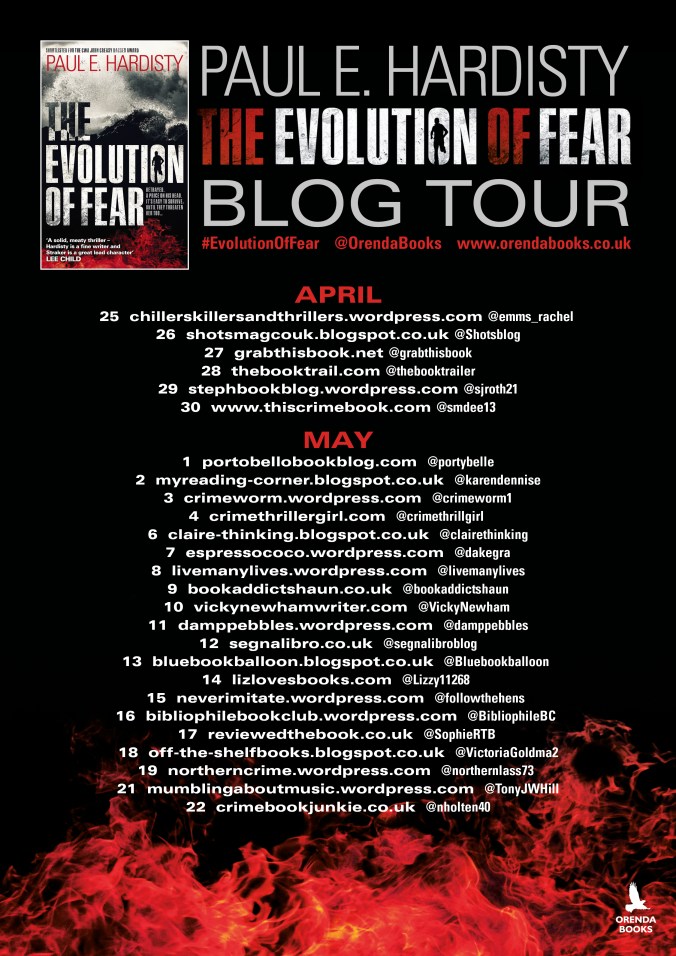
The blog tour for The Evolution of Fear is reaching its end and I’m very grateful to Karen at Orenda for asking me to take part and recommend checking out those entries that have preceded my stop as well as tomorrow’s with CrimeBookJunkie – and getting hold of this fantastic book.

Evolution of Fear Blog tour 2

Wicked Game

unspecifiedIt may be strange – especially as I’ve often bemoaned those that don’t read outside of or exclude genres from their reading – but the home-grown, UK-based thrillers have never been something that have appealed to me. Perhaps it’s my own mundane interaction with the local constabulary or TV shows likes The Bill or Motorway Traffic Cops (or whatever it’s called) but I’d not really seen the potential for a gripping read there in comparison to – say – an alcoholic Norwegian detective hunting murderers in the snow or – say (again) – one-man armies called Jack chasing justice in other far-flung places….

But…. then there’s Wicked Game by Matt Johnson. And it changes that preconception I’d held and it’s a wonderful thing when a book can do that.

Wicked Game finds Robert Finlay as he leaves the Royal Protection team and heads back to uniformed Police work in his search for a quiet, normal, life with his wife and their young daughter.

Let’s be honest; no character in a book or film that’s looking for such a thing gets it – we all know how many detectives get pulled into stopping Armageddon just days before retirement and are all too well aware that Sergeant Murtaugh is “too old for this shit”. We know from the off, then, that trouble is coming down the track for Robert, especially after the explosive start to the novel, and Wicked Game doesn’t disappoint when it comes to the drama. Finlay is far from the standard ex-army turned police officer he’s lead others to believe – he’s an ex-SAS officer with a troubled past that’s now kicking down the door to his longed-for quiet life and demanding his attention. Police officers are being killed. Police officers from his own SAS regiment. Secretive meetings with MI5 follow, luring him in – then there’s an attempt on his own life and it quickly becomes clear that these murders won’t stop until either Finlay or the killer are stopped…. but what’s the motive behind the murders? Why is Finlay a target and who can be trusted?

Far from a standard game of cat and mouse, Wicked Game is a surprisingly complex mystery and one that reaches back in time to bring the old enemies of the past into the terrifying now with an array of action sequences, cliff-hangers and surprises that make for a great read.

The narrative split between first and third person works well (Finlay’s voice is a convincing narration and lends plenty of emotional ballast to the story too) as well as very effective in keeping the reader gripped – especially as the tension grows and those third-person characters such as Grahamslaw are in possession of information Finlay isn’t at crucial, life-threatening points.

They say write what you know and it’s clear that Matt Johnson is writing from experience (having served as a soldier and with the Met for 25 years). When it comes to detailing the action and police-side sequences, as it were, Johnson’s knowledge and insight give the novel a real sense of authenticity. He does a great job of delivering some very real and genuine sequences populated by characters underscored by a convincing authority and precision that can only come from actually knowing those people such characters are likely composites of.

But there’s more than just that insider knowledge and attention to details at play here and it’s that which makes Wicked Game well worth a read – Matt Johnson has a very real talent and gift for thriller writing. Wicked Game cracks along at a great pace with plenty of gripping and original plot twists and turns with a finale that wouldn’t be out of place in a book with a protagonist called Reacher.

With Wicked Game Matt Johnson skilfully weaves together these two facets to create a compellingly gritty and convincingly real thriller.

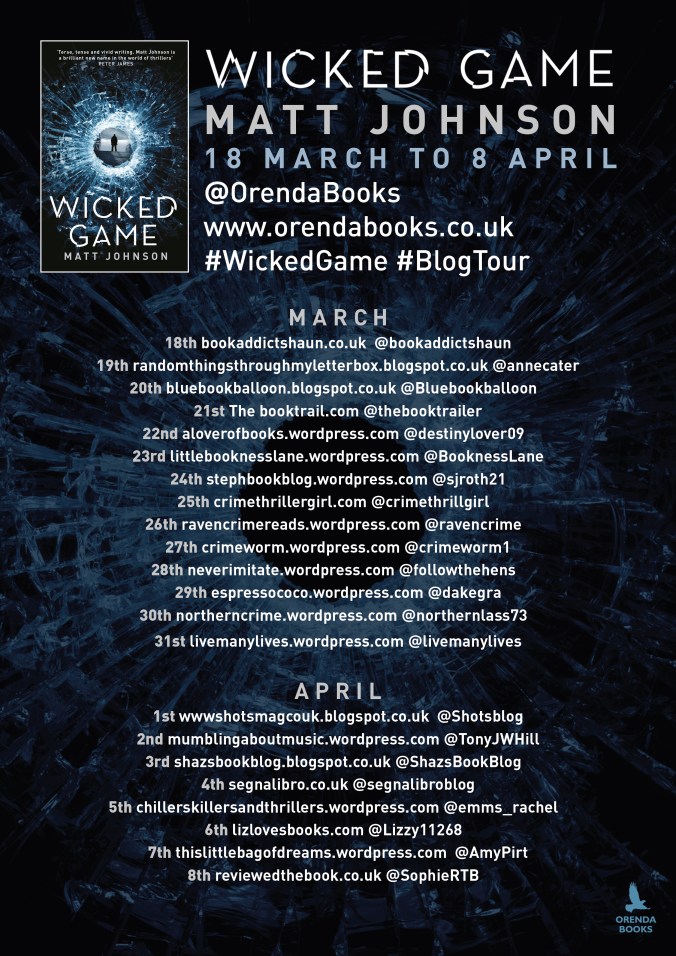
Thanks to Karen at Orenda Books for my copy and do check out the other stops on the Wicked Game blog tour:

Wicked Games Blog tour

We Shall Inherit The Wind

Having gotten a taste for Nordic Noir I’ve now been given the opportunity to read the man hailed as one of the fathers of the genre – Gunnar Staalesen.

First published in 2010 in Norway, We Shall Inherit The Wind is the 18th novel in the Varg Veum series and now published in English by Orenda Books (if ever there’s a publisher to follow devotedly it’s Orenda Books) with translation by Don Bartlett.

We Shall Inherit the Wind BF AW.inddSet in 1998, Staalesen’s private investigator Varg Veum sits at the hospital bedside of his long-term girlfriend Karin as she battles life-threatening injuries bought about by the events surrounding Varg’s latest investigation.

From here Staalesen takes us back – by “barely a week” – to re-trace those events (when I re-read that line for this review I had to read it twice as so much is packed into just a few days). Given how we know where they lead, the edge of the seat is pretty much all you’ll occupy from here on in.

This ominous start leads us into a missing-persons case, with Veum pretty certain that the missing man – Mons Mæland – is already dead. Veum’s initial digging into Mæland’s affairs opens up a Pandora’s Box of questions with no clear answers. Every clue seems to point toward a more complex mystery which becomes all the more thrilling when Mæland is found dead – in a most dramatic fashion – and the plot thickens.

Location is key. While Veum operates out of Staalesen’s own Bergen, most of the action takes place on the fictitious Brennøy and nearby islands. We’re a little outside of the comfort-zone here, you got the sense that you’re out in the wilds on each occasion that Veum leaves Bergen behind, with civilisation just a little too far over the horizon – indeed, law and order needs to arrive via helicopter.

From experience I know how stunning Norway can be but this isn’t a summer holiday; this is autumn and Staalesen uses the isolation afforded by the setting to up the chill-factor. From the off, almost, the remote locations hang heavy with foreboding:

…the trees stood like dark monuments to a time when not only the mountains had to be clad but every tiny scrap of island skirted by the fjord. Accordingly spruces lined long stretches of the Vestland cost. No one had thinned the striplings, and no one had cut down the trees except the cabin owners who had desperately tried to clear themselves a place in the sun. It looked as if they had given up here ages ago.

So much to love in that paragraph alone… “dark monuments”…. “desperately tried”…  “given up here ages ago”… you almost have the “abandon all hope” sign nailed to the start of the chapter.

Far from being a run-of-the-mill who-dunnit, We Shall Inherit The Wind is an intense read, pulling in eco-terrorism, religious fanaticism, corruption both at corporate and local-government level, plot twist after plot twist and a cast of characters with plenty of secrets and hidden connections. Two, three, four times I thought I’d sussed out who was behind Mæland’s murder only to be left utterly open-mouthed by the final reveal with Veum keeping his cards close to his chest right until the bitter end. I’ll admit I also felt like I’d been emotionally sucker-punched come the end, having been so caught up in the mystery as to be left open for the impact of the human consequences.

Varg means “wolf” in Norwegian and the novel approaches the plot just as a wolf its prey; elements come together piece-by-piece, as the wolf slowly and assuredly stalks it prey Varg is a wise hunter, patiently letting events unfold with delicate pacing. Rather than rushing in and barrelling along at a frantic pace there’s long drives and ferry rides (the novel is set in the fjords of Norway, not down-town LA afterall), a stealthy gathering of every shred of evidence (and a lot of people’s cages rattled) before going in for the violent and bloody climax.

Gunnar Staalesen is clearly a master-at-work by now, having first introduced the world to Varg Veum back in 1977. The prose is richly detailed, the plot enthused with social and environmental commentary while while never diminishing in interest or pace, the dialogue natural and convincing and the supporting characters all bristle with life.

A multi-layered, engrossing and skilfully written novel, there’s not an excess word in We Shall Inherit The Wind. It’s a slow-building exercise in suspense that’s 100% addictive, one that gets you in the wolf’s jaws with the first few lines, sinks its teeth in and won’t let go until long after the finale.

After my first dip into the world of Varg Veum I’m left wanting more. With We Shall Inherit The Wind I’ve been afforded a snap-shot into the life of a very complex but nonetheless endearing and relatable character and anxiously await the next two instalments from my favourite publisher. Though I may search out the earlier two novels to have made it into English.

I’m one of the last stops on the blog tour for this novel so do check out those that have come before me including yesterday’s great interview with Staalesn at Nordic Noir and get your hands / kindle / e-reader / whatever on a copy of this hugely rewarding read via Orenda.

We Shall Inherit the Wind Blog Tour

Nothing Ever Happens Around Here

Careful; the smallest whiff of a spoiler is contained fleetingly herein.

Iceland.

If you’d asked me a couple of weeks ago what I associate with that country I’d have suggested a few bands like Sigur Rós, múm, Of Monsters and Men, Olafur Arnalds and that woman called Björk , Reykjavik 101, unpronounceable (by me) volcanoes and geysers. Oh, and the chap who sang “Ég á líf” at Eurovision a couple of years ago.

If you ask me the same question today I’ll add fjords, the herring boom, and great Nordic crime fiction to that list.

For in the last week I had the utmost pleasure of reading Snowblind by Ragnar Jónasson.

The fist novel in Ragnar Jónasson’s Dark Iceland series – almost up to its sixth installment in Iceland – has now been translated into and published in English by Orenda Books.IMG_4357

Snowblind introduces us to Ari Thor Arason – finishing his police training (after starting and dropping other pursuits including Theology) on-the-job having spontaneously accepted a posting in the northern town of Siglufjörður. It’s a posting that takes him hundreds of kilometres away from his home, his partner and his comfort zone. Plunging him into a small town where things aren’t quite as tranquil as they seem and a killer is on the loose.

Quiet and remote, Siglufjörður is a small fishing town only accessible via perilous mountain roads and a small tunnel seemingly carved out of the rock without a millimetre of excess width for as Ari Thor takes his first journey through the sense of a trap being sealed begins to sneak in – “it was a narrow single track…. carved through the mountainside more than forty years ago” with water dripping in the darkness from a ceiling unseen. Even on the other side the weather is starting to turn grim and oppressive (“every winter is a heavy winter in Siglufjörður”).

Still, what could go wrong?  Siglufjörður is an idyllic little community set amongst the mountains and fjord where – according to Police Inspector Tomas “nothing ever happens”.

Nothing that is except murders, manslaughter, literary theft, adultery, fugitives in hiding, drunk locals stumbling into the wrong house at night and seemingly not a character in the story without a history of loss and tragedy and, of course, the politics of local am-dram.

Having visited such small towns at the foot of a fjord (albeit in Norway not Iceland) in summer when the majesty of the scenery will steal your breath, I often wondered how different those imposing mountains would be when winter sets in and the calm of such detached living is replaced by a sense of being cut-off and encircled by thousands of metres of impenetrable nature. I need wonder no more; Ragnar Jónasson perfectly creates an atmosphere of dense, stifling claustrophobia, an impenetrable trap tightening with every falling flake, using geology to form a locked-room style setting with the imposing mountains and heavy snow falling in like a heavy, stifling blanket:

Claustrophobia had sneaked up on him, a feeling that had deepened as the snowfall around the station had become increasingly heavy. It was as if the weather gods were trying to construct a wall around the building that he would never be able to break through. He saw things around him grow dim and suddenly he found himself fighting for his breath.


Siglufjörður beset by snow

Siglufjörður beset by snow

The fact that Ari Thor – like the reader – is the only one not used to such environs deftly adds to the fish-out-of-water feeling, almost a “am I the only sane person here?” element adding to the tension.

Just as the winter snow falls gently at first but builds, the plot unfolds slowly; each of the character arcs expanding at their own pace, gently but intractably linking to each other and interspersed with snippets of a knife-point burglary so obviously doomed to a bad end that no matter how tranquil that which follows may be, a sense of foreboding and danger pervades.

For a debut novel, Snowblind is startlingly confident and sure-footed. The characters and dialogue all ring true, the plot is original and packed with plenty a surprise. Perhaps most pleasingly of all, Jónasson steers clear of hackneyed plot devices and reveals; while Ari Thor possess a talent for his work he’s no ‘instant wonder / super cop’ – in fact his inexperience lands him in a very dangerous position as he enthusiastically blunders into a confrontation with a killer, preventing any real chance of justice being served and only solves the novels main “who dunnit” by chance.

It’s clear that Ari Thor is a character that has plenty of space and potential to grow and that the sequel is currently in-translation by Quentin Bates (who deserves very positive praise for his translation of Snowblind) can only be considered great news. The first sliver of NightBlind is enough to have me hooked while confirming that Ragnar Jónasson is a writer with plenty more up his sleeve.

From it’s opening prelude, Snowblind steps back a couple of months to put the pieces in place, then assuredly and calmly expands into a compelling thriller that keeps you gripped throughout and delivers a final 1-2-3 punch of revelations that will leave your gob on the floor.

Get a hold of a copy today and check out the other stops on the blog tour.

snowbling-blog-tour-2

Ploughing Through and You Don’t Know Jack

Oops; another month slips by without a post. Life is a busy thing with a toddler. The library has continued to grow and while my to-read list grows I’m getting through some great books. This last month (and a few days) I’ve ploughed through four books of an evening / weekend crashtime – and, in the case of one; lunchtimes. Let’s discuss…. IMG_4323 A Christmas gift from my wife (presumably as I’ve often mentioned that nobody says ‘bastard’ or does repressed anger as brilliantly as JC), John Cleese’s autobiography So Anyway was an odd read.

Odd as Cleese is an undoubtedly funny man with a rich and varied career in television and film comedy from Pythons and hoteliers to barristers hankering after Jamie Lee Curtis and even a few straight roles to mix it up a bit. He’s also known for a rather torrid personal life – currently married to his fourth wife – and the odd disagreement / heated debate with other Pythons named Terry Jones. YET wordage is not handed over to any of these but for the passing reference and occasional “so this is where that sketch / idea / character” originated. More ink is spent retrospectively linking events in his life to theories he’d later discover in psychology books than it is on those years so many were sure to have expected coverage of.

But… it’s still a good read. It’s a slow starter – Cleese gives a (sometimes too) thoroughly detailed account of his childhood, school years and early education. We learn how he inexplicably started supported the Australian cricket team as a young child and wonder why we need to know this nugget of information. So Anyway… is as insightful as an auto-bio could be and provides a great arc of a young man finding his calling in comedy – albeit unintentionally at first – and the road that took him to Python. It’s clear that even pre-Python Cleese packed more into these 30 years than many a full-career bio that lines the bookshop shelves. The overwhelming sense though is one of “but what about…”.

One of the things I like about short story collections is the ease of which you can dip in and out, one story at a time as it were, without losing any narrative thread. The problem with short story collections though is that there is no narrative thread, they can jump from tone to tone, first-person to third person narrative and the quality can vary dramatically. You often feel that you’re reading a series of sketches – ideas that will later be fleshed out, trimmed down and slipped in in a minor role or re-worked into a different context in the writer’s novels.

This is certainly the case, in part, with Tales From The Underworld, a collection of short stories by Hans Fallada. While his novels are rich, tightly bound mines of quality, the short stories here are perhaps too obviously touch-points for his later works to be taken at face-value. References to Altholm (setting for A Small Circus) rub shoulders with portrayals of farmworkers suffering at the hands of the government, characters across different stories share names and petty criminals and criminal acts populate a number of these stories. The struggles to get by, scrape an existence and find succour in the arms of loved ones at the most austere of times form the binding theme between those stories gathered here.

That being said, Fallada is a vastly underrated writer and even the lesser of those stories within Tales From The Underworld is only judged so in comparison to his own more-fulfilled writing. A darkly humorous and at times devastatingly moving collection, the short stories here are sequenced chronologically and show Fallada refining his style and themes. The quality tails off toward the end, sadly, but when viewed in line with his own life add up to show an insight into his thinking and writing process.

Reading thrillers has become something of a pleasure again. I’d started to lean into the genre a while ago – then stopped. The same authors I’d started to enjoy started leaving me a bit tired – namely Jeff Abbott and Robert Ludlum. First two Bourne books; brilliant. Third book; awful. Any other Ludlum book I tried was achingly formulaic. First Jeff Abbott books I read – Panic, Fear, Run – cracking stuff. Then he started in with the Sam Capra series and my attention waned as it all became too obvious.

But then lately…. lately I’ve been getting more into it all again. So, first stop: The Ghost by Robert Harris. Many’s the time I’ve been wandering around the supermarket at lunch and have seen a number of cheap books and thought of buying to read during the lunch breaks. This was one of those. I paid just £1 for it having immensely enjoyed Fatherland and found the story behind its publishing intriguing – upon hearing that Tony Blair was to resign, Harris stopped what he was working on in order to write this and get it out ahead of Blair’s own memoirs.

The Ghost is equal parts thriller and political swiping at Blair; a ghost-writer is bought in to help former Prime Minister Adam Lang complete his memoirs following the death of his former assistant. Very much a dig at Labour, its cozying up to the US and involvement in the War on Terror, The Ghost is still a gripping and well written thriller with enough grip and cliff-hanger-shockers to be a bloody good read even without the political overtones – especially as the final reveal is so shocking it surely cannot be true or intended to suggest so. While I’m not about to rush out and start filling the H section of the book shelves with the spines of Mr Harris’ novels, it’s certainly well worth a read – especially at just £1. They ought to include it in the Meal Deal for that value. 

IMG_4327

So with an appetite for a good thriller and having found the film adaptation of the character to be fine enough for brain-off entertainment I decided it was time to indulge a long-harboured curiosity and meet Jack Reacher.

Being the stickler for order that I can be I wanted to start at the beginning so got hold of The Killing Floor and devoured it in just a couple of days (not bad considering I really only read before falling asleep or at lunch). There’s been so much praise lauded upon Lee Child and his one-man-army Reacher that I won’t attempt to do so. But: bugger me it’s a good book. I will say that I was hooked from the start and will happily and readily get hold of more instalments.

I won’t go the full-hog though, given that the 20th such book is about to be published. I can’t justify the expense or book shelf space. Sorry, Jack.

When the sky is torn…

Claymore Straker is a man on the edge. A civilian in a dangerous land at a dangerous time. Kidnapped, held at gunpoint and lead into the depths of Yemen to be given an ultimatum by a man believed to be behind a number of terrorist acts including one which resulted in the death of Straker’s colleague. The tension is palpable and it’s only a matter of time before the inevitable eruption as Straker makes his break…

Before the old man could react, Clay bought his left knee up hard, smashing the old guy’s pelvis. The Arab’s mouth opened, the first note of a groan hanging in space, truncated an instant later as Clay’s right fist smashed into his face. Clay felt the key go in, the give as a membrane flexed, heard the slight pop as it broke, then the sucking sound as he pulled back his fist, the key with it.

Lovely, right?

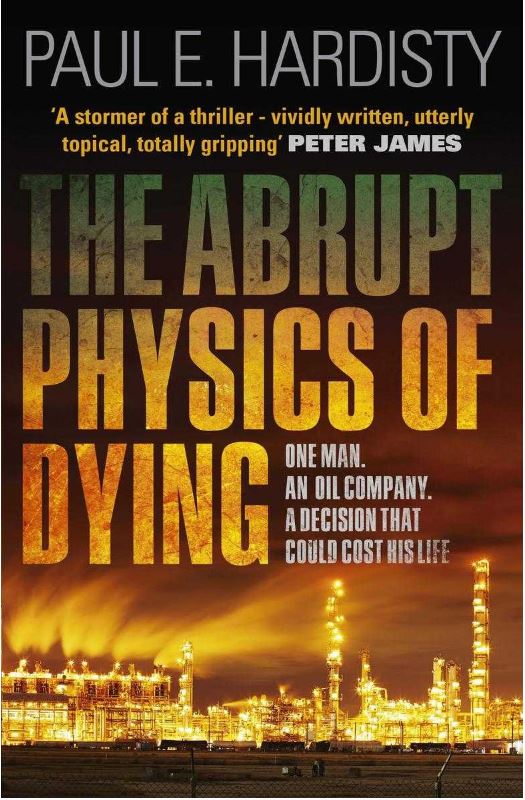
abrupt physics of dyingThis is the start of The Abrupt Physics of Dying by Paul E Hardisty. It’s also the point at which you realise you haven’t put this book down for four chapters and probably won’t until you’ve reached the last page.

Having worked around the world for 25 years as an engineer, hydrologist and environmental scientist, Hardisty survived a bomb blast in a cafe in Sana’a and was one of the last Westerners out of Yemen before the outbreak of the 1994 civil war. This should come as no surprise having read Abrupt Physics… as Hardisty details Yemen, the political climate and the science with an authority that’s never questionable and with a delivery that’s polished enough to make you wonder whether he hasn’t secretly been publishing thrillers under a different name for years.

Clay Straker is  trying to forget a violent past, working as a contractor for an oil company as it seeks to expand it’s grip and presence in Yemen. His job is simple – complete the environmental surveys in a manner that gets approval for Petro-Tex and pay off any locals that need their palms greasing to remain calm. Until he’s kidnapped, of course.

Held at gunpoint and with his friend / driver taken as hostage by a terrorist organsiation, Clay is tasked with finding out what’s causing a widespread illness among the local children.

Of course we know it’s got to be something to do with the oil company but the hows and whys lead us into a world of political and corporate corruption and greed, violence and conspiracy – all set in a country on the verge of being torn apart by terrorism and civil war.

As events unravel the plot is dotted with twists and people with questionable allegiances that will leave you guessing until the end all the while rooted in strong, compelling characters and attention to culture – with dialogue liberally sprinkled with local and Afrikaans phrases to add further to the sense of immersion.

Everything you look for in a good thriller is here in abundance: a brooding hero with a troubled past, faraway locations, shady characters with even shadier motives, a love-interest, taught dialogue, corporate and moral deceit, the underdog risking it all with potentially disastrous ramifications, plot twists and counter twists and, of course, a bit of action.

The violence comes hard, fast and often. Straker takes so many and so severe a beating at times it’s hard not to wince while reading and wonder just how much one man can take. However, unlike so many thrillers which rely purely on such violence and action, The Abrupt Physics of Dying is driven instead by a compelling plot and well-crafted story telling, with near-poetic descriptions in some of the most unlikely of places:

A tendril of blood trickled from the dead soldier’s neck, a thread unravelling, scrawling a strange calligraphy onto the sand.

That being said, I do think it could find itself with an honourable mention in the Literary Review’s Bad Sex In Fiction Awards for the line “She was as slick as a tidal flat in a flood tide”.

This isn’t a no-brain, thirst-for revenge type thriller. At the heart of The Abrupt Physics of Dying lies an exploration of just how far corporate greed will go in its neglect of morals. As Clay questions his own morals and values its hard not to do the same. The atrocities and body count not celebrated but lamented and the concern for the damage being wrought on the local population reads as genuine.

So: Thriller? Thriller with a conscience? Eco-thriller? Geo-political thriller? How about bloody good book? It’s all of these.

In his first book Hardisty has created a thriller as assured, gripping, well paced and finely detailed as they come.  There’s a sequel in the works, The Evolution of Fear. Judging by the first chapter included in ‘Abrupt Physics’, it can’t come soon enough. 2016 seems a long way off now.

A great first publication from Orenda Books from whom I’m sure more greatness will arrive.

I love anyone who wants to phone home

Bt0VZ8AIUAAxmMJ

This is a house of horror. A house of metal and country music. That Coldplay stuff isn’t even funny. It just makes for a bad atmosphere.

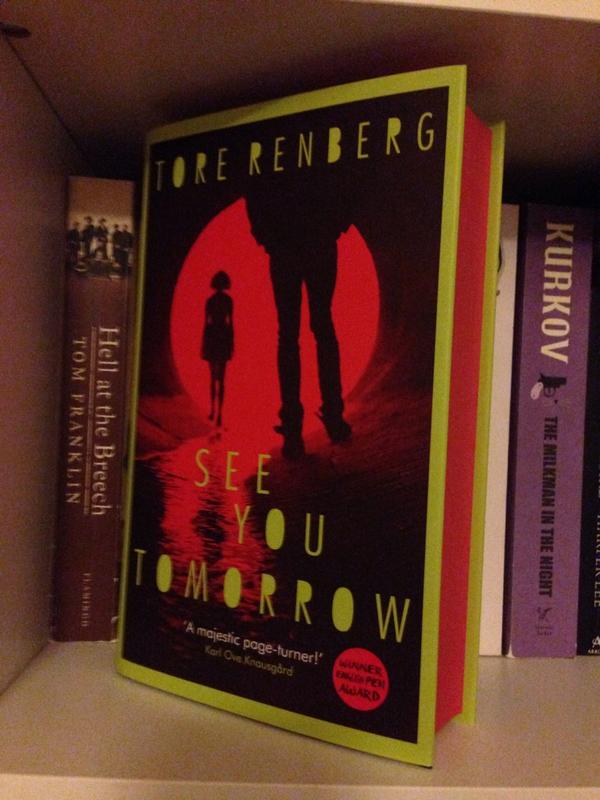
Not too long ago I came home from holiday to find two boxes waiting for me from Arcadia Books. One of those contained See You Tomorrow by Norwegian author Tore Renberg. The other contained Fan by Danny Rhodes (which I’ve just finished).

I was caught up in finishing two other books (The Goldfinch and Overlord) prior to picking up See You Tomorrow. I wanted to give it a clear run, the attention a glance at its first pages showed it clearly deserved. I knew nothing of Mr Renberg – first published in ’95 and widely known in Norway for his Mannen som elsket Yngve (The Man Who Loved Yngve) series (upwards of 400,000 copies sold).

This is the first novel from a Norwegian author I’ve read and I was pleasantly surprised to find that it’s set in Stavanger – a city I’ve been lucky enough to visit. That being said, the Stavanger within these pages is so far from the tourist’s snapshot I got of the city on my visit that were it not for the mention of a few landmarks and one character visiting Platekompaniet (a music store I shopped in during my own visit), I’d not be able to bring the two versions together in my mind.

There’s a great few articles to read around this, on the use of music within the novel (link) and a great interview (link).

Even now, two books on, I still feel under the spell of those red-edged pages. To review it was hard. I needed to review it, I wanted to review it but how to find the words when I hadn’t come across something this (and I don’t often use this word) groundbreaking for a long time.

How was the question I was faced with, how….

How do you review a book like See You Tomorrow; a book that deftly defies classification by mere genre yet incorporates elements from each, creating a compelling tapestry of a novel that satisfies every criteria for great fiction?

I suppose that’s a start. At least it’s a start that doesn’t – deservedly – lay every superlative possible on it.

See You Tomorrow captures the events of three days in which Stavanger is treated to unexpected, unseasonable warmth and sun as the lives of eleven characters cross paths with violent results.

Tore Renberg has said that it took six years to write See You Tomorrow. That he created playlists for each of the principle characters from whose perspectives the story is told (all eleven of them) in order to get into their skin. It shows. Each of the characters live and breath in these 600 pages with such an alarming vitality – very alarming in the case of Tong – that I hated putting this book down for fear something would happen while I wasn’t immersed in its world. It’s just that gripping.

Yes, there are 600 pages but there’s not a spare word amongst them. The narratives are so densely written and the events of the story’s three days so closely examined from every angle that the story rips along at a breakneck pace.

Themes abound – from broken families, social criticism, criminal undercurrents and the destructive power of secrecy to the frustrating catchiness of Coldplay – all served with dark humour and a quest to find the light in such a world.

And there’s the key. For all the damage the characters in See You Tomorrow carry with them and into the lives of others, this novel is ultimately uplifting. Whether it’s Pål’s desperate measures to end his financial burdens, Daniel’s ‘life-plan’ to mute the horror of his past to Tiril’s singing Evanescence to a crowd… even the delightfully unhinged petty criminal Rudi is a self-declared man of love. All are looking for the ray of light in these dark times, a way out, a release from their secret. In most cases, though at no small cost and in ways previously undreamed of, they find just that by the end of the three days.

Three days of unexpected warmth and light when least expected.

I cannot imagine just how tricky this book must have been to translate yet Sean Kinsella deserves praise for managing to do just that while retaining Renberg’s mastery of prose and wit.

See You Tomorrow is not only one of the best books I’ve read this year but is in serious contention for one of the best I’ve ever read. It would be a struggle to find such an original and compelling book as this. That Tore Renberg has a sequel to unleash upon us can only be good news.