Where does time go? Anyway, a quick share in between editing other posts: I’m loving this video that Kevin Shuss (Pearl Jam’s videographer) put together to celebrate Pearl Jam’s induction into the Rock and Roll Hall of Fame (thoughts here).
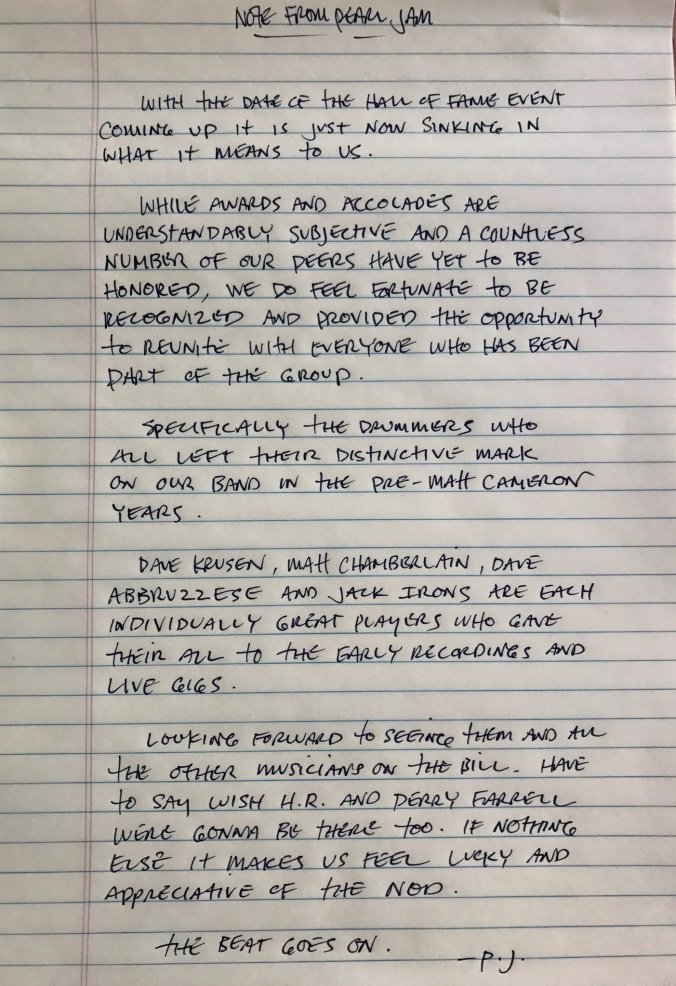
Pearl Jam are right up there at the top of my Unimpeachables list (I ought to write that list down really). I’ve been listening to the Vs/Vitalogy box (and the live album included) in the car for the last week or so and given that I believe this era represents peak Pearl Jam I was most definitely heartened by the band’s published response to the ‘drummer debacle’ that had been stirred by their induction*:
This brings three things to mind:
1. Just how many years I’ve been loving this band.
2. They are a decent bunch of guys really
3. It’s been three and a half years since Lightning Bolt! What the fuck, guys? Get your arses in the studio already ffs.
*Though I, and many, are certainly not impressed by their cropping out of former drummers when it comes to photos on social media etc.
“One day I was playing my guitar on the edge of my bed, working on song ideas, and the words ‘born to run’ came into my head… I liked the phrase because it suggested a certain cinematic drama that I thought would work with the music I was hearing in my head.”
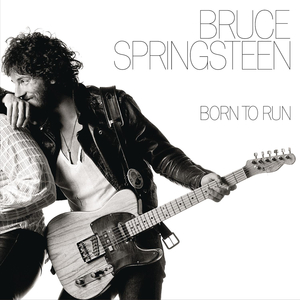
There’s probably very little I could add to anyone’s knowledge or appreciation of Born To Run, an album that’s undoubtedly at the top of many a list and is very likely many people’s favourite album of all time. ‘Born To Run’ may have taken six months to write but it and Born To Run changed everything for Bruce, both in terms of sales / success and writing. This was the album that lived up to the promise of ‘Rosalita (Come Out Tonight)’, maintaining its excitement and drive “while delivering it’s message in less time and with a shorter burst of energy. This was a turning point, and it allowed me to open up my music to a far larger audience.”
It was this song that made sure the world would become aware of Springsteen in more ways than one. Neither his début or The Wild, The Innocent and the E Street Shuffle had achieved the level of success that would make a record company throw money for studio time at him. He had to write something that would get him his last shot. He may be somewhat flippant about its origins (if not its impact) now but writing ‘Born To Run’ in early 1974 got him that chance – it was recorded during touring breaks (with drummer Ernest ‘Boom’ Carter*) and an early mix was released to radio in November of the same year. It’s popularity on radio meant previous Springsteen singles began picking up more airplay and gave him validation to get to work on the rest of the album.
Like, I’m sure, it was for many, ‘Born To Run’ was the first Bruce Springsteen song I was aware of. Specifically the 1987 video from a performance shot during Boss Mania. What strikes me most about the song, and the album as a whole, is the poetry of the lyrics. How many other FM rock songs used a lyric like the “the amusement park rises bold and stark” or “beyond the Palace, hemi-powered drones” found in ‘Born To Run’? And if we’re talking lyrics, let’s look at how the album kicks off:
“The screen door slams, Mary’s dress waves. Like a vision she dances across the porch as the radio plays.” Or what about the “One soft infested summer” of ‘Backstreets’ or ‘Jungleland’ with it’s “In a bedroom, locked. In whispers of soft refusal and, then, surrender”? Bruce may have claimed that “the poets down here don’t write nothing at all” (I’ll admit the double negative still bothers me some) but from a lyrical point of view, Born To Run saw the volley of words on Greetings.., the romance of The Wild, The Innocent… turn into something much more direct and universal (earlier characters and scenes were much more specific, that ‘screen door’ could be anywhere) and coupled with a new-found confidence from years of honing his act on the stage to produce some of Springsteen’s most evocative and memorable lines.
Work on the album is something of a legend in itself – Springsteen aware that it’s his make or break shot, agonising over takes and layering track upon track (there’s close to a dozen guitar tracks on the title song) as he struggled to explain the sounds he heard in his head, it lead to a changing of both studio location and began the changing of the guard with Appel vs Landau when the sessions got bogged down… or even the number of takes it took to get Clarence Clemons’ finest performance just right…
The thing is that such ardent efforts can sometimes lead to something that just sounds overworked**. In Born To Run though, it equals magic. You don’t hear what must have been a stressful session in those closing minutes of ‘Jungleland’ or the fact that it took nearly 14 months to record an album that fades out less than forty minutes later than a harmonica swept it in. What you hear is an album of meticulous detail and ambition underpinned by a songwriter hitting his stride and not holding back.
It’s packed with moments of magic – the intro of ‘She’s The One’*** giving away to the Bo Diddley beat that Springsteen admits he wrote just to hear Clarence blast all over, the jazzy film-noir intro for ‘Meeting Across The River’, the “hiding on the Backstreets” refrain, every single second of ‘Jungleland’ but especially it’s mid-point swing and ‘this ain’t over yet’ sax break….
Every song on this album works on its own. The biggest ‘hits’ from Born To Run – the title track, ‘Thunder Road’ ‘Jungleland’ – all stand as great songs in their own right but (and I urge you to go and do so) work best when played in sequence, they belong together. They ebb and flow as a story across one magnum opus and create one of the greatest albums ever made.
I will say, though, that it’s worth making sure that you get a decent master of this album. The first one I had… the remastering for CD was pretty crap. The version (that I guess is now in standard production) that came with the 30th Anniversary box really jumps out at you.
*If you’re only gonna be on one Bruce Springsteen song….
**Ahem; Human Touch
***Bruce wasn’t even sure if he should put this one on the album
“Then the lights go out and it’s just the three of us
You me and all that stuff we’re so scared of”
In June 1984 Bruce Springsteen released Born in the USA. It was the most successful album in America in 1985 (the year following its release), shifted over 30 million copies, spawned SEVEN Top Ten singles, saw Springsteen shift from selling out arenas to stadiums and launched Boss Mania. Just as America’s celluloid heros took the form of muscle-bound Vietnam vets, a gym-enhanced Springsteen preached his own unique take of Heartland Rock to the masses from the radio to stages around the world and MTV as Bruce embraced the video format.
So how do you follow that? If you’re Bruce Springsteen, you demur from the expected. Exhausted and, according to many a report, changed by the success of USA (how you could you not be?), Springsteen took something of a break by his standards and focused on his personal life. At the peak of Boss Mania, Bruce met and married actress Julianne Phillips and sought the settled down personal life that had thus far eluded him. He kept a low profile living on the west coast for a year then, in 1986, logged a series of solo sessions in his home studio, Thrill Hill West. But, with a market and fan base hungry for new product, those sessions were abandoned and focus shifted to preparing his first live album. Live 1975-1985 was released against advance orders of 1.5 million.
As 1987 got under way Bruce headed back to New Jersey and began work on his next studio album, cutting three songs in one day. This time round, though, the writing took a different direction and most of the recordings were completed alone and with little involvement from the E Street Band*. Springsteen made a conscious decision to step back from the bombast.
“I really enjoyed the success of Born in the U.S.A., but by the end of that whole thing, I just kind of felt “Bruced” out. I was like “Whoa, enough of that.” You end up creating this sort of icon, and eventually it oppresses you….So when I wrote Tunnel of Love, I thought I had to reintroduce myself as a songwriter, in a very noniconic role. And it was a relief.”
Tunnel of Love is often referred to as the point at which Bruce began writing about men and women in relationships. That’s certainly not true – he’d been doing so for most of his career – only those relationships were more ‘fairytale’ (bleak or joyous) and told from the somewhat distant standpoint of the loner image Springsteen’s previous lack of commitment in the arena had afforded him. No; Tunnel of Love is Springsteen’s first set of truly nuanced, intricate, intimate and mature relationship songs that handle adult relationships and, yes, chiefly, marriage.
In focusing on his own relationship and putting those thoughts to song, Bruce created his most personal album to that point. It was clear that for the most part, these songs – besieged by inner demons – were based on personal experience. Of course, this inward focus didn’t please all. When he played the opener (the sparse ‘Ain’t Got You’) to Steven Van Zandt, it led to one of the biggest fights the pair had had- “I’m, like, ‘What the fuck is this?'” recalls Van Zandt. “And he’s, like, ‘Well, what do you mean, it’s the truth. It’s just who I am, it’s my life.’ And I’m like, ‘This is bullshit. People don’t need you talking about your life. Nobody gives a shit about your life. They need you for their lives. That‘s your thing. Giving some logic and reason and sympathy and passion to this cold, fragmented, confusing world – that’s your gift. Explaining their lives to them. Their lives, not yours.'”
For an album opener, Ain’t Got You, is an odd one. I imagine it was sequenced in that way to give as clear an indication as possible that this isn’t Born in the USA 2. But it’s ‘Tougher Than The Rest‘ that sets the tone for the album – layered, synthesiser-heavy sound with a bit of menace and shot through with personal lyrics. For my money (and my blog), that personal insight adds a truth and grit to these songs that had erstwhile been absent from Springsteen’s relationship songs and look for a larger goal. No longer do Bruce’s characters jump in a car and go looking for a promised land, Tunnel of Love (as with Nebraska) finds them dealing with the fact that the answers to their troubles lie with themselves. In ‘Cautious Man’ Bill Horton even heads down to the highway but “when he got there he didn’t find nothing but road”.
The album isn’t entirely without the sheen and polish that would lure radio, though and Springsteen threads his quieter, more subdued and introspective songs around a roster of FM-friendly tunes. The album’s centre piece ‘Brilliant Disguise‘ (which Springsteen has referred to as containing the real crux of the album in its lyrics) was a Top Five hit and a further four of its songs were released as singles** including the album’s sole out-and-out rock tune ‘Spare Parts‘. Personally, my favourite of those is ‘One Step Up’ – that simple but effective melody that ticks away throughout just clicks perfectly for me.
Given the events that followed its release, Tunnel of Love is mostly viewed as Springsteen’s ‘divorce album’ – he’d soon part ways with both his wife and the E Street Band – and so it tends to be signposts for this that are looked for in the lyrics. Certainly ‘One Step Up’ with “we’ve given each other some hard lessons lately
but we ain’t learnin” fits that mould but to single-track the album in such a way would be way off as it’s much more of a multi-dimensional album than that. Songs like ‘All That Heaven Will Allow’ and ‘Valentine’s Day’ are those of a man still looking for the salvation of love (“They say he travels fastest who travels alone, but tonight I miss my girl mister tonight I miss my home”).
Still, with the hindsight of history, the gruff “Thanks Juli” in the liner notes, it’s going to be hard for Tunnel of Love to be seen as anything other than an insight into the state of the Springsteen’s marriage. Slipping into the jet stream from Boss Mania meant that Tunnel of Love did well upon release though Springtseen’s own attempts to pare down the hysteria, the hushed atmospherics of the album and the retreat from the limelight that followed has meant that this has become one of his most over-looked albums and one barely touched upon live any more. Perhaps that’s down to it’s meaning for Springsteen himself – as Bob Dylan said of his own similarly-themed album Blood On The Tracks: “A lot of people tell me they enjoy that album, it’s hard for me to relate to that. You know, people enjoying that type of pain.”
For me Tunnel of Love is one of Springsteen’s very best – that’s why it’s up here in the list as it’s listened to so very often. Lyrically I don’t believe he’s ever been so sharp and insightful. Yes, the production is a little 80’s but it’s nowhere near as over punched as USA – hell, at times the vocals are clearly cut in a small room – and there’s so much more to this album than often considered and more revealed with each listen and the passing of time and experience. One summary I found while putting this together gets it right on the nail so I’ll finish with that and urge all to give this gem a fresh spin: “The songs are about men and women who flirt, have sex, fall in love, get married, get bored, have sex with other people, and wind up stuck in the middle of that dark night from the second disc of The River.”
*While Tunnel of Love was the first real studio album to name the band, the E Street barely feature – Clarence Clemons’ sax is missing completely and his only credit is for backing vocals on ‘When You’re Alone‘ (I guess he’s somewhere in the mix). It marked as big a change to his established sound as Nebraska did and was part of Springsteen’s belief that he’d achieved all he could with the E Street Band’s sound – even on the following tour he swapped positions around to try and mix things up.
**Though not all were released in every territory, Springsteen perhaps wary of over exposure following USA.
It’s been a real pressure cooker of a week so time to blog has not been permitting – no opportunity to kick into the final three on the Bruce Least to Most series or any of the other posts sitting in ‘drafts’.
Here, though, is a quick surmise of those tunes that I’ve been listening to of late.
Ryan Adams – Shiver and Shake
Holy shit is Prisoner good. More than being a divorce album this is one of Ryan Adams’ finest. Gorgeous layers and echoes of Tunnel of Love Springsteen and drenched in dollops of that sun-kissed, late-80’s AOR vibe that so many have embraced of late (see Haim, War on Drugs etc) as to sound delicious and lyrics (“I miss your loving touch, I miss your embrace, but if I wait here any longer I’m gonna fade away”) that are more open and deft than he’s sung for some time. I don’t think I’ve played a new record as much as I have this one in a long time.
Tool – Ænema
I’ve really gotten back into this album over the last couple of weeks – I was determined to introduce my wife to the band but their unwillingness to stream and the fact that their albums still sell at ‘standard’ price means it’s not so easy but I picked this one up at a decent price and it hasn’t left the car since. Any album so unabashed in its Bill Hicks reverence is gonna be ok; “Learn to swim, see you down in Arizona Bay”
I think my wife dug it. I know my three-year-old son loves it though I’m now having to be more cautious as to the lyrical content of songs he hears. I don’t want him saying “Fuck L Ron Hubbard” after all. Although…
잠비나이 (Jambinai) – Connection
A couple of weeks ago I found (well, my wife pointed it out and encouraged me to go in) a really cool little independent vinyl-only record store in Canterbury with a great name – Vinylstore Jr. The guy had just dropped Jambinai’s album on the turntable. They’re a South Korean (obviously not North) post-rock band, their label describes them as “less like a band than a force of nature, fusing the full dramatic range of post-rock dynamics to Korean folk roots to create an exhilarating, vivid and unique fusion. ”
From the PR: “When Hedda Hellberg fails to return from a retreat in Italy, where she has been grieving for her recently dead father, her husband discovers that his wife’s life is tangled in mystery. Hedda never left Oslo, the retreat has no record of her and, what’s more, she appears to be connected to the death of an old man, gunned down on the first day of the hunting season in the depths of the Swedish forests. Henning Juul becomes involved in the case when his ex-‐wife joins in the search for the missing woman, and the estranged pair find themselves enmeshed both in the murky secrets of one of Sweden’s wealthiest families, and in the painful truths surrounding the death of their own son. With the loss of his son to deal with, as well as threats to his own life and to that of his ex-‐wife, Juul is prepared to risk everything to uncover a sinister maze of secrets that ultimately leads to the dark heart of European history. ”
“It’s like having a gun to your head”, being a dad, according to Henning Juul: “You go around being frightened the whole time. Frightened that something might happen… And you think that all the awful stuff you read about in the papers – it won’t happen to you and your child; it only happens to other people’s kids.” Juul, you see, is living every parent’s nightmare – his son was killed. As Henning and his son slept the apartment they were in was set alight as a warning – Juul’s investigations having come too close to some presumably powerful and truly nasty people. All of which, I understand (and please correct me if I’m wrong) happened before the events of the first Henning Juul novel, Burned.
So here we are with Cursed, the fourth entry in the Henning Juul series and it’s an absolute belter that cost me a fair bit of sleep in my reluctance to put it down. I’ve not read the previous novels in this series but I never felt that I was lost or missing anything for having not yet done so (only that I now need to go back and start at the beginning as this was such a good read) as Thomas Enger does a great job of bringing you up to speed without being heavy handed.
As Juul continues to search for the man who set alight his apartment and delve deeper into Oslo’s dark underbelly with some memorable scenes and characters, his ex-wife Nora is asked to investigate the disappearance of Hedda Helberg.
Having discovered the motivations and back story behind Juul’s investigations I honesty didn’t expect Nora’s case to be able to compete in terms of either drama or grip, but then I do like to be surprised by a book and the supposed missing-person case of Hedda Helberg soon becomes just as demanding of attention as slowly but surely a web of deceit and lies surrounding one of Norway’s wealthiest families is pulled apart.
Both of these investigations and narratives have the slow-burning, intricate and meticulous plotting that I so enjoy in a good thriller and that the two gradually become linked as they gather both pace and intrigue mean there’s zero chance of putting it down. The switch between narrative focuses proving a great device as it allows for a fuller view of each of the characters.
It’s hard to read Cursed and not be moved by the loss that Nora and Henning have endured while also noticing the difference between the two characters and how the death of their son has affected them both. Nora slowly but surely moving forward in life, back to work and in a new relationship, all the while carrying a ball that their son played with in her bag. Juul – presumably blaming himself in many a way – is driven by nothing but finding justice for his son, his entire being devoted to the cause. The tragic and heartbreaking (seriously where is the Orenda Gut Check warning on this one?) back story makes this novel all the more compelling.
Cursed just about has the lot; intrigue from the off, tightly weaved plots that pull you right in, plenty of twists, gritty and scarred lead characters and enough emotional heft and resonance to floor come the final reveal – all underpinned by a back story and over-riding story arc that ensures the Henning Juul series demands attention.
A complex, taught and thoroughly gripping read, Thomas Enger’s Cursed is a first-rate character-driven thriller that doesn’t disappoint.
Many thanks to Karen at Orenda for my copy and do check out the other stops on the Cursed Blog Tour.


 Mumbling About...