Least to Most; Bruce – I’m just around the corner to the light of day

So I’ve cleared the half way post. Hell, I’ve cleared the 75% mark and I’m about to go charging into the Top 5 like a hot stepping hemi with a four on the floor… *

As such I thought that, with 15 of 20 (given that I included both Tracks and The Promise) it was time for a quick re-cap of the order so far.

It’s been quite the challenge – a post per album and twenty total – but I’m happy to have managed thus far and have enjoyed the process, rediscovering many a near-forgotten gem or detail while listening to each one again and it’s served as a real reminder of just what a prolific and talented song writer Bruce is. Even on those albums that sit at the Least end of this spectrum there’s a good few songs that would make a compilation. Perhaps that’s the next compilation challenge – one, and only one, song from every release… In hindsight, while there’s a fair few bands / artists I reckon I could run this same format I don’t know that I’d go so far as a post per album. Then again, not so many acts have made the 20 album mark.

Again, this isn’t Worst to Best, this is purely personal preference and I could understand how an argument could be made for any one of these to be somebody’s favourite. I don’t think Bruce has mad a ‘bad’ album and even those at the tail end are better than many an artist at their best.

20. Human Touch (1992) Link

19. High Hopes (2014) Link

18. Lucky Town (1992) Link

17. Working on a Dream (2009) Link

16.  Wrecking Ball (2012) Link

15. Devils and Dust (2005) Link

14. We Shall Overcome: The Seeger Sessions (2006) Link

13. The Ghost of Tom Joad (1995) Link

12. Greetings From Asbury Park, NJ (1972) Link

11. The Promise (2010) Link

10. Born In The USA (1984) Link

9. The Rising (2002) Link

8. Tracks (1998) Link

7. Magic (2007) Link

6. The Wild, The Innocent and the E Street Shuffle (1973) Link

5. …..


*answers on a postcard.

Current Plays

I’m still on a bit of a Bruce break before delving into the Top 5* next week so here’s a little of what I’m playing at the moment.

Jets To Brazil – Wishlist

After the demise of the punk-leaning Jawbreaker, Blake Schwarzenbach went indie-rock with the more melodic Jets To Brazil. I love the line “If ever I should seem to take for granted, this lovely life that I have been handed, darling don’t just stand there, come knock me around.”

JJ Grey & Mofro – King Hummingbird

A band I found via House of Cards and have explored a little more since. A real earthy, blues/rock jam band feel with plenty to enjoy. This is from their fifth album Georgia Warhouse and is the kind of ballad that Chris Robinson would have given his right arm to write / sing.

Chamberlain – Lovely and Alone

On the subject of bluesier sounds…. I got into Chamberlain thanks to one of those long-since departed record shops that had notes / guides from the staff: “for fans of…” “..latest project from…” sort of thing. Formed by members of hardcore band Split Lip, Chamberlain saw them move into a more mature sound and focused on the vocals, never really cut through despite getting a pretty solid fan following. I got hold of Exit 263 while they were still around and later found out that it’s actually a collection of demos they compiled for release after it was rejected by their label. Shame…

Talking Heads – And She Was

Because nothing beats a classic.

One more?

Prince – Sometimes It Snows In April

Because his music is now up on Spotify I’ve been building my own Purple play list. Sat at the piano saying goodbye to his alter-ego from the Under The Cherry Moon film…


*Tricky as, definitely for the Top 4, the order from this point could change daily.

**They’re like buses: you wait years and then two Black Crowes references in as many posts. Maybe I’ll dust off The Southern Harmony and Musical Companion

Revisiting: 14 Songs

Background:

I got into The Replacements too late. I had to, really, they split up before I was eleven… What I mean is that they’re one of those bands that when I finally did get into them I hungrily devoured the lot and couldn’t believe that I’d left it so long to be hearing these songs. They’re a band that cast a long shadow and I’d heard more about them and their influence before I’d even heard a note of their music.

In fact, my first introduction was via the two Paul Westerberg solo tracks on the Singles soundtrack*. Having made the connection between singer and former band I went back, then forward into Westerberg’s solo discography.

14_songs_paul_westerberg_album_-_cover_artConsidered by many as pioneers of the alt-rock scene and with a legacy that’s at odds with the success they achieved during their run, The Replacements blew out of Minneapolis in 1979 as punk rock band whose début album, Sorry Ma, Forgot To Take Out The Trash, was a raw, raucous affair but, by the release of the follow up, Hootenany, the band was quickly evolving and songs like ‘Within Your Reach‘ marked the way forward as elements of blues, folk and chiming pop were bought to the fore along with Westerberg’s insightful and maturing song-writing skills. The difference between ‘Kids Don’t Follow‘ and the beautiful ‘Achin’ To Be‘ was massive.

Success wasn’t to be theirs, though. As much as they may have been at the forefront of the alt-rock scene, the self-destructive nature of the band meant that by the time the world started to pay attention, they were already imploding and they’re remembered more for potential than for breaking through. Poor production, famously disastrous live shows and TV appearances and internal strife meant that 1990’s All Shook Down would be their final album. That album was originally intended to be Paul Westerberg’s first solo album and, as such, features predominantly session musicians. The label talked him into making it a Replacements album. It would be three years before his first solo album would arrive…

The band (well, Tommy Stinson and Paul Westerberg) would reform 22 years later for a series of live shows, a victory lap for the praise and recognition they’d received after their split. There were a few abortive attempts at recording but Westerberg’s heart wasn’t in it and during the final shows he’d decorate his t-shirts with giant letters, eventually spelling out the missive: I HAVE ALWAYS LOVED YOU. NOW I MUST WHORE MY PAST.

14 Songs:

So, on a bit of a Bruce break**, I flicked as randomly as possible through my iTunes and landed on the brilliant ‘Runaway Wind’ from 14 Songs, which lead to digging out the CD and spending a few days with it in the car for the first time in a long time.

While it’s not exactly a masterpiece, it’s bloody good and starts with a run of four great songs, kicking off with a highlight, ‘Knockin’ On Mine’:

Don Was was a big fan of this album and would play it daily while recording The Rolling Stones’ Voodoo Lounge. I can get that, I love the guitar tones on this album and there’s a few on here that are clearly indebted to the Stones – this, the loose grove of ‘Dice Behind Your Shades’ and ‘Silver Naked Ladies‘ whose great instrumentation, bluesy guitar, honky-tonk piano (courtesy of Ian McLagan) and outright Jagger impression are so obvious I’d lay money on Westerberg having done a Jagger Shuffle*** dance in the studio. It’s a shame the lyrics are on the cack side. Don Was would produce Westerberg’s third solo effort and told him that Keith Richards would spend each morning cranking ‘Knockin’ On Mine’ out at full volume.

It’s assumed that ‘World Class Fad’ is about Nirvana’s Kurt Cobain… There’s an oft-commented upon similarity between the pair’s bands and Courtney Love was a big Replacements fan, her band often murdering covering ‘Unsatisfied‘. Chris Robinson of the Black Crowes**** had said “Yeah, Nevermind is a great Replacements record” which must’ve really cheesed Cobain. In the liner notes to the Westerberg’s Best Of (the brilliantly titled Besterberg) he slyly comments that “someone very famous thought it was about him” neither denying or confirming that it was… if that’s the case then “You wax poetic about things pathetic, as long as you look so cute” must have stung a bit. It’s a great tune though.

There was always a dichotomy in The Replacements between the soft and the hard. Westerberg has surmised it as “Sometimes you just love the little acoustic songs, and other times you want to crank the goddamn amp up, and those two parts of me are forever entwined.” That meant songs like ‘Here Comes A Regular’ rubbed shoulders with ‘Bastards of Young’ on Tim and the same is true in his early solo work though, free from the burden of being in a ‘punk’ band, there’s not so much hesitancy to bring out the acoustics or slower material.

‘Runaway Wind’ – for example is a great tune. Originally written for and turned down by Robin Zander, it’s vocal was recorded in just one take and features a brilliant Westerberg lyric: “You trade your telescope for a keyhole, Make way for the grey that’s in your brown, as dreams make way for plans, see ya watch life from the stands.”

Elsewhere tracks like ‘Even Here We Are’ and ‘Black Eyed Susan‘ are delicate, gentle acoustic numbers whose lo-fi production choices make them sound like lost, dusted-off gems sandwiched as they are between glossier sounding tunes and ‘Things’ is a delightfully sloppy yet endearing number. ‘Black Eyed Susan’ was recorded in Westerberg’s kitchen and the sound and lack of success in capturing a better take meant it made the album while ‘Things’ showed that even in his romantic tunes, Westerberg could add a tinge of sadness: “I could use some breathing room but I’m still in love with you.”

Even the best Replacements albums had some outright howlers buried in amongst the gold (I really don’t think anyone is going to make a case for ‘Lay It Down Clown’) and on 14 Songs that particular number is ‘A Few Minutes Of Silence’ – if the album had been called 13 Songs the track wouldn’t have been missed.

With the comic, cynical take on plastic surgery, ‘Mannequin Shop‘ (“You look bitching you look taut, I`m a itchin’ to know what was bought?”) oddly sequenced between the harder, more straight-ahead and solid rockers ‘Something Was Me’ and ‘Down Love’ I can’t help but think that, with better attention to the running order and a tiny bit more selectiveness on the tunes, 14 Songs would’ve gone from being bloody good to great in no time. It’s got a real band dynamic that’s often missing on singer-songwriter albums, a relaxed vibe and finds just the right balance between the two-sides of Westerberg’s writing, wrapping up his romanticism, wry lyrics and self-depreciating humour in a very strong collection of songs.

It wasn’t to be, though. Much like his former band, the album generated some strong reviews but failed to catch on commercially. By the time he released his solo record, the bands who he had influenced and shared listing with on the Singles soundtrack were getting the attention. From here there would be two more major-label albums before he’d ditch working with producers and go the home-recording route where he’d go on to pen some of his best work, even if not so many heard it (see 2008’s 49:00, if you can) before, following the 2012-15 Replacements reunion,  forming The I Don’t Cares with Juliana Hatfield. Their album, Wild Stab, is well worth a listen, too and I’ll finish off with a tune from it…. “Dreams I had before are now too bored to even show up.”


*If we’re talking best movie soundtracks (which I probably will one day) then this one will be way up the top of the list.

**It’s a lot of fun but I’m now about to hit the Top Five (which means I’ve already cleared fifteen) and could do with cleansing my aural palate a bit.

***We’ve all done it. I even had ‘Mixed Emotions’ played at my wedding so I could make use of the wooden dance floor this way.

****Is this really the first time I’ve mentioned The Black Crowes here? Given how near-perfect those first three albums were I’m very surprised…

Blog Tour: Rupture by Ragnar Jónasson

fullsizerenderThe calm, secluded Icelandic town of Siglufjörður is even more quiet than usual; the sudden illness and death of a visitor means the town is in quarantine.

For Ari Thór this is not necessarily a bad thing – he and Tómas are now the lone members of the police force, splitting shifts between them. But he’s not keeping idle. A local man, Heddin, asks him to look into a decades-old mystery: in 1955 two young couples moved to the isolated and otherwise uninhabited Hedinsfjörður. Their attempts to forge a new life come to disturbing end when one of the women dies after consuming poison, help too far away to reach her in time. The case was never solved and suicide considered the accepted explanation. Heddin, the son of one of the couples and born in Hedinsfjörður himself, has been given an old photograph that may prove something more sinister occurred in that desolate fjord – for, holding the infant Heddin in his arms, an unknown man smiles back at the camera.

Who is the man in the photo? Does he have anything to do with the death of Heddin’s aunt? What really happened out on that bleak fjord? Unable to leave town, Ari is assisted in his investigations by Ísrún, a news reporter (introduced in Black Out) who’s chasing a case of her own.

Isrun’s case is a far more complex and  multi-faceted one that brings together a child abduction, murder and political ambition that is at times genuinely chilling and nerve-wracking. The hurried, freedom of her movement in Reykjavík further emphasising the cooped-up restraint of Siglufjörður as both she and Ari Thór discover just how far the actions of the past can reach into the present.

The splitting of action in Rupture allows Ragnar Jónasson to really flex his skills as a writer; equally strong in both establishing a slow burning mystery in Siglufjörður and a gripping, fast-paced thriller of a story in Reykjavík, each complex and packed with enough intrigue and revelation to ensure the pages of Rupture are turned with speed.

With many a well known series character there’s not much of an unknown quality about them. Their history and character traits are pretty quickly established and it’s seeing how these known elements handle changing situations that make for so many of their books. Everyone knows, for example, how a Jack Reacher type will respond in a given situation or whether a Harry Hole type will pick up a drink or not. What makes the Dark Iceland series so bloody addictive is that this isn’t the case with Ari Thór; glimpses and insights into his past and character are revealed with each book (the violent jealousy in Black Out or the truth of his parents hinted at in Night Blind) but the whole remains hidden so as to make the character of its lead as much a mystery as the crimes themselves and keep the reader coming back to the police station in Siglufjörður.

Rupture is a fantastic book, another brilliant instalment in the Dark Iceland series which is itself a vital addition to both the thriller genre and any discerning bookshelf. I cannot recommend this enough.

Thanks again to Karen at Orenda for my copy and do check out the previous stops (I seem to have the honour of closing it) on the Rupture blog tour.

rupture-blog-tour

Least to Most; Bruce – The Wild, the Innocent & the E Street Shuffle

“This boardwalk life for me is through
You know you ought to quit this scene too…”

thewildtheinnocentWhat a difference six months can make. After his début failed to propel him to the dizzying heights hoped for by his signing as a ‘new Dylan’, Bruce Springsteen entered 914 Studios in New York to record his second album. This time, though, things would be a little different. For one, Bruce wanted more control of the sound and production. For another, and perhaps prompting the former, Springsteen was fired up about playing with his embryonic E Street Band and had reignited his passion for a big, full-band sound that was absent from Greetings From Asbury Park, NJ.

Everything on here is aiming for epic – the sound, the instrumentation and even the characters. Before he started singing about the less fanciful Marys, Wendys and Joes his New York and New Jersey characters were more colourful than a ‘gang meeting’ on Hill Street Blues. On The Wild, The Innocent… there’s Power Thirteen and his girl Little Angel, Sandy, Kitty, Big Pretty,  Catlong, Missy Bimbo, the Flying Zambinis, Margarita, Sampson, Tiny Tim, Spanish Johnny, Puerto Rican Jane, Billy, Diamond Jackie, Little Dynamite and Little Gun, Jack the Rabbit and Weak Knees Willie, Sloppy Sue and Big Bones Billy all amidst a maelstrom of boy prophets, Latin lovers and hard girls on Easy Street. Not to mention a certain girl called Rosie. All within just seven songs.

And what songs they are. Here Bruce ditched the rhyming dictionary and attempts to sing a novel at speed in every verse, embraced the opportunity offered by the band and delivered a set of songs with more ambition in terms of lyrics and scope than you’d have guessed possible of him just six months earlier. While personally I’ve never been hugely fond of the opening cut (it’s down to that phunk keyboard line dancing all over it like some platform-shoed drunk disco elephant) there’s no denying its quality. Other than that, every other song here gets a five star rating from me.

With its wistful tale of Madame Marie, ‘4th of July, Asbury Park (Sandy)’  alone shows the strides Springsteen took as a songwriter between albums and the benefits of road-testing songs before getting into the studio. It’s easy to see why Federici asked to play this showcase on his last performance with the band and this most romantic of Bruce’s songs remains a live highlight decades later.

‘Kitty’s Back’ is a monster of a tune, clocking in at over seven minutes and showcasing Springsteen’s guitar chops (again absent through Greetings..) and proving what a wild, R&B/Soul/Jazz/Rock powerhouse outfit his band was. I’ve heard criticism that ‘Wild Billy’s Circus Story’ takes itself too seriously but to that I say “arseholes”. It’s a cracking, fun little tune and contains a great lyric: “the runway lies ahead like a great false dawn”. It’s odd but I think that Springsteen’s lyrics often get overlooked as some of the real nuggets like this one are often missed when reflecting on the overall story of the song. At just 23 Bruce was already coming up with some great lines.

Listening back through these albums has meant I’ve been discovering little gems that I’d almost forgotten and that’s certainly true of ‘Wild Billy’s Circus Story’. It also means my young son has been getting introduced to these and along with calls for this one (the “Elephant Song” based on Gary Tallent’s tuba blasts) he’s surely one of precious-few three year old’s calling out for “Rosie!”

Ah yes, ‘Rosalita (Come Out Tonight)’. There’s no getting away from just how fucking good this song is. Described by Bruce as an early ‘Born To Run’ but with more humour, this is a real indicator as to where Springsteen’s sound was going. Just listen to the mix of sax and guitar around the 5:10 mark, you half expect “the highway’s jammed…” to come barrelling in. In this instance, it goes back to the party instead. Rolling Stone have described this song as “a raucous celebration of desire.” It is a big, beautiful and triumphant song and easily one of Springsteen’s best and does remain the album’s biggest sign post as to what’s to come both in terms of it’s “it’s time to bust out of here” and it’s sound, made especially arresting by it’s sequencing.

The prototype of Bruce’s ‘busting outta here’ song sits between his two most unabashed and wonderful epics; ‘Incident on 57th Street‘ and ‘New York City Serenade’. ‘Incident on 57th Street’ is a massive song in terms of Bruce’s song-writing. It’s like listening to the sound of all the pieces aligning properly as Bruce steps aside and delivers one of his finest – and earliest – songs sung from an observational point that’s far greater than the sum of its parts.

Why I mention sequencing, though, is that the sound of the final, gentle tickle of piano notes is quickly blasted away by the sheer force and power of ‘Rosie’, making the juxtaposition between the two styles all the more evident.

And then there’s ‘New York City Serenade’. You know there’s a few, a small few songs that I’ll listen to where the opening bar is so immediately ‘right’, so ‘spot on’ and tuned to me that it affects me to the core. It’s like an instant high. ‘New York City Serenade’ is one of those. That hammer of the piano strings, the cascade of notes that follows. Sometimes you’ll hear an intro that’s perfect and you’ll think ‘ok, how’s this gonna get marred?’ because not everything that follows can be as good. With ‘New York City Serenade’ everything works beautifully, the arrangement is so perfectly put together that every element just flows into the next in a way that makes it seem like effortless poetry. There’s not a single bum not or misstep in the entire song. Bruce Springsteen was 23 when he wrote and arranged ‘New York City Serenade.’ When I was 23 I though it was a good idea to call a band ‘Wookie Cushion’*. I’ve played this song to people who thought they knew what to expect from a Springsteen song and they’ve always had to question whether it was really “that Born in the USA guy”.

One of my all-time favourite songs.

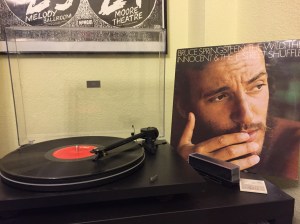
img_1456 What this also means is that Side B of this album might just be the finest 25 minutes of music put to vinyl.

Easily Springsteen at his most expansive, poetic and romantic, The Wild, the Innocent & The E Street Shuffle is a beautiful embrace of and gentle kiss goodbye to his boardwalk life as he takes his characters and breaks them out of their surroundings in pursuit of a new dream.

Oddly, though, his record label didn’t agree that the album was up to scratch. When Springsteen handed it in, the allies he’d had at Columbia were no longer in place. Instead of receiving the great feedback he’d hoped for, Bruce was instead told that the players were sub par and it was suggested that he re-cut the majority of it with professional studio musicians. Of course, this wasn’t an option. Unfortunately, sticking to his guns meant that Columbia buried the album. No release fanfare, no promotion, little distribution. Bruce would play shows in towns where they had no idea the album had even been released.

Thankfully, though, Bruce still had what it takes to cut it live and lay down a killer show. This lead to two things. The first was catching the eye of Jon Landau and the infamous  “I saw rock and roll’s future and its name is Bruce Springsteen,” review that would lead to the pair’s friendship and Landau becoming Springsteen’s manager.  Secondly, Springsteen took to taking aim at his record company during his on-stage patter. One particularly embittered voicing of his frustration happened at a college where the son of the label’s boss happened, unknown to Bruce, to be in attendance. Legend has it he called his father, explained just how much of an amazing act Springsteen was and what was being said and the head of the label soon sat down with his charge and said words along the lines of “what can we do to get this working?”

With Landau and his record label supporting him, it would be time to shed the mythic tales and follow The Wild, the Innocent & the E Street Shuffle with a last chance power drive…

Highlights: ALL OF IT


*You’d sit on it and it would go “Aaaaaaaaaaaaaaaarrrgh!”

Least to Most; Bruce – Magic

“I tried to combine personal and political, so you can read into the songs either way. You can read the record as a comment on what’s been going on, or you can read it just as relationship songs.”

bruce_springsteen_-_magicIn December 2016 Bruce sat down with Brendan O’Brien at his home, handed him a book of lyrics and then played the tunes on his guitar, offering the producer the pick of the litter. The two then decamped to Atlanta again and with a core band of Springsteen, Weinberg, Bittan and Tallent, laid the basic tracks for the album. Other band members were called in to lay down their parts as needed and sessions were complete within two months. Another example of the pair’s more precise recording practice, it meant that without the opportunity to spend protracted amounts of time exploring alternative avenues and ideas, all effort and concentration focused on the one group of songs and bringing them to perfection. Shorn of the fiddles of Seeger Sessions and the acoustic dirge of Devils and Dust, the resulting Magic is the high benchmark of Springsteen’s second chapter and bursts with a fire and passion that sets a lot of his work in the shade.

I’ll be clear – as if it wasn’t already – I fucking love this album. The songs here are harder and sharper than on The Rising, the E Street Band – during its late peak – is playing tighter than a duck’s arse and the result is a joy to behold. The sound is ridiculously lush and there’s more revealed with every listen; the mandolin on ‘Magic’, Federici’s organ on ‘Livin’ In The Future’, the moody atmospherics of ‘Devil’s Arcade’ but I’m jumping ahead….

It starts with guitars. A thousand guitars and pounding drums, as ‘Radio Nowhere‘ leads an impassioned, energetic blast of all the E Street’s finest qualities and Bruce growling out his call to arms “Is there anybody alive out there?” against a thumping beat and euphoric blast from Clarence Clemons’ sax. Magic is Bruce and the E Street tuned in and meaning business as they bore through a new Springsteen classic and straight into ‘You’ll Be Coming Down’ which sounds like a blast of Bruce’s sound from earlier decades:

Indeed, Bruce spoke of how for this album he tried to get back to his earlier, romantic sounds last heard on Born To Run and there’s a wealth of nostalgia in the sound*.

“There’s some classic Sixties pop forms. California-rock influences –Pet Sounds and a lot of Byrds. I wanted to take the productions that create the perfect pop universes and then subvert them with the lyrics – fill them with the hollowness and the fear, the uneasiness of these very uneasy times.”

Take ‘Girls In Their Summer Clothes’ – which, apparently, Bruce had little interest in but O’Brien pushed for its inclusion – as an example of this; the doubling up of Bruce’s voice for the first time in goodness knows how long against a gorgeous backdrop (and a great rhythm guitar part) . Or the horns of ‘Livin In The Future’ that blast like a Freeze-out on a certain avenue. Or the out-and-out joy of ‘I’ll Work For Your Love‘.

But even here, the fire lurks beneath the surface. Bruce is angry and the pain and disbelief are shot through every song no matter how much he may have tried to allow the songs to be taken without them. There’s the groundskeeper who “opened the gates and let the wild dogs run” in ‘Livin..’ or  how the “city of peace has crumbled, our book of faith’s been tossed” in ‘I’ll Work For Your Love’, there’s no getting around it and it makes for some of his finest and most pointed lyrics in a long time. Certainly the best of Bruce V.2

I’ve mentioned before that  ‘Gypsy Biker’ shares a lot of ground with ‘Shut Out The Light’. The earlier track was one of Springsteen’s Vietnam tunes, ‘Gypsy Biker’ is one of a more modern war – Johnny gets to pull out his Ford and polish up the chrome in the former, the biker in the latter is coming home in a coffin; “Sister Mary sits with your colors”. It’s one of his best.

I remember at the time of release, Magic was referred to as being about “love in the time of Bush” **. There’s no direct references here, no mention of specific wars or Bush (though it may well be his “boot heels clickin’ like the barrel of a pistol spinnin’ round” on ‘Livin In The Future’) but he doesn’t need to.  The threat he felt in 2006 is there throughout.  Perhaps its most telling on the beautiful title track. Quiet, gentle guitar and chamberlin undercut with strings and Van Zandt’s mandolin make for a soothing, hypnotic stroll or dance as Springsteen lists ‘magic’ tricks but then it’s there in the last verse:

“Now there’s a fire down below
But it’s comin’ up here
So leave everything you know
And carry only what you fear
On the road the sun is sinkin’ low
There’s bodies hangin’ in the trees
This is what will be, this is what will be.”

If there was any doubt left about this album’s thrust it’s obliterated by what comes next. ‘Last To Die‘ takes it’s lyrics from John Kerry’s testimony on Vietnam (“How do you ask a man to be the last man to die in Vietnam? How do you ask a man to be the last man to die for a mistake?”) and straps it to a howling, fierce track.

The album’s closing track*** ‘Devil’s Arcade’ is a dark bruiser of a tune that’s perhaps the most literal on it. A lover’s recall of portentous earlier memories and passion before her love enlists and winds up being wounded “the cool desert morning, then nothin’ to save, just metal and plastic where your body caved” and in a hospital while she waits for his touch –  Weinberg hammers home the rhythmic thump against the repeated “The beat of your heart, the beat of your heart”.

Again; it’s one of the finest things Springsteen has written and this album is chock-full of them. It’s strange to listen to this album again (though it’s rarely out of rotation) now as we find ourselves staring down even darker corridors than GW had lead the world. Then, as now, this album’s warmth and spirit remain a lighthouse; there is love, there is light and it needn’t be the monsters that call the tune, we have the choice.

Highlights: ‘Radio Nowhere’, ‘Livin In The Future’, ‘Your Own Worst Enemy’, ‘Gypsy Biker’, ‘Magic’, ‘Last To Die’, ‘Devil’s Arcade’.

*Something which would lead to a burst of writing just as the Magic sessions wound down and form the basis of Working On A Dream.

**Not the working title of a late-night Gabriel García Márquez adaptation.

***Officially. Following the death of Springsteen’s long-time assistant Terry Magovern, ‘Terry’s Song’ was added.

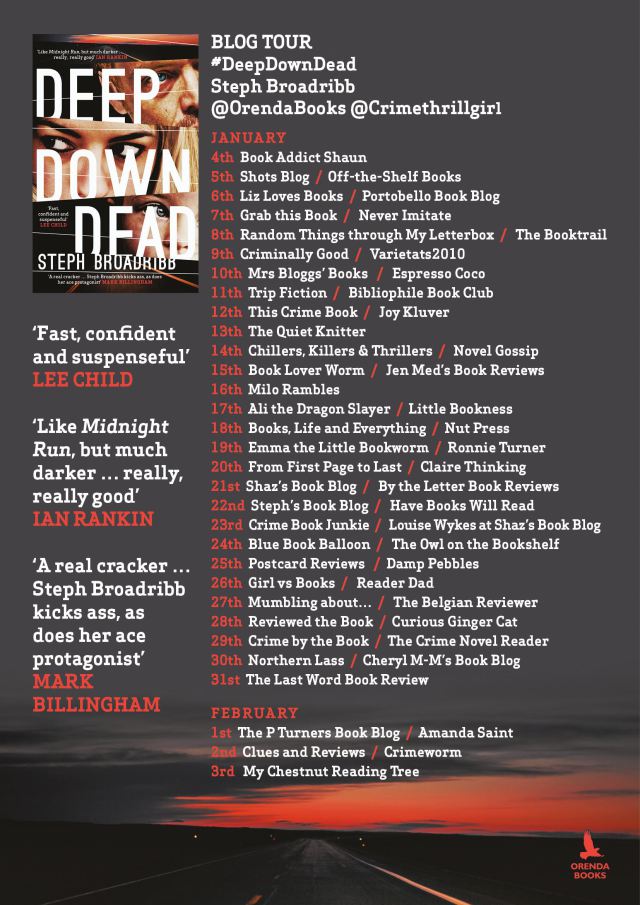
Blog Tour: Deep Down Dead by Steph Broadribb

From the PR: “Lori Anderson is as tough as they come, managing to keep her career as a fearless Florida bounty hunter separate from her role as single mother to nine-year-old Dakota, who suffers from leukaemia. But when the hospital bills start to rack up, she has no choice but to take her daughter along on a job that will make her a fast buck. And that’s when things start to go wrong.

The fugitive she’s assigned to haul back to court is none other than JT, Lori’s former mentor – the man who taught her everything she knows … the man who also knows the secrets of her murky past. Not only is JT fighting a child exploitation racket operating out of one of Florida’s biggest theme parks, Winter Wonderland, a place where ‘bad things never happen’, but he’s also mixed up with the powerful Miami Mob. With two fearsome foes on their tails, just three days to get JT back to Florida, and her daughter to protect, Lori has her work cut out for her. When they’re ambushed at a gas station, the stakes go from high to stratospheric, and things become personal.

Breathtakingly fast-paced, both hard-boiled and heart-breaking, Deep Down Dead is a simply stunning debut from one of the most exciting new voices in crime fiction.”

img_1586

This book cost me some sleep; once it gets going Deep Down Dead is an addictive read and one any fan of a good thriller will love. 

Now I look at the book on my shelves I’m surprised that it’s over 330 pages – it rips along with such a pace but then there’s an awful lot of good stuff packed into Deep Down Dead: a gritty female lead with more punch than a Klitschko brother and a back story that ensures you’re hanging to each page rooting for her while the plot has more twists and excitement than a ride at Winter Wonderland. That this is Steph Broadribb’s first novel makes that all the more impressive. 

A thoroughly enjoyable read with enough grip and twists to keep the reader hooked through to the end. A strong debut and I’m looking forward to the next chapter.

Thanks again to Karen at Orenda for my copy and check out the other stops on the tour.

ddd

Least to Most: Bruce – Tracks

“The alternate route to some of the destinations I travelled to on my records.” Bruce Springsteen

“Every song on Tracks is a lost argument”. Steven Van Zandt.

Strap in, this one is a long one…

bruce_springsteen_tracksIn 1998, with eleven studio albums to his name, close to 75% of Springsteen’s work remained in the vaults. His mammoth studio and recording sessions from Darkness on the Edge of Town onward meant that he’d essentially written four albums worth of material for every one that was released. His production and arranging partner for much of this time, Steven Van Zandt, would get frustrated by this practice – especially when he had to work so hard for his own songs – as many of his favourite tracks would end up shelved despite being the sort of thing other acts could make a career from but has referred to this period as Bruce’s “hundred song phase”. Not many artists are capable of such sustained writing periods, let alone when the material was so solidly strong.

When Tracks was released in 1998 it had already been whittled down from six discs of material to four and the 66 tracks ran from Springsteen’s 1972 audition tapes for Columbia through roughly chronological order to the late 90’s, divided up (as illustrated by the covers given to each of those discs inside the box) into what Bruce saw as the sections of his song-writing arc. Given that it came at the end of an otherwise sparse decade for Bruce fans, it was embarrassment of riches; of the songs included a handful had been released as B-Sides, some had leaked out on bootlegs and some had been heard live but never released. Plenty of them though had never even been heard of.

Those audition tapes kick proceedings off but, given the bare-bones approach to their released versions, don’t offer anything other than a passing interest and ‘Bishop Danced’ isn’t all that good if I’m honest. The first disc is made up of out-takes that, for the most part, it’s clear to see why; the songs are good ideas but don’t really make for strong contenders. I couldn’t imagine much debate went into ‘Zero & Blind Terry’ vs ‘Incident on 57th Street’ but the songs are good examples of Bruce working out ideas in the studio, with many a part stripped from one and dropped into another – albeit a couple of decades later with ‘Seaside Bar Song’s “the highway is alive tonight” lyric. But that’s because, up to, and including, the Born To Run sessions, Bruce’s writing hadn’t hit its stride (in terms of prolificacy not quality) and I imagine the constraints put upon him by the record label meant the time to do so wasn’t afforded to him in the way the Appel lawsuit would force it. For once the first disc reaches ‘Rendevous’ and the sublime ‘Iceman‘  we’re jumping into songs from Bruce’s most fertile period and the quality kicks up into a different gear. The leap is noticeable between ‘Linda Let Me Be The One’ and ‘Don’t Look Back’.

Now, in the same way the The Promise represents a lost album, the second and third discs of Tracks are nigh on faultless and could easily make up three classic albums from tracks completely omitted from The River and Born In The USA. Just take the breathless joy of Disc 2 opener ‘Restless Nights’ as Danny Federici whips up a dervish on his keys before Bruce’s guitar rips into it a minute and a half in:

Tracks like ‘Roulette‘, ‘Dolls House’, ‘Where The Bands Are’, ‘Loose Ends‘, ‘Living on the Edge of the World’ are pure, perfect three/four minute pop songs. Van Zandt was aghast that these were shelved – believing an album of these, plus ‘The River’ would be been a great thing. He’s not wrong. ‘Living on the Edge of the World‘ perhaps sounds strange but that’s because Bruce would take a few of it’s lines and strap them to altogether different beats for Nebraska‘s ‘Open All Night’ and ‘State Trooper’. Oh and there’s the absolute classic ‘Take ‘Em as They Come’ which just bounds along on a stellar beat that surpasses many a released song.

Slipped just before ‘Take ‘Em..’ is a Born In The USA out-take whose existence was previously unknown;

‘Wages of Sin’, another Bruce classic, is the first hint of what’s to come on Disc 3; a wealth of tunes that were recorded between 1982 and 1984 in that protracted recording period that lead to Bruce’s biggest-selling album. As big as that album was, the tracks that didn’t make the cut could easily be put together into an alternative album that would’ve been as good if not better. Just picking a handful of those tracks, say: ‘Wages of Sin, ‘Rockaway the Days‘, ‘Shut Out the Light’, ‘This Hard Land’, ‘Frankie’, ‘A Good Man Is Hard to Find (Pittsburgh)‘, ‘Lion’s Den’ will give you a strong album, if you were to add ‘My Love Will Not Let You Down‘, which breezes and rocks past plenty like on Born In The USA then you’ve got a classic and that’s without even mentioning another previously unheard of song – ‘Brothers Under The Bridges ’83’:

More than an ‘alternate route’ there’s alternate albums here. Oddly enough, Bruce even toyed with yet another album approach between Nebraska and …USA. Buoyed by the positive reception Nebraska‘s stripped-down sound received he headed back and laid down a few more tracks in a similar bare-bones, minimal approach before abandoning and heading back into the studio with the full band. Of those recorded during those sessions the soft tribute to Elvis, ‘Johnny Bye Bye’ and ‘Shut Out The Light’ would end up released as b-sides for ‘Born in the USA’ and ‘I’m On Fire’ before their inclusion on Tracks.

It’s not only ..USA that could’ve taken a different theme – just take a look at the difference in themes on those songs recorded during the Tunnel of Love sessions. ‘The Wish‘ is perhaps most known of these- a song Bruce wrote for his mother but felt unable to release officially given its sentimentality – while ‘The Honeymooners’ (a home-recording with the sound of dog barking captured in the background), ‘Lucky Man’ and ‘When You Need Me’ give a different insight to the men & women relationships that album tended to lean toward. Hell, ‘When You Need Me‘, similar in its uncomplicated sentiment as ‘Two For The Road’ is as content as Bruce would get this side of Lucky Town: “When you need me call my name, ’cause without you my life just wouldn’t be the same”.

The final disc loses the momentum a little with a lot of bass-heavy songs cut during the Human Touch sessions weighing it down. “I wrote about half a record on the bass, where you had a note and you had your idea. The only one that made it to release was ‘57 Channels,’”… indeed, and on Disc 4 there’s the remainder of those cuts – all exploring similar themes (internal dialogues working out psychological or relationships as Bruce himself was at the time) but none that really stand out as worthy of going further. That being said I’d rather something like ‘Gave It  A Name‘ or ‘When The Lights Go Out’ had seen release over the aforementioned Human Touch cut itself.

There’s still plenty to enjoy, though. In ‘Songs’ he explains that to shake off his writer’s block, Bruce started sessions for Human Touch by experimenting with different styles he “had always liked: soul, rock, pop, R&B”.  If you ask me, removed from much of the heavy-handed production that spoilt that album, they shine brighter here. One such song ‘Sad Eyes‘ is a cutting tune that’s better than most released on that album (and features David Sancious who also plays on ‘Part Man, Park Monkey’), ‘Seven Angels’ is back to the rock but undercut with more humour and looseness than anything that made the cut and ‘Gave It A Name’ – the master take couldn’t be found so Bruce and Roy Bittan recut the track in ’98 – is masterful in it’s minimalism. Oh, and there’s also ‘Happy’ the sole out-take from Lucky Town omitted only, I guess, because it shared the “gold and diamond rings…drug to ease the pain that living brings” line with the superior ‘My Beautiful Reward’.

The box is rounded out by the then-latest omissions. ‘Back In Your Arms‘ features the E Street Band and was recorded during the Greatest Hits sessions – like ‘Secret Garden’ it was originally one intended for Bruce’s shelved ‘Philadelphia’-style album – while ‘Brothers Under The Bridge’ is a beautiful out-take that was, exasperatingly when you considered what it could’ve replaced, omitted from The Ghost of Tom Joad and brings the set up to what was then Bruce’s most recent studio sessions. A story about a homeless Vietnam veteran living “who has a grown daughter that he’s never seen, and she grows up, and she comes looking for her dad. And what he tells her.” It would be performed live after ‘Born in the USA’ or ‘Shut Out The Light’ to place it within Bruce’s Vietnam arc and its one of those songs (like ‘The Promise’) whose live rendering meant fans were puzzled by its omission from the record.

Not everything on Tracks is brilliant but a lot of it is, much of it is very strong and some of the songs are absolute Bruce classics that stand above many in his catalogue. That’s why it’s on this list and why it’s on this list in this place; if I were talking to a Bruce newbie I’d recommend many of the songs on here well before a lot in his catalogue.

While many box-sets merely curate already-released material with a smattering of live cuts or offer up b-sides that are clearly inferior to their As, Tracks represents a much deeper fleshing out of the Springsteen narrative and emphasises just how strong a songwriter he is; even those tracks omitted from his albums piss all over many artist’s hits. Four discs and 66 songs is a lot to get through but it’s worth it. If you’re pressed for time then Discs 2 and 3 contain enough gold to make sure the box is worth of inclusion as an essential addition to a Springsteen collection / discussion.

Highlights: ‘Iceman’, ‘Don’t Look Back,’ ‘Restless Nights’, ‘Roulette’, ‘Take ‘Em as They Come’, ‘Shut Out the Light’, ‘My Love Will Not Let You Down’, ‘Frankie’, ‘Rockaway the Days’, ‘Brothers Under the Bridges ’83’, ‘Seven Angels’, ‘Gave It A Name,’ ‘Happy’, ‘Brothers Under The Bridge’

Not-so-highlights: The omission of ‘The Promise’. This actually lead to many a complaint from fans. A new recording of it would be slapped on the single-disc-sampler/cash-in 18 Tracks along with another couple of ‘new old’ tracks – ‘The Fever’ and ‘Trouble River’. 18 Tracks, intended for fans who didn’t fancy the full box, actually fared worse than Tracks in terms of sales and charting; Tracks was something of a hit for Bruce, hitting the Top 30 and shifting plenty of units, defying expectations for a Box Set in much the same way as Live: 1975-85 had a decade earlier.

Book Review: All the Light We Cannot See by Anthony Doerr

I’ve set myself a target / challenge of reading 40 books this year. It might seem like a few but I cleared 30 or so last year and I’m 3 down already. The first book I read in 2017 is going to take some beating though. It really cost me some sleep.

img_1467Some time last year I saw All the Light We Cannot See by Anthony Doerr on a table in the local (chain) bookshop. Immediately I was struck by the cover (I’m pretty sure a lot of others do judge books this way) even before I read the blurb on the back which well and truly got my interest. However; my TBR pile was already well stocked so it stayed on the table. Until it appeared under the Christas tree.

I’ve heard some people bemoan the historical fiction genre as limited and this has always baffled me. Aside from the opportunities offered by the ‘what if / alternative timelines’ explored by the likes of Fatherland, even small parts of history such as the Second World War offer a canvas so vast and wide as to be pretty much limitless in opportunities for invention and story while the gravitas of events is always going to add some emotional heft and that’s certainly the case with All the Light We Cannot See.

Thing is, with all that emotional heft and known touch points, it’s easy for historical novels to overdo it and try and hit every (see City of Theives) but that’s not the case here. While it’s clear from the get go that this is going to be an emotional novel – Marie-Laure is a blind girl whose mother died in childbirth while Werner and his sister Jutta are orphans in a harsh German mining town, Doerr doesn’t over egg the pudding. He doesn’t need to:

“Marie-Laure lives with her father in Paris near the Museum of Natural History, where he works as the master of its thousands of locks. When she is six, Marie-Laure goes blind and her father builds a perfect miniature of their neighbourhood so she can memorize it by touch and navigate her way home. When she is twelve, the Nazis occupy Paris and father and daughter flee to the walled citadel of Saint-Malo, where Marie-Laure’s reclusive great-uncle lives in a tall house by the sea. With them they carry what might be the museum’s most valuable and dangerous jewel.

In a mining town in Germany, the orphan Werner grows up with his younger sister, enchanted by a crude radio they find. Werner becomes an expert at building and fixing these crucial new instruments, a talent that wins him a place at a brutal academy for Hitler Youth, then a special assignment to track the resistance. More and more aware of the human cost of his intelligence, Werner travels through the heart of the war and, finally, into Saint-Malo, where his story and Marie-Laure’s converge.”

The story gets started with the night before the near destruction of Saint-Malo in 1944 before tracing the timelines of its two leads back to their childhoods and briskly bringing them to the present and to each other in one hell of a climax. Told in present tense, the prose is short and bullet sharp and keeps the momentum of the story ripping along, there’s no time to dwell on emotional impact (perhaps making it all the more hard-hitting when it comes) and there are moments when it’s clear that Doerr is himself wrapped up in the story and just letting it unfold and getting out of its way. An absolute joy to read.

A story of science and the power of radio, Nazi occupation, wonderment and the question of morality, All the Light We Cannot See by Anthony Doerr is a genuinely great novel- it’s a good thriller crossed with a damn good stab at great literature. It’s been pretty much highly received and won the 2015 Pulitzer Prize for Fiction (I’m also a big fan of the previous winner, Donna Tartt’s The Goldfinch).


Least to Most: Bruce – The Rising

“I need your kiss, but love and duty called you someplace higher
Somewhere up the stairs into the fire…”

I’ve mentioned before that I think the negative reaction to Human Touch and Lucky Town gave more of a knock to Springsteen’s confidence than he’d be willing to let on; rather than follow Greatest Hits with a full blown reunion and band album he went the solo route and still wasn’t convinced that the Reunion Tour was a good thing practically up until the last minute. When that tour finished in July 2000, many assumed the next logical step would be to get the reconstituted band into the studio for a new album, presumably featuring some of the new songs they’d aired during that tour.

springsteen_the_risingBut… not quite. Instead Bruce spent roughly half a year logging up solo recording sessions, perhaps wary of going for another ‘rock’ album after so many years. Indeed, during press for The Rising he admitted hesitancy at returning to his ‘rock voice’.  Then, in March 2001, Bruce assembled his then core production team of Landau and Chuck Plotkin with Toby Scott recording and bought the E Street Band into New York’s Hit Factory. A handful of songs were recorded but the results… didn’t jump. It seems hard to think that with the band at full power a recording could be flat but it had happened before when he struggled with the sound on The River and Bruce has admitted that he realised he was now a better writer and singer than he was a producer and that modern techniques and equipment were simply unknown to him. He also felt that there was no unifying theme to bind the tracks written thus far into a ‘record’. If Bruce and the E Street Band were to move into the new millennium as anything other than an oldies touring act, he needed a new sound and a subject.

Then everything changed one terrifying and tragic September morning.

On his way home to his wife and kids that morning Bruce was sat at a stop sign. The driver of a car hurtling down the off-ramp recognised him, wound his window down and, as he drove past, shouted “Bruce, we need you now!” Bruce got the message, he just didn’t know how he could respond. Whether it was the call from the car or Bruce reading obituary after obituary mentioning victims being his fans*, but as he found himself glued to footage and, watching the firefighters making the ultimate sacrifice, climbing up the stairs, bidding goodbye to this world and stepping into the unknown… the songs started coming with ‘Into The Fire’.**

Some years prior, the president of Sony Records had mentioned to Bruce that producer Brendan O’Brien (Pearl Jam, RATM, STP amongst many others) had mentioned a desire to work with him. The two connected, met up and Springsteen played him a couple of tracks he’d written. Now, O’Brien is a very hands-on producer, in search of the ‘song’ he’ll roll up his sleeves and get stuck in. This doesn’t always please the artists. By all accounts his sessions with Aerosmith in 2009 were fraught with tension between him and Tyler partly due to the frontman’s displeasure at O’Brien’s methods**. When Springsteen played him ‘You’re Missing’, O’Brien jumped straight in re-arranging. Initially he believed Springsteen was impressed, though he later found out The Boss wasn’t so happy at the idea but realised this might be needed: “At one point Brendan said, ‘Well, I think we should find another chord for this spot.’ I said, ‘Find another chord?! Wait a minute, now! Hold on, hold on! Those are the chords!’ But then I’m thinking that my job now as the producee, is to say yes.” They cut the demo and Brendan told Bruce “this is good, now go write some more”.

When recording on The Rising began in late January 2002 at Southern Tracks in Atlanta, it was out with the old and in with the new. Brendan O’Brien produced and mixed and recording was handled by Nick DiDia. In the past Springsteen album sessions were long and laborious. As Van Zandt, back in the band sharing second guitar duties with Nils Lofgren, Bruce would “write a bunch of songs, we’d record them, then, you know, hang out for a bit. He’d write another bunch of songs, we’d record them. What would happen is, we’d always do two or three or four records before one finally came out.” For The Rising the band would run through the song a couple of times and O’Brien would call time to record. Recording sessions for the last E Street Band album, Born in the USA, took over two years. Recording sessions for The Rising took seven and a half weeks.

urlThe first new Bruce Springsteen album I bought on day of release, The Rising is the sound of Bruce and his band embarking on a new era, re-galvanised and sounding tighter and tougher than before, songs focused and punchier than in over a decade. Bruce said of the change in sound that “I heard the way we sound right now. Today. And I said, ‘Well, that’s what we need to do.’ If somebody has all our other records, I want to make sure they don’t have this one. You can’t replace this one with some of the other ones.”

O’Brien’s touch isn’t as heavy-handed and obvious as a later producer would be, the altering of the band’s sound more of an update than an overhaul. His work seems to be more in finding the essence of a song, distilling it down and bringing different sounds to the forefront – the guitar tone on here eclipsing that of Lucky Town / Human Touch for example – and adding subtle touches to the overall palette.

The Rising never tackles the theme of September 11th directly, but it’s shadow can be felt across the album. With ‘Your Missing’ and ‘Into The Fire’ nine of the album’s fifteen tracks were written post 9/11 while ‘Nothingman’ and ‘My City Of Ruins’ fit the overall feel perfectly.

While not quite the finest record of the Bruce V2 era it’s certainly up there higher than most of his recorded output since and marked a fine return to form. I’m not a fan of ‘Waitin’ On A Sunny Day,’ nor am I that bothered about ‘Lets Be Friends (Skin to Skin)’ but I find it hard to find a fault with the rest of the album and it gets many a play. These are songs of loss, sure, but they’re also songs of finding strength in that loss. Songs of love, faith and power. Themes Springsteen had sung of throughout his career and, with the rejuvenation offered by The Rising, would go on to do so into a new chapter of his career.

Highlights: ‘The Rising’ ‘Into The Fire’ ‘Worlds Apart’ ‘Mary’s Place’ ‘You’re Missing’ ‘The Fuse’

*Bruce would reach out to the families of those victims, talking and consoling at length.

**’Into the Fire’ wasn’t finished just yet so come the A Tribute To Heroes concert it was ‘My City Of Ruins’, written previously for Asbury Park, that Bruce played.

***The band was already fraught with tension, Tyler was using again and were abandoned much to the chagrin of other members even after, according to Brad Whitford, O’Brien “bent over backwards to do whatever he could to make Steven comfortable”.