The Bird Tribunal

From the PR: “Two people in exile. Two secrets. As the past tightens its grip, there may be no escape… TV presenter Allis Hagtorn leaves her partner and her job to take voluntary exile in a remote house on an isolated fjord. But her new job as housekeeper and gardener is not all that it seems, and her silent, surly employer, 44- year-old Sigurd Bagge, is not the old man she expected. As they await the return of his wife from her travels, their silent, uneasy encounters develop into a chilling, obsessive relationship, and it becomes clear that atonement for past sins may not be enough…”

the-bird-tribunal-a_w-v4When I think of short books there’s many a favourite read that springs to mind – Pereira Maintains, Mother Night, Of Mice And Men… These are novels that manage to deliver  a cracker of a plot, great characterisation and plenty of punch without ever feeling rushed. There’s not a wasted full stop. And now I’m going to add The Bird Tribunal by Agnes Ravatn to that list.

They say you shouldn’t judge a book by it’s cover but I’d been eagerly anticipating this book since its cover was revealed back in April – there’s something mesmerising about that boat, empty and adrift on the fjord that’s not only intriguing but most certainly helps set the tone – after all, we all know what lurks beneath such still waters.

I wasn’t disappointed – I hungrily devoured this book in two sittings. It’s an intensely captivating read.  The Bird Tribunal is an intense, beautifully written book which pulls you in with its chilling atmosphere, weighted with an undertone of menace and barely-concealed dread as the initial calm and tranquillity is soon consumed by the darkness in the shadows, leaving you absolutely gripped as it builds to its thrilling conclusion. 

The pacing is superb, the characters and their motivation captivating, the plot gripping and original and the atmosphere – making full use of the stark, imposing nature of its remote Norwegian setting – is chillingly beautiful and spell-binding.

If there were stars at the bottom of these reviews this one is an easy five.

Thanks again to Karen at Orenda for sending this to me and do check out the other stops on the The Bird Tribunal blogtour:

bird-tribunal-blog-tour-poster

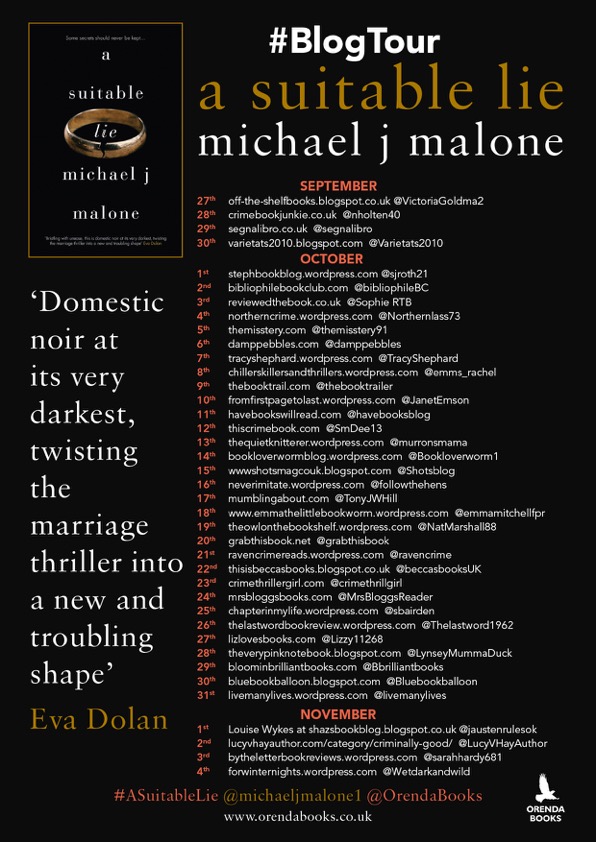
A Suitable Lie

I saw her curled up in a chair. Fast asleep. Even in the weak light I could make out the silted lines of mascara that ran from her eyes and down the pale expanse of her cheeks, almost past her nose.

She had obviously fallen asleep waiting for me.

And that was the first time I thought about murder.


From the PR: “Andy Boyd thinks he is the luckiest man alive. Widowed with a young child, after his wife dies in childbirth, he is certain that he will never again experience true love. Then he meets Anna. Feisty, fun and beautiful, she’s his perfect match … and she loves his son like he is her own.  When Andy ends up in the hospital on his wedding night, he receives his first clue that Anna is not all that she seems. Desperate for that happy-ever-after, he ignores it. A dangerous mistake that could cost him everything.

A brave, deeply moving, page-turning psychological thriller, A Suitable Lie marks a stunning departure for one of Scotland’s finest crime writers, exploring the lengths people will go to hide their deepest secrets, even if it kills them…”

A Suitable Lie AW.inddI’ll put my hands up; after the initial hook, most certainly an attention grabber, I started to wonder where this one was going… the courtship of Andy and Anna makes for a pleasant and often humorous read but not one that I was expecting after the opening quoted above.

But then… well, then I realised just how crafty Michael Malone is. All the gentle domesticity, all the loved-up courtship and redemption for Andy -the average guy trying to raise his son after the devastating loss (and here Mr Malone writes with a convincing and affecting sense of emotion) of his wife…. it’s just the lure to get you on the hook because this book.. this book is a sneaky bugger; lulling you into a false sense of security before delivering a read stuffed with a palpable sense of dread and tension and one which is, more frequently than not, a disconcerting and terrifying read.

Sitting at the core of this novel is the theme of domestic abuse and here Michael Malone takes a familiar trope and flips it on its head in a way that many have tried before but few have done with such startling and genuinely harrowing results. Malone deals with a very difficult topic with both sensitivity and boldness, delivering scenes of raw emotion and – frankly – horror which manage to skilfully tread the line between exploitation and being shocking realistic. There are scenes in this novel that make for an uncomfortable read but a story that doesn’t challenge the reader isn’t worth the paper it’s printed on and A Suitable Lie both challenges and rewards.

I don’t want to give anything resembling a spoiler away here as I’d rather recommend all to go out and read but I will say that there are parts of this story that left my mouth open. The conclusion is both heartbreaking and gripping in its intensity and twist – to use an oft-overused phrase – a real roller-coaster.

Michael Malone has a clear and unarguable talent when it comes to prose and story and A Suitable Lie is an engaging read  that will remain with you long after the final page has been turned – it went very quickly from being a “where’s this going?” to costing me sleep as I simply had to find out.

Huge thanks once again to Karen at Orenda Books for sending me yet another great read and do check out the other stops on the BlogTour:

suitable-lie-blog-tour-poster

Adversity and inspiration…. Louise Beech – Guest Post

Something a little different today. I’m delighted to host a guest post by the wonderful author Louise Beech as part of the blog tour for her latest novel The Mountain In My Shoe – published by Orenda Books.  Louise’s novel How To Be Brave was one of the best books I read last year and The Mountain In My Shoe promises to be a contender for this year’s list too.

Without further ado..

dscf5201-2

Adversity and inspiration….

During the Hull launch of my second novel, The Mountain in my Shoe, writer Russ Litten asked about what it was like writing a first novel compared with later ones. It’s a fantastic question, one I’ve been thinking about a lot since, and one I perhaps didn’t fully address in the excitement of a public interview, and with my mum heckling on the front row. What I think the question is referring to, is that writing without having been published (that is without acceptance, that magical YES) is different to writing with the safety net of a deal. Or is it?

The first book I penned (Maria in the Moon which is ‘pencilled in’ for publication next year) and my new one, The Mountain in my Shoe, were both initially written under the shadow of uncertainty. When I wrote Maria we had just endured the worst floods in UK history, those that hit Hull and other cities in 2007. We lost our home, belongings and car in hours. Worse still, my daughter became ill and I gave up my job in travel to care for her. As she got a little better, and while she was at school, I began writing. And writing and writing and writing. At a rickety metal desk that my husband had fashioned for me, with workmen banging away, rebuilding the town, I typed away. At that point I wasn’t thinking of publication; only getting the words out.

Adversity is a great place for inspiration. It’s not a great place to permanently live, but without it we don’t grow, survive, or scream to be heard.

When I wrote The Mountain in my Shoe a few years later I’d had thousands of rejections for my first two manuscripts. In many ways, I was changed. I was tougher. On both myself and on my work. I was hungry. I use this word not in a Scarlett O’Hara way, as she quite literally digs for food in the ground at Tara, but in an ‘I must make this happen’ way. And being hungry, I feel, is good. Wanting something makes you work. It makes you perfect your craft. It makes you rewrite and edit harshly. It teaches you.

So yes, I think there’s a difference in writing before publication and after. When editing The Mountain in my Shoe recently I was able to see it more clearly. The hunger is great for driving you, but having been accepted gives you clarity. You can breathe, you can calmly assess what works and what doesn’t. You can take on the edits suggested by your publisher, you can really see it.

In currently writing my fourth novel, I’m in a better place. I’m lucky enough to see the success of my debut, How to be Brave, continuing; lucky enough to see great reviews for The Mountain in my Shoe coming in; and lucky enough to be doing this writing stuff for real. To be writing for actual readers.

But no matter what happens, how many books I write, how much success I do or don’t have, I’ll never forget that hunger. That rickety desk, the tears of frustration and sadness, the loneliness, while hearing my world getting rebuilt. Because I created something I’ll never quite create again.


Do check out the other stops on The Mountain In My Shoe blog tour.

mims-blog-tour-poster

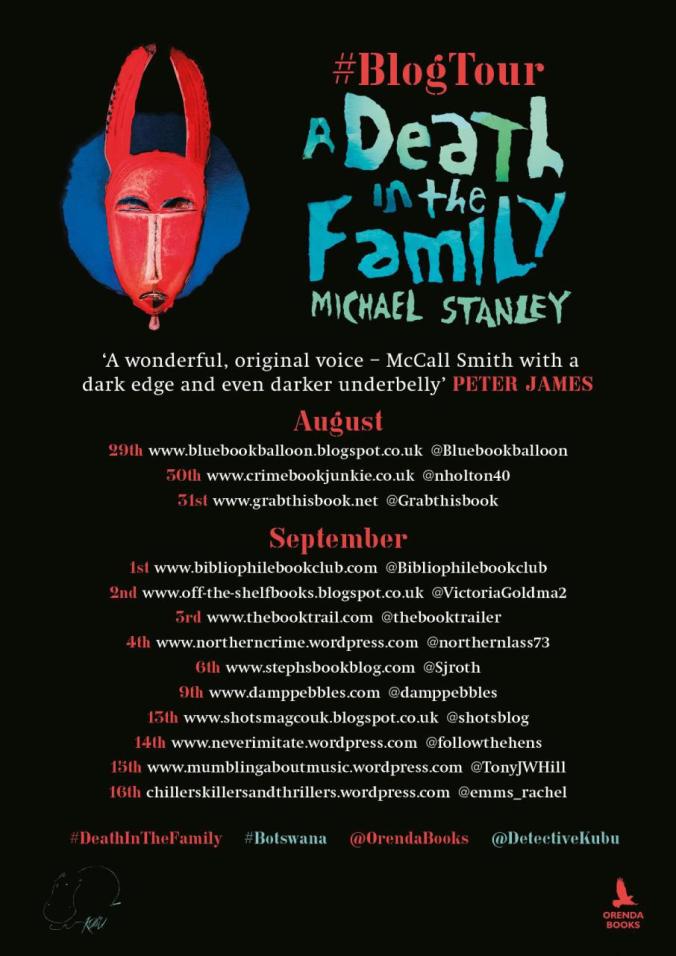
A Death In The Family

There’s no easy way to say this, Kubu. Your father’s dead. I’m afraid he’s been murdered.

Assistant Superintendent David ‘Kubu’ Bengu of the Botswana CID is back. His father, only recently diagnosed with Alzheimer’s, has been violently murdered. Who would murder a frail old man? Why was his father out alone? Who was he meeting?

A Death In The Family is the welcome return of Detective Kubu and this mystery from the writing team of Michael Sears and Stanley Trollip (writing as Michael Stanley) is another gripping instalment set beneath the hot African sun.

img_9790While the murder of his father leaves only questions, Kubu is not the policeman to find the answers – to his abject frustrations he is forbidden from investigating the case. Instead, Kubu is assigned to the apparent suicide of a government official. But, as he digs deeper, questions are raised over the involvement of Chinese mine-owners and foreign governments and it becomes clear that there is a lot more going on – as tensions over mine expansion in Shoshong (a town near Kubu’s ancestral home) explode into riots and violence, connections between the cases begin to appear.

What unfolds is a fantastically complex and artfully crafted plot that brings together political corruption, the incursion of foreign powers and companies in search of Botswana’s mineral wealth and the chilling, dangerous paths taken to satisfy greed.

Detective Kubu, in a genre stuffed to the bindings with great characters, is a real stand-out and fast becoming a firm favourite. In my review of Deadly Harvest I pointed out that it’s great to read such a warm character driven by a love of family (and biscuits). As such, Kubu’s grief and frustrations at not being involved in the case are compelling and thoroughly affecting; the authors create a vivid portrait of a genuinely loving family man wracked by the darkness of his father’s murder.

A Death In The Family is a great read that’s full of intrigue and delivers plenty of shock too. Thoroughly well-written and packed with convincing characters and settings. Not to mention it’s also a solid little introduction to rare earth mining.

I, personally, feel I’m somewhat on the back foot as this is already the fifth in the Detective Kubu series (the second to be published by Orenda). That’s more down to my hunger for more than anything else, though, as Messrs Sears and Trollip ensure that each of these instalments work brilliantly in their own right and there’s no need to have read its predecessors to enjoy A Death In The Family as I so thoroughly did.

A highly recommended book and one that rewards on every page.

Thanks, as always, to Karen at Orenda for my copy and do check out other stops on the blog tour.

deathinthefamilyblogtourposter


For Two Thousand Years

I will speak of a land that is mine, and for her I will risk appearing ridiculous, and I will love that which I am not allowed to love.

Mihail Sebastian is a very important writer, one of Romania’s finest and yet, possibly, lesser-known.

Born Iosif Mendel Hechter in 1907 to a Jewish family living in the town of Brăila on the Danube, Sebastian studied law in Bucharest before being attracted to literary circles and the ideas of intellectual groups (which included Mircea Eliade). He had a number of novels and stories published – including For Two Thousand Years – yet his timing was tragic; a Jew at the time when Europe, and Romania, saw an increase in anti-Semitism and the rise of fascism. Even amongst his friends Sebastian was seen as an outsider. Even more so when Eliade became a supporter of the Iron Guard.

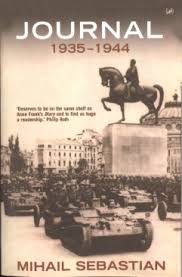
urlFrom 1935-1944, undoubtedly one of the worst time periods to be of the Jewish faith in Europe, Eliade kept a journal – it detailed the growing and horrifying persecution he faced both from strangers and former friends and the anti-Semitism that was rife in Romania at the time. It caused uproar when it was eventually published in 1996 (having been previously been smuggled out of the country by his brother in the diplomatic pouch of the Israeli embassy in Bucharest and kept safe until Romania was no longer under Communist rule)  as it shone a light on many a crime that had been quietly hidden and gained Sebastian a larger audience in the West thanks to its unflinching honesty.

I happened to find it, in English, one day some years ago in a bookshop in Bucharest – a few hours before my flight out. Thinking it might be more of a ‘war diary’ and with my interest in that field, I picked it up and was instantly hooked. For, alongside the fascinating accounts of how the writer pieced together the novel and plays he worked on during the period, the fact that a gentle, intelligent man who loved his country and it’s culture, was ruthlessly targeted, harassed and humiliated from all sides because of his faith left me aghast. It meant I stopped reading Eliade quite so keenly, too. In many a way it has drawn comparisons to Anne Frank’s diary.
urlIt left me with a thirst for more of Sebastian’s writing but I couldn’t find any of his work translated into English (there is a huge amount of literature from Romania that I’d love to see published in the UK). That was until, in bizarrely similar circumstances, I found this new (2016) translation of For Two Thousand Years during a long wait for a flight at Gatwick Airport.

It’s one of the best books I’ve read this year.

Written in a journal-like manner (though with more focus, of course, than a genuine journal), Mihail Sebastian’s For Two Thousand Years is, essentially, a story of what it means to be a Jew in Romania. A story in three parts, focusing first on the narrator’s tumultuous time at University in 1923 (when the constitution awarded citizenship to ethnic and religious minorities) where intimidation and violence was a daily part of simply trying to attend classes before moving ahead some six years to find the narrator moving ahead in his career then on to Paris before heading back to Romania.

At first the style is a little bewildering but, when framed in the context in which it is set, this becomes only more apt and well realised – a young man confronted with violence and setbacks struggling to understand and find his own way. As the narrator becomes more at ease with life with age and experience so too does the narrative change.

For Two Thousand Years is not only a brilliantly written story, framing some exceedingly important questions into its prose, but it’s disturbingly prescient with it’s dread of the future (it was published in 1934), predicting Vienna and the Anschluss as the tipping point. In this respect it’s also deeply moving for, with the benefit of historical hindsight, we know that the narrator’s fears that his work and dreams may amount to nothing and will likely be crushed by the changing socio-political landscape are more than accurate.

It – like Sebastian’s own journal – is an eye opener in terms of the treatment of Jews at the time. The narrator – as the author – remains proud of his fatherland, loves the Danube he grew up with and yet knows that he can never be truly considered Romanian. I wasn’t entirely surprised to learn from my mother-in-law that the novel had been banned in Romania for a long time.

Recalling how, for example, during military service, he is not permitted to take a shift of guard duty “since I might betray [the country] in the course of a night on guard duty.”

The resigned-to-fate manner of its conclusion becomes all the more evocative when viewed through today’s eyes and the knowledge of the trials and horrors that awaited those of his faith.

It’s hard, today and in my own privileged position and disregard for the petty ways in which we define people by the speck of dirt chance happened to place their birth, to imagine the world in which Sebastian lived; persecuted and prevented from being considered ‘of’ a country because of his faith. A such  For Two Thousand Years insightful and compellingly searching novel and was well worth the wait to finally read.

Having survived the Second World War, during which time he was refused permission to work and was kicked out of his home and forced to live in a slum, Mihail Sebastian got a job as a lecturer at Bucharest University. Unfortunately, on the way to give his first lecture (on Balzac) on May 29th, 1945 he was hit by an army truck and died. My hope is that there was a lightness and optimism in his heart at the time at least.

Yet, I won’t end there, after all in both For Two Thousand Years and his own journal Sebastian refused to give in to melancholy and sadness. I’ll pick up the quote I started this entry with:

“I will speak of the Bărăgan and the Danube as belonging to me not in a legal or abstract sense, under constitutions, treaties and laws, but bodily, through memory, through joys and sorrows. I will speak of the spirit of this place, of its particular genius, of the lucidity I have distinguished here under the white light of the sun on the plain and the melancholy I perceive in the landscape of the Danube, drowsing to the right of the town, in the watery marshes.”

Make Me

..he ducked his own hand under his own coat, grabbing at nothing but air, but the two guys didn’t know that, and like the good range-trained shooters they were they went for their guns and dropped into solid shooting stances all at once, which braced their feet a yard apart for stability, so Reacher stepped in and kicked the lefthand guy full in the groin.

I was late getting to the Jack Reacher party. Perhaps because I took a long break from reading books that could be slotted into the ‘thriller’ genre or perhaps because I’m sometimes wary / sceptical of such one-character driven series. Of course that changed when I did pick up Killing Floor. I also admit I got into it the wrong way round having watched the Jack Reacher film first.

There’s been a lot said about Lee Childs’ character and a pretty good article that also covers why, perhaps, I was hesitant in picking up my first Reacher books (is it ‘low taste’?) but I am now hooked. I’ve since cleared seven and there’s an eighth sat on my bookshelves lined up as my next-but-one read.

I’ve got a couple of weeks holiday rapidly approaching so went on the hunt for some holiday reading and there isn’t really much better for that than Lee Childs’ work. So I grabbed Make Me and Nothing To Lose – I’m not reading them in order, really – but ended up making the mistake of scanning the first page of the latest. It’s a mistake as you really only need to scan the first paragraph and Child will have your attention and interest piqued. I hadn’t picked it up sooner as I’d thought it may be better to read the earlier books first and, honestly, wasn’t hugely taken with the prior effort, Personal.  Either way, a couple of days later and I’d finished Make Me – number 20 in the Jack Reacher series.

Having not read even half of the series I can’t really pull the “best of the lot” or really cite favourites (though Persuader would take some beating) but I will say that Make Me is a bloody decent instalment and really does improve on Personal. It feels like a good solid Reacher novel and adds a lot more to the character than I was expecting and moves the character on in ways that have previously been missing.

Make Me starts off in what is now standard routine – Reacher finding himself, by chance, in the middle of a situation to which his sense of justice and skills and experience lend themselves. In this instance he’s climbed off the train at a town called Mother’s Rest out of idle curiosity over the town’s name. From here he’s pulled into another mystery, aided by another (in a long line) of women that he also takes a romantic interest in.

To be honest, though, that’s where the ‘norm’ finishes. The mystery in Make Me is a genuinely intriguing one and ends up going down some very, very dark roads. The humour is also a lot sharper and it did give me a good chuckle to find the one-man-army that is Reacher trying to get to grips with modern technology.

But, and here’s the thing, the Reacher of Make Me is a lot more human than previous entries have shown. There’s hints of, perhaps, a long-lasting relationship with Chang that perhaps even the author hasn’t decided where to take (given that Child writes without knowing exactly where the story is going and that the next Reacher novel is a step back in time) and we learn that Reacher can be injured in a fight by a single adversary.

Perhaps Child is aware that an audience can only see Reacher deliver the same lines (how often has Reacher had to explain his lack of permanent abode) and moves (there are, realistically, only so many ways to describer a head butt)  so many times before losing interest. Perhaps he too wants to add more to the character and give him something other than an endless road and line of adversaries to smack about. Regardless, I thoroughly enjoyed Make Me and am looking forward to see where Child takes his character next. I’ll have to wait for the follow up to Night School to find out, I guess. Still with a new Reacher-per-year timetable, the wait won’t be too long after all.


Black Out

Think of Iceland and you’ll no doubt think of geysers, calm, tranquil fjords… perhaps even volcanic eruptions. Crime and murder will probably not be one of those connections that springs to mind. The same is certainly true for Evan Fein, an American tourist, as he searches for Grettir’s Pool, an ancient stone-flagged hot bath, down narrow roads and scanning country lanes and farm gates. What awaits Evan, though, isn’t a relaxing dip in steaming water, it’s a dead body, a man brutally beaten to the point that he is “practically unrecognisable,” “where there had been an eye, there was now an empty socket.”

CnGralHXgAA9a6pThis is the start of Black Out, the latest instalment in Ragnar Jónasson’s Dark Iceland series to be translated into English and published by Orenda Books and it’s bloody good to be back in Siglufjörður once again. Black Out sits second in the Dark Iceland series and picks up after the events of Snow Blind; Ari Thór, while now more at peace in the town, is dealing with the fallout of his confession of infidelity to his girlfriend, Kristín who herself is now living a short distance away in the neighbouring Akureyri. The Inpector, Tómas, is debating his own future in the town after his wife’s move south to Reykjavik and Hlynur is dealing with the chilling consequences of his past.

It’s into this state of distraction that the news of the murder is dropped and Ari Thór and Tómas set about investigating the victim’s connections to the town – the only real starting point is that the victim, Elías, was part of a crew working on the new tunnel. Tómas is far from thrilled at the opening of the tunnel, worrying what it will bring into the town. Strangely enough, the more that Ari Thór digs into the storied past of some of the residents it’s clear that even without infrastructure upgrades, Siglufjörður holds many a disturbing secret. Some people know exactly what Elías was involved in but nobody is talking and so much remains hidden despite the 24-hour light of the Arctic summer that the police are in the dark.

That contrast of tones – darkness in the shadows of an otherwise idyllic scene – is what makes that creeping sense of dread so much more powerful and chilling as, piece-by-piece, the clues come together and the quiet town of Siglufjörður becomes the epicentre of a taught, methodically plotted story involving money laundering, sex-trafficking, child abuse, rape and murder. Be warned – Black Out gets very dark.

This time around it’s not just the Siglufjörður police that are trying to crack the case; Isrun, a news reporter is also chasing down and finding her own leads as she races for an exclusive. The introduction of Isrun means that Jónasson is able to add further elements to the story and take the reader further afield to Reykjavik (shrouded in a volcanic ash cloud) and the politics and rivalries of the newsroom. I’ll avoid going further in terms of Isrun’s involvement in the investigations or her own motivations to avoid spoilers but I will say that it was a genuine surprise and a welcome change up, further evidencing that Ragnar Jónasson’s writing is anything but formulaic. She’s also another thoroughly great and compelling character.

Jónasson has a gift when it comes to crafting memorable characters. Ari Thór, while not always likeable, is given increasing depth and dimension with every instalment and his relationship with Kristín gives greater insight as well as further developing her own character. Somewhat sadly, of all the threads surrounding the main narrative, it’s the sub-plot surrounding Hlynur that is perhaps the most gripping and while having already read Night Blind means I knew where it would lead, was nonetheless genuinely affecting and moving.

Weaving together all the sub-plots of such a multifaceted story could prove challenging yet Ragnar Jónasson makes it seem effortless – while his history of translating Agatha Christie novels into Icelandic means he’s no stranger to mystery writing, it’s his own voice and skill that makes Black Out and the Dark Iceland series one of the most compelling and rewarding additions to the thriller genre. Each instalment delivers more and leaves the reader in eager anticipation for the next. The first snippet of the next instalment (included at the end of Black Out) had me checking the door was properly locked and bolted. Not something I’ve done since I read The Snowman. A series and author well deserving of the highest praise. Very much looking forward to more.

Huge thanks once again to Karen at Orenda Books for my copy and I do wholeheartedly recommend Black Out.

Turning More Pages

Another couple of months and another chunk is taken out of the continually growing TBR pile.

Time doesn’t appear to be my friend of late for blogging larger reviews (life takes priority) so I’m gonna try and wrap up a few of those books whose spines I cracked over the last month or so.

The Amber Shadows is a 2016 release  (it’s not all that often I read books so close to their publish date) that I found via the author’s twitter – Lucy Ribchester’s book (her second) is set in 1940’s Bletchley Park and she’d been sharing some of those once-classified documents from home of Britain’s codebreakers during World War II  that had served as research for the novel. That’s enough to get my interest. The Amber Shadows is certainly well-researched and manages to give a very convincing account of the time and place without over-doing it to the point of stereotyped clichés as some do. The plot – Honey Deschamps works in Hut 6 transcribing decrypted signals from the German Army when she begins receiving mysterious packages of amber – is certainly promising and the writer is able to keep the reader guessing. The conclusion left me a little unsatisfied but, in retrospect, it’s certainly in keeping with the period in which it’s set in terms of how, with the second world war raging and life having taken on a different value, it may well have played out.

IMG_9417

The Sisters Brothers by Patrick DeWitt had been sat on my shelves for at least a year before I picked it up at the start of the month. I’d seen it in the hands of numerous travellers a few years back on a cruise and in many a list at the time so thought nothing of grabbing it for £1.99 in Sainsburys. Though I obviously didn’t think to read it either. I can only say I was stupid. It’s a brilliant book. A real ripper that I tore through hungrily. Many a review have likened it to a noir-ish Coen brothers story and I’d happily agree. Another book I’m glad I finally got around to reading and just in time it seems as Mr DeWitt has a new book out.

Jo Nesbo’s Harry Hole is, I guess, a name that isn’t one typo away from being obscene in its native Norwegian. The Redbreast is my third Harry Hole read (well out of sequence) and fifth Nesbo novel. I was hesitant to read this after my disappointment with Head Hunters but I needn’t have been. While not as genuinely terrifying as The Snowman or quite in possession of its writer’s realised style, this third Hole novel not only works as a good stand-alone instalment but also serves up plenty of fodder for the Oslo detective to tackle in later novels and it’s a good indication as to how both the character and series develop- having now read three of which at random I do know think I’ll be better served reading them in order, though.

Reading things in order brings me to the couple of Discworld novels I re-read last month. My gradual rebuilding of my Terry Practchett collection is going nicely – I’ve also finally added and reread Men At Arms and travelled back via Guards! Guards!– if slower down to my decision to purchase and read on a less specific order than chronological. As such I’m not merely going to Waterstones and buying new (not to mention my disliking of the new cover art) but popping into used book stores and looking for specific titles – Pyramids is next on my list – or seeing what they have (there seems to be an abundance of The Hogfather). I hadn’t read either Mort or Sourcery more than the one reading I gave them at least a decade and a half ago. As such it was great to rediscover how delightfully dark the humour in Mort is and laugh as Death attempted to understand what it is to be human. I can’t, in all honesty, say quite the same for Sourcery as it took me a few false-starts to get through this one. It lacks the spark and momentum that his earlier and later novels would have and, looking at where it sits in publishing order, perhaps Sir Terry was reaching the point where he was running out of fuel for the Wizards / Witches / Rincewind stories. Indeed he’d soon branch out into other character and story arcs to populate the Disc. That’s not to say Sourcery is without its charms or humour but I’d be surprised if it was listed as anyone’s favourite of the Discworld novels.

Where Roses Never Die

I’m going to come right out and say this at the start; Gunnar Staalesen is rapidly becoming one of my favourite writers and this is based purely on only the two Varg Veum books of his I’ve read – We Shall Inherit The Wind and, now, Where Roses Never Die.

With that in mind it was an absolute, relished delight to sit down at the start of May while away on holiday, overlooking a lake and armed with a fresh cup of coffee and no distractions (napping toddler), delve into Where Roses Never Die and another lesson in Nordic-Noir from the master.

IMG_9197In September 1977 a three-year-old girl, Mette Misvær is playing in the sandpit outside her home. When her mother, having been distracted, looks out the window to check on her daughter, Mette has disappeared. The tiny community – a model suburb – of Nordas is devastated. The police search everywhere but their enquiries produce nothing. Mette is never found.

Fast-forward almost 25 years and, as the statute of limitations approach, Mette’s mother approaches PI Varg Veum. She’s never been able to believe that her daughter is gone, the loss has haunted her and she’s desperate for answers. Veum is in no real shape to take a case, he’s still reeling from the aftermath of We Shall Inherit The Wind. But he takes the case – if only to rebuild his depleted bank balance – and begins to unravel a web of secrets and lies that lurk beneath the surface of a seemingly tranquil, idyllic little community.

As a parent the subject matter is a bit of an emotional punch as it plays directly into your worst fears (not the only book in Orenda’s stable to do so, I might add) but, having been writing Varg Veum novels since 1977, Staalesen knows how to navigate these waters and not let the reader drown and the energy and pull of Varg keeps it moving. It’s a haunting story and Staalesen plots it brilliantly, expertly bringing together seemingly unrelated events and characters into a revelation that’s an absolute shocker. That final revelation is a pretty dark one to say the least so I’m going to avoid going into plot for risk of giving anything away but, in the same way as the previous novel, the reveal here left me reeling. I can’t think of a more satisfying thing to get from a book than to be so genuinely floored by it.

Where Roses Never Die is superbly paced and with a story so intricately weaved together and with so many dark secrets pulled into the light you find yourself wondering what’s going on behind every drawn curtain. Characters are pulled from all shades of society and the moral spectrum and all believable – there are some for whose fate the reader can’t help but become invested in.

But these novels are more than gripping mysteries waiting to be unravelled, they’re glimpses into the life of one of Nordic-Noir’s greatest character’s; Varg Veum. If the ending of We Shall Inherit The Wind left the reader feeling battered then it sure as hell knocked Varg for six – he’s spent the years between “on the longest and darkest marathon” of his life . Veum is an immensely human and likeable character – he’s not always popular and very few are happy to see him twice but he’s driven by a sense of justice and finding out the truth, regardless of who’s feathers are ruffled. He, too, is, flawed – marked by a past and haunted his own mistakes. But even here, Staalesen’s mastery means that while there have been detectives nursing a battle with alcohol before it’s rarely so wonderfully evoked as within these pages:

Then I lifted the aquavit glass and drank deeply. For a second or two I had to close my eyes. I was sailing into a harbour I had left much too long ago, and on the quay stood people I hadn’t seen for years, who received me with cheering so quite that I could hear my pulse throbbing in my ears.

Staalesen’s prose is a master-class in efficiency, with minimal strokes he paints a complex plot that draws you into Veum’s world. Varg isn’t an all-action thriller detective, there’s no Reacher-style arms-behind-back fights here. No, Veum piece-by-piece pulls apart the web of lies, misdirection and secrets in his quest to discover what happened to Mette and as he slowly and methodically stalks the truth, so too does Staalesen’s prose until you’re immersed in a wonderful, enveloping narrative that holds you firmly in its grip until the final revelation – and long beyond finishing the last page too. More than just a personal favourite, Gunnar Staalesen is the absolute master of this genre and reading his work is a delight.

Translation is a tricky beast. It can make or break a book and Staalesen’s words are in very safe hands with Don Bartlett. With translations for Nesbo and Knausgaard to his name, Bartlett remains the translator of choice for Norwegian masters and his deft hand here ensures that Staalesen’s narrative and tone flows naturally.

There’s no question that if I were to put stars here there’d be five of them for Where Roses Never Die and, while we’re only just at the halfway mark for the year, it’s easily one of – if not the – best books of 2016.

I’m itching for more Varg Veum and will now (tbr pile allowing) make my way back through those available in English. Do get a hold of Where Roses Never Die – a big thank you to Karen at Orenda for mine – and check out the other stops on the blog tour.

Roses Never Die Blog tour

Deadly Harvest

Last month I found myself engrossed in an article about an albino who was forced to flee his home in Cameroon because his albinism made him a target – a target for those who believe they have special powers. It means that across Africa, in countries like Cameroon, Tanzania, Malawi and others, Albinos are killed and mutilated for the parts of their body. It’s an eye-opening article, not least because, from my sheltered seat and lifestyle, I found it so shocking to believe that, in other parts of the world, people still genuinely believe in the power of the Witch Doctors and that people run the risk of being abducted and killed for muti.

IMG_9187Then Karen at Orenda Books sent me a new novel to read- Deadly Harvest by Michael Stanley. Set in Botwsana, it tackles just that subject.

A young girl on her way home gets into a car with a mysterious man – she’s never seen again. Months later Samantha Khama – a new recruit to Botwsana’s Criminal Investigation Department – picks up the ‘cold case’, suspecting the girl was killed for muti. Then another girl disappears in similar circumstances. Witness, her devastated father, is just getting over the loss of his wife and the loss of his daughter, too, proves too much and pushes him down a dark path in search for revenge – it’s a path that leads him to accidentally and unknowingly blowing open a much larger case which brings corruption, politics and the plight of AIDS into the novel’s scope . When the investigation gets personal, Samantha enlists opera-loving wine connoisseur Assistant Superintendent David ‘Kubu’ Bengu to help her dig into the past. As they begin to discover a pattern to the disappearances, there is another victim – an albino man – and Kubu and Samantha are thrust into a harrowing race to uncover the true identity of the man behind the killings and bring the murders to an end.

Don’t let me mislead – I’m eager to point out here that muti in itself is not such an evil thing. It, more often than not, is nothing more than traditional herbal medicines (and, occasionally, the odd animal product) which is likely no more offensive than something you might pick up in Holland & Barrett (perhaps even less so). Sometimes though, it does get darker and can contain human elements. That darkness runs through Deadly Harvest like a potent undercurrent. Botswana is a modern country yet here amongst those living their daily lives are many who are still in thrall to Witch Doctors, the old ways and superstition – serving as a shackle as the country tries to progress and issuing a genuine, palpable threat to so many. Without repeating myself, it’s hard to conceive of such a world from the sheltered seat of the reader yet Deadly Harvest does a great job of bringing that terror, that monster in the dark, to life. Make sure your door is locked before reading this one at night.

It is a fantastic book. That it’s rooted in a disturbing reality makes it all the more powerful and important. Events unfold at a relatively leisurely pace but are interspersed with moments of palpable tension and a sense of foreboding as the Witch Doctor tightens his grip on those in his thrall as the police begin closing in. There’s plenty of humour in here too and events in Kubu’s own family life make for a great read.

I like Detective Kubu (not just because there’s usually a pack of cookies in my desk too, which reminds me….) – he’s a genuinely warm character with a stable, loving family life that’s almost an oddity in the world of crime novels. It’s nice to see a character who is fighting a battle with his waist line rather than one with alcohol / self-destructive habits and makes him an immediately more relatable character and one I very look forward to reading more of. In fact, all characters in Deadly Harvest are well written and convincing, many of which have back stories and character arcs that you know are going to make for intriguing stories as the Detective Kubu series continues (Deadly Harvest is the fourth and the fifth – A Death In The Family – is due soon).

The writer, Michael Stanley is, in fact, the writing team of Michael Sears and Stanley Trollip. Both Sears and Trollip were born in South Africa and on a flying trip to Botswana, they watched a pack of hyenas hunt, kill, and devour a wildebeest, eating both flesh and bones. That gave them the premise for their first mystery, A Carrion Death, which introduced Detective ‘Kubu’ Bengu of the Botswana Criminal Investigation Department. I’ve read books set in many a location but never one set in Botswana. It meant that this was one of those books that sent me off to that search engine beginning with G to discover more – always a good thing. Messrs Sears and Trollip write of Botswana with an authority that places the reader firmly in the location. They do a great job of weaving in genuine social concerns both in terms of the country’s political climate, the divide between wealthy and poor and the growing threat of AIDS and its devastating impact on families. The writers have a clear gift both for story-telling and hooking a reader – I was asking myself throughout as to just how the killer had lured the girls into his car so easily and the final reveal left me going back through wondering how I’d missed those clues that Kubu had put together. A genuinely intriguing and rewarding read.

Thanks again to Karen at Orenda for continuing to send me such high-quality novels and inviting me to be a part of this blog tour for Deadly Harvest. Do get a hold of the book if my review has any sway and check out the other stops below:

Deadly Harvest Blog tour