Tracks: Round-Eye Blues

Last night I closed my eyes and watched the tracers fly
Through the jungle trees
Like fireflies on a windy night, pulled up and onward by the breeze…


Kids In Philly remains a high water mark for Marah, and it was only their second album. Marah are one of those bands that shoulda, woulda, coulda been so much more but, following their second album, they were dogged by line-up changes and the ever-diminishing press interest and promotion that comes from a band that sign to a seeming merry-go-round of record labels. Back in 2000, though, the band with the Bielanko Brothers Serge and David at its core were coming off the enthusiastic critical response to their début Let’s Cut The Crap & Hook Up Later on Tonight – which saw them signed to Steve Earle’s now-defunct label – when they released Kids In Philly. The response was hugely positive.

Upon release critics lauded the band and the album for its originality and recasting of musical touch stones. References to Springsteen abounded along with phrases such as “imagine The Clash taking on Born to Run” documenting the album’s energy and lyrical call outs. Calling the album relentlessly infectious, AllMusic calls it stunning “in its diversity, and even more stunning in its ambition. The album forges its own confident, note-perfect rock & roll sound, while practising the type of effortless stylistic hopping that hadn’t been executed to such wonderful effect since the heyday of the Fab Four.”

Kids In Philly is an absolute blinder of an album and one that makes my own Essential 100 list (which I’m still miles from returning to let alone completing). It’s not only compellingly addictive in its urgency and song-writing craft but the lyrics come across as hugely authentic and miles away from the phoned-in, play-acting that was rife in so music at the time – 2000 was peak landfill-indie on the radio. Rolling Stone cited how the album “lives and breathes the streets where it was made.”

I found it, as with so much music at the time, via one of Uncut Magazine’s Unconditionally Guaranteed cds glued to the cover (I wonder if I ought to start buying that magazine again). I’ve got an odd soft-spot for these war story songs (Goodnight Saigon serves as another example and even Stand Ridgway’s Camoflauge for other reasons) that try and put something so inhuman into a human context. It’s tricky, though, to get it right – find the balance between affective lyrics, a good tunes and a song that works in its own right. In that respect Round-Eye Blues exemplifies everything that makes the album it’s from great; instantly catchy, full of hook, biting lyrics and great craftsmanship in both the tune and the lyrics.

Somehow these guys manage to make a bitter tune sung from the point of view of a Vietnam vet (another little nod to Bruce) convincingly genuine despite the fact that they would only have been in their early 20’s at the time  – “But late at night I could still hear the cries of three black guys I seen take it in the face, I think about them sweet Motown girls they left behind and the assholes that took their place.”

From here it was a bit of a stalling, down hill tumble for Marah. Their follow-up was made by Owen Morris (who was known for producing Oasis so Be Here Now should have served as a red-flag in terms of suitability), the over-produced (so much so that they later released a “de-constructed” version) and aimless Float Away With The Friday Night Gods failed to capitalise on the doors opened by Kids In Philly (or the practically-buried cameo from Springsteen himself) and led to the previously mentioned label-hopping and line-up changes. I stuck around for a few more albums hoping for a return to form but, while they remained capable of turning out the odd little reminder of their song-writing charm the energy and urgency of Kids In Philly eluded them and lack of effective record distribution made it harder to get hold of their work. Still, I understand that they’ve since ‘reformed’ to celebrate the album’s 15th anniversary so who knows.


Turning More Pages

Another couple of months and another chunk is taken out of the continually growing TBR pile.

Time doesn’t appear to be my friend of late for blogging larger reviews (life takes priority) so I’m gonna try and wrap up a few of those books whose spines I cracked over the last month or so.

The Amber Shadows is a 2016 release  (it’s not all that often I read books so close to their publish date) that I found via the author’s twitter – Lucy Ribchester’s book (her second) is set in 1940’s Bletchley Park and she’d been sharing some of those once-classified documents from home of Britain’s codebreakers during World War II  that had served as research for the novel. That’s enough to get my interest. The Amber Shadows is certainly well-researched and manages to give a very convincing account of the time and place without over-doing it to the point of stereotyped clichés as some do. The plot – Honey Deschamps works in Hut 6 transcribing decrypted signals from the German Army when she begins receiving mysterious packages of amber – is certainly promising and the writer is able to keep the reader guessing. The conclusion left me a little unsatisfied but, in retrospect, it’s certainly in keeping with the period in which it’s set in terms of how, with the second world war raging and life having taken on a different value, it may well have played out.

IMG_9417

The Sisters Brothers by Patrick DeWitt had been sat on my shelves for at least a year before I picked it up at the start of the month. I’d seen it in the hands of numerous travellers a few years back on a cruise and in many a list at the time so thought nothing of grabbing it for £1.99 in Sainsburys. Though I obviously didn’t think to read it either. I can only say I was stupid. It’s a brilliant book. A real ripper that I tore through hungrily. Many a review have likened it to a noir-ish Coen brothers story and I’d happily agree. Another book I’m glad I finally got around to reading and just in time it seems as Mr DeWitt has a new book out.

Jo Nesbo’s Harry Hole is, I guess, a name that isn’t one typo away from being obscene in its native Norwegian. The Redbreast is my third Harry Hole read (well out of sequence) and fifth Nesbo novel. I was hesitant to read this after my disappointment with Head Hunters but I needn’t have been. While not as genuinely terrifying as The Snowman or quite in possession of its writer’s realised style, this third Hole novel not only works as a good stand-alone instalment but also serves up plenty of fodder for the Oslo detective to tackle in later novels and it’s a good indication as to how both the character and series develop- having now read three of which at random I do know think I’ll be better served reading them in order, though.

Reading things in order brings me to the couple of Discworld novels I re-read last month. My gradual rebuilding of my Terry Practchett collection is going nicely – I’ve also finally added and reread Men At Arms and travelled back via Guards! Guards!– if slower down to my decision to purchase and read on a less specific order than chronological. As such I’m not merely going to Waterstones and buying new (not to mention my disliking of the new cover art) but popping into used book stores and looking for specific titles – Pyramids is next on my list – or seeing what they have (there seems to be an abundance of The Hogfather). I hadn’t read either Mort or Sourcery more than the one reading I gave them at least a decade and a half ago. As such it was great to rediscover how delightfully dark the humour in Mort is and laugh as Death attempted to understand what it is to be human. I can’t, in all honesty, say quite the same for Sourcery as it took me a few false-starts to get through this one. It lacks the spark and momentum that his earlier and later novels would have and, looking at where it sits in publishing order, perhaps Sir Terry was reaching the point where he was running out of fuel for the Wizards / Witches / Rincewind stories. Indeed he’d soon branch out into other character and story arcs to populate the Disc. That’s not to say Sourcery is without its charms or humour but I’d be surprised if it was listed as anyone’s favourite of the Discworld novels.

Self-compiled; Aerosmith Pt 2

Oddly enough I like the idea of doing a split, two-parter post as it gives me something resembling a structure to post on rather than ramble – especially when current events are something I need to stay away from if only for the sake of my blood pressure and keeping that black dog at bay.

Earlier this week I got the Pre-Milk Spillage Aerosmith compilation up having been inspired by Jim over at Music Enthusiast’s post-trilogy on the Toxic Twins. Turns out that one was the easiest of my original comps to recreate on Spotify and share. For some reason Falling Off isn’t included on the streaming version of Nine Lives (I guess it was cut from international versions of the album) which meant I head to substitute it for the lesser Walk On Down and Can’t Stop Messin’ has been culled from Get A Grip but once you start substituting….Well, I wanted to get something from the latest Music From Another Dimension on there and Out Go The Lights seemed the only one to fit (I guess because the tune has its origins from the Pump era) which meant I was able to slice out some of those awful ballads that I’d no longer want to hear (and clog up most of Big Ones).

But then with an extra minute or three do any of the tracks from the period between Nine Lives and Music… warrant selection? Well, no. I, like Mr Perry (2010: “I don’t think we’ve made a decent album in years. Just Push Play is my least favorite. When we recorded it there was never a point where all five members were in the room at the same time and Aerosmith’s major strength is playing together. It was a learning experience for me: it showed me how not to make an Aerosmith record”) don’t care for Just Push Play. And, yes, I open with three from Pump and even include two more including the only one of their ballads that I can still enjoy (if you’ve seen them live and been part of the crowd that sings along to the start so loudly it shuts Steven Tyler up you’ll have a soft spot for it too) but Pump is to their latter-day period what Rocks is to their initial run; unimpeachable.

So, it was possibly the trickiest to compile and is by no means perfect but if I were to compile for CD length, tunes from the Post-Rehab (I can’t really call this one Post-Milk Spillage as I’ve selected nothing from Done With Mirrors) now it would probably look like this:

Honourable mentions go to:

Monkey On My Back

The Movie

Line Up

Heart’s Done Time


Confronted by this latest atrocity

“I think I read that we get more information in one day in modern times than people in the 1700s used to get in a whole lifetime. So if you’re every feeling crazy or overwhelmed or insignificant or frustrated or beaten down, there’s a fucking reason. It’s impossible to keep up. There’s a lot of tragedy in the world; we just didn’t used to hear about all of it… it all goes into being overwhelmed and there’s no better song than this one.”

There’s too many home fires burning and not enough trees..

The arguments for and against streaming have and will rage for a lot longer than I’ll be bothered to partake of them. Noel Gallagher recently pointed out “someone tried to sell me Spotify once and I was like, ‘Why would I want the entire fucking catalogue of the Kaiser Chiefs?” – though his argument of ‘if I want music I’ll buy it’ doesn’t necessarily work when not everyone has sold 40 million albums (not to mention the presence of his own music on the platform and that I don’t really want / need access to Dig Out Yer Soul)

There’s also the argument that the availability of so much music in one place means that archival releases and collections are diminishing – everything is already there but you have to find it first.

I’m not even going to touch the money / artist’s pay issue.

Anyway, I digress. This was supposed to be a quick one. So let’s call this rant “Advantages of Spotify, Example 53.8”

  1. Pink Floyd’s complete* discography is now there for streaming
  2. This includes The Final Cut
  3. I haven’t had to fork over cash in order to hear this, now, for the first time in full
  4. It’s cost me nothing to discover that a) it’s almost** a complete turd of an album and b) it’s a bloody good thing Gilmour kept the band going and this wasn’t it’s final release
  5. I’ve now heard the sole exception to the above. Not Now John is the only track on the album to feature Gilmour’s vocals and obvious involvement. It’s no wonder it was the lead only single released from it. It’s also a worthy and bafflingly-overlooked addition to any Pink Floyd compilation and I can’t help but enjoy hearing Mr Gilmour sing, with obvious relish “fuck all that” and wonder if, to his mind, he wasn’t singing about all the tosh that had preceded this song’s placement at the arse end of an arse of an album. Arse.

Here it is:


* No Point Me At The Sky, unfortunately.

** The Flethcher Memorial Home is alright. Though only thanks to Gilmour’s guitar arriving to pull the turgid lump away from Waters’ unconvincing wailing and When The Tigers Broke Free isn’t too bad either but that’s about it. Yep. That’s about it.


Self-compiled; Aerosmith Pt 1

There are some real simple / guilty pleasures in my music collection. They might not be ‘critical’ favourites but I’ll always stick em on.

MTV has a lot to answer for. That’s the MTV that used to be – the one that actually showed more music than reality TV. I can’t say that I’ve watched it for years. Back in the 90’s it was a gateway into a lot of music. For me, in amidst all the “holy shit” moments that came with the explosion of grunge, the video for Aerosmith’s Livin’ On The Edge was an attention grabber – Joe Perry wringing a solo out of his guitar as a freight-train barrels down on him, only to casually step out of the way all cool-as-fuck.

A few years later when the video for Falling In Love (Is Hard On The Knees) aired I went out and got the CD single (again, almost a defunct format now) but listened more to the b-sides instead – Seasons of Wither and  Sweet Emotion. It was like a taster for the early Aerosmith. So, after Big Ones I went right back to the music shop (again, a chain that has long since been relegated to the “do you remember?” list) and picked up Rocks the next day. It got, and gets, a lot more plays than that sumo-wrestler featuring comp.

Jim over at Music Enthusiast (I really need to update my blogroll etc) just finished a great 3-post wrap-up covering Aerosmith and it got me thinking about my own Aerosmith favourites. It wasn’t a deep thought, mind, as back in the days of cassettes I’d already compiled a couple for the car and – though they were on the old 90 minutes cassette and a touch of trimming was required – then done the same with CD. And, now, Spotify.

But why a self-compile in the first place? This is a band with 12 compilations to their 15 studio releases. Chiefly the length of Aerosmith’s career (now at 40+ years and counting) and the switch in record labels from Columbia to Geffen and then back meant that there was no one-stop album that would compile both until 2002’s disappointing compilation (odd song selection, ‘remix’ tracks in the running order, reeked of cash-grab) and those volumes that covered either chapter – let’s call it Pre and Post-Milk Spillage – were a little short on the run time and, therefore, missed a lot of key tracks for my tastes.

Those tracks that were cut off to fit on a CD-length comp were Downtown Charlie and Shithouse Shuffle and a longer, live version of Chip Away At The Stone replaced the studio version here. A few of these tracks (Train and Same Old Song And Dance) most definitely fare better in a live setting but that’s the way it is. Lightning Strikes or Jailbait from Rock In A Hard Place made the cut when there was more tape space but when faced with cutting for length they simply don’t hold up to the rest. Listening through this again now what strikes me most about this part of Aerosmith’s career is the rawness of the sound. Their later work would have a tendency to be more slick and over-produced in its sound as they sought the higher echelons of the chart. Prior to sobriety I guess they just wanted to tear the arse off the place.

So – here’s the slightly trimmed compilation I’ve been spinning in one form or another for the last decade or two from those early days. Starting with what has to be their greatest lead-in to a track, covering personal favourites like Seasons of Wither and the first Tyler/Perry collaboration Movin’ Out before concluding with the biographical No Surprize and, of course, Dream On:


Mother Earth Is Pregnant For The Third Time

This isn’t quite a Tracks post but the way it’s going it could well be. This is more of a “how the hell had I missed this?!” post.

My wife and I have been getting back to watching TV lately – well, more bingeing on box sets of Mad Men – after the haze of tiptoeing at night so as not to wake the little man. It gave me a desire to re-watch a bit of House again too and I was watching the episode “The Down Low” and, true to form with that show (there’s an awful lot of good music used there) the tune that played out over the conclusion was a belter. Only thing was I didn’t a) recall the episode or b) know the music – but I sat up in my chair, rewound it so that I could both get the name of the track and hear it again.

It was Maggot Brain by Funkadelic. Spotify was calling.

I mean; holy shit. This is just fucking awesome. I’m gob-smacked I’d not heard this before. To quote Wikipedia “The original recording of the song, over ten minutes long, features little more than a spoken introduction and a much-praised extended guitar solo by Eddie Hazel”. Just listening to it you can hear how many players it influenced, careers it started, bands that owe it their existence. I don’t think it would be a stretch to point to the George Clinton connection and say that the Red Hot Chili Peppers probably owe everything about their music that isn’t Kiedis finding a new rhyme for “Dope dick” to these 10 minutes.

Rolling Stone, in their entry for Eddie Hazel in their 100 Greatest Guitarists list said this:

Legend has it that funkadelic’s “Maggot Brain,” the 10-minute solo that turned the late Eddie Hazel into an instant guitar icon, was born when George Clinton told him to imagine hearing his mother just died – and then learning that she was, in fact, alive. Hazel, who died of liver failure in 1992 at age 42, brought a thrilling mix of lysergic vision and groove power to all of his work, inspiring followers like J Mascis, Mike McCready and Lenny Kravitz. “That solo – Lord have mercy!” says Kravitz of “Maggot Brain.” “He was absolutely stunning.”

Gotta be thankful for the ‘digital age’ of music here – otherwise I wouldn’t have been able to have heard the full thing by now (I watched that episode on Saturday) or found this version with Pearl Jam (and the RHCP’s Chad Smith on drums) seguing from Little Wing into Maggot Brain.

So… Right now, I’m stuck on this:

Current Spins

While my head’s been spinning over recent political events, it doesn’t mean my turntable hasn’t been.

So as part of my continued effort to break the habit of being lured into depressing and nerve ruining news stories I’m gonna drop down a few thoughts on those albums that have been getting the most of my ears lately.

Mogwai – Atomic

I’ve said this a few times and I’ll keep saying it; I fucking love Mogwai. Their soundtrack work often has a habit of being some of their best (see Zidane and Les Revenants). Atomic is technically but not totally a soundtrack as it comprises material reworked from their contributions to a BBC4 documentary “Atomic: Living in Dread and Promise” about the Hiroshima nuclear bomb and its legacy. As with their previous soundtracks I’ve not seen that which this music scores – nor do I feel up to it right now to be honest – but, again in common with those, it’s not a requirement as Atomic functions as a wonderful, often ethereal and continually beautiful and surprising Mogwai album in its own right. There’s less ‘rock’ on here, instead it’s an album of poignant textures and a blend of hope and fear, death and life.

Here’s Ether from it:

Minor Victories – Minor Victories

Keeping with the Mogwai love as Stuart Braithwaite here steps away from those Glaswegian post-rock legends to join Slowdive’s Rachel Goswell, The Editors’ Justin Lockey and his brother James in a new project, Minor Victories. I’d had this on pre-order since the album and lead track were revealed and was not disappointed by the album. The oddest thing about this album is that at no point did all members record together yet they sound like a new band, not “a bit like Slowdive, a bit like Mogwai” but a new, brilliant sound that crackles with a taut electricity and energy that belies the distance between members during its construction. It’s alive with brooding drama and cinematic sweeps with Goswell’s vocals floating above in the mix with the only odd step coming with “For You Always” which features Goswell duetting with Mark Kozelek. How you feel about it will depend on how whether you like his current “steam of consciousness, verbal diarrhoea” approach to lyrics. Or his continued examples of douchebaggery. That aside, this album is one of the year’s best for me and has barely left the car cd player.

Here’s Folk Arp:

Radiohead – A Moon Shaped Pool

The grammatically questionable title aside, I love this album. I didn’t like King of Limbs; maybe listened to it in full just the once. Yet this…. from the opening rococo strings and paranoid urgency of ‘Burn The Witch’ to the echo-dripping reverb combo of piano and voice on closer ‘True Love Waits’ (a much stronger and far more powerful take than that which appeared years before) with Thom Yorke’s evocative “Just don’t leave, don’t leave” plea, this album is their best for some time. It’s more personal (Yorke having recently separated from his partner of 23 years and mother to his children), delicate piece which gives the sense of the band rediscovering beauty over the angles that have been dominant in more recent work.

Gary Clark Jr – Live

Still, given recent events, I had to make a change up and give the likes of Radiohead and Mogwai a little rest and find something more upbeat to try and get moving that way.

As such I returned to this. I’ve already spoken as to how I came to find Gary Clark Jr’s music so won’t repeat myself. This album though is still a go-to. On record I don’t think Gary has yet to find either the right producer or set-up to do his intensity and playing justice. Blak and Blu was a strong start and last year’s The Story of Sonny Boy Slim had some genuine highlight’s but wandered a little too all-over and lacked the potency he can get across with his guitar on a stage. Obviously that’s not an issue with this 2014 double wallop of great playing. The first time I heard it I was unable to sit still. I’m still not able to sit still when hearing it and nor can my two-year-old son, it’s a guaranteed way to get some bad dad-dancing going. There’s not many that can touch him when it comes to blues guitar and tracks like ‘Numb‘ and ‘Don’t Owe You A Thang’ show he’s got a shed load more in him than standards and Hendrix covers.

Quick List: Out of Europe

What a terrible, terrible result greeted those of sane mind on Friday morning.

I’m still in a state of shock and find myself hoping that somehow this nightmare can be halted, the damage curbed and sensibility prevail. As Bob Pollard says “Everybody’s got a hold on hope, it’s the last thing that’s holding me.”

So I’ve been in a state that I can only liken to a hangover, a walking dream of fuzzy-headed lack of comprehension. Life has had some real positives since but I was locked down by the impact of what Out could mean. I’m starting to shake that off, step away from the bar and get some distance, level-headedness again and so to try and push that along and get back to something resembling normality I pinged a message to a friend: “Out of Euope; Top five songs by European Artists”.

A sort of ‘here’s what we’re gonna lose’ type thing.

This was mine:

Sigur Ros – Starálfur

I could’ve gone with practically anything from this band. At the top of the tree, though, would be either this or #1 Untitled from () which gives me goosebumps each time I hear the start but this one, with it’s palindromic strings, means a whole lot to me.

Refused – New Noise

Can I scream?

Noir Desir – Un Jour En France

There’s a huge amount of controversy about whether it’s still ok to listen to this band. I’m not going to go into it or even dare to pretend I can offer an opinion as it’s one of those that leaves me startled.

For myself, though, Noir Desir represent something of a happy memory. When my now-wife and I were dating and living in Paris I remember being stuck in traffic on the périphérique and then, amidst all the usual dross on the radio that was removed from what I could tune into, hearing a heavier, rocking sound. It was this. I came to hear them after Bertrand Cantat was already in prison so my enjoyment of them (songs like Lost or Le vent nous portera and Tostaky (Le continent)) is more tied to my own time in France and with my wife than anything else.

Girls In Hawaii – Misses

Girls In Hawaii are a Belgian band and another that remind me of my time in France as it was my wife who get me into them while she was still living there and we’d played their first album almost non-stop on our first holiday together while driving around Normandy – you can kind of get the idea as to why the Leave vote is such a hard one to bear. They’re a cracking little band who sadly lost their drummer in a car accident after recording their second album. This track, the first new material they released some years after his death, is undoubtedly connected and all the more affective as a result.

Cardigans – My Favourite Game

Because this was everywhere at the tail end of the 90s and re-introduced the band that everyone was tired of after the overplaying of Lovefool. A great album too.

So that’s my list. It’s not perfect, and it was a spontaneous one. If I’m in an editing / revising one I know already I can saw there’s two Swedish acts there, no Last Days of April, no Air and no Nouveau Western which deserves more than an honourable mention of only for its video. But then I could, and may, just as easily do a Top 5 for some of the EU countries alone.

However, yes, along with Nouveau Western I’ll add some honourable mentions for:

Last Days of April; Feel The Sun Again (see my previous post on Aspirins and Alcohol for more)

Eric Serra / Arthur Simms: It’s Only Mystery (if you’re going to watch Subway don’t get the dubbed version)

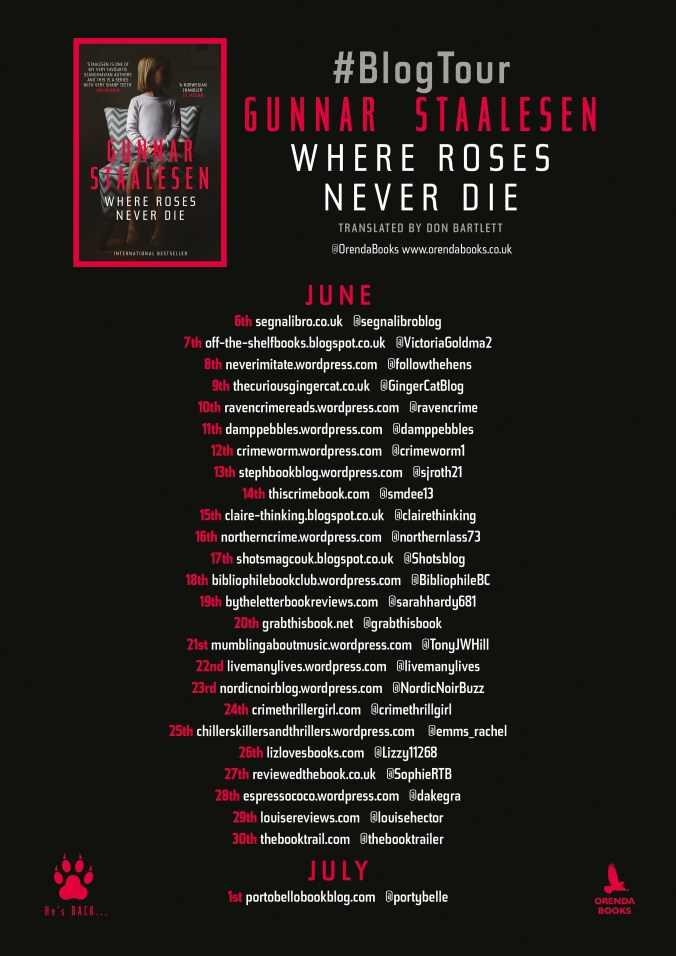
Where Roses Never Die

I’m going to come right out and say this at the start; Gunnar Staalesen is rapidly becoming one of my favourite writers and this is based purely on only the two Varg Veum books of his I’ve read – We Shall Inherit The Wind and, now, Where Roses Never Die.

With that in mind it was an absolute, relished delight to sit down at the start of May while away on holiday, overlooking a lake and armed with a fresh cup of coffee and no distractions (napping toddler), delve into Where Roses Never Die and another lesson in Nordic-Noir from the master.

IMG_9197In September 1977 a three-year-old girl, Mette Misvær is playing in the sandpit outside her home. When her mother, having been distracted, looks out the window to check on her daughter, Mette has disappeared. The tiny community – a model suburb – of Nordas is devastated. The police search everywhere but their enquiries produce nothing. Mette is never found.

Fast-forward almost 25 years and, as the statute of limitations approach, Mette’s mother approaches PI Varg Veum. She’s never been able to believe that her daughter is gone, the loss has haunted her and she’s desperate for answers. Veum is in no real shape to take a case, he’s still reeling from the aftermath of We Shall Inherit The Wind. But he takes the case – if only to rebuild his depleted bank balance – and begins to unravel a web of secrets and lies that lurk beneath the surface of a seemingly tranquil, idyllic little community.

As a parent the subject matter is a bit of an emotional punch as it plays directly into your worst fears (not the only book in Orenda’s stable to do so, I might add) but, having been writing Varg Veum novels since 1977, Staalesen knows how to navigate these waters and not let the reader drown and the energy and pull of Varg keeps it moving. It’s a haunting story and Staalesen plots it brilliantly, expertly bringing together seemingly unrelated events and characters into a revelation that’s an absolute shocker. That final revelation is a pretty dark one to say the least so I’m going to avoid going into plot for risk of giving anything away but, in the same way as the previous novel, the reveal here left me reeling. I can’t think of a more satisfying thing to get from a book than to be so genuinely floored by it.

Where Roses Never Die is superbly paced and with a story so intricately weaved together and with so many dark secrets pulled into the light you find yourself wondering what’s going on behind every drawn curtain. Characters are pulled from all shades of society and the moral spectrum and all believable – there are some for whose fate the reader can’t help but become invested in.

But these novels are more than gripping mysteries waiting to be unravelled, they’re glimpses into the life of one of Nordic-Noir’s greatest character’s; Varg Veum. If the ending of We Shall Inherit The Wind left the reader feeling battered then it sure as hell knocked Varg for six – he’s spent the years between “on the longest and darkest marathon” of his life . Veum is an immensely human and likeable character – he’s not always popular and very few are happy to see him twice but he’s driven by a sense of justice and finding out the truth, regardless of who’s feathers are ruffled. He, too, is, flawed – marked by a past and haunted his own mistakes. But even here, Staalesen’s mastery means that while there have been detectives nursing a battle with alcohol before it’s rarely so wonderfully evoked as within these pages:

Then I lifted the aquavit glass and drank deeply. For a second or two I had to close my eyes. I was sailing into a harbour I had left much too long ago, and on the quay stood people I hadn’t seen for years, who received me with cheering so quite that I could hear my pulse throbbing in my ears.

Staalesen’s prose is a master-class in efficiency, with minimal strokes he paints a complex plot that draws you into Veum’s world. Varg isn’t an all-action thriller detective, there’s no Reacher-style arms-behind-back fights here. No, Veum piece-by-piece pulls apart the web of lies, misdirection and secrets in his quest to discover what happened to Mette and as he slowly and methodically stalks the truth, so too does Staalesen’s prose until you’re immersed in a wonderful, enveloping narrative that holds you firmly in its grip until the final revelation – and long beyond finishing the last page too. More than just a personal favourite, Gunnar Staalesen is the absolute master of this genre and reading his work is a delight.

Translation is a tricky beast. It can make or break a book and Staalesen’s words are in very safe hands with Don Bartlett. With translations for Nesbo and Knausgaard to his name, Bartlett remains the translator of choice for Norwegian masters and his deft hand here ensures that Staalesen’s narrative and tone flows naturally.

There’s no question that if I were to put stars here there’d be five of them for Where Roses Never Die and, while we’re only just at the halfway mark for the year, it’s easily one of – if not the – best books of 2016.

I’m itching for more Varg Veum and will now (tbr pile allowing) make my way back through those available in English. Do get a hold of Where Roses Never Die – a big thank you to Karen at Orenda for mine – and check out the other stops on the blog tour.

Roses Never Die Blog tour