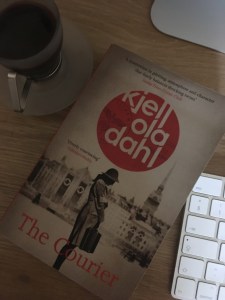
Book Review: The Courier by Kjell Ola Dahl

From the PR: “In 1942, Jewish courier Ester is betrayed, narrowly avoiding arrest by the Gestapo. In a great haste, she escapes to Sweden, saving herself. Her family in Oslo, however, is deported to Auschwitz.

In Stockholm, Ester meets the resistance hero, Gerhard Falkum, who has left his little daughter and fled both the Germans and allegations that he murdered his wife, Åse, who helped Ester get to Sweden. Their burgeoning relationship ends abruptly when Falkum dies in a fire.

And yet, twenty-five years later, Falkum shows up in Oslo. He wants to reconnect with his daughter. But where has he been, and what is the real reason for his return? Ester stumbles across information that forces her to look closely at her past, and to revisit her war-time training to stay alive…

Written with Dahl’s trademark characterization and elegant plotting, The Courier sees the hugely respected godfather of Nordic Noir at his best, as he takes on one of the most horrific periods of modern history, in a exceptional, shocking thriller.”

First read of 2019 and, while it’s really early days to be making such statements given we’ve just passed the halfway point of January; The Courier is going to take some beating in the best read of 2019 stakes.

An instant classic, The Courier contains everything I look for in a book – it’s set in WW2 and uses that time period’s underlying menace and drama, it’s got a deep, involved plot that spans across different periods in time, there’s mystery and espionage everywhere, it’s populated by great characters that you actually care about and it’s written in the formidable style of the master that is Kjell Ola Dahl. It almost feels like it was tailor made for my bookshelves.

There’s a great many well-read books  on WW2 in my library yet, aside from David Howarth’s We Die Alone (recommended if you’re after some non-fiction on the subject) and summaries in overview works, life in Norway during its occupation is an area I was fairly unaware of – certainly when you factor in the persecution of the country’s Jewish population at the hands of both Nazi intruder and Norway’s own collaborative government and STAPO. The Courier details this period in a manner that is both authoritative and realistic as a result of the author’s research / knowledge without being heavy handed in its portrayal and it’s that which makes it a great piece of historical fiction – as well as adding an additional level of underlying menace to the tension of the mystery in those chapters set in 1942.

What am I trying to say here? I’ve often toyed with setting a story against the backdrop of global conflict and the possibilities but it’s full of pitfalls. Using a period as well documented and broad as the Second World War can go either way – it takes a gifted writer to frame a story against such a vast backdrop and not throw the kitchen sink at it. For every Winter in Madrid or All The Light We Cannot See there’s a dozen City of Thieves –  that overdo it and try to hit try every emotional and historical touch point whether it’s relevant or not.

Kjell Ola Dahl is an exceptionally talented writer and manages to set a gripping story against a backdrop of global menace and terror that perfectly blends the historical with the thrill of fiction in an authoritative manner.  The Courier sits up there with my favourites of the historical fiction genre like Fatherland and Gorky Park and the aforementioned All The Light We Cannot See.

The Courier is peopled with characters that really hook you in and a mystery that will keep you glued until its, frankly, shocking reveal. Kjell Ola Dahl, best known for his Oslo Detectives novels, has here created a deep, slow-burning thriller that’s not only one of the best reads of the year but one of the best reads of the genre.

My thanks to Karen at Orenda Books for my copy – it really was right up my alley .

Turning Pages: 50 Great Reads

So we’ve entered that time of the year known as ‘List Season’.

I don’t think I can honestly drop a ‘Best of 2018’ list this year as I’ve only given a handful of new albums a real deep listen and most of my reads this year were not published in 2018 so it would be a case of shuffling those into an arbitrary order. Plus – who gives a flip.

However… an ALL TIME list… now that’s something that’s always worth sitting up and paying attention to in between wrapping up gifts and eating your own body weight in Christmas dinner, right?

Well, William over at a1000mistakes recently dropped two such lists – 50 Great Reads and a Top 50 Movies. I don’t think I could get a list of 50 films together but books… that I can do.

So, without further preamble, here are my 50 favourite books /reads in no order other than alphabetical – though if it’s in bold it’s in the Top 10. This is also limited to fiction or I’d have been here all day:

Wasted Morning – Gabriela Adameșteanu

How to Be Brave – Louise Beech 

Captain Corelli’s Mandolin-  Louis de Bernières

Birds Without Wings – Louis de Bernières

Heart of a Dog – Mikhail Bulgakov

The Master and Margarita – Mikhail Bulgakov*

Confessions – Jaume Cabré

The Moonstone – Wilkie Collins

White Noise – Don DeLillo

Crime and Punishment – Fyodor Dostoyevsky

LA Confidential – James Ellroy

Perfidia  – James Ellroy

Alone In Berlin – Hans Fallada

Iron Gustav – Hans Fallada

Birdsong – Sebastian Faulks 

Hell at the Breach – Tom Franklin

The Corrections – Jonathan Franzen

The Diary of a Nobody – George & Wheedon Grossmith

Epiphany Jones – Michael Grothaus

The Good Soldier Svejk – Jaroslav Hašek

Catch-22 – Joseph Heller

A Farewell to Arms – Ernest Hemmingway

Flowers for Algernon – Daniel Keyes

The President’s Last Love – Andrey Kurkov

Death and the Penguin – Andrey Kurkov

One Hundred Years of Solitude – Gabriel García Márquez

The Life of Pi – Yann Martell

Lolita – Vladimir Nabokov

Dr Zhivago – Boris Pasternak

Pyramids – Terry Pratchett

Men at Arms – Terry Pratchett

See You Tomorrow – Tore Renberg

The Little Prince – Antoine de Saint-Exupéry

For Two Thousand Years – Mihail Sebastian

Gorky Park – Martin Cruz Smith

Perfume – Patrick Süskind

One Day in the Life of Ivan Denisovich – Aleksandr Solzhenitsyn 

Where Roses Never Die – Gunnar Staalesen

Cannery Row – John Steinbeck

Pereira Maintains – Antonio Tabucchi

The Little Friend – Donna Tartt

A Fraction of the Whole – Steve Toltz

Jihadi: A Love Story – Yusuf Toropov

A Gentleman in Moscow – Amor Towles

The Man Who Died – Antti Tuomainen 

Journey to the Centre of the Earth – Jules Verne

Mother Night – Kurt Vonnegut

Slaughter House 5 – Kurt Vonnegut

Memoirs of Hadrian – Marguerite Yourcenar

The Shadow of the Wind – Carlos Ruiz Zafón

*Master and Margarita is, in all likelihood, my favourite read full stop. However, as with all translated fiction, finding the translation is crucial and can make or break a book. The Penguin edition published in 2006 with the blue cover is the best I’ve found and the fact that this was the version given to me as a gift by my wife one day in Oxford after she expressed disbelief that I’d not yet read it only helps ensure it’ll not be toppled from the top of this list.

Blog Tour: The Luckiest Thirteen by Brian W. Lavery

From the PR: “A true-life drama of an intense battle for survival on the high seas.

The Luckiest Thirteen is the story of an incredible two-day battle to save the super trawler St Finbarr, and of those who tried to rescue her heroic crew in surging, frozen seas.

It was also a backdrop for the powerful stories of families ashore, dumbstruck by fear and grief, as well as a love story of a teenage deckhand and his girl that ended with a heart-rending twist. From her hi-tech hold to her modern wheelhouse she was every inch the super ship the great hope for the future built to save the fleet at a record-breaking price but a heart-breaking cost.

On the thirteenth trip after her maiden voyage, the St Finbarr met with catastrophe off the Newfoundland coast. On Christmas Day 1966, twenty-five families in the northern English fishing port of Hull were thrown into a dreadful suspense not knowing if their loved ones were dead or alive after the disaster that befell The Perfect Trawler. Complete with 16 pages of dramatic and poignant photographs from the period.”

I’ve long held a fascination with the sea and am at my most relaxed when I’m by the water. Yet, as much as it has a calming effect on me and I’ve often looked at the small fishing boats in harbour bobbing up and down on the tide and fancied taking a go out to sea, the realities of the deep and the dangers of the sea outside of the safety of the harbour walls means there’s no real chance of my swapping my comfy desk-bound career for that of the life of the trawlerman –  especially the life of the deep-sea fishermen. Even with a lot of naval history in my family.

Yet, despite my interest, it’s not a subject I’ve read too much around so when I was offered the chance to review “a true-life drama of an intense battle for survival on the high seas” there was no chance I’d say no. I’d never heard of the St Finbarr or its fate but, then again – why would I? I was born over a decade after the fact and never really ventured further north than Coventry.

The Luckiest Thirteen is a startlingly vivid and detailed account of an oft-forgotten tragedy at sea – the fate of the St Finbarr and her crew and the devastating loss experienced by their families back in Hull. As laid out in cold hard fact in the opening pages: “On Christmas Day, 1966, a fireball explosion ripped through the super-modern Hull trawler St Finbarr in wild Arctic waters on Newfoundlands’ Grand Banks. Ten men from a crew of twenty-five died instantly. Two more perished in the subsequent desperate rescue bid”.

What makes The Luckiest Thirteen a strong addition to any bookshelf and so compelling is Laverly’s style. Non-fiction can prove a dry genre at times and even the most fascinating of subjects rendered somniferous by bad telling,  but Brian W. Lavery – who refers to this book as ‘creative non-fiction’ – combines an authoritative level of knowledge that can only come from dedicated research with the personal and human stories to create a heady mix.

It’s in the recreating of the crews personal stories, the lives they left – and in many cases never returned to – when they set out to sea in the St Finbarr that makes the events that befell the vessel so much more devastating. Laverly’s research and dedication to telling the stories of the people involved means The Luckiest Thirteen is more moving tribute than just plain fact.

I was gripped by the events as they unfolded on the St Finbarr and stunned by the speed at which everything went so spectacularly wrong – Laverly’s account is so detailed as to render events as if they were unfolding there and then rather than retold from decades-old memory. I had no idea just how perilously hard and near-impossible rescue from such situations is – the fact that two 1,000 tonne vessels could be thrown together by mountainous seas and thus unable to get close enough to each other for the ‘movie-style’ rescue imagined by those as previously clueless as I, for example – and, thus, how miraculous it was that so many were saved.

Yet perhaps most affecting of all is the impact the events had on those that survived. They were all left scarred in some way and the story of Walt Collier, in particular, has stayed with me long after finishing the book.

A thoroughly informative and yet uniquely personal and moving book, The Luckiest Thirteen is both gripping and highly recommended . My thanks to Anne Cater for my copy and inviting me to take part on this blogtour.

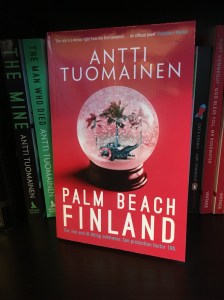
Blog Tour: Palm Beach, Finland by Antti Tuomainen

From the PR: “Sex, lies and ill-fitting swimwear … Sun Protection Factor 100

Jan Nyman, the ace detective of the covert operations unit of the National Central Police, is sent to a sleepy seaside town to investigate a mysterious death. Nyman arrives in the town dominated by a bizarre holiday village – the ‘hottest beach in Finland’.

The suspect: Olivia Koski, who has only recently returned to her old hometown. The mission: find out what happened, by any means necessary. With a nod to Fargo, and dark noir, Palm Beach, Finland is both a page-turning thriller and a black comedy about lust for money, fleeing dreams and people struggling at turning points in their lives – chasing their fantasies regardless of reason.”

I’m gonna put my hands up at the start; It’s tricky to write this review. Not because I have any issue with the book but, in a style that wouldn’t be at all out of place in Palm Beach, Finland, I managed to misjudge the alignment of saw blade and protector and put some deep new grooves into the the tips of fingers and thumb of my right  hand. As such typing is a little hit and miss so you’ll have to excuse any typos I miss while editing.

Palm Beach, Finland is a ridiculously good book. Combining dark and slapstick humour with a bit of Scandinavian Noir for what is easily one of my favourite reads of the year -much as The Man Who Died was one of last year’s top five reads.

It’s kind of like a whodunnit in reverse, really. We, as readers, learn both the motive and guilty parties within the opening pages. The fact of the matter is, though, that the murder and circumstance are so bizarre that the rest of the town – and the National Central Police – can’t solve the case and the rest of the novel follows their exploits in doing so. Oh and the continued exploits of the guilty parties as, in their efforts to carry out the simplest of crimes, only cause further hilarity and confusion. It also helps that the victim of the murder is revealed, in retrospect, to have been every bit as hapless as his accidental killers.

Such an approach could make for a very quick story but Tuomainen keeps things interesting by throwing in a burgeoning, albeit every bit as hilariously clumsy as the crime, romance and another far more dangerous character who’s trying to get to the bottom of the murder; the victim’s brother. Who happens to be a professional hit man.

Tuomainen is clearly an author who knows how to write characters. This is the third of his novels I’ve had the pleasure to read and each has been populated with characters that convince and ring true. That he peoples Palm Beach, Finland with characters so earthed in reality – including the failed rock-star dreams of Chico to Jorma Leivo’s desperate hatred of humidity that drives him to create the most absurd of holiday resorts – makes it all the more brilliant and its humour even more darkly delicious.

The book is also dripping with fantastic secondary characters each with their moments of hilarity. My favourite, though is Nyman’s boss – Muurla. Every scene with Muurla made it tricky for me to contain my laughter and the story – to which Nyman pays zero attention – that ended with “The toilet door is ajar too. Teija is in there. She’s got short cropped hair and there she is having a piss standing up. I leave the box of chocolates on the table and wander off into the Old Town in Stockholm. Charming place, lots of history and good food” cost me a mouthful of good coffee.

A big crime in a small town and, in the case of some of the characters, small minds. Palm Beach, Finland is every bit as funny and obscure as the holiday resort around which the plot revolves. Absurd, hilarious and thoroughly compelling, Antti Tuomainen has given us another fantastic slice of Finnish fiction that should be at home on as many book shelves as possible. It also deals very heavily in Bruce Springsteen references which is always going to get a thumbs up from this reader.

My thanks, always, to Karen at Orenda Books for my copy and Anne Cater for inviting me to take part on this blogtour.

Blog Tour: Trap by Lilja Sigurdardottir

From the PR: “Happily settled in Florida, Sonja believes she’s finally escaped the trap set by unscrupulous drug lords. But when her son Tomas is taken, she’s back to square one … and Iceland.

Her lover, Agla, is awaiting sentencing for financial misconduct after the banking crash, and Sonja refuses to see her. And that’s not all … Agla owes money to some extremely powerful men, and they’ll stop at nothing to get it back.

With her former nemesis, customs officer Bragi, on her side, Sonja puts her own plan into motion, to bring down the drug barons and her scheming ex-husband, and get Tomas back safely. But things aren’t as straightforward as they seem, and Sonja finds herself caught in the centre of a trap that will put all of their lives at risk…

Set in a Reykjavík still covered in the dust of the Eyjafjallajökull volcanic eruption, and with a dark, fast-paced and chilling plot and intriguing characters, Trap is an outstandingly original and sexy Nordic crime thriller, from one of the most exciting new names in crime fiction.”

OK: once again I’m at the point of wondering how the hell to review a book without giving away any spoilers. I’ll start at the beginning – the beginning of the trilogy of which Trap is the second part, that is. Last year’s Snare was a thoroughly clever thriller that managed to mix a fiendishly complex web of subplots with a real  emotional punch thanks to a cast of characters that made you question the lines between ‘right’ and ‘wrong’. Trap takes everything that was great about Snare – which was plenty – and ratchets it up a level… or five.

While Snare was definitely a compelling read, it was very much a laying of foundations and, as such, reading it is kind of a perquisite for fully understanding Trap as it’s here that everything really kicks off and in the second installment in Lilja Sigurdardottir’s Reykjavik Noir Trilogy it’s on from the word go and doesn’t let up until the last page. Hugely compelling and addictive (I spent many a late night glue to this one), Trap does not pull any punches and blends the tenderness of its characters’ emotional motivations with the brutal reality of the world of drug smuggling to staggering affect. Throw in the white-collar crimes and corruption of the Icelandic financial crash and you’ve got a real page-turner on your hands that delivers on all levels.

Lilja Sigurdardottir has a real talent and manages to weave some fantastically complex plots together without losing any of the momentum and populates them with characters so well written as to generate a genuine emotional investment in them from the reader – especially, of course, when it comes to Sonja and Tomas. Which was an odd one for me as for the vast majority of Snare I found it hard to develop any sympathy for her given her actions. Again I’m really trying not to give anything away but  as the plot of this trilogy deepens and increasing levels of deception and back stabbing are revealed along with the reality of other characters’ actions and just how much of a, pardon the pun, trap Sonja was lead into,  it’s impossible not to get hooked and caught up in the web of lies and emotional manipulation. And as for Bragi and his motivations… well, it’s a need to read.

Trap is a powerful follow-up to Snare and I’m really looking forward to the final chapter of the trilogy.  My thanks as always to Orenda Books for my copy and to Anne Cater for inviting me to take part in this blogtour.

Book Review: Dear Mr Pop Star by Derek & Dave Philpott

From the PR: “For more than a decade, Derek Philpott and his son, Dave, have been writing deliberately deranged letters to pop stars from the 1960s to the 90s to take issue with the lyrics of some of their best-known songs. They miss the point as often as they hit it.

But then, to their great surprise, the pop stars started writing back…

Dear Mr Pop Star contains 100 of Derek and Dave’s greatest hits, including correspondence with Katrina and the Waves, Tears for Fears, Squeeze, The Housemartins, Suzi Quatro, Devo, Deep Purple, Nik Kershaw, T’Pau, Human League, Eurythmics, Wang Chung, EMF, Mott the Hoople, Heaven 17, Jesus Jones, Johnny Hates Jazz, Carter the Unstoppable Sex Machine, Chesney Hawkes and many, many more.”

Derek Philpott – and his son Dave – have clearly got too much time on their hands. Let’s face it: who hasn’t listened to a song with a questionable lyric or message and wanted to ask, say, just how much of Summer of ’69 was feasible given that Mr Adams would only have been 9 years old at the time. But it’s not like any of us have actually taken the time to take any pop stars to task on the matter.

Well, Derek and Dave Philpott have taken the time to do so. Obviously not all of them have responded but many did.

In amongst the sarcastic “thank you for your observation” openers – like Carol Decker’s “I recently found your letter. It had got lost in the substantial
fan mail I still receive along with requests for my underwear” –  there are some exceedingly funny and genuinely interesting responses from the artists ‘Mr Philpott’ writes too. Take the fact the response from Mott the Hoople’s Verden Allen as an example in which he responds to the request to “clarify how, oh, man, you may question the need for TV when you got T.Rex.” – its nothing to do with Marc Bolan.

Of course, it’s not just the letters back from the musicians that make for great reading but – questions surrounding the lyrics and songs aside – the letters from Messrs Philpott are bloody funny too with many an obscure and surreal story causing a good coffee splutter. And, in that way, Dear Mr Pop Star makes for an ideal coffee table book for anyone who loves either a good laugh or music and especially both.

My thanks to the authors – whoever they may really be – for taking the time out from questioning Del Amitri to ask me to read their book, I thoroughly enjoyed it.

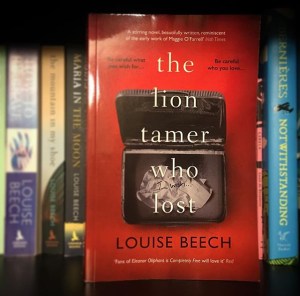
Book Review: The Lion Tamer Who Lost by Louise Beech

From the PR: “Be careful what you wish for…  Long ago, Andrew made a childhood wish, and kept it in a silver box. When it finally comes true, he wishes he hadn’t… Long ago, Ben made a promise and he had a dream: to travel to Africa to volunteer at a lion reserve.

When he finally makes it, it isn’t for the reasons he imagined… Ben and Andrew keep meeting in unexpected places, and the intense relationship that develops seems to be guided by fate. Or is it? What if the very thing that draws them together is tainted by past secrets that threaten everything?

A dark, consuming drama that shifts from Zimbabwe to England, and then back into the past, The Lion Tamer Who Lost is also a devastatingly beautiful love story, with a tragic heart…”

Hmmm… once again I find myself sitting here wondering how to review a book and how to review one as enjoyable and brilliantly written as The Lion Tamer Who Lost without giving away any spoilers.

I think I’ll start by saying that Louise Beech is a sod. I’ve used the analogy before but reading one of Louise’s novels is akin to watching a Pixar film: you know (or you bloody well should by now) that there’s gonna be an emotional punch to the gut coming up and you start with your guard up but she’s so good at pulling you into the story and the characters that you’re so immersed in it that you forget and then it really flaws you. Only this time she does it twice!!

This is not a bad thing. In fact, there is not a single bad thing about The Lion Tamer Who Lost. I thoroughly enjoyed every page and, once again, Louise Beech refuses to shy away from subject matters that other writers may fear to touch.

For a non-thriller (I have no idea what ‘genre’ most novels are these days nor do I care to) there’s a huge amount of mystery and suspense in The Lion Tamer Who Lost and it really keeps you gripped  – from the moment it’s hinted at – “He came here for the now. For this. He surveys again the new and beautiful land. Every day, every moment, he tries to hard not to think about…” – in the opening pages it’s a case of “what? what is it???” and a real desire to find out exactly what Ben escaped in England even as you’re drawn into the ongoing drama unfolding in Zimbabwe.

As to how Louise Beech reveals ‘it’… it’s clear she’s really hit her stride as a writer now. The narrative ducks and dives between moments of drama and revelation in the past and present and across different character voices as fragments become whole and viewpoints become fully rounded and the whole story is woven masterfully together.

Oh and it’s bloody funny too and charming and warm throughout, written with real attention to character detail and little nuances that make these more than just entries on a page (or Kindle or whatever you substitute print, binding and bookshops for 😉 ) and really helps you get pulled in to the story and root for a positive outcome for them – lookout: here comes that Pixar Punch from Mrs Beach!

Put simply, The Lion Tamer Who Lost is a bloody brilliant, absorbing and compelling read that will knock you sideways with its emotional honesty and power. I genuinely look forward to the next novel from Louise.

My thanks, as always, to Karen at Orenda Books – a purveyor  of nothing but the finest fiction – for my copy.

Pages turning, 2018 Part Deux

It’s been a while since I put one of these review wrap ups together. To be honest I’ve barely read anything. I’ve been so busy watching the E! Network, protesting against the EU and for a hard Brex… nah I can’t. I’ve read a shite load this year. We’re halfway through the year and I’m pretty much on track to complete the (not seriously so) challenge I set of 40 books again.

Given that it’s been a while since I’ve done a wrap-up of my recent reads this is something of a ‘bumper’ edition, grab a coffee….

Forest of the Hanged by Liviu Rebreanu. was gifted to me by my wife and is a book I read in two hits: I needed to take a break as the first half was very intense and perhaps caught me at the wrong time… an echo of the black dog means I’m not always able to process books that deal with certain themes. However, once I got back to it I was hooked. Liviu Rebreanu based, at least partly, this First World War novel on the experience of his brother who was an officer in the Austro-Hungarian Army but was hanged for espionage and desertion in 1917. What starts as a very heavy exploration of a reaction to death becomes an insanely good exploration on the themes of identity, faith and, of course, how ordinary people change in the face of the extraordinary.A

At the start of the year I read Gorky Park by Martin Cruz Smith and loved every page. I was keen to read more of his Arkady novels but, for some reason, they don’t seem as readily available – at least not the second, Polar Star, and I don’t want to read out of sequence. But The Girl From Venice is a ‘stand alone’ novel from Martin Cruz Smith that seemed right up my alley: a tense, literary thriller set in the Second World War as the German army pulls out of Italy? Sign me up. This is a great little novel – I say ‘little’, it’s about 300 pages depending on your format but I powered through this – that’s definitely worth a read.

Håkan Nesser was among the first ‘nordic noir’ authors I read, a few years ago now, and The Inspector and the Silence is only the second of his that I’ve read – though, in sequence, it places before the only other in the Van Veeteren series, The Unlucky Lottery. That’s not because I didn’t enjoy that novel – far from it – more a case that Nesser’s novels don’t seem to be as widely distributed, nor do they pop up so often in the used book stores whose shelves I rummage. A little of a tougher and more disturbing subject matter sits at the heart of the deceptively calm The Inspector and the Silence than my previous outing with Van Veeteren (who barely appeared in The Unlucky Lotter) yet there’s something compelling and satisfying about reading these slower-paced and intricately plotted thrillers – much like the work of Gunnar Staalesen – that means I do need to keep an eye out for more by Nesser. Thankfully, I’ve got one sitting on my shelf waiting its turn.

Of course, when it comes to complex and intricately plotted beasts, there’s nothing like a slab of James Ellroy. Thankfully it’s been so long since I saw the film that the entire plot of L.A Confidential was new to me when I picked up the novel – I’m trying to make my way through Ellroy’s works in semi-order with the L.A Quartet then the Underworld USA trilogy, hopefully before the next in his Second L.A Quartet, This Storm, is published in paperback. There really is nobody that can write anything as hard-hitting, absorbing and thorough as Ellroy. There was a point, about a third of the way in that I was still inclined to think that The Big Nowhere had a couple of inches on this one but then it kicked up a notch – and that’s the thing about Ellroy, he writes these massive novels that keep ratcheting it up and blowing everything wide open when other authors would be looking to stitch it all up for conclusion. This series keeps getting better, on to White Jazz.

Of course; I don’t only read books that are part of a series, but… while we’re on the subject of crime novels and series that keep getting better…  I’m now almost up to date with the Jo Nesbo’s Harry Hole series (I think he took a few years off) having also demolished Police. While it’s often considered in line with the airport boilers, Nesbo’s writing and, in particular, the Harry Hole series has been continually evolving and moving in broader strokes with every novel – bringing in political turpitude, social commentary and further-reaching character arcs along into each ‘stand alone’ novel in the series.

I’m also continuing to grow my Terry Pratchett collection and re-read the Discworld series, with recent additions Wyrd Sisters and Jingo having scratched that itch in the best way possible.

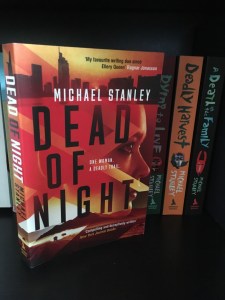
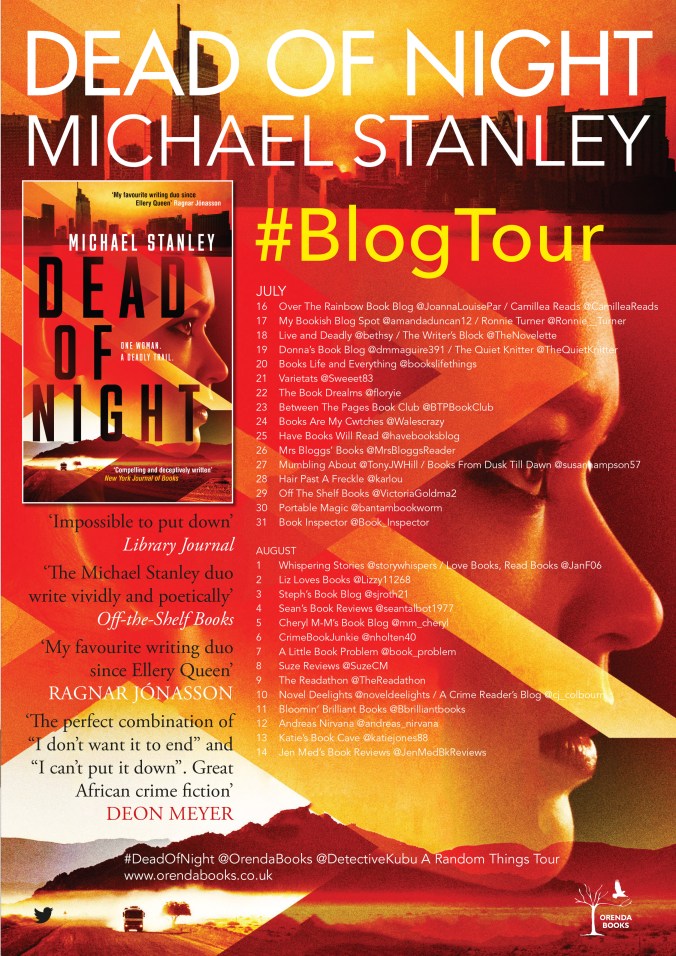
Blog Tour: Dead of Night by Michael Stanley

From the PR: “When freelance journalist, Crystal Nguyen, heads to South Africa, she thinks she’ll be researching an article on rhino-horn smuggling for National Geographic, but within a week she’s been hunting poachers, hunted by their bosses, and then arrested in connection with a murder. And everyone is after a briefcase full of money that she doesn’t want, but can’t get rid of…

Fleeing South Africa, she goes undercover in Vietnam, trying to discover the truth before she’s exposed by the local mafia. Discovering the plot behind the money is only half the battle. Now she must convince the South African authorities to take action before it’s too late, both for the rhinos and for her. She has a powerful story to tell, if she survives long enough to tell it…

Fast-paced, relevant and chilling, Dead of Night is a stunning new thriller from Michael Stanley, author of the award-winning Detective Kubu series, introducing an intriguing new protagonist, while exposing one of the most vicious conflicts on the African continent…”

This is not the novel I was expecting when I ripped open the padded envelope and found the new Michael Stanley (writing team of Michael Sears and Stanley Trollip) book inside. For, you see, Michael Stanley are the authors behind Detective Kubu – one of my favourite characters – and I was honestly expecting another in that series.

In a recent guest post on Have Books Will Read as part of this blogtour, the authors explained that the “features that make a series rich – the history and backstory of the main character – also constrain what one can do and where one can go…. We wanted to try something different – a different style of book with a completely different protagonist.”

So, what about Dead of Night? Well, put simply, it’s fucking awesome. It’s a hard-hitting, thoroughly engrossing thriller that rips along at a pace and rhythm completely different to the aforementioned Kubu series and demonstrates just how talented a writing team and adept at different writing styles messers Sears and Trollip are.

The novel’s protagonist, Crystal Nguyen – or Crys – makes for a compelling lead – tough and determined yet vulnerable and relatable. The story is one of my favourite of the year so far – what starts of as a search for a missing journalist and a story on rhino poaching soon becomes a fast paced thriller that delves into political corruption, social issues in South Africa and human morality with a volley of fast-paced and occasionally brutal action scenes.

The levels of complexity and connections in the plot and the fact that such a strong story is rooted in a very real and believable situation make for a real page turner. For me, it’s that combination of fact – rhino hunting and the fight against the poachers is a very violent and deadly fight – and, strong, engrossing fiction that ensures that Dead of Night is compelling and lends it some real clout.

I thoroughly recommend Dead of Night – thanks again to Orenda for my copy and to Anne Cater for inviting me to take part in this blogtour, check out the other stops below.


Blog Tour: Big Sister by Gunnar Staalesen

From the PR: “PI Varg Veum receives a surprise visit in his office from a woman who introduces herself as his half-sister, and she has a job for him. Her god-daughter, a nineteen-year-old trainee nurse from Haugesund, moved from her bedsit in Bergen two weeks ago. Since then no one has heard anything from her. She didn’t leave an address. She doesn’t answer her phone. And the police refuse to take her case seriously.

Veum’s investigation uncovers a series of carefully covered-up crimes and pent-up hatreds, and the trail leads to a gang of extreme bikers and to a shadowy group, whose dark actions are hidden by the anonymity of the Internet. And then things get personal…

Chilling, shocking and exceptionally gripping, Big Sister reaffirms Gunnar Staalesen as one of the world’s foremost thriller writers.”

When it comes to reading there is no greater pleasure than getting stuck into a new Gunnar Staalesen book.

The problem, mind, is how to review a book like Big Sister without a) simply repeating ‘amazing’ emphatically and b) giving anything away. So I’ll talk, in general terms, about just how much I loved this book.

There is something just so fantastically absorbing about Staalesen’s work that I’m always longing to read more. To me it’s like enjoying a good mug full of coffee, you have to take your time with it and savour every moment before you get the kick. It’s not a fast-paced thriller; Staalesen’s prose is a much calmer affair that lures you in and immerses you in its mystery. A real slow-build but with not a single spare word – it’s the writing of a master at play, really. Richly detailed yet concise, tightly-plotted fiction that effortlessly packs more punch and weight than novels three times its page count.

One of the things I really enjoy about Staalesen’s narrative style is the way in which he – and Veum – casts a wide net out at the start of the story and slowly hauls it in, revealing little ideas and avenues of intrigue, some which lead nowhere but others which lead off into some fascinating places before Veum discovers the particular line of investigation which brings them together and solves the case. As Veum himself says: “when I stumble over some peripheral information during a case, an investigation I’m doing, my experience is that it might well end up having some significance.”

Big Sister is no exception to this – some of the leads he follows reveal some really dark stuff this time round, mind (though anyone familiar with the last three novels would argue that that’s nothing new), but it all slowly and deliberately creates a huge web of connections between the lives of the characters that manages to show just how far-reaching and devastating events that were thought long-since buried can become. It means that when the truth is realised it hits you like a tonne of bricks.

Reading a new Staalesen novel is like catching up with an old friend, getting a glimpse into Varg’s life for a few weeks at a time to see how life is treating Bergen’s almost-only PI. Veum is a refreshingly human character in the genre, flawed (though I don’t think he touched a drop of aquavit in this one) and – particularly as his age advances – vulnerable. It’s impossible not to root for him. It’s great that Big Sister really managed – as the 18th novel in the series – to reveal something new about such an established character and his past and I thoroughly look forward to seeing if that particular thread is picked up on in the next book.

It’s impossible to do a novel like Big Sister justice in a review. I fucking loved it but, then, I’ve loved every novel I’ve read thus far by Staalesen and I really need to get my hands on those novels pre We Shall Inherit The Wind that have been translated into English too. Every time I think I’ve read the best book I will in a year, Orenda drops a new Gunnar Staalesen that jumps straight to the top of the list. As such, my thanks to Karen at Orenda both for my copy and continuing to publish such wonderful fiction and to Anne for inviting me to take part in this blogtour. Always a pleasure, never a chore 😀