Blog Tour: The Louisiana Republic by Maxim Jakubowski

From the PR: “New York, and the world, have been transformed by an unexplained global catastrophe now known as ‘the Dark’.

Once a modest researcher, (don’t recall if I gave character an actual name; if so, please insert) has now become an involuntary detective.

When he is recruited by her elder sister to find the missing daughter of a local gangster in a city in chaos where anarchy and violence are just a step away, he soon discovers the case is anything but straightforward and compellingly close to home.

Compromising photographs and the ambiguous assistance of a young woman with ties to the criminal gangs lead him to New Orleans, which has seceded from the rest of America in the wake of the Dark.

A perilous journey down the Mississippi river, murderous hit women and sidekicks, and the magic and dangerous glamour of the French Quarter become a perilous road to nowhere and to madness in his quest for the amoral daughter, his own lost love and his sanity.

Will he find the missing women or lose himself?”

Crikey. Where to start with a review on this one.. perhaps I should proffer up the ‘warning’ that accompanied the description of The Louisiana Republic when I was invited to read and review it:

“Please be aware! The novel is quite ‘harsh’ and should be avoided if you are more into the ‘cozy’ area. If you enjoyed Epiphany Jones by Michael Grothaus, this may be for you! There are strong erotic elements”

Now initially I only got as far as ‘if you enjoyed Epiphany Jones‘ before replying in the positive. I loved that book and I love a book that challenges and takes me out of my comfort zone so I was, of course, interested – it wasn’t the ‘erotic elements’ that got me. Especially when I read the note from the author that he “published 10 novels under a pen name in another genre during the last five years, many of which ended up on the Sunday Times Top 10, but under a female pseudonym (as imposed on the publishers by supermarkets and chains!), so this book is quite important to me, and have a lot to say about it.”

So: does The Louisiana Republic deliver such an intriguing sell? In short: yes, very much so.

In not so short: oh, fuck yes! The Louisiana Republic is a massively addictive book which delivers on so many levels. While there is certainly some heavy and strong stuff in here that would warrant a ‘not for the weak of knee’ it’s not there for shock factor alone and  serves to add both punch and horror in all the right places.

The story itself is set to a familiar narrative – a PI on the search for an elusive truth if only for self-satisfaction – yet Jakubowski throws in plenty of twists and counters to keep you glued as it becomes increasingly complex and multifaceted. There are so many different elements at play that it’s a real delight as things start to come together. In fact I’d go so far as to say that the ploy of using a familiar trope is a very clever sleight of hand on the writer’s part, for what really sets The Louisiana Republic apart and makes it so compelling is setting just that trope against a backdrop as jarring as that created by ‘the Dark’.

Jakubowski’s portrayal of a dystopian near-future, a decade after  the world had been deprived of technology, the internet and electronic data is fantastic. There’s no didactic, heavy-handed or soap-opera style explanations, The Louisiana Republic pulls you into its world and gradually reveals a very realistic, convincing and shocking world where, post-technology, society has nearly (that’s what makes it so believable, I think – the blending of the retained ‘norms’ with the dystopian) broken down – cities divided into different fiefdoms, violence and primitive, base urges satisfied at whim.

It would be impossible to pigeonhole The Louisiana Republic into one genre – it’s got elements of noir, there’s some hard-boiled Chandler-esque grit, deliciously dark humour, plenty of and some mysticism that made me think of Eliade and then there’s the dystopian future element thrown in to add more to the mi along with plenty of boxes ticked in the ‘thriller’ category…. so; shocking thriller? urban noir? dark comedy? dystopian road trip novel?  Brutal gut-punch commentary? It’s all of these and it’s very very bloody good.

My thanks to Anne Cater for inviting me take part in this blogtour and for my copy of The Louisiana Republic – published by Caffeine Nights.

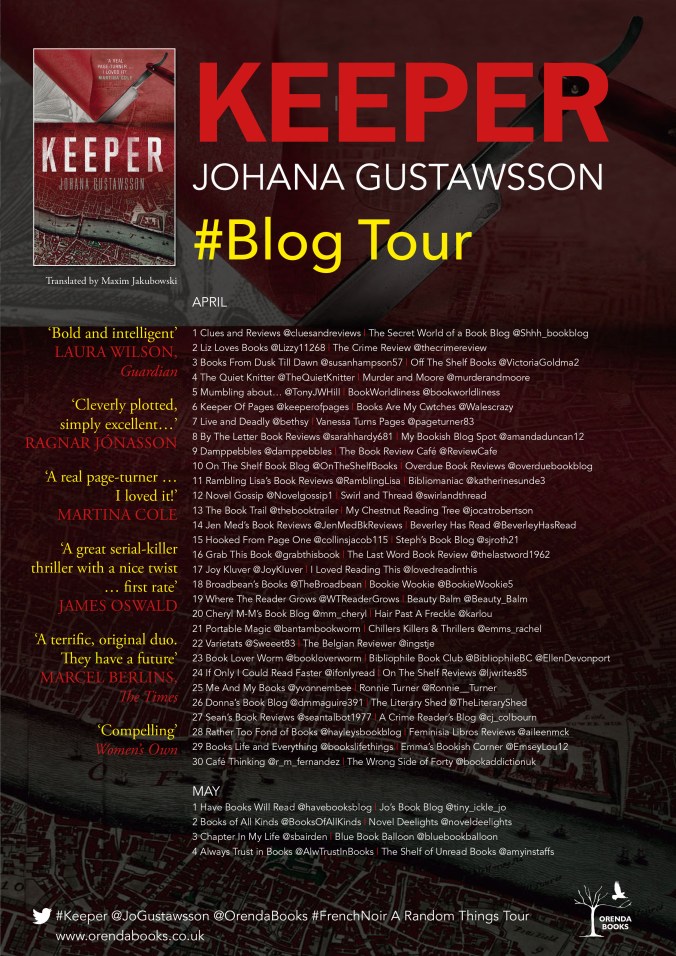
Blog Tour: Keeper by Johana Gustawsson

From the PR: Whitechapel, 1888: London is bowed under Jack the Ripper’s reign of terror.

London 2015: actress Julianne Bell is abducted in a case similar to the terrible Tower Hamlets murders of some ten years earlier, and harking back to the Ripper killings of a century before.

Falkenberg, Sweden, 2015: a woman’s body is found mutilated in a forest, her wounds identical to those of the Tower Hamlets victims. With the man arrested for the Tower Hamlets crimes already locked up, do the new killings mean he has a dangerous accomplice, or is a copy-cat serial killer on the loose?

Profiler Emily Roy and true-crime writer Alexis Castells again find themselves drawn into an intriguing case, with personal links that turn their world upside down. Following the highly acclaimed Block 46 and guaranteed to disturb and enthral, Keeper is a breathless thriller from the new queen of French Noir.”

Blimey: I don’t think I’ve read a book as quickly as I read Keeper. This review is probably as fresh as it gets from turning the final page to hitting ‘new post’. So let’s see if I can stop saying “holy shit” to myself over an ending I did not see coming enough to start this review properly. Where to start….

Let’s start with last year. More specifically, Keeper‘s predecessor Block 46. It’s one of those books that stays with you long after turning the final page – it really left me contemplating the nature of evil and just how dark humanity can get. It was also bloody good. Otherwise it wouldn’t have a) stayed in my mind of so long and b) made me so keen to read Keeper when the opportunity arose.

Keeper find us back with the Roy and Castells and many of the ‘supporting’ cast of Block 46 but turns everything up a notch or twenty as Johana Gustawsson has clearly hit her stride with the characters and can really let things loose. Rather than just a follow-up Keeper feels like a real evolution for both characters and writer and I get the distinctly satisfying feeling that I’m in on the ground floor at the beginning of what will hopefully be a very long and fulfilling series.

As with Block 46Keeper combines past and present – in this instance the Jack The Ripper murders form the grisly historical pull – and it’s this blurring of known fact with fictional which makes Keeper so thoroughly gripping and raises it above the standard thriller fare. The odd thing is that this is an area of crime / history which – thanks to a random song – I’ve recently been fascinated by and exploring (timing, eh?)… the crimes themselves, the myriad of suspects and possibilities and the ‘letters’ from the Ripper that did the rounds. Keeper details the Whitechapel murders and the period in a way that’s both accurate enough to be convincing yet fresh and vital enough to keep the reader hooked.

Keeper is also not for the faint of heart. Johana Gustawsson writes with an absorbing prose and her pacing is so perfectly poised that there’s no chance of not being lured in  – and credit goes to translator Maxim Jakubowski as this book flows so perfectly you’d never know it was translated – so that when those revelations and shockers come they really hit hard.

Gustawsson has a really great knack for setting out her pieces early in the game, setting different, seemingly unrelated, narratives in motion across disparate locations and time and slowly, methodically, expertly weaving them together in a compellingly complex and taught plot that’s massively addictive and, once again, thought provoking. Keeper is a superbly written novel with great characters, a brilliantly conceived and delivered plot and more than enough to keep you thinking and hooked.

I thoroughly enjoyed and recommend Keeper – published by Orenda Books – and my thanks again to Karen and Anne for my copy and inviting me to take part on this blogtour, do check out the other stops.

Blog Tour: The Ice Swimmer by Kjell Ola Dahl – Guest Post

Like any avid reader and devourer of the written word I carry a continually evolving ‘wish list’ with me (it’s on my phone) to refer to whenever I find myself in a bookshop. At the top of that list are a couple of authors represented by name only. These are authors where it’s a case of wanting to get hold of anything they’ve written.

Kjell Ola Dahl is amongst those authors. He’s one of the godfathers of the Nordic Noir genre and since I was introduced to his Oslo Detectives series with last year’s Faithless I’ve been anxious to read my way though his back catalogue. This year’s The Ice Swimmer (review to follow) is another ridiculously good installment in the series – absorbing and masterfully written.

As such I’m delighted, as part of the blogtour for The Ice Swimmer (out on ebook now and paperback April 30th via the wonderful Orenda Books) to host a guest post from the author himself. So I’ll shut up and get out of the way…


My first novel was a police procedural, and I didn’t reflect much on the implications of this choice at that time. I was inspired by writers like Ed McBain, who wrote about Steve Carella and a collective of police officers solving crimes in the 87th precinct in a fictive city called Isola. One thing I liked about those books was that McBain wrote about the full collective. The readers got to know many of the police officers. And when McBain changed the main protagonist in some books, Steve Carella was always there, although not always at the front of the action. McBain even chose criminals for protagonists in some of his books.

After publishing Lethal Investments I did not stay with my police officers, and I went on to write other things. The second book in the Oslo Detectives series was published years after the first one. But then I said to myself, you cannot stop at two: A trilogy is the thing. So I was quick this time and published the third book in the series a year later. But after that novel – The Man in the Window – I returned to my old sins, writing other things.

This year in Norway, I will publish the ninth book in the Oslo detectives series. I still write other things in between – fiction, non-fiction, short stories, crime fiction – and I always write under my own name. Ed McBain used a lot of pseudonyms: Richard Marsten, Hunt Collins, Curt Cannon, Ezra Hannon and more, and not one of these names was his own! Privately he called himself Evan Hunter. And even the name Evan Hunter was a pseudonym: his Christian name was Salvatore Albert Lombino. It is like one of those Russian dolls. Inside every name, new ones would pop up. I guess Mr Hunter/Lombino himself had some sort of system for the use of names. His production was huge.

The use of pseudonyms is a widespread habit among writers – especially writers of crime fiction. Even Georges Simenon used a lot of them. And the truth is, I don’t really understand why.

Many of my fellow writers use their series to explore their one and only protagonist. I stick to the method of Ed McBain. I explore my collective. The protagonist in the Ice Swimmer is Lena Stigersand, a female police officer in her mid-thirties. She was not present in the first book in the series, and first appeared with minor roles in the two novels previous to the Ice Swimmer. Even if she is the protagonist in The Ice Swimmer, there is one super protagonist in the series – Mr Gunnarstranda. In fact, everything in the series rotates around him, and he has developed over the years. He is no longer as grumpy as he was in the first book. And these days he is more into jazz music than he was to begin with. I think it is because I know him better now. But he is still a widower. And he still doesn’t have a first name. That is a fact. I have never dared to suggest a first name for him. I fear he won’t like my suggestions very much. Personally, I think that shows how strong he is as a character. He is still mysterious to me, which means that he will still be able to surprise me. It also tells me that I will write more about him. I am still curious about his whereabouts and especially curious about his first name. But I doubt I will ever find out what it is.


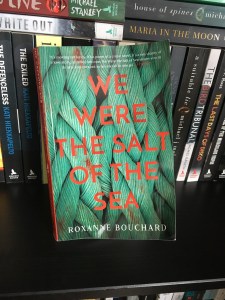
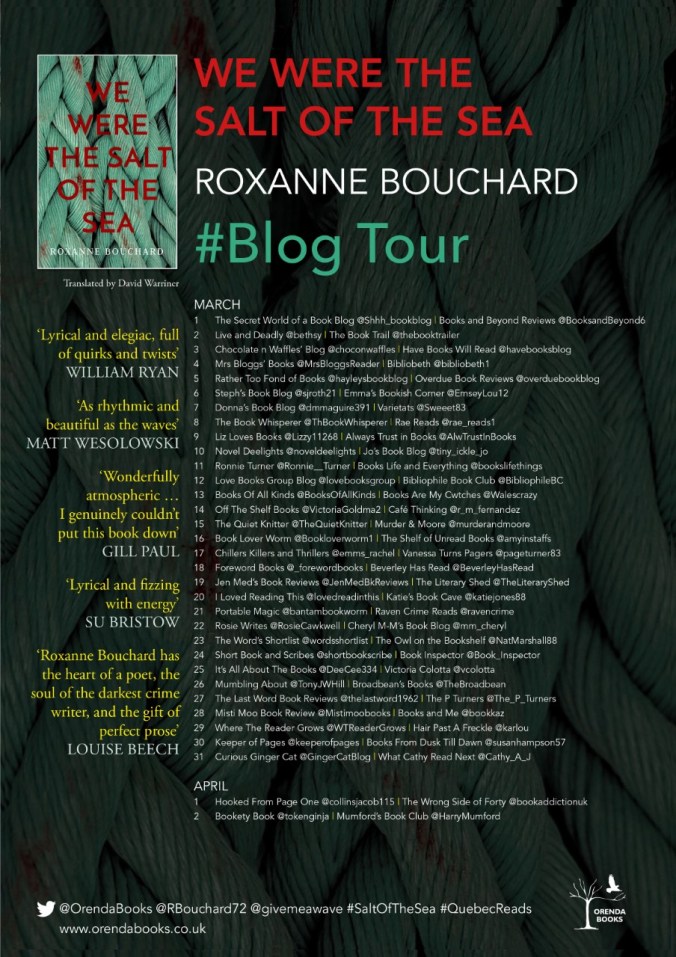
Blog Tour: We Were the Salt of the Sea by Roxanne Bouchard

From the PR: “As Montrealer Catherine Day sets foot in a remote fishing village and starts asking around about her birth mother, the body of a woman dredges up in a fisherman’s nets. Not just any woman, though: Marie Garant, an elusive, nomadic sailor and unbridled beauty who once tied many a man’s heart in knots. Detective Sergeant Joaquin Morales, newly drafted to the area from the suburbs of Montreal, barely has time to unpack his suitcase before he’s thrown into the deep end of the investigation.

On Quebec’s outlying Gaspé Peninsula, the truth can be slippery, especially down on the fishermen’s wharves. Interviews drift into idle chit-chat, evidence floats off with the tide and the truth lingers in murky waters. It’s enough to make DS Morales reach straight for a large whisky… ”

When I was sent the above description for We Were the Salt of the Sea (big thanks to Anne Cater) and asked if I’d like to take part in the blog tour, I leapt at the chance. There was something about it – aside from it having the unimpeachable Orenda logo on its spine – that suggested I’d love it.

So, let’s cut to the chase: did I love it? Oh hell yes! We Were the Salt of the Sea is an absolute, slow-burning masterpiece. A thoroughly absorbing and mesmerising read that draws you into both its story and setting and leaves you wanting to linger long after the last page.

It could be because I’ve always had a fondness for the sea and for harbours but it’s also a case that Roxanne Bouchard writes so compellingly of the Gaspé Peninsula, its people and environs that I found myself wondering about heading out to that remote spot. Though, as Bouchard conveys with almost poetic grace, the sea is far from calm and what it gives it takes. There were times when reading We Were the Salt of the Sea that I was left stunned by the tragedies and hardships many of this novel’s characters have borne with such stoic acceptance. It’s in the detailing of these lives and the slow unfolding of these stories and it’s characters’ lives that We Were the Salt of the Sea stands out – this is more exceedingly well crafted literary fiction than fast paced thriller.

But there is very much a mystery at the heart of We Were the Salt of the Sea,  and with a narrative that – as the blurb says – sees interviews and leads into Marie Garant’s death fade “into idle chit-chat” and events and eccentricities overtake avenues of investigation, the reader is in a unique position: on the one hand you’re after more of the insights into the lives of, say, Vital Bujold (who’s back story damn near broke my heart) but then, on the other, you also share the frustrations of DS Joaquin Morales as an outsider trying to break through just those distractions and find the truth.

It’s a very cleverly and beautifully written book and one with a reveal which, I don’t mind admitting, I did not see coming. Without dropping any spoilers I can honestly say that I did not for one moment suspect either the correct person or scenario, and it’s not all that often that that occurs. I was just too bloody happily caught up and entranced by everything We Were the Salt of the Sea has to offer – fantastic, deeply compelling characters, a great story and brilliant prose. Very highly recommended.

My utmost thanks, again, to Anne Cater and Orenda Books for my copy of We Were the Salt of the Sea and do check out the other stops on this blogtour.

Page turning, 2018 Part 1

I read a lot last year. I cleared 41 books in total, surpassing my target by 1. So, did I extend my target for this year? No, I’m going for 40 again – it seems like a good target and I don’t think I’d necessarily find more reading time in my days to get another 10 in.

That being said, I’m already off to a strong start to the year with 7 down and 2 on the go at the moment.

Oddly enough, there’s a bit of a theme that ties three of these four – and at least another four on the TBR for the next couple of months – together that wasn’t necessarily intended but Martin Cruz Smith’s Gorky Park was the first of the year and probably set the ball rolling.

Gorky Park was one of those books I’d often see in bookshops and ponder its contents before moving on but, this time, I read the back and took it home. An absolute 5 Star book – well deserving of the attention and praised it received. A crime thriller set in Soviet Union during the Cold War, Gorky Park reads more like literary fiction than your standard thriller and is so thoroughly engrossing and, in Arkady, powered by a great character – I’m genuinely glad that this one evolved into a series of novels and will  be adding the following instalments (along with everything Ellroy’s) to my longer term reading list.

Trying to vary my reading I thought I’d take a stab at a ‘classic’ early on this year and ended up continuing a theme. One Day In The Life of Ivan Denisovich by Alexander Solzhenitsyn is set in a Soviet labour camp in the early 1950s and follows the single day of one of the prisoners – Ivan Denisovich. Ivan’s deep into a 10 year sentence for ‘spying’ – he’d escaped his German captors during the war, made it back to his lines and was arrested as a spy. Solzhenitsyn had first-hand experience of the Gulag system and it adds a sense of weight and truth to this novel (if you’re up for a heavier read his Gulag Archipelago is a game-changer). It’s a short but intense read and noteable as it was one of the first accounts of Stalinist repression to have been published (less than 10 years after Old Whiskers’ death).

Of course, there’s always a need for something lighter and, as my Discworld collection slowly grows toward completion, I’ve usually got a Terry Pratchett novel ready to reread for the first time in at least a decade. I had – again – forgotten just how painfully funny The Last Continent is. First published in 1998, that means it had been two decades since I’d last read it and, as I had the briefest of memories of it and remembered nothing of its plot it was akin to reading it for the first time. Pratchett’s parody of Australian culture and media touch-points – Priscilla, Queen of the Desert, Mad Max, Crocodile Dundee all get a warm roasting – easily sits as one of his funniest and most accessible reads. The invention of Vegemite and Australian slang, in particular, had me chuckling into the night.

Back in 2016 I read Joseph Kanon’s Leaving Berlin. It’s a great novel, a cold-war thriller set in Berlin as the divide was going up. Another book-shop spotting, this year’s Defectors again finds Mr Kanon setting his work in the cold war, this time – spotting that them yet? – in Moscow. As the title suggests, Defectors tackles the theme of the defections in the 1950s / 60s and, specifically, what came next. A former CIA agent, Frank Weeks slipped the net and escaped to Moscow and, over a decade later, sends word to his brother, Simon, that he – and the Soviet State – wish to publish his memoirs and wants to use Simon’s publishing house to do so.

Leaving aside the twists of the plot for fear of giving anything away, where Defectors excels is in the depiction of life for those former ‘field agents without a field’ – living in a strange suspended state, a  sort of prison within the larger prison of the Soviet Empire. Technically ‘free’ to be yet only allowed to travel to enclosed dacha complexes, use certain stores and continually monitored. Kanon manages to fill his story with sufficiently realistic and historically accurate details to make it ring true without overdoing it and slowing down the momentum – this is a thriller after all. Kanon clearly an author whose back catalogue now warrants investigation.

Up next: more Russian classics, some World War Two diaries and some new novels from Nordic Noir’s godfathers…

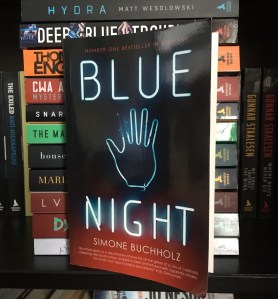
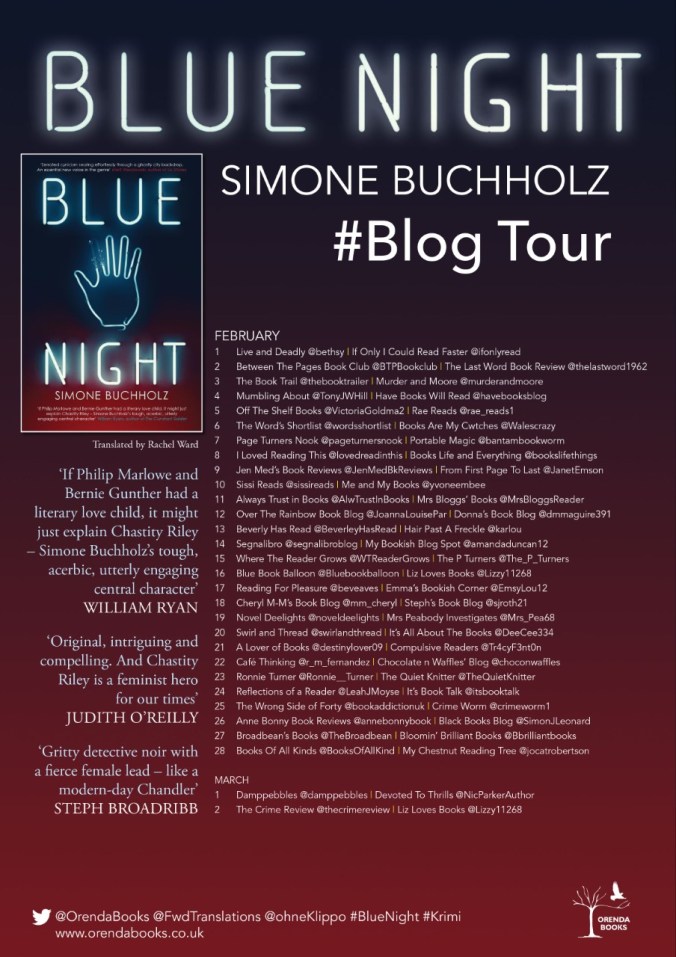
Blog Tour: Blue Night by Simone Buchholz

From the PR: “After convicting a superior for corruption and shooting off a gangster’s crown jewels, the career of Hamburg’s most hard-bitten state prosecutor, Chastity Riley, has taken a nose dive: she has been transferred to the tedium of witness protection to prevent her making any more trouble. However, when she is assigned to the case of an anonymous man lying under police guard in hospital, Chastity’s instinct for the big, exciting case kicks in.

Using all her powers of persuasion, she soon gains her charge’s confidence, and finds herself on the trail to Leipzig, a new ally, and a whole heap of lethal synthetic drugs. When she discovers that a friend and former colleague is trying to bring down Hamburg’s Albanian mafia kingpin single-handedly, it looks like Chas Riley’s dull lifeon witness protection really has been short-lived…”

Aside from a tiny bit of wear on the cover, my copy of Blue Night is pretty much pristine. There are no pages with creased corners from place marking and no cracks in the spine. Why? Because this book did not spend long in my hands. I tore through Simone Buchholz’ novel so fast as to not to leave a mark on a book that left plenty of impression on its reader. So hungrily did I rip through these 180 pages or so of tightly packed, immensely well plotted fiction that I found myself carried forward by such momentum as to be disappointed when it finished.  Not disappointed by the contents in any way whatsoever! No: disappointed that there wasn’t immediately more, more and more!

Blue Night is also deceptive – it might be a short read and require fewer trees than many but it packs in way more into its pages than many a pulp-and-ink-hungrier book manages. Between the covers (another tip of the hat to Orenda – has anyone mentioned just how many great covers come out of this publisher?) is a rich, tightly woven plot that’s brimming with intrigue and with plenty of back story woven in, compelling characters and a great approach to narrative… oh, and it all rips along at one hell of a pace.

As I’m a) an early stop on this tour and b) pretty out of touch with social media of late I haven’t seen all too many reviews for Blue Night just yet (I’m fortunate enough to have been sent a proof copy) but aside from expecting to see unanimous praise for Simone Buchholz I imagine there’ll be plenty of comparisons to other authors as time progresses so I’ll get in there early and say that I won’t draw any: Buchholz’ writing style is original and she delivers a fantastic story in a unique voice that’s a welcome blast of fresh air and a great start to the year’s reading.

I thoroughly recommend Blue Night – thanks, again, to Karen for my copy and do check out the other stops on the blogtour.

38, 39, 40…. 41! Pages Turned

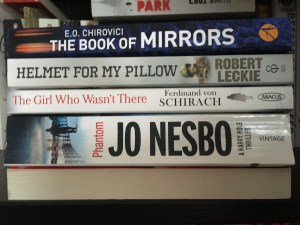
I thought it was going to come down to the wire but I managed to hit my, strictly self-imposed, challenge of reading 40 books in 2017 and even managed to squeeze in an extra for added bonus points.

Oddly, aware of the looming ‘deadline’ I still pulled the hefty Phantom by Jo Nesbo from the the TBR pile to kick off the final stretch. Continuing the Harry Hole saga in chronological progression from The Snowman  I’m enjoying every instalment more than the last and Phantom was a real gripper for every one of its 550 or so pages, taking every element of the Hole saga to date and turning them up to 11. As he develops as a writer, Nesbo manages to take an almost literary-fiction style approach to the thriller genre, layering in so many different sub-plots and factors as to really mark his work out as a leader in the field.

Ferdinand von Schirach’s The Girl Who Wasn’t There is very much a book of two halves, so very distinctly different in terms of narrative style that I had to double check it was still the same story. It had been on the shelves for a year or so after my wife read it with my occasionally eyeballing it and I’m very much glad I decided to read it, if only based on the thinking that it’s slightness would enable me to reach my goal. Instead I discovered that it’s one of those deceptive short-novels, with so much packed in as to feel like a larger read. A beguiling an beautiful slow-burn of a first half coupled to a completely bat-shit crazy, what the fuck is going on, fast paced thriller of a conclusion.

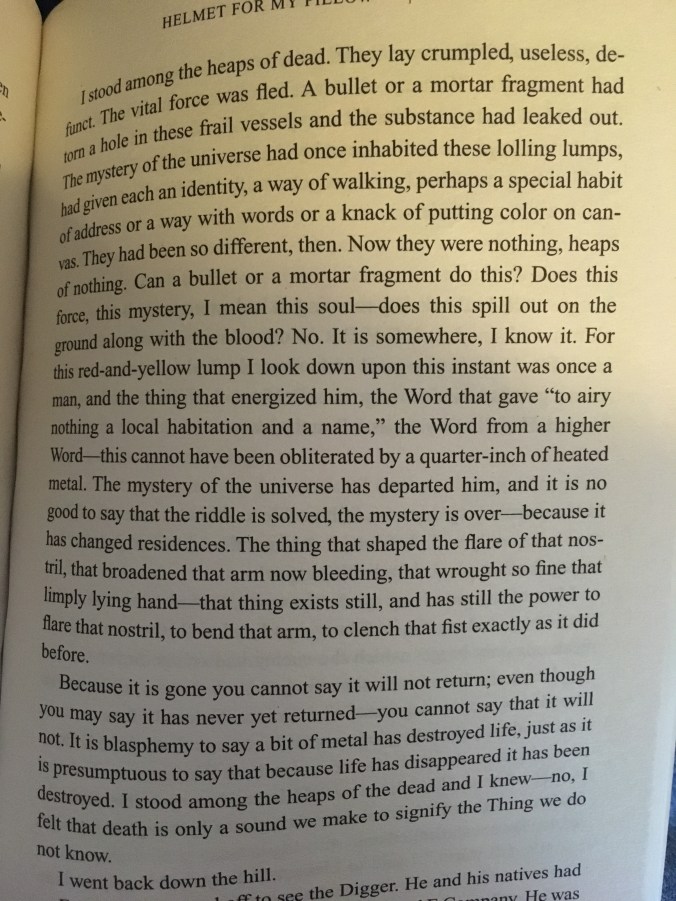
With two weeks remaining in the year I thought I’d round out the 40 with the only non-fiction of the year (something of a rarity in itself) – Robert Leckie’s Helmet for my Pillow. As a big fan of HBO’s Band of Brothers and having read the material that informed that show too, I thought I’d do the same with 2010’s The Pacific. While not as absorbing, to me at least, as Band of Brothers there was an intensity about The Pacific which meant I quickly bought the books that had informed it…. and let them sit on my shelf as I never got round to them. Having been left aghast at the perception of his war by South Pacific – Robert Leckie put pen to paper to give an unflinchingly honest and occasionally harrowing description of his experience as a Marine during the Second World War. What I look for in such a book isn’t the “guts and glory” – that sort of thing doesn’t appeal to my near-pacifist mentality – it’s the accounts of normal people who find themselves in an extraordinary situations unimaginable to those of us who live in a sheltered, comfortable world (due, thinking about it, to their actions).

Helmet For My Pillow, clearly the work of a literary man, makes for a shocking read at times but I found it compelling throughout and deeply human. It certainly ranks up high in the list of those memoirs of this era I’ve read*. Leckie manages to find the humanity in what were deeply dehumanising circumstances. Particularly striking for me was this passage:

But, with the festive break from work affording more reading time I managed to clear Leckie’s book with time to spare and got started on book 41 of 2017, a gift from my wife, The Book of Mirrors by EO Chirovici, a Romanian author. Turns out this one was something of a big deal in the publishing world back in 2015 – this is Chirovici’s first novel in English and was snapped up by publishers in 23 countries, landing him a likely seven-figure sum just in publishing deals ahead of its actual publication in 2017. After all that hype is it any good? Yes, in short. I thoroughly enjoyed it even if, for the first session or two with it I was still feverish and ended up with it going round in circles in my head. It’s a simple enough whodunit that explores the reliability of memory but Chirovici delivers it with a lot of narrative play, a lot of psychological twisting and turning and a nice leaning on good old mystery and thrill.

I’ve hedged my bets for 2018 and not extended my aim beyond trying for 40 again.


*Iron Coffins by Herbert A. Werner ranks as my favourite and Alan Deere’s Nine Lives probably rubs shoulders with the U-Boat commander’s account.

Pages turned

I seem to have become a lapsed blogger again. It’s what happens when life gets busy and spare time either shrinks or becomes more important. In this instance a new role has kept me busier and lunchtimes have not lent themselves to composing updates.

However – I’m now done for the year so let’s catch up, shall we?

I’m pretty much on-track to hit my self-imposed target of 40 books this year with the last one well underway with a week and change left of 2017. I managed quite a bit of progress this last month or two though with a book like The Big Nowhere by James Ellroy there’s no way to read it quickly.

Ellroy’s writing has been praised by many before and better than I’m sure I could. I will say that his is a unique and powerful voice that envelops a reader and sucks you into the seedy underbelly of 1950’s LA with a knack for the ‘big’ storylines that cross and weave into something huge. If I’m forced to I’d rate The Big Nowhere over The Black Dahlia – a much wider ranging story – and am anxious to move on to LA Confidential in the New Year.

I’ve yet to write that post I keep meaning to on Terry Pratchett. In the meantime my rebuilding of my Pratchett collection is going well. I’d say that of the 41 Discworld novels there’s what I consider a ‘golden’ period where Sir Terry hit his stride and get his style on the nose. For my money it’s from 1989’s Pyramids through to Monstrous Regiment in 2003. That’s a hell of a time frame for quality output  that recent re-reads Reaper Man and Feet of Clay both fall within. It had easily been 15 years since I’d read Reaper Man and I’d remembered nothing of it aside from ‘Death takes a holiday’ so I loved every page. The same could also be said of Feet of Clay though my memory of that one was clearer so I knew almost exactly where it was going – that being said it was still a pleasure to re-read. The Dark Side of the Sun, that being said, is pre-Discworld Pratchett and his voice was not yet found. It’s a very heavy-sci-fi book and feels, for the most part, as though Pratchett is trying too hard to force himself into a style that’s not his. There’s a brief section where the humour and narrative that would make him one of the UK’s biggest-selling authors makes an appearance but, for the most part, the 158 pages of The Dark Side of the Sun felt like a slog through three times as many.

Thinking of my need to clear a few more books by the end of the year I played a ‘cheat’ card and read 61 Hours by Lee Child – because reading a Reacher book never takes more than a couple of sittings. After being disappointed by the recent Night School I was very surprised by 61 Hours and would say it ranks up the top of those ten or so Reacher novels I’ve read to date. A great concept and plot setup and the countdown really pushes you on. The fact that Lee Child took Reacher out of his comfort zone and stuck him in an inhospitable location that often handicapped him really helped and I get the feeling Child himself was trying to shake the format up too – especially as he left Reacher’s fate unknown at the end.

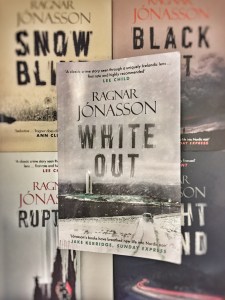
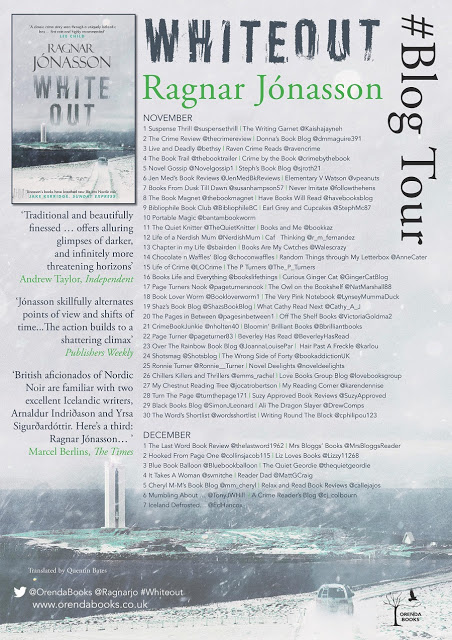
Blog Tour: Whiteout by Ragnar Jónasson

WhiteoutFrom the PR: “Two days before Christmas, a young woman is found dead beneath the cliffs of the deserted village of Kalfshamarvik. Did she jump, or did something more sinister take place beneath the lighthouse and the abandoned old house on the remote rocky outcrop?

With winter closing in and the snow falling relentlessly, Ari Thór Arason discovers that the victim’s mother and young sister also lost their lives in this same spot, twenty-five years earlier. As the dark history and the secrets of the village are unveiled, and the death toll begins to rise, the Siglufjörður detectives must race against the clock to find the killer, before another tragedy takes place.”

With Whiteout, the fifth of his Dark Iceland novels published into English by Orenda Books (though, I think, the fourth chronologically?), Ragnar Jónasson seems to have set himself a challenge – a remote and isolated location, a small (and dwindling) number of witnesses / suspects and a limited time window for the investigation. Throw in the possibility that there was foul play afoot in the deaths of the victims mother and sister years previously in the same location and Mr Jónasson has created a belter of a read.

Taking  characters and events out of Siglufjörður removes both the characters and the reader from the relative comfort zone of the former instalments of the series and adds a real edge to proceedings, heightened further by both the remoteness of Kalfshamavík and the chilling nature of all three deaths under investigation. Setting such a chilling (and, come the reveal, thoroughly disturbing) series of events against the backdrop of the build up to Christmas and its festivities doesn’t hurt either: in place of festive cheer and celebrations there’s deaths and secrets being dragged up.

As this is part of a series – though would certainly work just as brilliantly as a stand alone – I’ll restrain myself from dropping any spoilers.

Having translated some fourteen Agatha Christie novels into Icelandic before embarking on his own writing career, Ragnar Jónasson was no stranger to the genre but while I’m sure there will be comparisons drawn (I’ve never read a Christie novel but am familiar enough with the style, certainly thanks to the numerous television adaptations), it’s Jónasson’s skill as a writer that makes the Dark Iceland series so addictive. With Whiteout he expertly weaves a deep and intricatly plotted mystery  that’s genuinely compelling with calm and deliberate pacing that slowly builds to a dramatic reveal. That he does this against the challenges of both the closed setting and ticking clock without making it feel rushed is even more impressive.

One of the other compelling aspects of the Dark Iceland series has been the life and development of Ari Thór. While the pacing and time pressure of the main narrative of Whiteout don’t necessarily allow for too much insight into Ari, what there is still enough to ensure the reader remains plenty interested in this Icelandic copper and most certainly lays the groundwork for some revelations to come.

In a way, the location and focus of Whiteout make it an unusual instalment in the Dark Iceland series though Ragnar Jónasson’s skill as a writer ensures it remains an essential one.

Thanks to  Orenda Books and Anne Cater for my copy and inviting me to take part in this blogtour.

Blog Tour: The Man Who Died by Antti Tuomainen

From the PR: “A successful entrepreneur in the mushroom industry, Jaakko Kaunismaa is a man in his prime. At just 37 years of age, he is shocked when his doctor tells him that he’s dying. What is more, the cause is discovered to be prolonged exposure to toxins; in other words, someone has slowly but surely been poisoning him. Determined to find out who wants him dead, Jaakko embarks on a suspenseful rollercoaster journey full of unusual characters, bizarre situations and unexpected twists.

With a nod to Fargo and the best elements of the Scandinavian noir tradition, The Man Who Died is a page-turning thriller brimming with the blackest comedy surrounding life and death, and love and betrayal, marking a stunning new departure for the King of Helsinki Noir.”

I was not expecting this book to be the book it is, if that makes sense. See, last year I read The Mine – a complex and intelligent thriller that was at times very dark and dealt with some pretty heavy issues. As such I was kind of expecting a read of a similar nature, not that that would be a bad thing. That’s certainly not what The Man Who Died is. The best way to explain this is quote from the Acknowledgements: “After writing five very dark books… I started to feel that I needed to change things up a bit. More than a bit, to be honest. I told my agent this. I think I also told him I needed a laugh a bit.”

The Man Who Died reads like a Finnish Kurkov novel. It’s ridiculously good; brilliantly conceived and plotted, fantastically treads the line between laugh out loud and wickedly dark, surreal humour and has so much going that it’s pretty much impossible to put down. One of the best books I’ve read this year.

From the moment Jaakko receives his diagnosis and starts ‘waking up’ it’s an absolute ripper of a story as he discovers just how much has been going on around him while he’s been blissfully unaware. It would be impossible to point out exact specifics without giving away any plot – and I really don’t want to do that because I sincerely urge all to read this book – but there are so many moments that are so deliciously absurd that I found myself laughing aloud.

Every word in this book is vital and well placed, it takes real skill to get the pacing just right – especially when told first-person narrative – and Antti Tuomainen has it spades. It cracks along at a sizzling pace and it’s hard to believe that so much takes place in such a short space of time sorry wise yet there’s not a moment of bloat as the story builds to its er… explosive finale. A really gifted writer at work here.

The Man Who Died is easily one of my favourite reads of the year. A real treat and one can only hope Antti Tuomainen feels the need to laugh in his writing again.

My thanks again to Karen at Orenda for my copy and inviting me to review and take part in the blogtour.