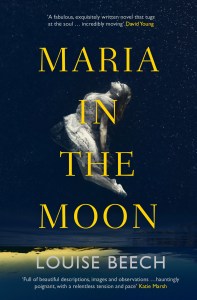
Blog Tour: Maria in the Moon by Louise Beech

From the PR:‘Long ago my beloved Nanny Eve chose my name. Then one day she stopped calling me it. I try now to remember why, but I just can’t.’

Thirty-two-year-old Catherine Hope has a great memory. But she can’t remember everything. She can’t remember her ninth year. She can’t remember when her insomnia started. And she can’t remember why everyone stopped calling her Catherine-Maria.
With a promiscuous past, and licking her wounds after a painful breakup, Catherine wonders why she resists anything approaching real love. But when she loses her home to the devastating deluge of 2007 and volunteers at Flood Crisis, a devastating memory emerges … and changes everything.

Dark, poignant and deeply moving, Maria in the Moon is an examination of the nature of memory and truth, and the defences we build to protect ourselves, when we can no longer hide…”

Ok, I’m starting to think the best way to approach Louise Beech’s novels is with the same level of trepidation with which I watch a Pixar film; just when you’re settled in with the characters and plot she manages to completely sucker punch you emotionally. This is certainly true of last year’s The Mountain In My Shoe and it’s most definitely true of Maria In The Moon, Louise Beech’s latest novel and one which – on the strength of her previous two efforts (well, published efforts as this was written first) – I’d looked forward too with eager anticipation. Of course she managed to completely wreck me again.

Hang on, that sounds almost like a conclusion – let’s back up a bit. How does Louise Beech manage to leave me – and, from what I’ve seen of other reviews for this book – her readers feeling like they’ve been watching the opening ten minutes of Up? Well, first she creates characters that live and breath within the pages of her novels. This isn’t a crime thriller or one waiting to be turned into a Tom Cruise movie – Louise Beech deals in real people battling against circumstance and struggle that few should have to face (I say this because each of her three novels to date has done so so brilliantly). This means that Catherine Hope (great surname choice, considering) becomes an immediately relatable and human figure for whom we as readers almost immediately begin to feel empathy. She’s funny, kind and plagued with doubt and has a gaping hole in her life thanks to her father’s early death. Yeah, it’s impossible not to let your heart go out to Catherine – especially as a parent – when Louise so effectively portrays the grief and turmoil that entered Catherine’s life at a young age.

But Catherine has another gap in her life. There’s a vast period of her life that she can’t remember that becomes apparent – because how do you know you’ve forgotten something if you’ve forgotten it? – when she’s asked to recall what happened when she was nine. Of course, nobody puts up a mental block because something amazing happened and we need to forget just how happy we were so we know that there’s a trauma at the centre of Catherine’s memory block but, given that her father had died before that period, we too are at a loss for a) what it could be and b) just how bad it has to be that the death of her father remains in her memory but this doesn’t.

Of course, Louise Beech knows how to write a story so we’re not about to get the answer immediately – besides, suppressed memories don’t just return to you because you file a reveal request with yourself. Catherine’s journey to discovery takes us on one hell of a ride and by the time the reveal comes slamming home like a wrecking ball, I doubt any reader will not be desperate for both answers and for Catherine to catch a break.

And, yes, that reveal is a wrecking ball. It was hard to read and will alter your breathing, this isn’t a bad thing; I’ve said before that a writer that’s scared to challenge shouldn’t be writing and Louise Beech is not scared to do so. Yes, it’s something that’s been dealt with in fiction before and no doubt will gain but few writers manage to handle this subject and its impact as well as this. I’m not going to give a spoiler here but I will say that it did leave me feeling gutted and bare and that’s because of both the subject matter and Louise’s skill at both leading the way to the reveal and unfolding it at exactly the right moment – she doesn’t go overboard, there’s no hacky dramatics or cheap-movie moments, just genuine honest and true emotion and deftness of hand, allowing events and characters to play out. This – as I’ve said before – is where Louise Beech stands apart, writing with an emotional bravery and honesty that few others can or do and delivers something that, because you’re so caught up in the character and because it’s written so honestly, hits fucking hard.

Again; don’t get me wrong – this isn’t a book that’s all emotional wreckage. Maria In The Moon is also very funny, immensely charming, engrossing and bloody well written and will stay with you for some time. So, yes, in a way, my opening summary still holds and, in the same way I still check out a Pixar film I’ll do the same with the next novel to be penned by Louise Beech and recommend doing the same.

Thanks again to Karen and Orenda Books for my copy, no-thanks to “sorry not sorry” Louise Beech for wrecking me again and do check out the previous stops on the BlogTour.

Page Turning – Another Three

Crikey, here we are already with September under way and autumn barrelling down on us with the onset of cold mornings and the tug of breezes forgotten.

I’m currently 26 books down on my 40 Books challenge for 2017 and the 27th underway. As has become the norm, here’s a few of those that have been read of late – a couple of which took a little longer than the usual week / week and a half that I can usually pace for reasons that will be discussed.

The Black Dahlia by James Ellroy

There is no way of reading Ellroy without fully immersing yourself in his rich, enveloping and truly unique prose. I finally discovered the wonder of Ellroy’s writing in 2015 with Perfidia and it formed part of the first of these Turning Pages posts. Knowing that Perfidia was a prequel of sorts to Ellroy’s ‘LA Quartet’ I was keen to read more but read them in order and The Black Dahlia did not disappoint. As CB over at Cincinnati Babyhead points out; Ellroy “nails the whole under belly L.A. thing” and there’s nothing like wallowing in his world. My habit of sticking my nose in charity bookshops has borne fruit and I now have a copy of The Big Nowhere sat on the TBR list so I can continue walking those mean LA streets.

The Leopard by Jo Nesbo

A Christmas or two ago my wife gave me Jo Nesbø’s The Snowman to feed my growing appetite for Nordic Noir. I found it insanely addictive and chilling (I have zero faith the upcoming film will do it any justice) and have sought out other Harry Hole (pronounced: HOO-LEH so not quite one letter away from a real cultural hiccup) novels since though – as I was going back in the timeline and Nesbø’s career I didn’t find them quite as rewarding.

So I was happy to grab a copy of The Leopard at good second-hand price as it’s the next instalment in the series. I get the impression that it’s around this time in his writing career that Nesbø perfected his style. The earlier novels are bloody good, mind, but all the elements really seem to have come together; the writing is tight and focused, the plot is intricate and well weaved and the suspense and mystery are genuinely gripping.

The back-story of police corruption that was found in novels leading up to Nemesis has faded more into the background and the focus – aside from the murders – is firmly on Harry as he tries to overcome his own scars and wounds from the events of both a long and hard career and those of The Snowman – in this instance I’d say that readers would be at a loss if they hadn’t read that novel first. With both Phantom and Police sitting on my TBR pile I very much look forward to reading more of Harry Hole’s adventures.

A Gentleman In Moscow by Amor Towles

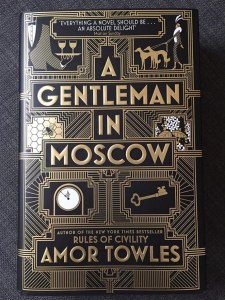
For all the hype that surrounds it I found, in my first year of membership, Amazon’s PrimeDay to be something of a disappointment. While my son occasionally (as is the whim of toddlers) takes delight in his LED flashing shoes, precious little else interested me. With the exception, that is, of the cover of A Gentleman in Moscow. I mean, I know you’re not supposed to judge a book by such things but… it’s a hell of a great looking book jacket. Not only that but the description:

“On 21 June 1922 Count Alexander Rostov – recipient of the Order of Saint Andrew, member of the Jockey Club, Master of the Hunt – is escorted out of the Kremlin, across Red Square and through the elegant revolving doors of the Hotel Metropol.

But instead of being taken to his usual suite, he is led to an attic room with a window the size of a chessboard. Deemed an unrepentant aristocrat by a Bolshevik tribunal, the Count has been sentenced to house arrest indefinitely.

While Russia undergoes decades of tumultuous upheaval, the Count, stripped of the trappings that defined his life, is forced to question what makes us who we are. And with the assistance of a glamorous actress, a cantankerous chef and a very serious child, Rostov unexpectedly discovers a new understanding of both pleasure and purpose.”

It was practically begging me to read it! Well, turns out it’s one of the best things I’ve read all year. Ridiculously well written, every single page was a delight to read and a lesson in craft and style. Rostov is a character for real literature lovers and the level of storytelling and sub plots are surprisingly complex given the initial premise and form a deliciously rich and vital background, giving real weight, humanity and warmth to a novel that could so easily have been the slightest of things.

A Gentleman in Moscow works as both a fantastic novel full of humour, charm and heart as well as a deviously funny allegorical take on Russia’s not too distant past. Reading this novel I had to keep reminding myself that it was published just this year – with its classic style, insightful observations and supporting cast of characters and the impact of historical occurrence, it genuinely felt at times as though discovering a well-loved classic and the ending…. is just sublime. Much in the same vein as Antony Doerr’s All the Light We Cannot See (another novel I picked up based on the cover and hook of the blurb), A Gentleman in Moscow is easily one of the best novels published in recent years and much deserving of a place on a discerning bookshelf.

Blog Tour; The Other Twin by L V Hay

From the PR: “When India falls to her death from a bridge over a railway, her sister Poppy returns home to Brighton for the first time in years. Unconvinced by official explanations, Poppy begins her own investigation into India’s death. But the deeper she digs, the closer she comes to uncovering deeply buried secrets. Could Matthew Temple, the boyfriend she abandoned, be involved? And what of his powerful and wealthy parents, and his twin sister, Ana?

Enter the mysterious and ethereal Jenny: the girl Poppy discovers after hacking into India’s laptop. What exactly is she hiding, and what did India find out about her?

Taking the reader on a breathless ride through the winding lanes of Brighton, into its vibrant party scene and inside the homes of its well-heeled families, The Other Twin is a startling and up-to-the-minute thriller about the social-media world, where resentments and accusations are played out online, where identities
are made and remade, and where there is no such thing as the truth…”

Returning to a hometown after years away is always a strange thing – sights are familiar but somehow the subtle differences can make the entire place feel different and you a stranger in the environs you grew up in.  If you add the further sense of detachment and changed reality that comes with the death of a loved one and grief it’s not likely to make for a pleasant homecoming. A very real sense of disorientation, an unease with the familiar. Here we are, then, with The Other Twin by L V Hay and published by Orenda Books in which Poppy finds herself called back to Brighton after nearly five years of living in London after her sister is found dead from an apparent suicide and where the sense of unease with the familiar drips from each page.

Unable to believe her sister committed suicide, Poppy digs into the life of the sister that she hadn’t spoken to for over four years and uncovers a lot more besides when she begins trying to discover the meaning behind India’s blog posts. I think it’s fair to say that – as would likely be true of most of us – Poppy isn’t a great detective. Both she and the reader alike are in the dark and scrabbling for pieces and clues and looking for a foothold in the increasingly disturbing world of secrets she inadvertently seems to have stumbled into. It’s an interesting and effective technique and makes a welcome change from those too-slick-to-be-real detectives and further adds to the sense of reality. The reader is very much along for the ride.

The vivid and detailed descriptions of Brighton make for an equally disorientating sensation as picturesque, seaside tourist postcards rub shoulders with some very murky and disturbing actions as the differences between perception and reality blur. Whether it’s the relatonship with her mother, that of her mother and Tim, Poppy’s relationship with Matthew and even India’s own life vs her online life… the sense of something unpleasant lurking behind the familiar, that feeling that all is ‘not quite right’, is omnipresent making for a very gripping read.

L V Hay writes with a confidence atypical of many a debut novel and for all the twists and turns that Poppy’s determined digging throws out, the final reveal is very much a real surprise that had me going back through the book and wondering how I’d missed it.

A very strong debut and I look forward to more from L V Hay. Thanks to Karen at Orenda for my copy and the invitation to take part in The Other Twin’s blog tour.

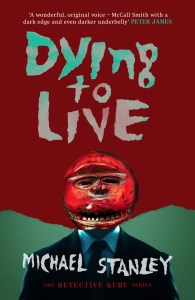
Blog Tour; Dying To Live by Michael Stanley

From the PR: “The body of a Bushman is discovered near the Central Kalahari Game Reserve, and the death is written off as an accident. But all is not as it seems. An autopsy reveals that although he’s clearly very old, his internal organs are puzzlingly young. What’s more, an old bullet is lodged in one of his muscles … but where is the entry wound?
When the body is stolen from the morgue and a local witch doctor is reported missing, Detective ‘Kubu’ Bengu gets involved. As Kubu and his brilliant young colleague, Detective Samantha Khama, follow the twisting trail through a confusion of rhino-horn smugglers, foreign gangsters and drugs manufacturers, the wider and more dangerous the case becomes… A fresh, new slice of ‘Sunshine Noir’, Dying to Live is a classic tale of greed, corruption and ruthless thuggery, set in one of the world’s most beautiful landscapes, and featuring one of crime fiction’s most endearing and humane detectives.”

When a new Detective Kubu book arrives on my shelves I know for a fact that I’m going to love every second of it. Reading the work of Michael Sears and Stanley Trollip (writing as Michael Stanley) is never anything short of a delight. Detective Kubu is, three books in, one of my favourite characters and there’s always a grin on my face when he’s on the page. In Assistant Superintendent David ‘Kubu’ Bengu, Sears and Trollip have created a character I could read all day every day and never get bored. I’ve said it before but it’s impossible not to say it again but in a genre stuffed to the bindings with great characters he’s a real stand out, even if I’ve now abandoned the snacks and keeping cookies in my own desk draw, it’s a delight to read a character so wonderfully human and warm who’s only ‘flaws’ are his dietary indulgences. It makes the subplot concerning his family worries all the more affecting too.

But, of course, a good character does not make a good book alone. Dying To Live is a great read for so many other reasons as well. The portrayal of Botswana and it’s clashing of cultures both in terms of those embracing the new vs traditional ways (the ongoing import placed on witch doctors and traditional healing that played such a key role in Deadly Harvest) and place of the Bushmen in that society along with the inclusion of those colloquial words from South African languages amongst the English add, as intended by the authors, a real sense of authenticity and make for an immersive experience.

Nor is Kubu the only character in the novel, obviously. The supporting cast are made up of faces familiar and new and Messrs Sears and Trollip possess a real knack of creating a compelling ensemble each of whom could carry a story on their own, I’m sure. It’s great to see Samantha Khama developing as a strong female member of Botswana’s CID and it’s clear that Constable Ixau is a character that’s got legs and I look forward to more of his involvement in the series. At least I hope there’s more to come.

So… what of the plot? Well; it’s a real gripper. What seems like a routine call out for an unimpressed detective soon escalates into a story that reaches across continents. A fantastically written slow burner of a plot that builds into a complex mix of corruption and greed with plenty of red herrings and sucker punches to keep you hooked to the very end  with a mystery that throws smuggling, organ theft, murder and political turpitude into one ridiculously rewarding brew. Dying To Live firmly marks the writing team of Michael Sears and Stanley Trollip as one to very quickly get addicted to and demonstrates that the northern climes have got nothing on ‘Sunshine Noir’ when it comes to compelling, blockbuster intrigue and action.

If you’ve not been lured into exploring the Detective Bengu series then Dying To Live is a great place to start and, if you have, you’ll love every page.

Thanks again to Karen at Orenda for my copy and do check out the other stops on the blogtour.

Page Turning – Three More

According to Goodreads I’m pretty much on track for my 40 books challenge this year – two days into July I finished reading the 21st book I’d started in 2017.

So with a longer review for one of those four cleared since I last dropped any summary, here are those other three rounding out the list of those completed.

Night School by Lee Child

The most recent in the Jack Reacher series and one which – perhaps as Child didn’t know where to take his one man army immediately  after Make Me – hurtles us back in time to the mid-90’s (I wouldn’t mind getting on that time machine) to a time when Reacher was still actively serving in the army.

I’m now up to nine of the twenty-one Reacher novels and I’m beginning to be able to form an impression as to which ones are strong and which ones are merely ok. For my money this one sits in the latter category.  Make Me was a real strong entry after the relative water tread of Personal and took Reacher in a direction that showed growth and potential. By heading back into the past Child removes any real sense of jeopardy and it becomes more of a “Reacher gets into fights in Germany” read than anything else. The closeness of events to those of Killing Floor mean there’s nothing revelatory about Reacher’s past offered up and Child’s method of writing without knowing where events are going is too often on display when it comes to the ‘mystery’ at the centre of events.

Let’s hope The Midnight Line is another step forward rather than more standing still. Not bad but I’d be disappointed if I’d paid anything more than the £2 this one cost me.

Lolita by Vladimir Nabokov (some spoiler)

This one had been sat on the Want-To and then the TBR list and pile for a while now. My wife got to it first and praised it and there’s no denying the regard it’s held in. I’d be gobsmacked if somebody hadn’t heard of it; its infamy probably known more than its contents.

So… do I rave about this book? Well, nobody can write like Nabokov, that’s for sure. I’d not read a line by him before now but even the first sentence is pure brilliance: “Lolita, light of my life, fire of my loins. My sin, my soul. Lo-lee-ta: the tip of the tongue taking a trip of three steps down the palate to tap, at three, on the teeth. Lo. Lee. Ta.”

The dark comedy is sublime, the character of Humbert is one for the archives and so brilliantly painted and there are times when one can’t help but feel for him and, yes, so much of this misperceived (by those who haven’t read it) novel is less about Humbert’s pursuit of his nymphet as it is about Lolita’s absolute playing and exploitation of his sickness.

BUT, here’s what stops me wanting to read this again and again in the same way I do about a book like The Master and Margarita* and maybe I am a prude, or over-thinking this but a large part of this novel is essentially Humbert on a cross-country tour of America having sex with a very under-age girl. It makes for a very uncomfortable read – especially when he points out her crying herself to sleep every night – and, yes, this is intended, yes Lo is “seduces” him and yes his revelling in such activities makes the downfall so much more dramatic  but the lengthy segues that detail the realisation of Humbert’s desires (no matter their forming and Lo’s scheming) are still just too visceral to make an enjoyable read for my tastes.

But – while I won’t necessarily read this one again – it is a hugely well written and brilliantly told story that underlines Nabokov’s importance in the literary cannon and should be read at least once but any such student of the form.


Pyramids by Terry Pratchett

Pretty much impossible to review any of Sir Pterry’s novels in anything other than adoration. I’ve mentioned before both that it would be tricky to overestimate the  importance of Terry Pratchett in my library and literary explorations  and my desire to gradually re-read the Discworld series.

I think Pyramids often slips through the cracks when people talk about Discworld novels, I might be wrong. It’s not one that features any of the recurring characters – there’s no Rincewind or Nanny Ogg, for example – but it’s an important one. Sitting seventh in the published order it marked Terry’s first move away from the Wizzards and Witches that had dominated thus far. Prior to re-reading this one I’d done the same with Sourcery and couldn’t help feeling that perhaps even the writer was getting a little tired of the theme. Pyramids was one of the first in what’s now called the ‘cultures’ series as well as the exploration of belief on the Discworld.

Like many of those pre, say, Men At Arms, I had only vague recollections of Pyramids having read it originally some two decades ago and not since. Of course I remembered Pteppic and You Bastard, the Disc’s greatest living mathematician and – as with all of those I’ve revisited in the last couple of years – reading this one again was a real joy. Preatchett really was in a league of his own and to sit there chuckling away at this one served just to remind how much of a loss it is to no longer receive the joy of a new Discworld novel every year or so.


*I cannot recommend this one enough, just make sure you get a good translation as I’ve seen far too many bland ones on the shelf that seem to suck the passion and charm out of the prose.

Page Turning – Quick Reviews

So I set myself the target of reading forty books this year. I’m still on track with seventeen cleared already and another three or four en route for completion by the end of this month.

I’m getting through some great books,  and while the population of my bookshelves has continued to grow as my to-read list builds I haven’t yet dropped full whack on a book -some I’ve been lucky enough to be sent in exchange for a review, others were gifts and many the result of second-hand book shop hauls. I’m very keen to expand my collection of works by several authors like James Ellroy and my Discworld collection is growing but I don’t like, and this is purely an aesthetic comment, so seek out their older versions.

Anywho. A few of those read so far include…

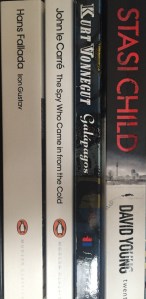
Iron Gustav by Hans Fallada

I, like many others, discovered and fell in love with the writing of Hans Fallada when  Alone In Berlin was published in English, so many decades after his death. Since then I’ve been devouring whatever Fallada book I can get my hands on, if only the publisher – aware of the demand for this particular German writer – wouldn’t price them so highly for a standard paperback.

Reading Iron Gustav is like reading a master-class in fiction. Fallada was not only an astoundingly talented writer – creating hugely intricate and tightly woven portraits of everyday people and their struggles – but also witness to some of history’s most fascinating and shocking events. Written in 1938 Iron Gustav portrays the hardships bought upon a Berlin family – as a microcosm of Germany itself – following World War One. Forced by the Nazi regime to extend its timeline to include that party’s rise and rewrite chapter, Fallada was left with little choice but to acquiesce and also rewrote the ending. This version gets as close as possible – 70 years after the author’s death –  to Fallada’s original story and is an absolute joy to read. A hugely powerful and important novel restored from the dark past. I simply cannot get enough of Fallada’s writing.

 Galapagos by Kurt Vonnegut 

Another writer of whom I simply can’t get enough is Kurt Vonnegut. It was a while before I picked up Slaughterhouse 5 but once I’d had my first sip of this master’s work I wanted the whole bloody goblet. Galapgos, another very apt satirical take on mankind’s failings, is the story of a handful of people who, stranded on the island of Santa Rosalita, become mankind’s last hope after a superbly funny series of events lead to the collapse of the World’s economy, a mass conflict and all of the planet’s women becoming infertile.  

While it’s not my favourite of Vonnegut’s work on my shelves – at this point I’d give that to Mother Night – it’s another fine addition and a real blast to read.

The Spy Who Came in from the Cold by John le Carré

Last year I read and thoroughly enjoyed Joseph Kannon’s Leaving Berlin. The combination of spy thrill and the Cold War fascinated me and I wanted more so I thought – after constantly seeing references to his work – it was time to give John le Carré a go. I read the first few paragraphs of The Spy Who Came in from the Cold a read online, was hooked so ordered the whole thing and… well…. meh.

I really, really wanted to enjoy this book. I did. The opening is a real hook and the plot itself is certainly a classic in terms of its intricacy and espionage but… I don’t know. This took me far too long to get through and at times it felt like a slog. Maybe it’s down to the main character simply not being all that much of a draw, maybe it’s the writing style feeling a little too dated or just the fact that (spoiler alert) I so dislike an ending that renders having spent the previous 300 pages becoming invested in the characters so bloody pointless that it actually made me angry. The same could be said for Dominion and that bastard was 700+ pages of drudgery.

Still, I’m not completely turned off the idea of John le Carré so may try another in time to come. Plus the Cold War still proves a fascinating era and a very potent backdrop for fiction….

Stasi Child by David Young

I was seeing this book all over the place last year – social media, book shops etc and finally got around to picking a copy up this year. And, given the statement above, and the premise how could I not; “East Berlin, 1975. When Oberleutnant Karin Müller is called to investigate a teenage girl’s body at the foot of the Wall, she imagines she’s seen it all before. But when she arrives she realises this is a death like no other. It seems the girl was trying to escape – but from the West.

Stasi Child is a very well plotted and gripping thriller. It bounds along and it’s sense of place and time is very carefully and skilfully woven in without being heavy handed with the contrast between life in the East and West very convincingly portrayed without resorting to tired cliché and tropes. Almost perfect and I’m very much looking to more from David Young – I see Stasi Wolf was published this year – and the series.

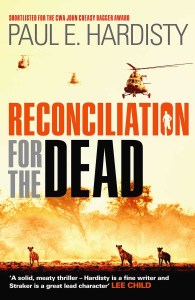
Blog Tour: Reconciliation for the Dead by Paul E Hardisty

From the PR: “Fresh from events in Yemen and Cyprus, vigilante justice-seeker Claymore Straker returns to South Africa, seeking absolution for the sins of his past. Over four days, he testifies to Desmond Tutu’s newly established Truth and Reconciliation Commission, recounting the shattering events that led to his dishonourable discharge and exile, fifteen years earlier.

It was 1980. The height of the Cold War. Clay is a young paratrooper in the South African Army, fighting in Angola against the Communist insurgency that threatens to topple the White Apartheid regime. On a patrol deep inside Angola, Clay, and his best friend, Eben Barstow, find themselves enmeshed in a tangled conspiracy that threatens everything they have been taught to believe about war, and the sacrifices that they, and their brothers in arms, are expected to make.

Witness and unwitting accomplice to an act of shocking brutality, Clay changes allegiance and finds himself labelled a deserter and accused of high treason, setting him on a journey into the dark, twisted heart of institutionalised hatred, from which no one will emerge unscathed.”

Here we are with the third volume in Hardisty’s Straker series and let’s get this out of the way now; they just keep getting better – Reconciliation for the Dead is a massive leap forward and the best of the three and I do hope there’s more to come. Don’t misunderstand; I thoroughly enjoyed both The Abrupt Physics of Dying and The Evolution of Fear but Reconciliation for the Dead is something else both as part of the Clay Straker family and as a novel.

At this point in time we’re a little ahead of the book’s publication date so I’ll be wary of giving away too much in terms of plot or spoiler. Instead I’ll say that Reconciliation for the Dead is a real genre-defier; at times action thriller, at times political intrigue, at others social commentary and at times literary fiction but BRILLIANT throughout. Hugely gripping, deeply moving, highly intelligent, and – as is a real hallmark of Hardisty’s work – a story with heart and conscience.

As detailed in the PR, this novel sees Clay return to his native South Africa to testify in front of the Truth and Reconciliation Commission – not so much for personal absolution but to lay out the truth on behalf of those unable to tell their stories. This isn’t one for the faint of heart; there are some intense scenes involved, bold and powerful revelations  from which Hardisty does not flinch. It’s practically impossible to run through just which atrocities we’re talking about here but we’re looking at the real nadir of human behaviour that’s let loose at times of war.  That so much of it is based on real events makes it all the more affecting.

The action scenes – into which you’re thrust pretty much from the get-go – are hugely immediate and crack along at a dizzying pace while retaining an intelligence that’s not all that common in the genre. For those who have read the previous novels Clay and Crowbar are both familiar characters – the events of Reconciliation for the Dead allow a far greater an understanding, filling in the gaps of a troubled and tortured history merely hinted at before.

This is a novel of actions and their consequences, of the past and its long shadow, the importance and cost of conscience and of the weight of regret. It makes for a gripping and compelling read. Hardisty’s writing, already accomplished – in my review of his first book I wondered if he hadn’t secretly been penning thrillers for years under an assumed name – is at it’s finest here; insightful, nuanced and intelligent and courageous; asking us all to examine our humanity and the cost of our actions.

Reconciliation for the Dead is as intense, thought provoking and hugely rewarding a read as it gets. Easily one of the best books of 2017. My thanks, as always, to Karen at Orenda for my copy of this book and do check out the other stops on the blogtour.


Blog Tour: Faithless by Kjell Ola Dahl

From the PR: “Oslo detectives Gunnarstranda and Frølich are back … and this time, it’s personal…

When the body of a woman turns up in a dumpster, scalded and wrapped in plastic, Inspector Frank Frølich is shocked to discover that he knows her … and their recent meetings may hold the clue to her murder. As he begins to look deeper into the tragic events surrounding her death, Frølich’s colleague Gunnarstranda finds another body, and things take a more sinister turn. With a cold case involving the murder of a young girl in northern Norway casting a shadow, and an unsettling number of coincidences clouding the plot, Frølich is forced to look into his own past to find the answers – and the killer – before he strikes again.”

Caution- a whiff of slight spoiler may be ahead…

So… today is my stop on the BlogTour for Kjell Ola Dahl’s Faithless and I’m not really sure where or how to start with a review for this one because it is so fucking good.

I suppose I could start by pointing out that I have zero prior familiarity with Kjell Ola Dahl’s work or the Oslo Detectives series into which this novel slots but it’s safe to say it’s not required. At no point while reading did I feel as though I was missing out on something vital in terms of plot or character arcs as Faithless has been so ridiculously well crafted as to work not only, I assume, as a fantastic continuation of a series but as a bloody strong stand alone novel too.

As for the plot… gripping and so brilliantly pieced together as to leave no question that this book would be put down until finish. Frølich, tired after an all-night surveillance pulls over a person of interest and discovers she’s carrying cocaine. She’s booked, reveals nothing, pays a fine and is set free. Frølich then meets her again when it turns out she’s engaged to an estranged friend with whom he’s recently reconnected. When she’s murdered just days later it’s all a little to close to home. The disarmingly calm and methodical investigations reveal a complex web that may or may not connect it to a decades-old murder and comes with plenty of surprises and twists.

The stately prose and style is that of a master (expertly translated by Don Bartlett); precise and clinical without a spare word and packing plenty of punch.

When it comes to the characters… as I said – I have no prior knowledge of this series (something I desperately need to fix) but in no way felt I was missing anything; Frølich, Gunnarstranda and all are perfectly rendered and genuine characters for whom any reader will root and find common ground.

To say Karen at Orenda has impeccable taste would be an understatement right now. A couple of years ago she introduced me to the work of Gunnar Staalesen, “one of the fathers of Nordic Noir” , and now here we are with yet another master of the genre on her list. Unbelievable amount of talent and beautiful prose. A real must read that I cannot enthuse enough about. Many thanks, again, to Karen for my copy and do check out the other blogs on the tour:

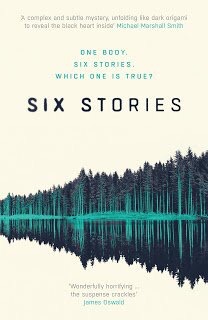
Blog Tour: Six Stories by Matt Wesolowski

From The PR: “1997. Scarclaw Fell. The body of teenager Tom Jeffries is found at an outward bound centre. Verdict? Misadventure. But not everyone is convinced. And the truth of what happened in the beautiful but eerie fell is locked in the memories of the tight-knit group of friends who took that fateful trip, and the flimsy testimony of those living nearby.
2017.

Enter elusive investigative journalist Scott King, whose podcast examinations of complicated cases have rivalled the success of Serial, with his concealed identity making him a cult internet figure. In a series of six interviews, King attempts to work out how the dynamics of a group of idle teenagers conspired with the sinister legends surrounding the fell to result in Jeffries’ mysterious death. And who’s to blame…

As every interview unveils a new revelation, you’ll be forced to work out for yourself how Tom Jeffries died, and who is telling the truth.”

Right then, here we are with Six Stories, one of the most interesting books I’ve read in a while with something of a unique narrative approach – like a contemporary take on The Moonstone‘s multi-character narrative. One unsolved crime, six key stories as told, judgement free, to Scott King on his podcast  with listeners being left to form their own views on what happened – that’s the premise of ‘Six Stories’.  Six Stories, told as though an episode of said podcast, unravels the mystery of what happened to 15 year old Tom Jeffries who went missing one night on Scarclaw Fell before his body was discovered a year later.

Twenty years ago the death Jeffries had been ruled as ‘misadventure’ – his body having been eventually discovered in the mud of the Fell one night by Harry Saint Clemeny- Ramsay (who also adds a narrative thread in between the Six Stories) and his friends’ dogs  – but then what were Harry and his friends really doing out in the wild with their dogs, lamps and guns? Hunting? For what? Why had the body been missing for so long despite thorough searches at the time?

As each of the six stories unfolds we’re treated to more questions and intrigue, more revelations and head scratchers – thankfully ‘Scott King’ provides plenty of recaps and additional voices, corroborations from those outside the ‘six’ – for Six Stories is most definitely a very meticulously plotted and tightly wrapped story. Deeply engrossing and one that cost plenty of sleep – there’s so much here that made me flip back in the book to re-read earlier threads and some genuinely chilling moments that are capable of raising the odd goosebump or three and once you’ve gotten into the swing of the style it’s impossible to finish reading one ‘story’ and not want to plough straight into the next one to see what that character brings to the mix.

Those characters are all brilliantly written and their stories all so comprehensively well delivered – the multi-angle and narrator approach really keeps things rocking and gives adage to the notion that not every story is one-sided and events become increasingly detailed and multi-faceted with every witness’ version of events, though I will say these were either a pretty precocious bunch of 15-year-olds or I lived a sheltered existence. It’s strange but after you get into it – the first two ‘stories’ are not from any of the then-teenagers –  you really want to see how the Rangers have aged, what they’re like now after reading so much of what they were like then.

It’s hard to talk too much about Six Stories and its narrative style and how it goes on to deliver in spades without dropping an almighty spoiler but I will say that the final story and its revelation is an absolute belter and written / handled in such an accomplished manner as to leave the reader in no doubt that Matt Wesolowski is a  very much a  talent to keep an eye on.

Six Stories is a compelling and rewarding read with enough intrigue and mystery to keep you glued to the end. Thanks again to Karen at Orenda for my copy and do check out the other stops on the Blog Tour:

Blog Tour: Cursed by Thomas Enger

img_2005From the PR: “When Hedda Hellberg fails to return from a retreat in Italy, where she has been grieving for her recently dead father, her husband discovers that his wife’s life is tangled in mystery. Hedda never left Oslo, the retreat has no record of her and, what’s more, she appears to be connected to the death of an old man, gunned down on the first day of the hunting season in the depths of the Swedish forests. Henning Juul becomes involved in the case when his ex-­‐wife joins in the search for the missing woman, and the estranged pair find themselves enmeshed both in the murky secrets of one of Sweden’s wealthiest families, and in the painful truths surrounding the death of their own son. With the loss of his son to deal with, as well as threats to his own life and to that of his ex-­‐wife, Juul is prepared to risk everything to uncover a sinister maze of secrets that ultimately leads to the dark heart of European history. ”

“It’s like having a gun to your head”, being a dad, according to Henning Juul: “You go around being frightened the whole time. Frightened that something might happen… And you think that all the awful stuff you read about in the papers – it won’t happen to you and your child; it only happens to other people’s kids.” Juul, you see, is living every parent’s nightmare – his son was killed. As Henning and his son slept the apartment they were in was set alight as a warning – Juul’s investigations having come too close to some presumably powerful and truly nasty people. All of which, I understand (and please correct me if I’m wrong) happened before the events of the first Henning Juul novel, Burned.

So here we are with Cursed, the fourth entry in the Henning Juul series and it’s an absolute belter that cost me a fair bit of sleep in my reluctance to put it down. I’ve not read the previous novels in this series but I never felt that I was lost or missing anything for having not yet done so (only that I now need to go back and start at the beginning as this was such a good read) as Thomas Enger does a great job of bringing you up to speed without being heavy handed.

As Juul continues to search for the man who set alight his apartment and delve deeper into Oslo’s dark underbelly with some memorable scenes and characters, his ex-wife Nora is asked to investigate the disappearance of Hedda Helberg.

Having discovered the motivations and back story behind Juul’s investigations I honesty didn’t expect Nora’s case to be able to compete in terms of either drama or grip, but then I do like to be surprised by a book and the supposed missing-person case of Hedda Helberg soon becomes just as demanding of attention as slowly but surely a web of deceit and lies surrounding one of Norway’s wealthiest families is pulled apart.

Both of these investigations and narratives have the slow-burning, intricate and meticulous plotting that I so enjoy in a good thriller and that the two gradually become linked as they gather both pace and intrigue mean there’s zero chance of putting it down. The switch between narrative focuses proving a great device as it allows for a fuller view of each of the characters.

It’s hard to read Cursed and not be moved by the loss that Nora and Henning have endured while also noticing the difference between the two characters and how the death of their son has affected them both. Nora slowly but surely moving forward in life, back to work and in a new relationship, all the while carrying a ball that their son played with in her bag. Juul – presumably blaming himself in many a way – is  driven by nothing but finding justice for his son, his entire being devoted to the cause. The tragic and heartbreaking (seriously where is the Orenda Gut Check warning on this one?) back story makes this novel all the more compelling.

Cursed just about has the lot; intrigue from the off,  tightly weaved plots that pull you right in, plenty of twists, gritty and scarred lead characters and enough emotional heft and resonance to floor come the final reveal – all underpinned by a back story and over-riding story arc that ensures the Henning Juul series demands attention.

A complex, taught and thoroughly gripping read, Thomas Enger’s Cursed is a first-rate character-driven thriller that doesn’t disappoint.

Many thanks to Karen at Orenda for my copy and do check out the other stops on the Cursed Blog Tour.

cursed-blog-tour